
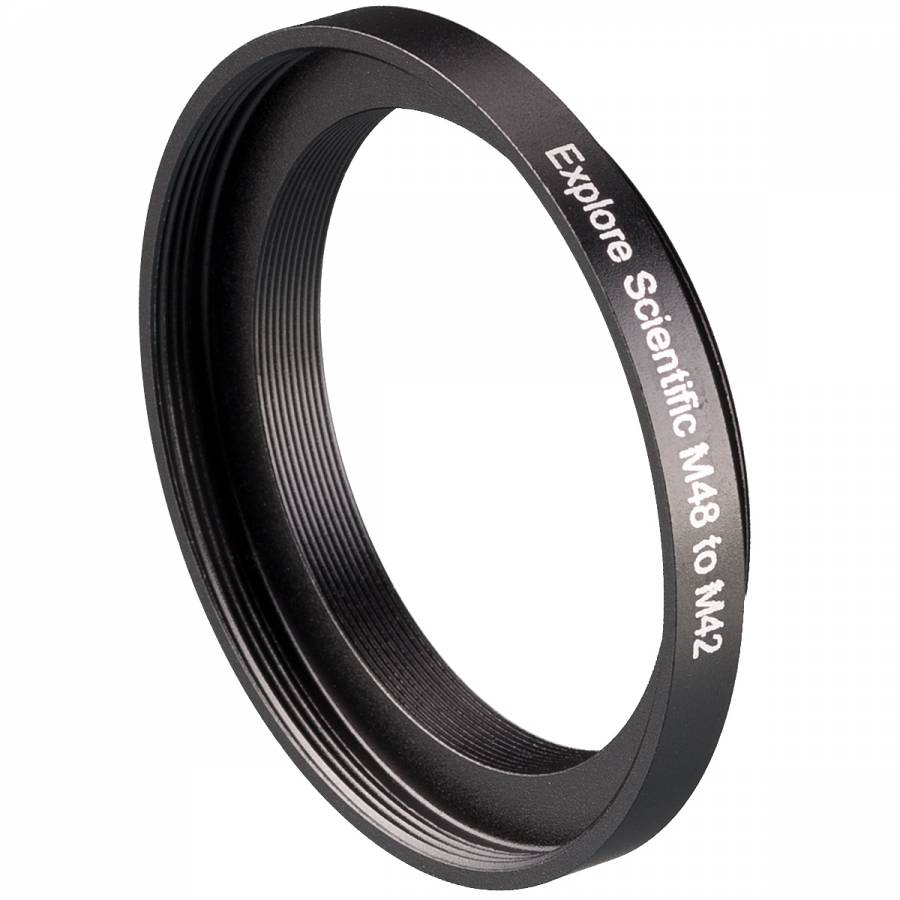

- Description
Product Overview
This is the small ring that lets the two competing astrophotography thread standards talk to each other. Explore Scientific describes it as adapting from the larger M48 x 0.75 thread down to the smaller M42 x 0.75 thread — M42 x 0.75 being the thread the industry calls T2 or T-mount. The published figures are a free inner diameter of 39.0 mm, an outer diameter of 50.65 mm (2 inches), matte black anodised aluminium construction, and a weight of just 10 grams. Explore Scientific singles out one use in particular: fitting 2-inch colour and nebula filters between the camera and the telescope. Vendor item number 510382 / 05-10382.
Who It's For
Astrophotography quietly runs on two thread standards, and sooner or later you own parts from both. T2 (M42 x 0.75) is the older and more universal of the two, and it is what most T-rings, most Barlows with removable heads and most small camera adapters are cut to. M48 x 0.75 is the wider standard that arrived with full-frame sensors, and it is what Explore Scientific's field flatteners, focal reducers and larger camera rings use. When the piece in your hand ends in one and the piece it needs to meet ends in the other, the night stops until you have a ring like this.
The other reason to own one is filters. Two-inch astrophotography filters are cut with an M48 x 0.75 thread, which means an M48 junction in the imaging train is also a filter holder. Putting a light pollution or narrowband filter in the train ahead of the camera rather than in front of an eyepiece is often the tidiest place for it, and this adapter creates exactly that junction while stepping the train down to the T2 fittings on the camera side. It is a cheap part that unblocks an expensive one.
Key Features & Design
- Bridges the M48 x 0.75 and M42 x 0.75 (T2) standards in a single ring, so no stack of step rings is needed
- Published free inner diameter of 39.0 mm, which is the true clear aperture of the finished junction
- Published outer diameter of 50.65 mm, the standard 2-inch dimension
- Accepts 2-inch colour and nebula filters at the M48 end, per Explore Scientific's own guidance
- Machined from aluminium with a matte black anodised finish to keep internal reflections down
- Published weight of 10 grams, which is as close to nothing as a mechanical part gets
- All-threaded connection, so nothing can slip, rotate or sag once tightened
Mechanical Design
The interesting engineering here is what happens to the light path. M48 x 0.75 exists because M42 x 0.75 does not have the aperture to feed a full-frame sensor: a T2 thread leaves roughly 38 to 39 mm of clear opening, and a full-frame sensor has a 43.3 mm diagonal, so the corners get clipped. This adapter's published free inner diameter is 39.0 mm, which tells you plainly what the reduction costs. The moment you step down to T2, the wide M48 aperture upstream stops helping, because the narrowest point in an optical train is the point that governs illumination. That is not a flaw in this ring — 39.0 mm is about as generous as an M42 x 0.75 junction can physically be — but it is the reason this is a compatibility part rather than an upgrade part. If your sensor is APS-C or smaller, its diagonal is around 28 mm and the 39.0 mm opening is irrelevant to your images. If your sensor is full frame, you should be looking for a way to keep the train at M48 all the way to the camera rather than reducing to T2 partway along. The other design consequence is spacing: every ring you insert adds mechanical length, and back focus in a corrected imaging train is usually specified to within a millimetre, so this ring's contribution has to be counted.
Recommended Uses
- Joining an M48 corrector, flattener or reducer to a T2 camera adapter or T-ring
- Adding a 2-inch colour, light pollution or narrowband filter into the imaging train ahead of the camera
- Making an existing T2 accessory usable on a newer M48 telescope-side fitting
- Crop-sensor imaging where the 39.0 mm clear aperture is comfortably larger than the sensor diagonal
Compatibility and Accessory Notes
Do not order this on the strength of the name alone — order it on the strength of what is on each of your two parts. Explore Scientific publishes the two thread sizes and the fact that the adapter reduces from M48 to M42, but the page does not state which end is male (external) and which is female (internal), and that detail decides whether it solves your problem or sits in a drawer. Names in this corner of the hobby are not reliable either: a ring described as an M48-to-M42 reduction and a ring described as an M42-to-M48 step-up can be the very same part seen from opposite ends. The way to get this right is to describe both fittings you are trying to join — which threads, and whether each is male or female — and let us match them. This is exactly the sort of thing our team in Bolton will confirm for you before you buy, and it takes one message. Note also that this ring is a different item from the M48 x 0.75 adapter made specifically for the Explore Scientific 0.7x focal reducer and field corrector; that one is a dedicated fitting for a particular corrector, whereas this one is a general-purpose thread reduction.
Good to Know Before You Order
No filters, no camera and no other adapters are included; this is the ring on its own. Explore Scientific does not publish a light path length or mechanical thickness for it, which matters because a corrected imaging train usually has a back focus target measured to the millimetre. If you are working to a specific back focus figure, contact us and we will measure the ring on our own scales and callipers before you commit. Be clear-eyed about the aperture too: stepping down to a 39.0 mm opening means a full-frame sensor will show corner falloff regardless of how wide the rest of the train is, so treat this as the part that makes two standards meet rather than the part that improves your images. And because thread gender is not published, please confirm the direction with us if you are ordering to solve a specific fitting problem.
Frequently Asked Questions
Is M42 x 0.75 the same as T2? Yes. T2 and T-mount both refer to a 42 mm thread with a 0.75 mm pitch. It is not the same as the older M42 x 1.0 Pentax screw mount, which shares the diameter but has a coarser pitch and will cross-thread.
Can I put a 2-inch filter in it? Yes, that is one of the uses Explore Scientific highlights. Two-inch astrophotography filters are threaded M48 x 0.75, so the M48 side of this adapter doubles as a filter cell.
Will it vignette my full-frame camera? The 39.0 mm free inner diameter is smaller than a full-frame sensor's 43.3 mm diagonal, so yes, expect corner falloff. Crop-sensor cameras are unaffected. For full-frame work, keep the train at M48 rather than reducing to T2.
Which end is male and which is female? Explore Scientific does not publish that, and we would rather check than guess. Tell us the two fittings you are joining and we will confirm the correct part before you order.
Bottom Line
Ten grams of anodised aluminium that keeps a night from being wasted, provided it is the right ten grams. It joins the M48 and T2 standards and gives you somewhere to put a 2-inch filter, at the cost of a 39.0 mm clear aperture that full-frame sensors will notice. Describe both of your fittings to our team in Bolton and we will confirm this is the ring you need.
You may also like
Recently viewed
Recent Blog Posts
View all
Your Guide Graph Is Lying to You
Read More
D-Size vs V-Size: A Complete Guide to Telescope Dovetail Systems
Read More
What Is Back Focus in Astrophotography? Telescope Reducers, Flatteners, and Spacing Explained
Read More