


- Description
Product Overview
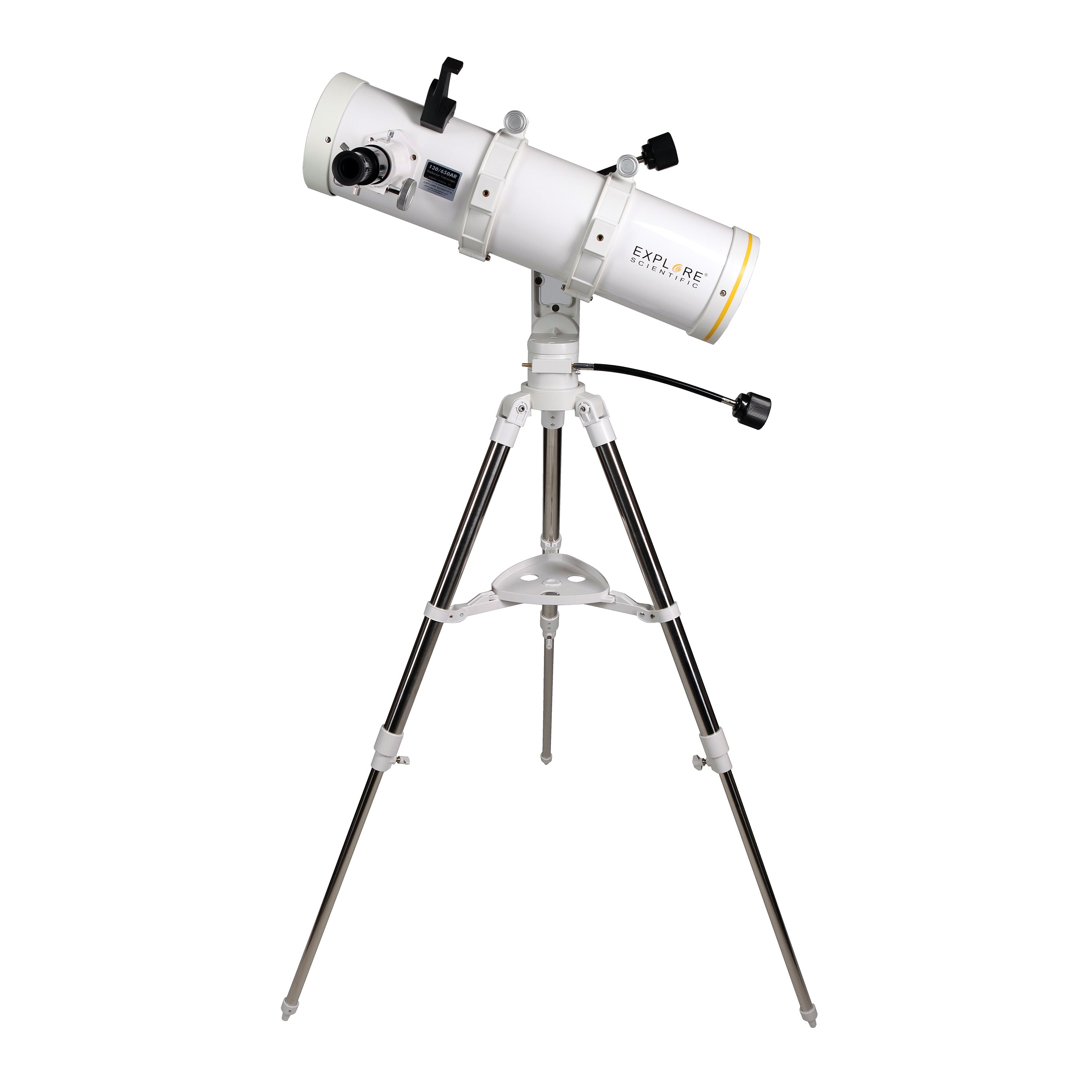
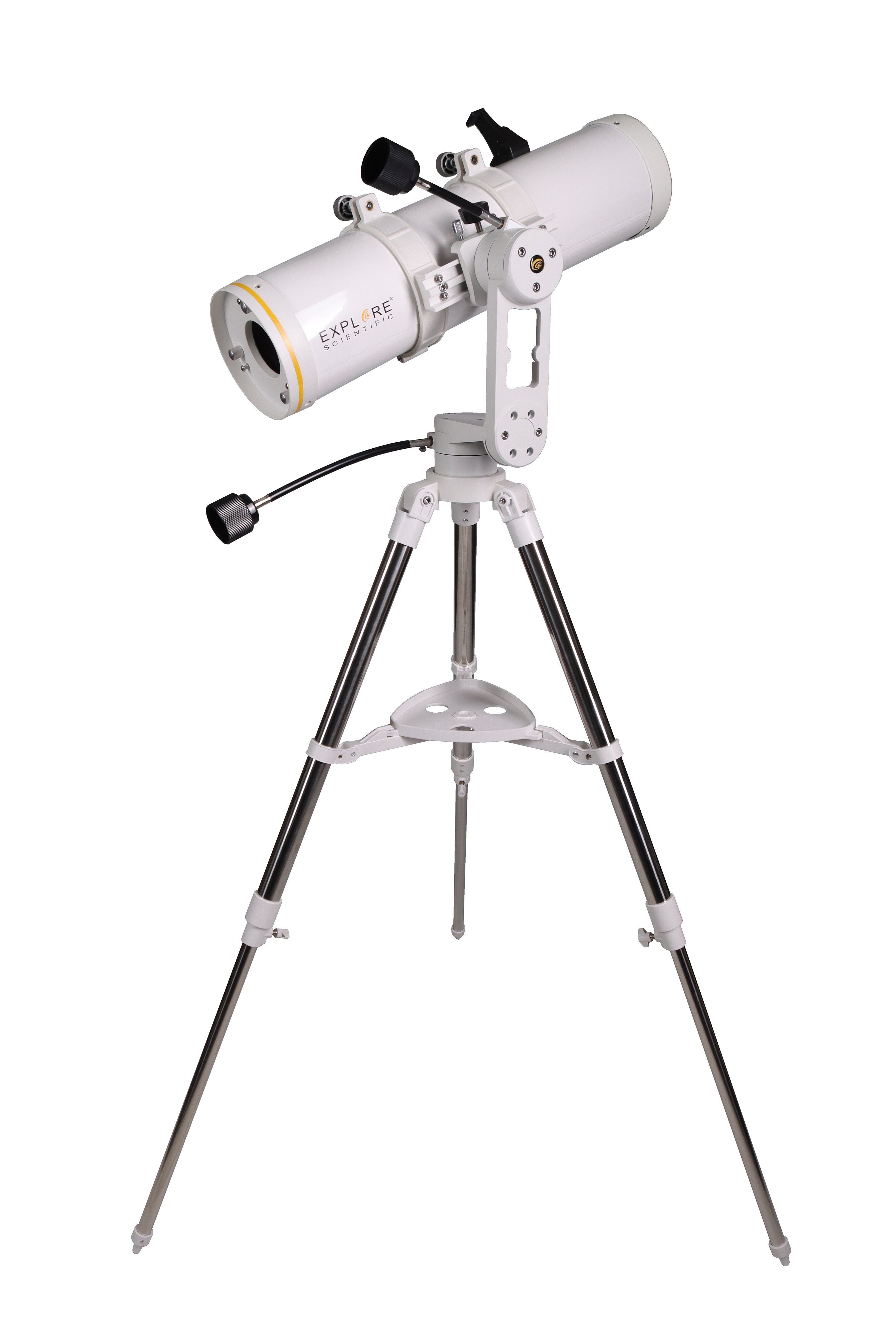
The Sidara Essential 130 is a 130 mm Newtonian reflector of 650 mm focal length, which works out to f/5, supplied on Explore Scientific's Essential alt-azimuth mount with a tripod and eyepieces and accessories per the package configuration. Explore Scientific writes that "the 130 mm aperture captures more light, revealing greater detail in deep sky objects such as nebulae and galaxies," and that "the 650 mm focal length provides a wide field of view that makes locating objects easier." They position it as a package "for those looking to step up in performance while maintaining ease of use." It carries vendor item number ES-N130650-MAZ01-ST10.
Who It's For
Of the five Sidara packages, this is the one that gives you the most aperture for the least money, and that is not a small thing when you are buying a first telescope. Against the 90 mm Sidara Nano it collects roughly twice the light; against the 102 mm Essential refractor it collects about sixty per cent more. What that actually looks like at the eyepiece is more deep sky objects being worth looking at rather than merely being detectable. The Moon and planets are still the reliable crowd-pleasers, with Jupiter's belts, Saturn's rings and lunar craters all easy at moderate power. Beyond those, the Orion Nebula shows real shape, M13 in Hercules starts to look grainy at its edges instead of uniformly fuzzy, and open clusters are genuinely beautiful. It is worth being blunt with a gift buyer, though: galaxies through any beginner telescope are faint grey ovals, not the coloured spirals in posters, and from a bright suburban street they may be barely there at all. That is the sky's fault, not the telescope's, and a short drive to darker countryside changes the picture more than any upgrade would.
Choosing a reflector at this price means accepting a small amount of ownership work in return for aperture. There is no colour fringing at all, because mirrors bend every wavelength identically, so bright objects look cleaner than they do through the achromatic refractors in this range. You pay for that with collimation, the periodic alignment of the two mirrors, which is a short routine once learned but is a routine nonetheless, and with a secondary mirror sitting in the light path that slightly reduces planetary contrast against a refractor of the same size. The open tube also needs time to cool to outdoor temperature before the image settles. If the telescope is destined for a younger child or for someone who will be put off by any maintenance at all, the 102 mm Essential refractor is the kinder choice even though it shows less. If the buyer is curious and does not mind learning one mechanical skill, this is more telescope for the money.
Key Features & Design
- 130 mm Newtonian reflector at 650 mm focal length, an f/5 system with a wide, bright field.
- The best aperture-per-dollar position in the Sidara range, and a clear step up in light grasp from the Nano packages.
- Essential alt-azimuth mount with dual-axis slow-motion controls for smooth, controlled tracking.
- Adjustable mount design, which Explore Scientific notes "allows for comfortable viewing positions, even when observing objects high in the sky."
- Sky Assist integration, described by Explore Scientific as helping "simplify navigation, allowing users to quickly find and observe celestial targets."
- Mirror optics with no chromatic aberration, so no violet fringing on the Moon, Venus or Jupiter at any power.
- Supplied complete: 130 mm Newtonian tube, Essential mount, tripod, and eyepieces and accessories per the package configuration.
Optical Design
The f/5 focal ratio is the most consequential number on this specification sheet, and it cuts both ways. A short focal length relative to aperture produces a wide true field of view at any given eyepiece, which is exactly what a beginner on a manual mount needs: a wider field means an object you have aimed at roughly is still likely to be somewhere in view, and it means less frequent correction as the sky drifts. That is why Explore Scientific specifically credits the 650 mm focal length with making objects "easier" to locate. The cost of a fast light cone is that it is less forgiving. Collimation errors that a slow telescope would tolerate become visible at f/5, and inexpensive eyepieces show coma and edge softness that better ones control. In magnification terms, 650 mm of focal length divided by a 25 mm eyepiece gives about 26x for wide sweeping, and a 10 mm gives about 65x, which is a sensible planetary starting point. The practical ceiling for a 130 mm aperture is around 150x to 180x on a typical night, and pushing much beyond that trades detail for a larger, dimmer, mushier image. Beware any claim that a telescope of this size delivers several hundred times magnification usefully.
Recommended Uses
- Deep sky observing on a budget: nebulae, open and globular clusters, and the brighter galaxies from darker sites.
- Wide-field sweeping of the Milky Way, where the f/5 focal ratio shows large regions of sky in a single view.
- Lunar detail at moderate to high power, entirely free of colour fringing.
- Planetary observing of Jupiter and Saturn once the mirror has cooled and collimation is good.
- A first telescope for a teenager or adult who wants maximum aperture for the money and will learn to collimate.
Compatibility and Accessory Notes
Budget for a collimation tool alongside this telescope. A simple sight tube or a laser collimator turns mirror alignment from an intimidating unknown into a two-minute check, and at f/5 it makes a visible difference to image quality. After that, a better low-power wide-field eyepiece is the single upgrade that will most improve the views, because fast focal ratios expose the limits of basic eyepieces at the edge of the field. A neutral density Moon filter is worth adding too. Explore Scientific does not publish the focuser barrel size, the eyepiece specifications, the finder type or the mount's load capacity for this package, so before you order a collimator, eyepieces or filters, contact our team in Bolton and we will confirm whether it takes 1.25-inch or 2-inch fittings. If you are considering moving this tube onto a different mount later, or a different tube onto the Essential head, that is genuinely model-dependent and we would rather check it for you than have you order on assumption.
Good to Know Before You Order
Explore Scientific publishes no shipping weight for this item, so we are confirming it on our own scales before the listing goes live. That is why it is currently unpublished. Contact us and we will give you a shipping figure for your address. Two further points are worth making plainly. First, the vendor's product page carries no specification table and does not itemise which eyepieces, finder or diagonal are in the box, saying only that eyepieces and accessories are included per the package configuration. We will not fill those gaps with guesses, so ask us and we will confirm against the carton before you order. Second, this is a manual alt-azimuth mount with no motors and no GoTo, and a Newtonian reflector will need collimation, particularly after it has travelled in a vehicle. Neither is a drawback exactly, but both are things a first-time buyer is better off knowing in advance than discovering on a cold night. It is not an astrophotography telescope.
Frequently Asked Questions
What does Sky Assist actually do here? Explore Scientific describes it on this package as navigation help that "simplifies navigation, allowing users to quickly find and observe celestial targets." On their motorised Sidara Pro mounts they describe Sky Assist as letting users "select targets and allow the mount to move the telescope into position," but the Essential mount is manual, so on this telescope it guides you to a target and you make the movement yourself with the slow-motion controls. Explore Scientific has not published what the feature requires or how it is set up, and we are not going to describe app features they have not documented. Contact us and we will confirm the current details with the distributor.
How hard is collimation really? Easier than its reputation. It is the adjustment of three screws behind the primary mirror while looking through a sight tube, and once you have done it twice it takes a couple of minutes. Expect to check it every few sessions and after the telescope has been transported.
Is the jump to the 150 mm Sidara Plus worth the extra money? The 150 mm gathers about a third more light and comes on the heavier Plus mount, so it is a real step rather than a marketing one. Whether it is worth it depends on how dark your skies are; under heavy light pollution the extra aperture is partly wasted, and under rural skies it is very much not.
Can I look at things on the ground with it? Not usefully. A Newtonian gives an inverted image and has a very long minimum focus distance, so it is a poor terrestrial instrument. If daytime use matters to you, the 102 mm Essential refractor is the one to choose.
Bottom Line
The Sidara Essential 130 is the value pick of this group: the most light-gathering area for the money, on a mount with proper geared controls, in a package that a beginner can learn on without being overwhelmed. The trade is a small amount of collimation work, which most owners find takes minutes rather than evenings. If you would like help deciding between this, the 102 mm refractor and the larger 150 mm, contact our team in Bolton and we will talk it through.
You may also like
Recently viewed
Recent Blog Posts
View all
Your Guide Graph Is Lying to You
Read More

D-Size vs V-Size: A Complete Guide to Telescope Dovetail Systems
Read More

What Is Back Focus in Astrophotography? Telescope Reducers, Flatteners, and Spacing Explained
Read More