
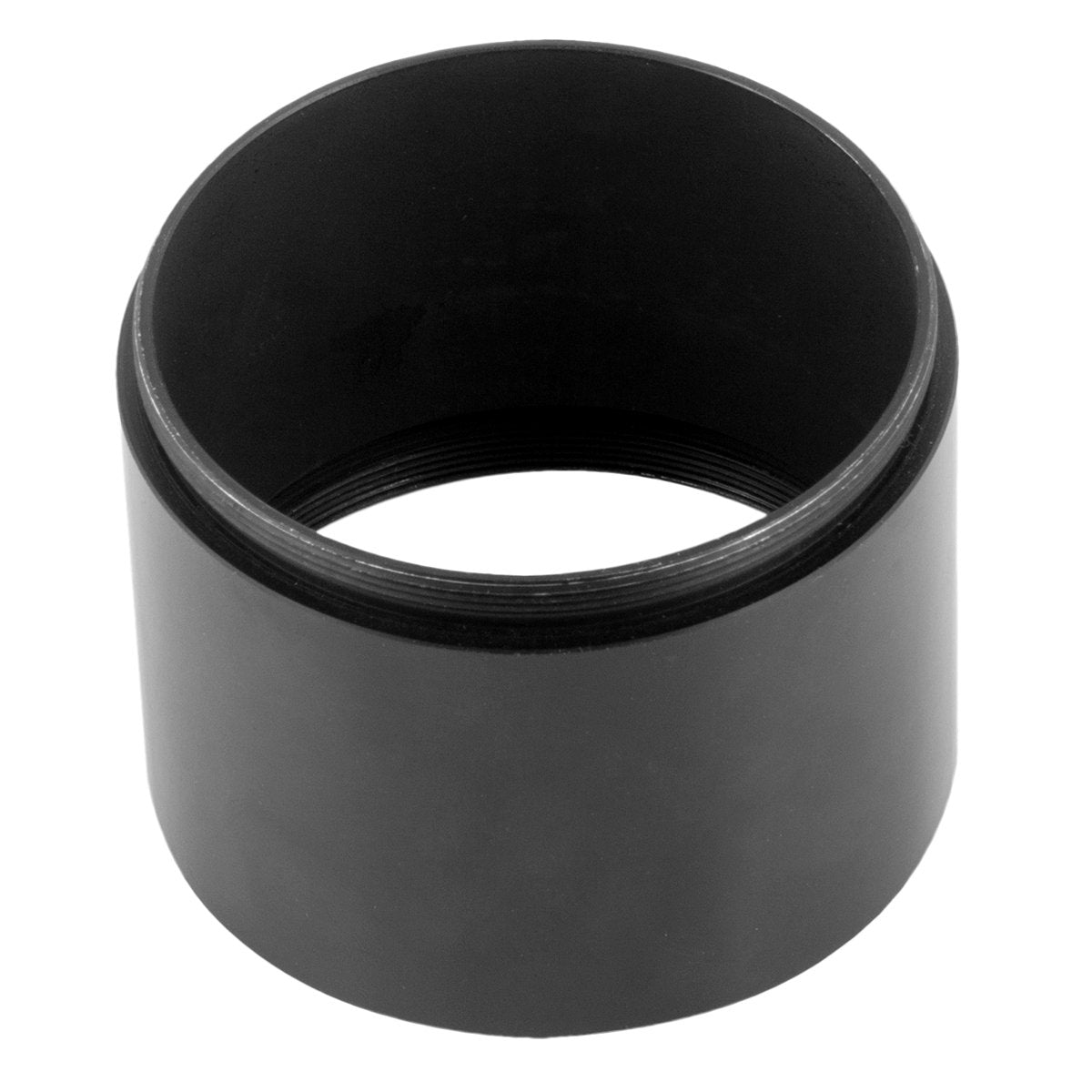

- Description
- Specifications
Product Overview
This is an Explore Scientific extension tube for the 2-inch rack-and-pinion focusers fitted to their ED APO telescopes, carried under item number ESRPEXT2. It adds 1.5 inches of additional travel to the focuser, which lets an imaging or visual train reach focus in configurations that would otherwise run past the end of the focuser's native range.
It is a plain machined tube. There is no glass in it, no moving part and no electronics — it sits between the focuser and whatever follows it, and its only job is to place that equipment 1.5 inches further back.
Every telescope brings light to focus a fixed distance behind the focuser flange. A visual eyepiece in a diagonal usually lands inside the focuser's travel comfortably; a camera, a binoviewer, a filter wheel or a long adapter stack often does not, and the focuser reaches the end of its outward travel before the image is sharp. An extension tube moves the whole train outward by a known amount so that focus falls back inside the range the focuser actually has.
Who It's For
- Owners of Explore Scientific ED APO telescopes with 2-inch rack-and-pinion focusers, which is the fitment this tube is specified for.
- Anyone whose focuser runs out of outward travel before an image comes to focus — the classic symptom being a focuser racked fully out with the stars still soft.
- Binoviewer users: a binoviewer consumes a large amount of light path, and reaching focus with one is a common reason to add a fixed extension.
- Imagers assembling a train: when the sum of camera, filter wheel, spacers and adapter comes up short of the required distance, a fixed extension is the simplest way to make up the difference.
Key Features & Design
- Adds 1.5 inches of travel to the focuser's native range.
- Made for 2-inch rack-and-pinion focusers on Explore Scientific ED APO telescopes.
- Machined tube with no optical elements: nothing in the light path to add aberration, reflection or colour.
- No moving parts: a fixed spacer holds its length exactly, which is what makes it predictable in an imaging train where spacing is arithmetic.
- Item number ESRPEXT2, the designation to quote when checking fitment against a particular telescope.
- Supplied on its own — the vendor lists no additional included accessories with it.
Recommended Uses
- Reaching focus with a binoviewer, which typically needs more light path than a single eyepiece.
- Adding length to an imaging train that falls short of the required backfocus distance.
- Restoring focus after a diagonal has been removed from a visual setup, which shortens the path considerably.
- Giving a camera enough standoff from the focuser that the focuser is not working at the very end of its travel, where a rack-and-pinion is least well supported.
Compatibility and Accessory Notes
- Fitment: specified for the 2-inch rack-and-pinion focusers used on Explore Scientific ED APO telescopes. If you are unsure which focuser your tube carries, send us the model and we will check it.
- Length added: 1.5 inches, which is 38.1mm. That is the figure to use when adding up an imaging train.
- Direction of the change: an extension pushes the focus point outward. Where a setup already reaches focus with the drawtube well in, adding this tube pushes it further out and may take some setups past their inward range instead — which is why extensions are added to trains that come up short rather than as a default.
- Optical effect: none of its own. There is no glass, so it changes distance and nothing else.
- Filters: the vendor does not publish a filter thread for this tube, so that row is absent from the specifications rather than estimated.
Good to Know Before You Order
- The vendor lists this item under two names. Explore Scientific titles it a 1.5-inch extension tube while the part is catalogued as the 2-inch rack-and-pinion focuser extension — the 2 inches refers to the focuser it fits and the 1.5 inches to the travel it adds. Item number ESRPEXT2 identifies it either way.
- Explore Scientific publishes no dimensional or weight specification for this part. Outer diameter, thread type, material and mass are not given, so those rows are absent below rather than estimated. If a specific figure decides the purchase for you, ask us and we will put the question to our Explore Scientific rep.
- An extension solves a shortfall, not a surplus. Where a train already focuses with room to spare, adding length works against you. The useful check is whether the focuser currently runs out of outward travel before the image sharpens.
- Any extension adds a joint to the light path. With a heavy camera on the end, that additional cantilever is worth accounting for in how the train is supported — keeping the heaviest item as close to the focuser as the spacing allows is the usual approach.
- Fitment is worth checking once rather than guessing. Send us your telescope model and the accessories going behind it and we will tell you whether this is the right part before it ships.
Frequently Asked Questions
Is it difficult to set up?
No. It threads or slots into the 2-inch rack-and-pinion focuser and the eyepiece, diagonal or camera goes on after it. There is nothing to adjust, align or calibrate, and refocusing after fitting it is the only step.
How much length does it add?
1.5 inches, which is 38.1mm.
Will it degrade the image?
There is no glass in it, so it introduces no aberration of its own. What it changes is the distance between the focuser and everything behind it.
How do I know whether I need one?
The usual sign is a focuser racked all the way out with the image still soft — the focus point is falling behind where the drawtube can reach. Send us a list of what is in your train and we will work out whether 1.5 inches is the right amount.
Does it work with a binoviewer?
Binoviewers are one of the common reasons to add a fixed extension, because they consume a substantial amount of light path. Whether 1.5 inches is enough depends on the particular binoviewer, so send us the model and we will check.
Will it fit a focuser from another brand?
It is specified for Explore Scientific 2-inch rack-and-pinion focusers. Other 2-inch focusers vary in how they accept accessories, so tell us what you have and we will look at it before you order.
Bottom Line
In short: a simple machined extension that adds 1.5 inches of travel to the 2-inch rack-and-pinion focusers on Explore Scientific ED APO telescopes, with no glass and nothing to adjust — the straightforward fix when a camera, binoviewer or adapter stack pushes focus beyond the focuser's reach. Send us your telescope and the accessories behind it and we will tell you whether this is the piece that closes the gap.
| Item Number | ESRPEXT2 |
|---|---|
| Type | Focuser extension tube, no optical elements |
| Added Travel | 1.5 inches |
| Fitment | 2-inch rack-and-pinion focusers on Explore Scientific ED APO telescopes |
| Outer Diameter | Not published by vendor |
| Thread Type | Not published by vendor |
| Material | Not published by vendor |
| Weight | Not published by vendor |
| Filter Thread | Not published by vendor |
You may also like
Recently viewed
Recent Blog Posts
View all
Your Guide Graph Is Lying to You
Read More
D-Size vs V-Size: A Complete Guide to Telescope Dovetail Systems
Read More
What Is Back Focus in Astrophotography? Telescope Reducers, Flatteners, and Spacing Explained
Read More