
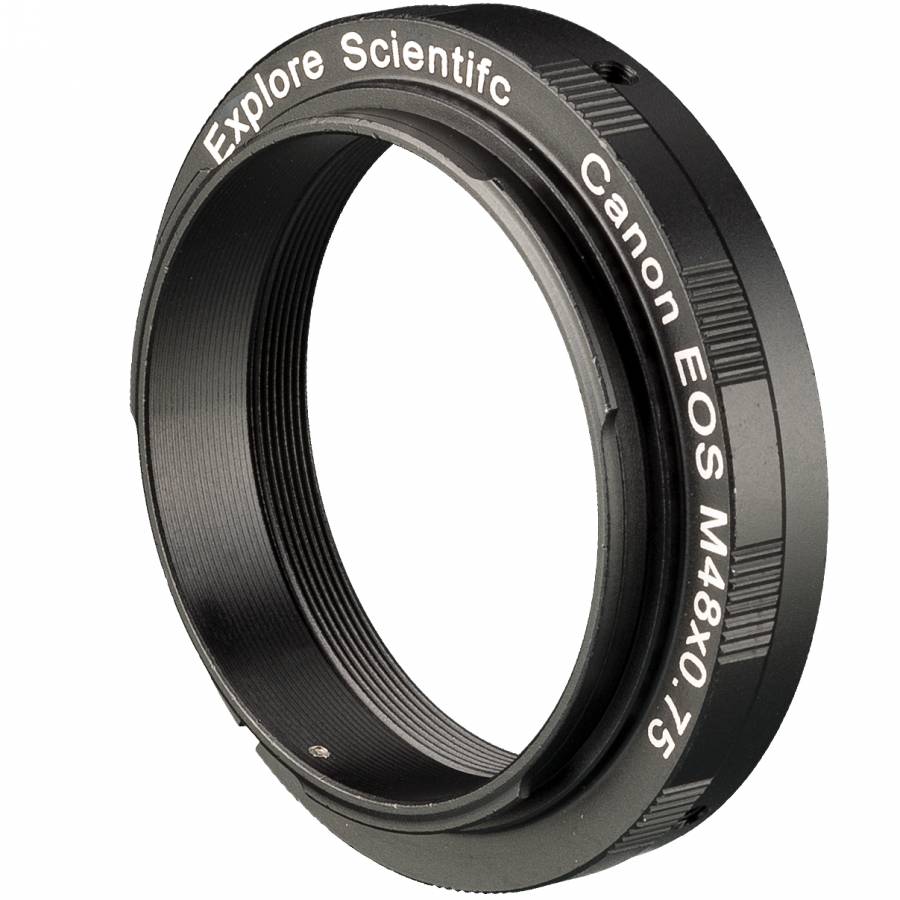
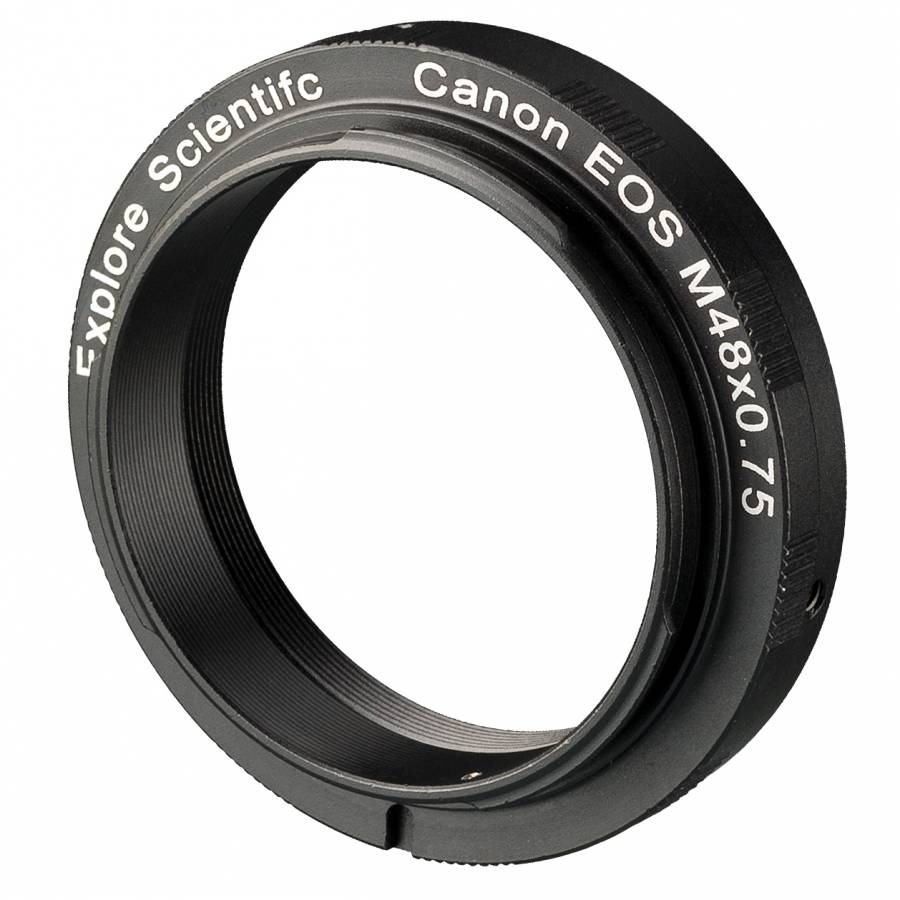
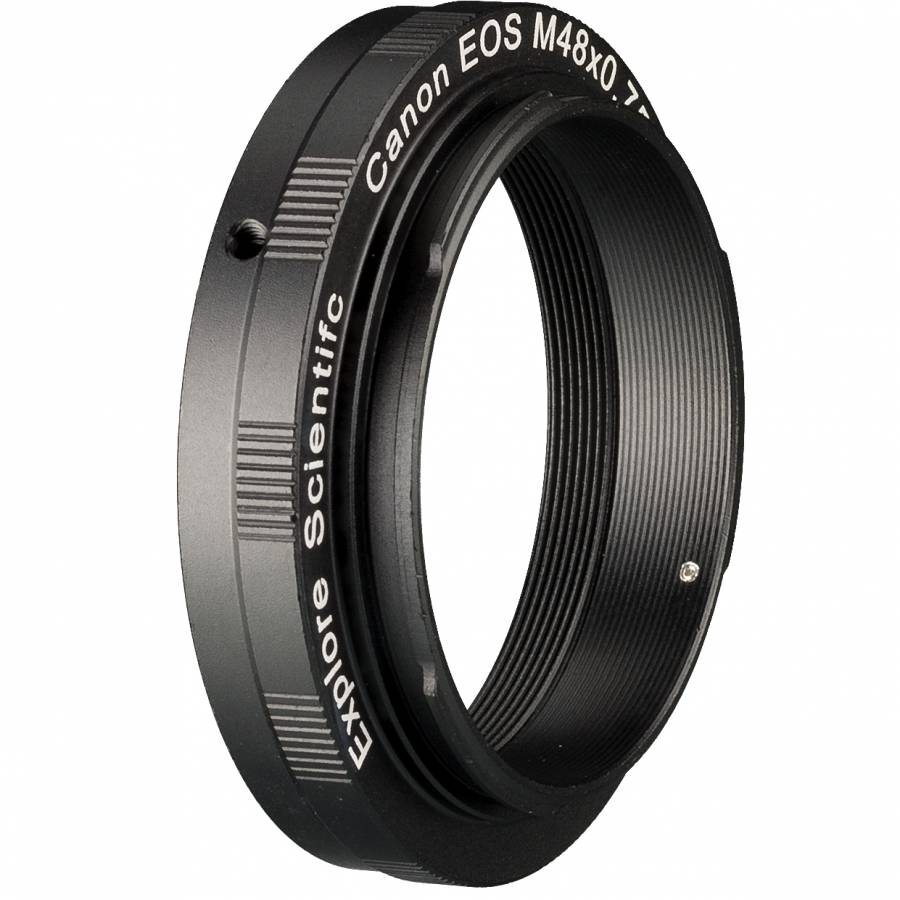


- Description
Product Overview
This is Explore Scientific's Canon EOS camera ring, the part that turns a Canon bayonet body into a threaded component of an M48 imaging train. The camera side is a genuine Canon EOS bayonet; the telescope side is a female M48 x 0.75 thread with a published clear inner diameter of 47.5 mm, which is the whole reason to choose M48 over the older T2 standard. Explore Scientific machines it from aluminium with a matte black anodised finish, publishes a light path length of 10.0 mm, and publishes a weight of 40 grams (about 0.09 lb). Vendor item number 510383 / 05-10383.
Who It's For
If you shoot a Canon EOS body on a telescope and you have ever pulled a frame off the card to find the corners noticeably darker than the centre, this ring is the fix. The usual culprit is not the telescope. It is the T2 adapter in front of the camera, whose M42 thread leaves only about 38 mm of clear aperture. A full-frame sensor measures 43.3 mm across the diagonal, so the light cone is being clipped before it ever reaches the corners. Opening the bottleneck to 47.5 mm clears the full-frame diagonal with room to spare, and the corner falloff you are left with is the honest signature of your optics rather than an artefact of the adapter.
It is equally worth having on a crop-sensor Canon. An APS-C sensor will not vignette in a T2 train, but an M48 ring future-proofs the imaging train for the day you move to a 6D, a 5D or a full-frame R body, and M48 is the thread that Explore Scientific's field flatteners and focal reducers are built around. Buying the ring that matches the rest of the train saves you a stack of step rings later, and every step ring you remove is one less place for flexure and tilt to creep in.
Key Features & Design
- Native Canon EOS bayonet on the camera side, so it locks onto EF and EF-S bodies the same way a lens does
- Female M48 x 0.75 thread on the telescope side, matching Explore Scientific's flatteners, reducers and M48 accessories
- Published clear inner diameter of 47.5 mm, comfortably larger than the 43.3 mm full-frame sensor diagonal
- Published light path length of 10.0 mm, a figure you need when you calculate back focus for a flattener or reducer
- Machined from aluminium with a matte black anodised finish to suppress internal reflections and stray light
- Published weight of 40 grams, so it adds essentially nothing to the load hanging off the drawtube
- Threaded telescope interface rather than a slip fit, which removes camera rotation and sag from long exposures
Mechanical Design
The number that matters on a camera ring is where it puts the sensor. A Canon EOS body has a flange focal distance of 44.0 mm, meaning the sensor sits 44.0 mm behind the bayonet face. Add the 10.0 mm light path that Explore Scientific publishes for this ring and the sensor lands 54.0 mm behind the M48 thread face. That is worth writing down, because most flatteners and reducers specify their back focus as a distance from their own rear thread to the sensor, commonly 55 mm. This ring gets you to 54.0 mm on a Canon, so if your corrector calls for 55 mm you will want roughly a millimetre of additional spacing to hit the number exactly. A millimetre sounds trivial and often is at slow focal ratios, but on a fast astrograph it is the difference between round stars and slightly elongated ones in the corners, so it is worth checking rather than assuming. The other half of the design is the 47.5 mm aperture. Thread diameter sets the narrowest point in the light path, and once that point is wider than the sensor diagonal it stops being the limiting factor — which is exactly why the M48 x 0.75 standard exists alongside T2.
Recommended Uses
- Prime focus deep-sky imaging with a full-frame Canon EOS body where corner illumination matters
- Building an M48 imaging train around an Explore Scientific field flattener or focal reducer
- Lunar and solar imaging with a Canon DSLR at native focal length, with proper full-aperture solar filtration
- Replacing an existing T2 ring that is vignetting a full-frame sensor
Compatibility and Accessory Notes
The camera side fits Canon EOS bayonet bodies — the EF and EF-S DSLR line, from the entry-level Rebel and 90D bodies through the 6D and 5D full-frame cameras. Canon's RF mirrorless bodies use a different, much shorter 20 mm flange, so an R-series camera needs Canon's own EF-to-RF mount adapter in the chain; that adapter is designed to restore the 44.0 mm EF register, so the 54.0 mm figure above still holds once it is fitted. On the telescope side you need an M48 x 0.75 male thread to screw into. Explore Scientific's field flatteners and focal reducers already provide one, as do many modern 2-inch imaging accessories. What this ring will not do is thread straight onto a T2 fitting: T2 is M42 x 0.75 and this is M48 x 0.75, so a bridging ring is needed between them. Explore Scientific's M48 to M42 reduction adapter is the usual candidate for that job, but the vendor does not publish which of its ends is male and which is female, and a ring described as an M48-to-M42 reduction can be the same object as one described as an M42-to-M48 step-up, seen from the other end. Describe both fittings to us and we will confirm the correct bridging part rather than let you order on a guess. Fit is genuinely model-dependent once a corrector is involved, so tell our team in Bolton which scope, corrector and Canon body you are pairing and we will confirm the spacing arithmetic with you.
Good to Know Before You Order
This is a mount ring only. It contains no glass, corrects nothing, and does not include the camera or the telescope-side adapter it threads onto. It is also Canon EOS specific — if you shoot Nikon, you want the Nikon version of this ring rather than this one, because the bayonet and the flange distance are both different. Bear in mind that an M48 ring only delivers full-frame coverage if everything upstream of it is also at least M48; a 47.5 mm aperture behind a 2-inch nosepiece with a narrow throat still vignettes, and the ring cannot undo a bottleneck that sits further forward in the train. Finally, note that the 47.5 mm clear aperture and 10.0 mm light path are Explore Scientific's published figures, and the 54.0 mm sensor distance above is those figures added to Canon's standard 44.0 mm register.
Frequently Asked Questions
Will this fit my Canon EOS R mirrorless body? Not directly. RF bodies have a 20 mm flange distance and a different bayonet. Add Canon's EF-to-RF mount adapter between this ring and the camera and it works normally, with the same effective spacing as a DSLR.
How far behind the M48 thread does it put the sensor? About 54.0 mm, which is Canon's 44.0 mm flange distance plus the 10.0 mm light path Explore Scientific publishes for this ring. If your flattener specifies 55 mm, plan on roughly a millimetre of extra spacing.
Can I screw this onto a T2 adapter? Not directly, because T2 is M42 x 0.75 and this ring is M48 x 0.75. A bridging ring between the two standards is required, and Explore Scientific's M48 to M42 reduction adapter is normally the part for it. Thread gender is not published, so send us the details of both fittings and we will confirm.
Do I still need this if I shoot a crop-sensor Canon? Not strictly, since an APS-C sensor will not vignette behind a T2 adapter. It is still worth it if you plan to move to full frame or if the rest of your imaging train is already M48, because fewer step rings means less flexure and tilt.
Bottom Line
A well-made, genuinely useful piece of aluminium that removes the most common cause of vignetting on a full-frame Canon: the adapter, not the telescope. If you are running an Explore Scientific flattener or reducer, this is the ring the rest of that train expects. Send our team in Bolton your scope, corrector and camera and we will confirm the spacing before you order.
You may also like
Recently viewed
Recent Blog Posts
View all
Your Guide Graph Is Lying to You
Read More

D-Size vs V-Size: A Complete Guide to Telescope Dovetail Systems
Read More
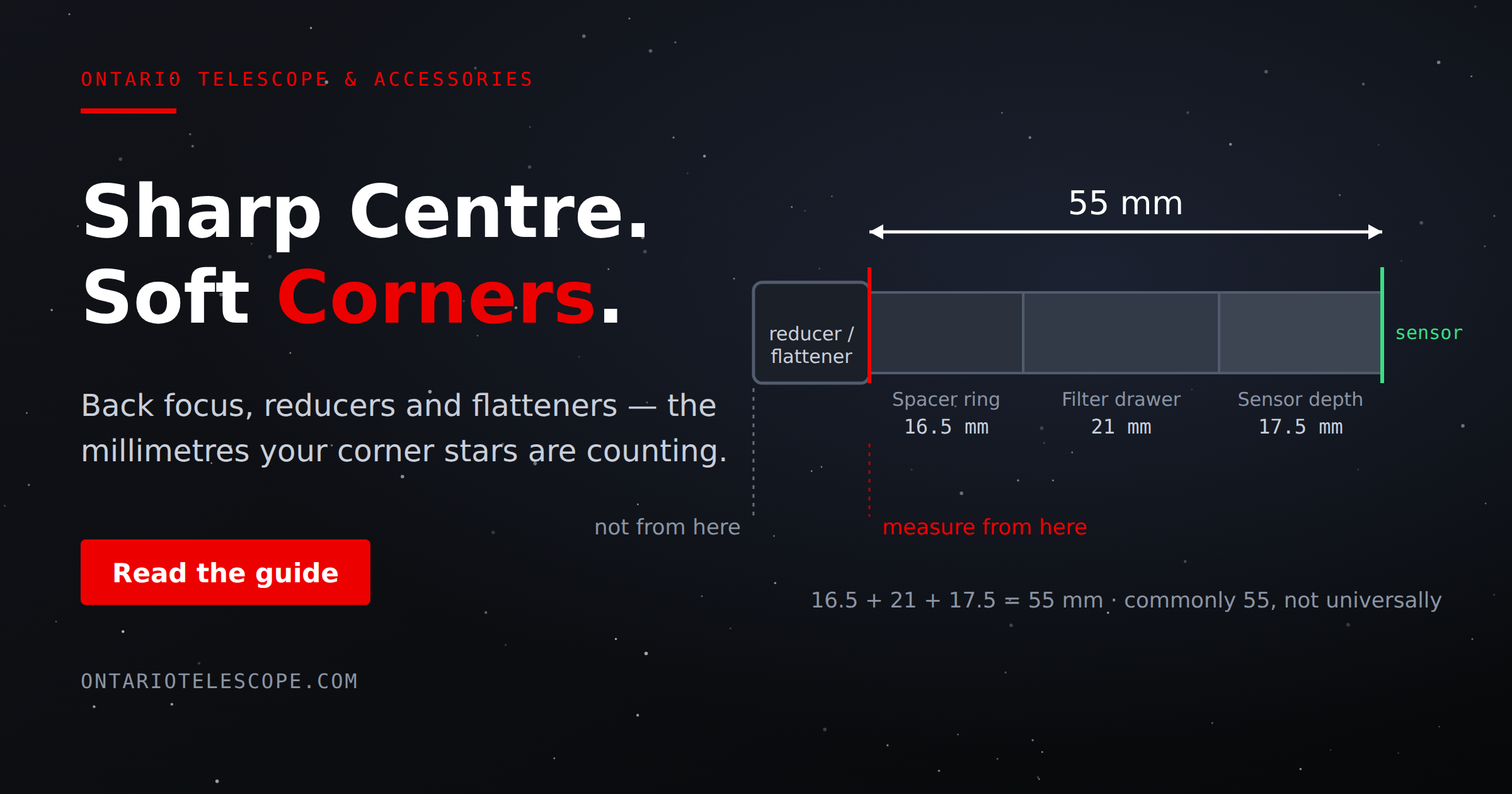
What Is Back Focus in Astrophotography? Telescope Reducers, Flatteners, and Spacing Explained
Read More