
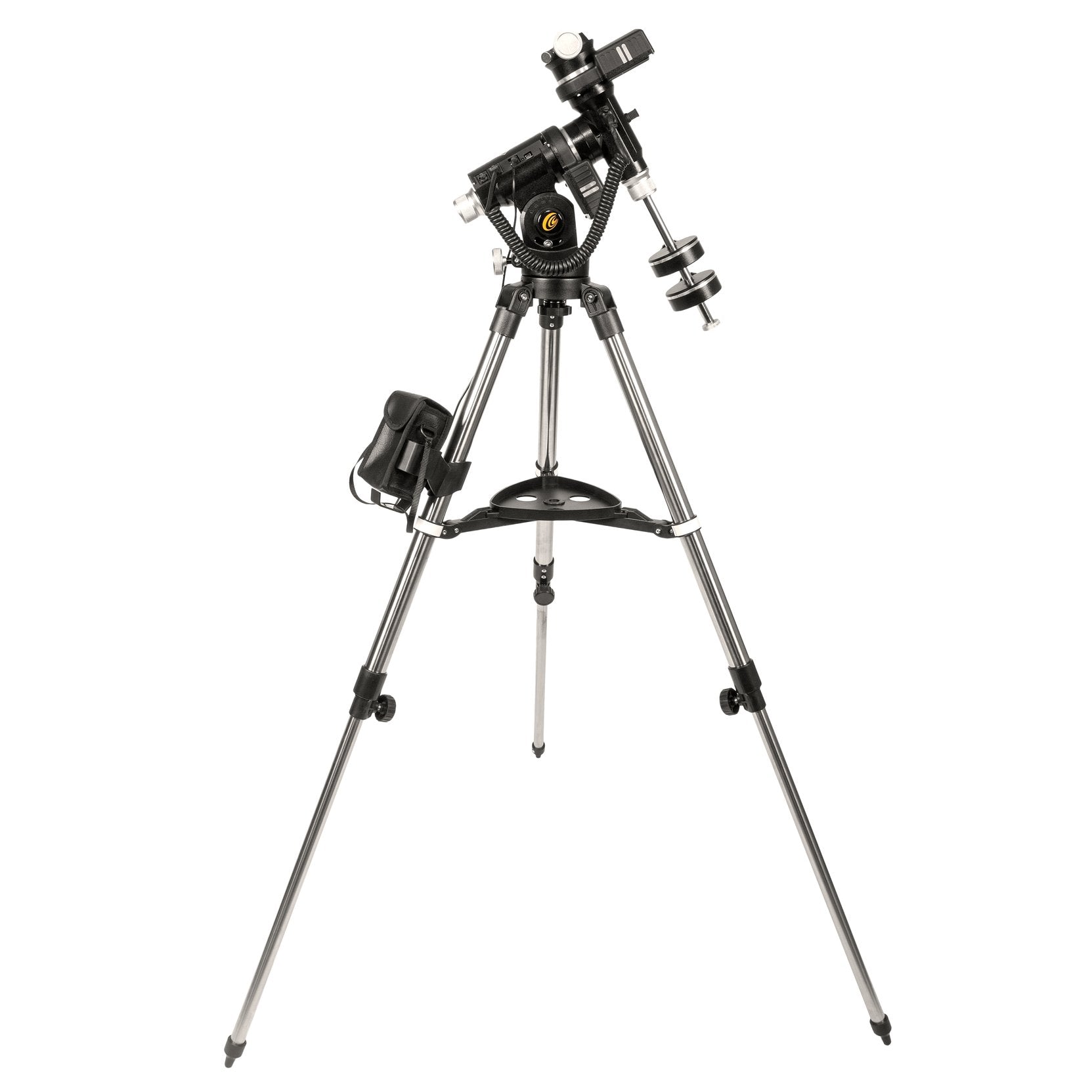
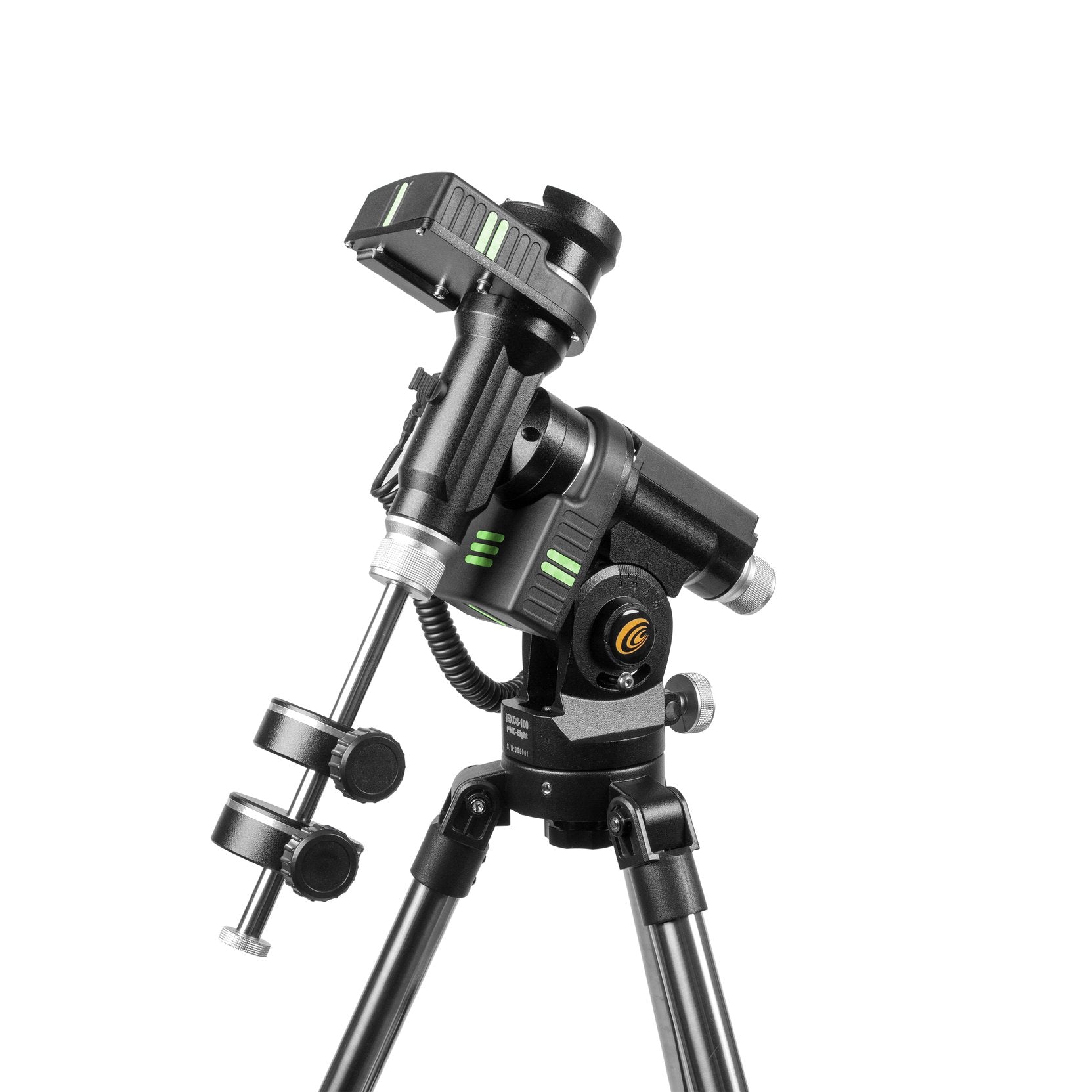
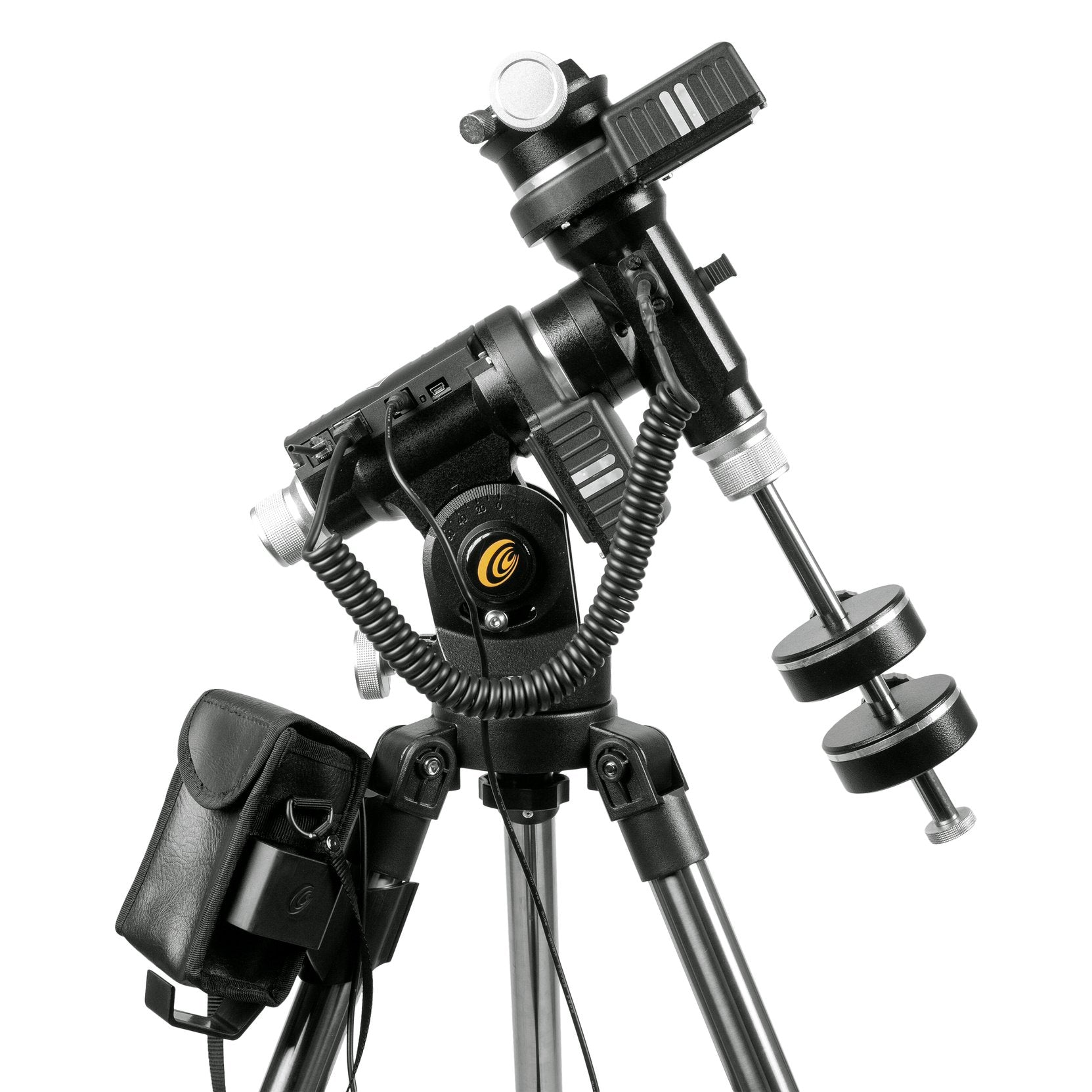
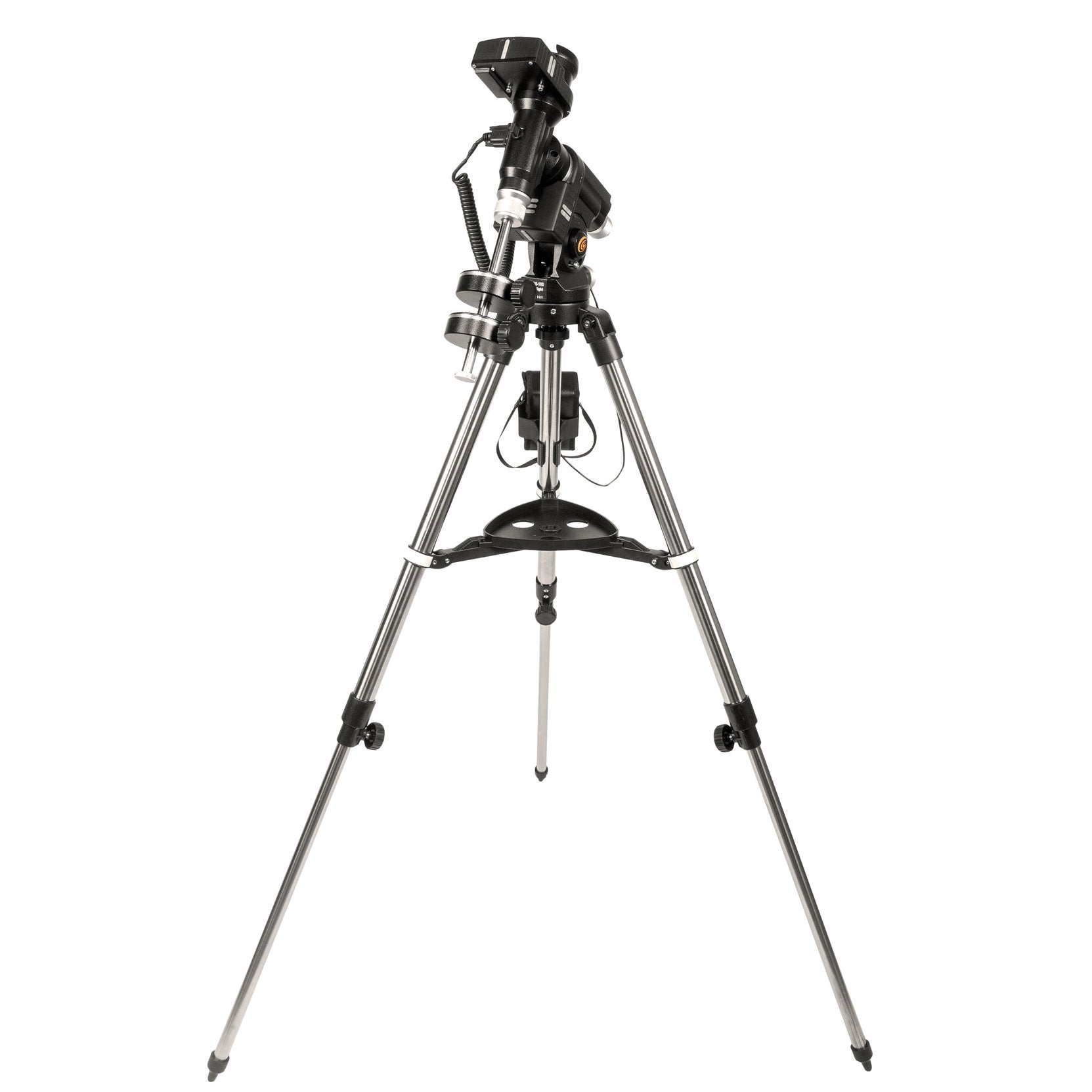


- Description
- Specifications
Product Overview
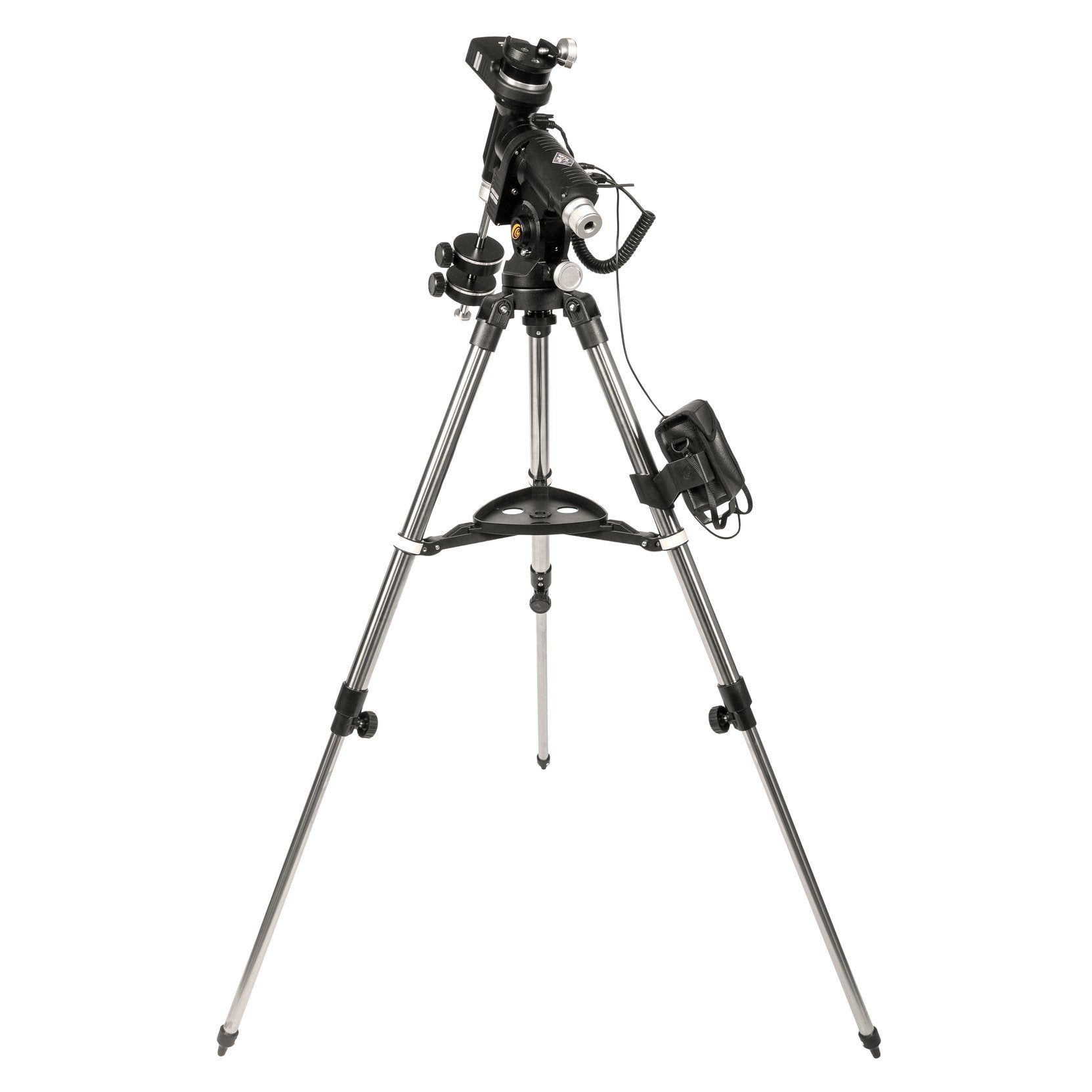
The Explore Scientific iEXOS-100-02 is a computerised German equatorial GoTo mount built on the PMC-Eight control system, supplied as a complete tracking package: mount head, travel tripod, two 1 kg counterweights, a battery pack and access to the ExploreStars control app. The mount head weighs 9.45 lbs and the tripod 5.35 lbs, with a travel tripod listed at 5.5 lbs and 27.25″ collapsed, which is what makes the whole system a carry-on-sized proposition rather than an observatory fixture.
PMC-Eight is the part that gives the mount its name: eight independent CPUs, each assigned to a specific operational task, rather than one processor time-slicing between motor control, communications and pointing. Drive is by dual-axis stepper motors through belt reductions, and both axes carry clutched worm gears so the telescope can be released and balanced by hand.
Connection is by wire, WiFi or Bluetooth, so the mount can be driven from a phone, tablet or laptop without a hand controller in the loop. A polar alignment sight hole through the right ascension axis handles the initial setup on Polaris.
Who It's For
- Wide-field and travel imagers: the published photographic capacity is 15 lbs with counterweights fitted, which covers a short refractor, a camera and a guide scope.
- Visual observers wanting tracking: approximately 19 lbs visual capacity with counterweights, which is a different and higher figure than the imaging one because visual work tolerates more flex.
- Observers who travel: a 9.45 lb head and a 5.35 lb tripod split into two easy loads, and the travel tripod collapses to 27.25″.
- This is a good match if you already run a phone or tablet at the telescope and would rather control the mount from that than from a dedicated hand controller.
- Anyone assembling a compact imaging rig where every pound of payload is accounted for against the published 9 lbs of equipment-only capacity.
Key Features & Design
- PMC-Eight control system: eight independent CPUs, each dedicated to a specific task, which is how the design keeps motor timing separate from communications traffic.
- Dual-axis stepper motors with belt drives: belts take up backlash and run quieter than a direct gear train.
- Clutched worm gears on both axes: the clutches release for balancing and for slewing by hand, then re-engage for tracking.
- Built-in WiFi and Bluetooth, with wired connection also available — three routes to the same control layer.
- ExploreStars app control from a tablet or phone, included with the system.
- Polar alignment sight hole through the polar axis for the initial northern alignment.
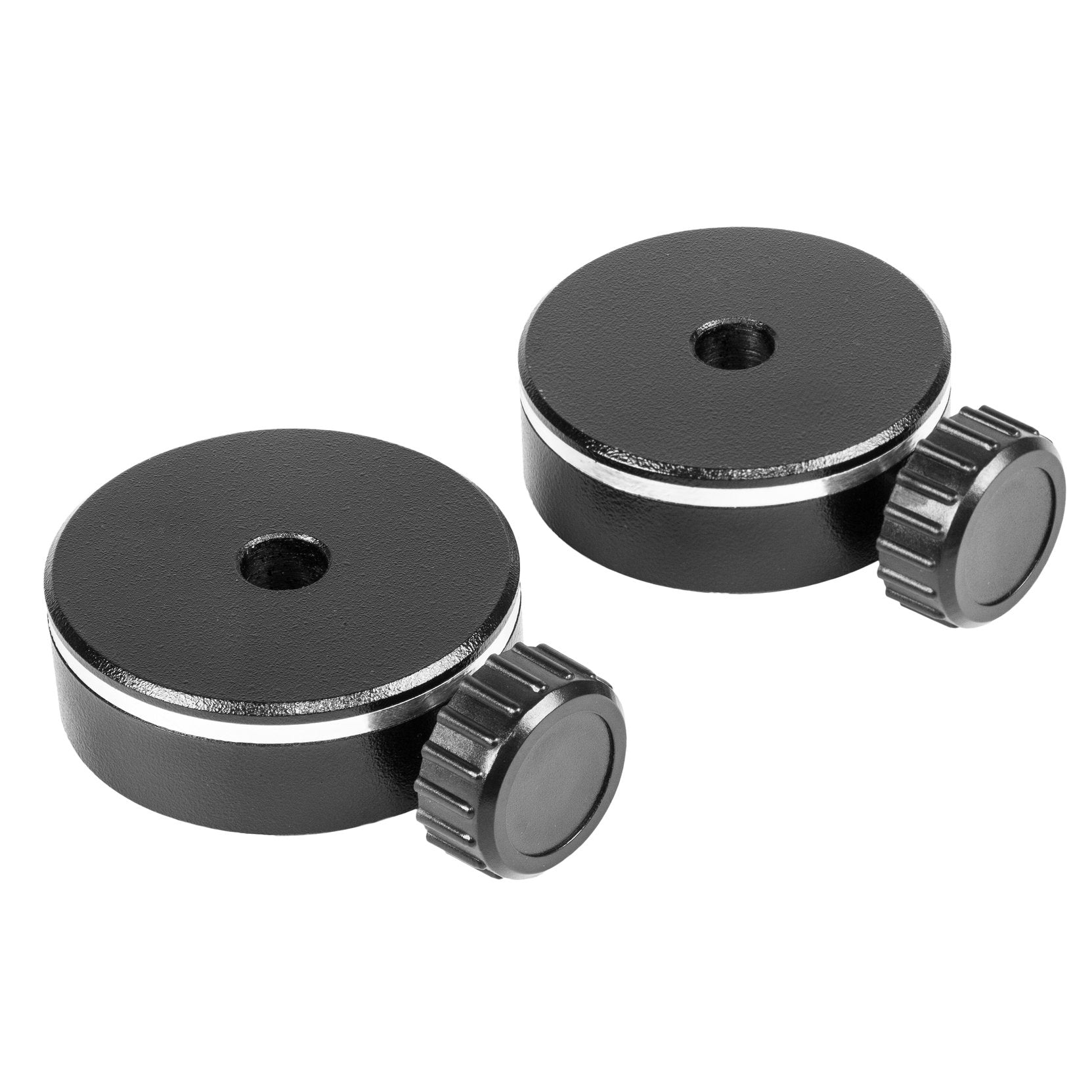
- Two 1 kg counterweights supplied, which is what lifts the rated capacity from about 9 lbs of equipment alone to 15 lbs photographic and about 19 lbs visual.
- Published weights: mount head 9.45 lbs, tripod 5.35 lbs, travel tripod 5.5 lbs.
Recommended Uses
- Tracked visual observing with small to medium refractors and compact catadioptric tubes.
- Wide-field astrophotography with a camera lens or short refractor inside the 15 lb photographic figure.
- Travel and dark-site sessions where the whole system has to fit in a car boot or a case.
Compatibility and Accessory Notes
- Capacity, read carefully: Explore Scientific publishes three figures — approximately 9 lbs for equipment alone, 15 lbs photographic with the counterweights fitted, and approximately 19 lbs visual with the counterweights. Imaging asks more of a mount than visual use does, which is why the photographic number is the lower of the two loaded figures.
- Counterweights: two 1 kg weights come with the system. Heavier payloads within the rated range are balanced by moving the weights out along the shaft rather than by adding more.
- Control: wire, WiFi or Bluetooth into the ExploreStars app. No separate hand controller is needed for the mount to function.
- Tripod: supplied. The heights above are the published figures with and without the head fitted, which is the number to compare against your seated or standing eyepiece height.
- Telescope attachment: Explore Scientific does not publish the saddle or dovetail standard for this mount in its specification list, so that row is absent below rather than guessed. Send us the dovetail on your telescope and we will check the fit for you.
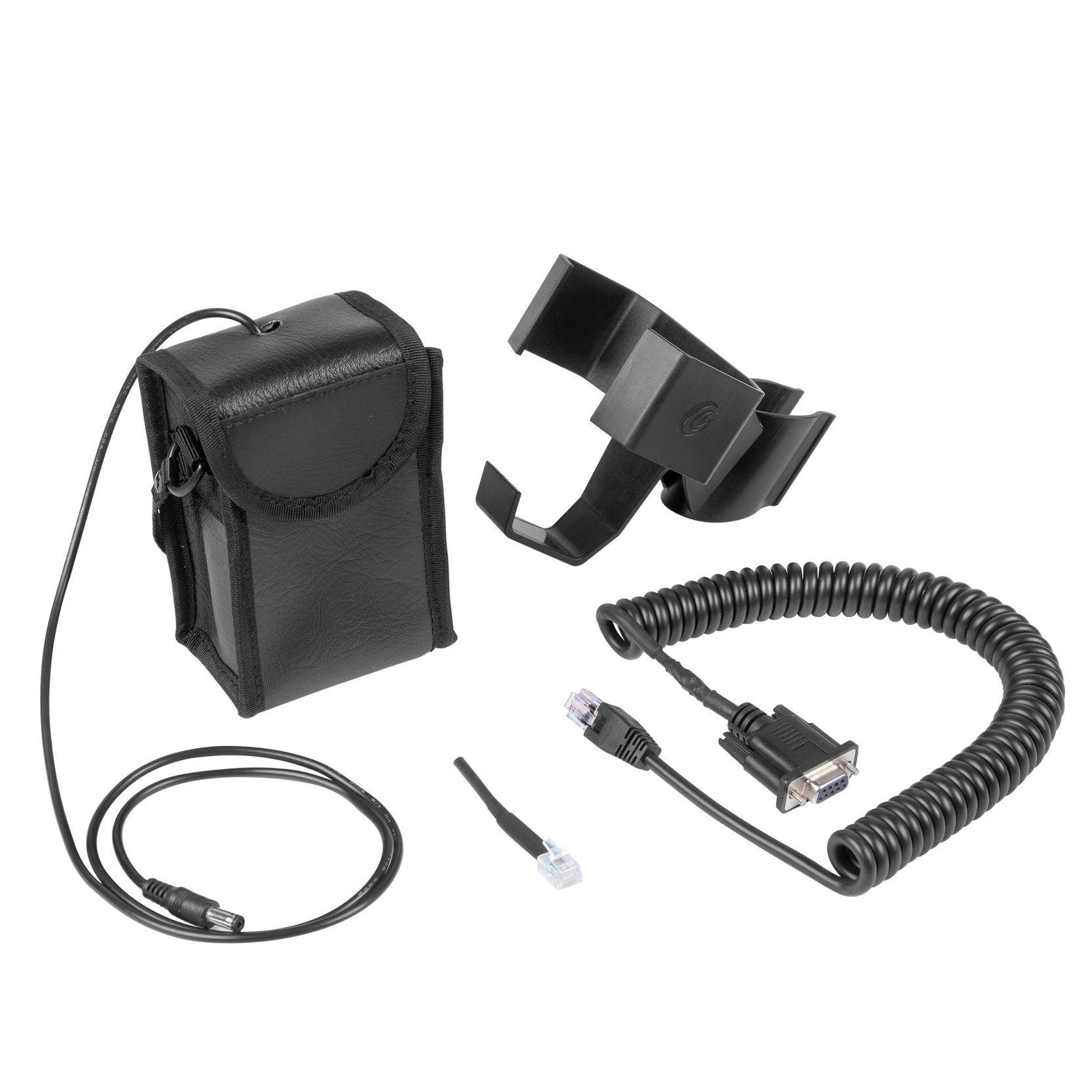
- Power: a battery pack is included. Longer imaging sessions are usually run from a larger external supply.
Good to Know Before You Order
- Capacity is the number that governs everything here. At approximately 9 lbs of equipment alone, this is a mount for short refractors, camera lenses and compact tubes rather than a large SCT. If you tell us the telescope you plan to put on it, we will add up the loaded weight with you before you order.
- Equatorial mounts want polar alignment. The sight hole through the polar axis handles the visual case in a couple of minutes; imaging generally benefits from a more careful routine, and drift or software-assisted alignment covers that.
- Tracking accuracy figures are not published. Explore Scientific does not list periodic error or guiding specifications for the iEXOS-100-02, so those rows are absent below rather than estimated. If that is your deciding figure, ask us and we will put it to our Explore Scientific contact.
- The included battery pack suits short sessions. Imaging runs of several hours are usually powered from a larger 12V supply, and we stock those.
- Two tripod figures appear in the vendor data — a 5.35 lbs tripod and a 5.5 lbs travel tripod at 27.25″ collapsed. Both are reproduced below exactly as published, and we are happy to confirm which one is in the box for the configuration you are ordering.
Frequently Asked Questions
Is it difficult to set up?
The mechanical part is quick: legs out, head on, counterweights on the shaft, telescope in the saddle, then balance both axes with the clutches released. The step that is new to anyone coming from an alt-azimuth mount is polar alignment, and the sight hole through the polar axis reduces that to lining up on Polaris. After the first evening the whole routine settles at around ten minutes.
How much can it carry?
Explore Scientific publishes approximately 9 lbs for equipment on its own, 15 lbs for photographic use with the counterweights fitted and approximately 19 lbs for visual use with the counterweights. Imaging is the more demanding case, so the photographic figure is the one to plan an imaging rig against.
Does it need a hand controller?
No. Control runs through the ExploreStars app over WiFi, Bluetooth or a wired connection, from a tablet, phone or computer.
Is a telescope included?
No. The system covers the mount head, tripod, two 1 kg counterweights, battery pack and app access. The optical tube and its dovetail are separate.
How tall does it stand?
With the mount head fitted, 38.5″ at the highest point with the legs retracted and 45″ with them fully extended. Without the head, the tripod runs from 25″ open and retracted to 42″ fully extended.
Can I guide it for long exposures?
The mount tracks under app control and the payload figures allow for a small guide scope within the 15 lb photographic rating. Explore Scientific does not publish guiding port or periodic error specifications, so we would rather talk through your imaging train with you than quote numbers that are not in their data.
Bottom Line
In short: a PMC-Eight computerised German equatorial mount with WiFi, Bluetooth and wired control, a 9.45 lb head, a travel tripod, two 1 kg counterweights and a battery pack — tracking and GoTo in a package sized for travel, rated at roughly 9 lbs of equipment alone and 15 lbs photographic with the weights fitted. Send us the telescope you plan to put on it and we will add up the loaded payload with you before you order.
| Item Number | ES-iEXOS-100-2 |
|---|---|
| Mount Type | Computerized German equatorial GoTo tracking mount |
| Control System | PMC-Eight, eight independent CPUs |
| Drive | Dual-axis stepper motors with belt drives; clutched worm gears |
| Connection | Wire, WiFi, or Bluetooth® |
| App | ExploreStars |
| Mount head weight | 9.45 lbs |
| Tripod weight | 5.35 lbs |
| Travel Tripod weight | 5.5 lbs |
| Travel Tripod collapsed height | 27.25" |
| Tripod fully collapsed (no mount head) | 25.5" |
| Tripod open, retracted legs (no mount head) | 25" |
| Tripod open, retracted legs (with mount head) | 38.5" at highest point, 36" to center of bracket |
| Tripod open, legs fully extended (no mount head) | 42" |
| Tripod open, legs fully extended (with mount head) | 45" at highest point |
| Counterweights | (2) 1 kg each |
| Mount weight capacity | ~9 lbs (equipment only), 15 lbs (photographic with counterweights), ~19 lbs (visual with counterweights) |
| Polar Alignment | Sight hole through polar axis |
| Power | Battery pack included |
| Saddle / Dovetail Standard | Not published by vendor |
| Periodic Error | Not published by vendor |
| Telescope | Not included |
You may also like
Recently viewed
Recent Blog Posts
View all
Your Guide Graph Is Lying to You
Read More
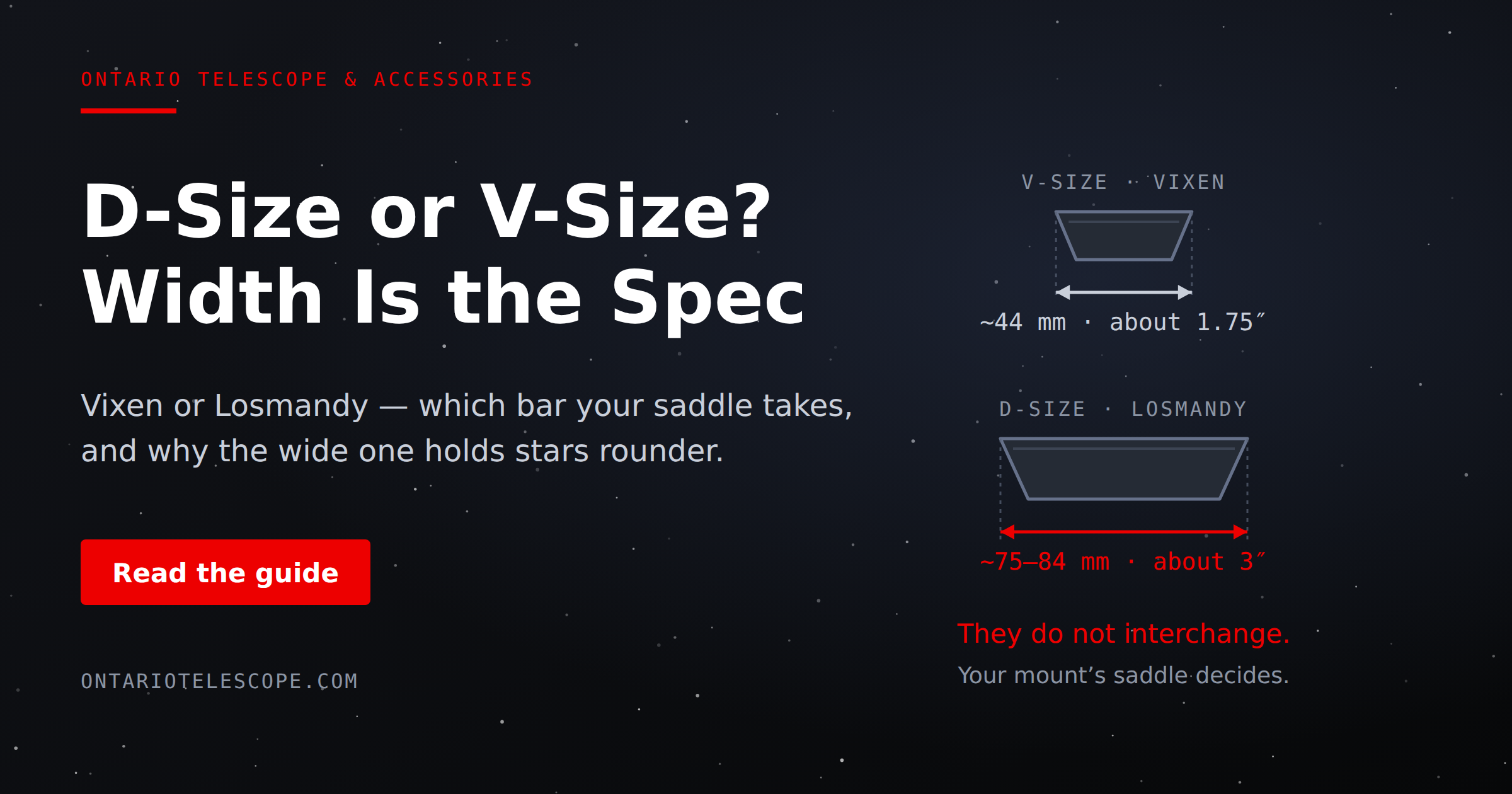
D-Size vs V-Size: A Complete Guide to Telescope Dovetail Systems
Read More
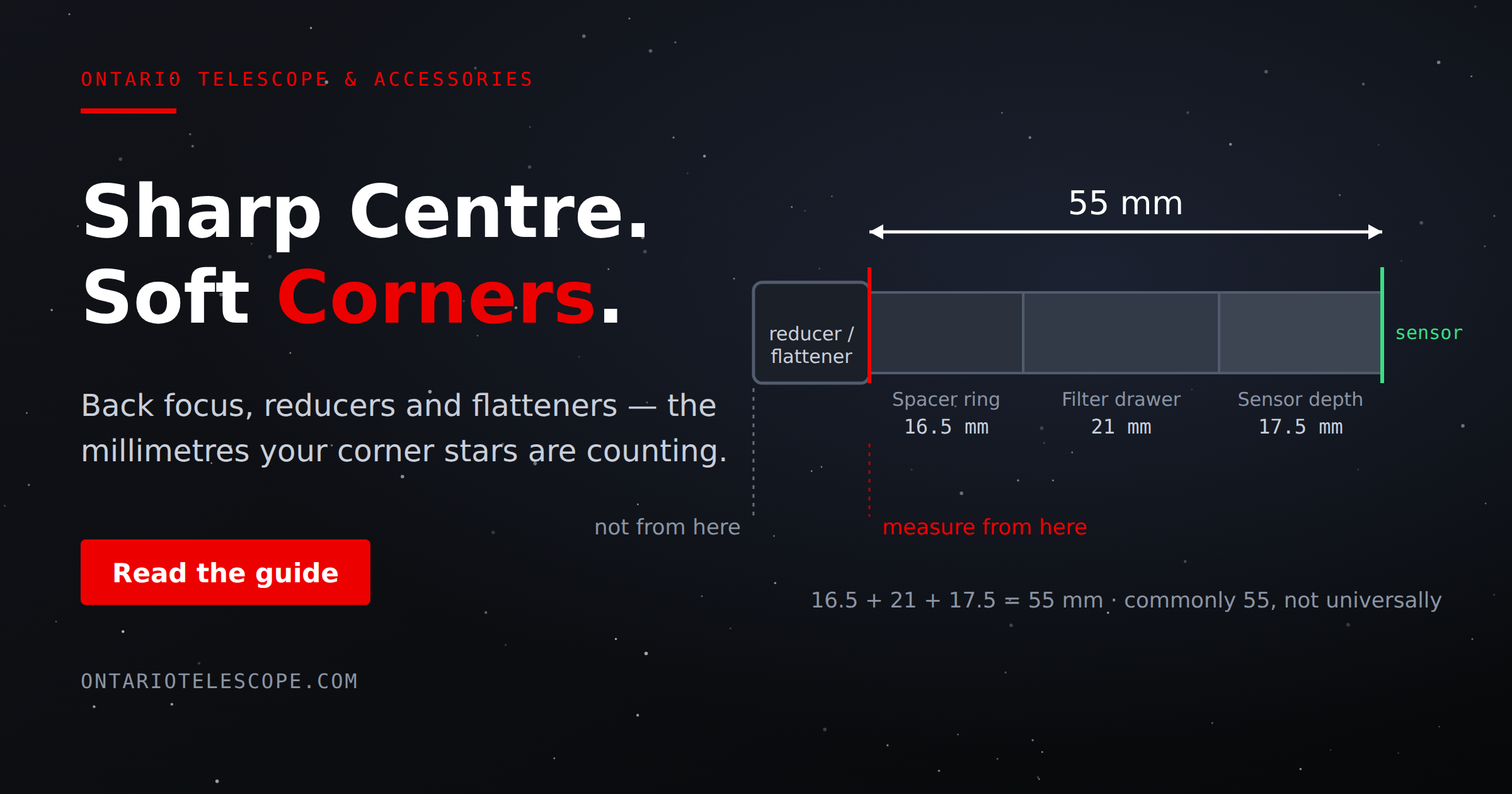
What Is Back Focus in Astrophotography? Telescope Reducers, Flatteners, and Spacing Explained
Read More