


- Description
Product Overview
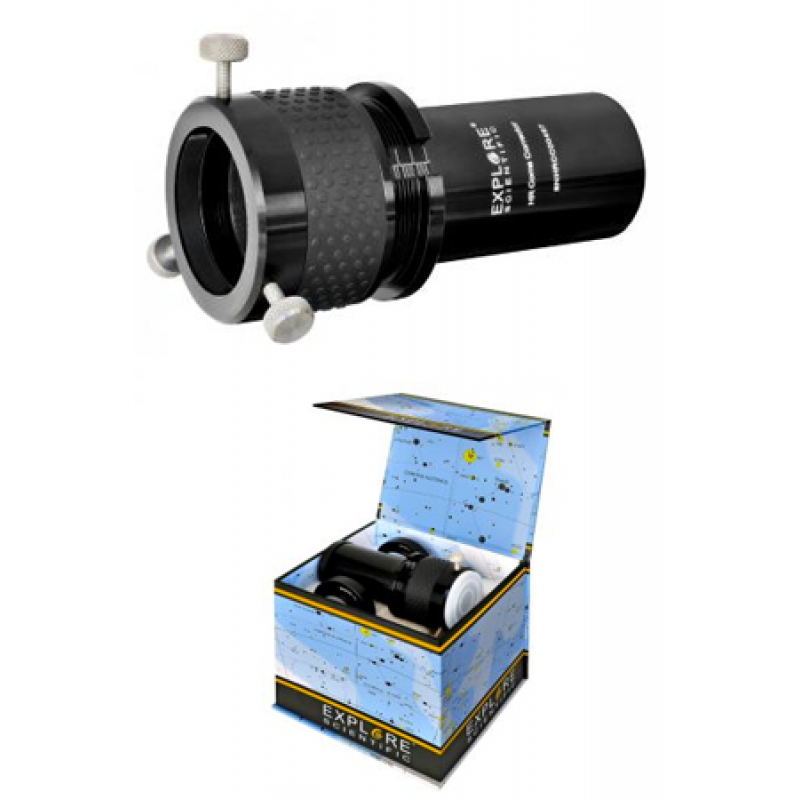
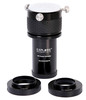
The Explore Scientific HR Variable Coma Corrector is a 2-inch corrector for Newtonian reflectors, designed by the optical designer Harrie Rutten and EMC coated to hold down internal reflections. This is item HRCC02-00, the version supplied with camera adapters: both an M42x0.75 and an M48x0.75 adapter are in the box, along with three thumbscrews and a protective cap. Explore Scientific publishes a weight of 1 lb (0.45 kg), a diameter of 69.3 mm and a height of 147.2 mm.
Explore Scientific offers the same corrector without those adapters as item HRCC02-01, at a lower price. If you intend to screw a camera directly onto the corrector, this is the version to buy.
Who It's For
Anyone imaging or observing with a fast parabolic Newtonian who is tired of comet-shaped stars in the corners. Coma is inherent to the paraboloid: it grows with distance from the optical axis and it grows fast as the focal ratio drops, so an f/4 mirror shows it well inside the field of a 2-inch eyepiece while an f/8 mirror mostly hides it. This corrector is the standard remedy, and Explore Scientific specifies it down to around f/3.9.
Choose this HRCC02-00 version if you are attaching a camera. The two threaded adapters are what let a DSLR or dedicated astro camera screw straight onto the corrector at a fixed, repeatable spacing, which is exactly what you want when you are trying to reproduce a working imaging train night after night.
Key Features & Design
- 2-inch coma corrector for parabolic Newtonian reflectors, specified for fast mirrors from around f/3.9
- Includes both M42x0.75 and M48x0.75 camera adapters for a direct screw-on camera connection
- Optical design by Harrie Rutten
- EMC coating to suppress internal reflections and ghosting on bright stars
- Variable spacer with markings, so the corrector can be set for different telescopes
- Three thumbscrews and a protective cap supplied
- 1 lb (0.45 kg), 69.3 mm diameter, 147.2 mm tall
Optical Design
A parabolic mirror brings light to a sharp focus on axis and nowhere else. Off axis, rays striking different zones of the mirror land at slightly different places, and the resulting flare is coma: stars grow a one-sided tail that points away from field centre and lengthens the further out you look. Because the effect scales roughly as the inverse square of the focal ratio, halving the f-number quadruples the coma — which is why a fast Newtonian, the very telescope you want for wide-field imaging, is also the one that shows the aberration worst.
The corrector sits in the converging beam ahead of focus and applies an equal and opposite aberration, straightening those tails back into points. Its distance from the sensor or eyepiece field stop is what determines how completely it does that, and it is why the spacer is marked rather than fixed — different telescopes want different spacings, and the markings let you find yours and return to it. The EMC coating matters more here than on a simple accessory, because a multi-element group sitting in a converging beam is a good place to generate ghost images from bright stars if the surfaces are not properly treated.
Recommended Uses
- Deep-sky imaging with a fast parabolic Newtonian, where corner stars would otherwise flare
- Wide-field visual observing at low power in a fast Dobsonian, sharpening the field edge
- Any Newtonian imaging train where the camera needs to screw on at a fixed, repeatable spacing
Compatibility and Accessory Notes
This corrects coma; it is not a focal reducer and it will not shorten your focal length or speed up your system. It is designed for parabolic primary mirrors — Newtonians and Dobsonians — and is not intended for refractors, which need a field flattener instead. It fits a 2-inch focuser and needs enough in-travel to reach focus with the corrector and camera in place, which on some Newtonians means a low-profile focuser or a shortened tube. The M42x0.75 and M48x0.75 adapters supplied here cover both common camera thread standards, so you will still need a T-ring for your specific camera body but not a separate thread adapter. Tell us your telescope and camera and we will confirm the spacing and back-focus before you order.
Good to Know Before You Order
The one decision to get right is which version you want. This HRCC02-00 comes with the M42 and M48 adapters. The cheaper HRCC02-01 is the identical corrector without them, and if you buy that one and later want a screw-on camera connection you will be sourcing adapters separately — which usually costs more than the difference between the two listings. Buy this one if a camera is anywhere in your plans. Note also that reaching focus with a corrector in the train is the commonest snag on Newtonians; if you have not used one on your telescope before, check your focuser travel or ask us.
Frequently Asked Questions
What is the difference between HRCC02-00 and HRCC02-01? The adapters. This version (HRCC02-00) includes M42x0.75 and M48x0.75 camera adapters. HRCC02-01 is the same corrector supplied without them, at a lower price.
Will it work on my f/5 Dobsonian? Yes — it is designed for parabolic Newtonians and Explore Scientific specifies it for fast mirrors from around f/3.9, so f/5 is well within range. Reaching focus is the thing to check, not the optics.
Does it change my focal length? No. It corrects coma and leaves the focal ratio alone. If you want a shorter focal length you are after a focal reducer, which is a different product.
Can I use it visually? Yes. It sharpens stars at the edge of the field with wide-angle eyepieces at low power, though the gain is most obvious on fast mirrors.
Bottom Line
The Harrie Rutten HR coma corrector in its complete form — EMC coated, marked variable spacer, and both M42 and M48 camera adapters in the box. If you are imaging with a fast Newtonian, this is the version that saves you a second purchase. Send our Bolton team your telescope and camera and we will check the spacing with you.
You may also like
Recently viewed
Recent Blog Posts
View all
Your Guide Graph Is Lying to You
Read More

D-Size vs V-Size: A Complete Guide to Telescope Dovetail Systems
Read More

What Is Back Focus in Astrophotography? Telescope Reducers, Flatteners, and Spacing Explained
Read More