


- Description
- Specifications
Product Overview
This is the Explore Scientific mechanical adapter that joins the FFFR507X-00 3-inch 0.7x field flattener and focal reducer to a 2.5-inch hex focuser. It carries no optical elements of its own. Its entire job is to hold two components of different diameters concentric, square to the optical axis, and at whatever spacing the corrector was designed for — which, in an imaging train, is the difference between round stars in the corners and elongated ones.
The FFFR507X-00 is a 3-inch corrector, sized for the larger focusers fitted to Explore Scientific's bigger refractors. A 2.5-inch hex focuser has a smaller drawtube, so on its own the corrector has nothing to seat against. The adapter is the interface that makes that pairing mechanically possible.
Explore Scientific does not publish a specification table for this item — no dimensions, no thread callouts, no weight and no optical path length. Everything below that is not in their data is stated as unpublished rather than estimated, and we are glad to take a specific question to our Explore Scientific contact on your behalf.
Who It's For
- Owners of the FFFR507X-00 3″ 0.7x corrector who want to use it on a telescope fitted with a 2.5-inch hex focuser rather than a 3-inch one.
- Imagers assembling a fixed, repeatable optical train, where a purpose-made adapter is more rigid and more concentric than a stack of general-purpose rings.
- Anyone who has changed focusers or telescopes and needs to carry an existing corrector across to the new setup.
- Observers troubleshooting corner star shapes, where a mechanical mismatch in the train is one of the usual causes.
Key Features & Design
- Purpose-built interface: made specifically for the FFFR507X-00 to 2.5-inch hex focuser pairing rather than adapted from a generic ring.
- Mechanical only: no lenses and no coatings, so it introduces no aberrations of its own and needs no cleaning regime beyond keeping the mating faces clean.
- Concentricity and squareness: the two functions that matter in an adapter. A part machined for a specific pair holds the corrector on-axis more reliably than a chain of step rings does.
- Fixed geometry: a single machined part contributes one known length to the train rather than the accumulated tolerance of several stacked components.
- Part of the Explore Scientific accessory line, so the mating dimensions are drawn from the same drawings as the focuser and the corrector it joins.
Recommended Uses
- Fitting the FFFR507X-00 3-inch 0.7x reducer and flattener onto a 2.5-inch hex focuser.
- Building a deep-sky imaging train that reduces focal length and flattens the field in one component.
- Moving an existing corrector between telescopes with different focuser sizes.
- Replacing an improvised stack of step rings with a single machined interface.
Compatibility and Accessory Notes
- Corrector side: made for the Explore Scientific FFFR507X-00, the 3-inch 0.7x field flattener and focal reducer.
- Focuser side: made for the 2.5-inch hex focuser.
- Spacing matters downstream of it. A reducer and flattener has a designed distance from its rear surface to the sensor, and that distance is set by the parts that follow the adapter — the camera, the filter wheel, any spacer rings. If you send us the camera and any filter wheel or off-axis guider you plan to use, we will work through the spacing with you.
- Filters in the train add optical path. Glass in the light path shifts focus slightly, which is one of the more common reasons a train that measures correctly still does not quite deliver. It is straightforward to allow for once it is accounted for.
- Explore Scientific publishes no thread specification, length or weight for this adapter, so those rows read as unpublished below. For a specific figure, ask us and we will take it to our Explore Scientific contact before you commit to an order.
- Other correctors: this part is specified for the FFFR507X-00. If you have a different flattener or reducer in mind, send us the model and we will look at whether the interface suits it.
Good to Know Before You Order
- It is a mechanical adapter, not a corrector. The optical work is done by the FFFR507X-00; this part positions it. Both are needed for the pairing, and we can supply them together.
- Explore Scientific publishes no specification table for it. No dimensions, thread callouts, optical path length or weight appear on their product page, so the table below records those rows as unpublished rather than estimated. If a figure decides the purchase for you, ask and we will get it from our Explore Scientific contact first.
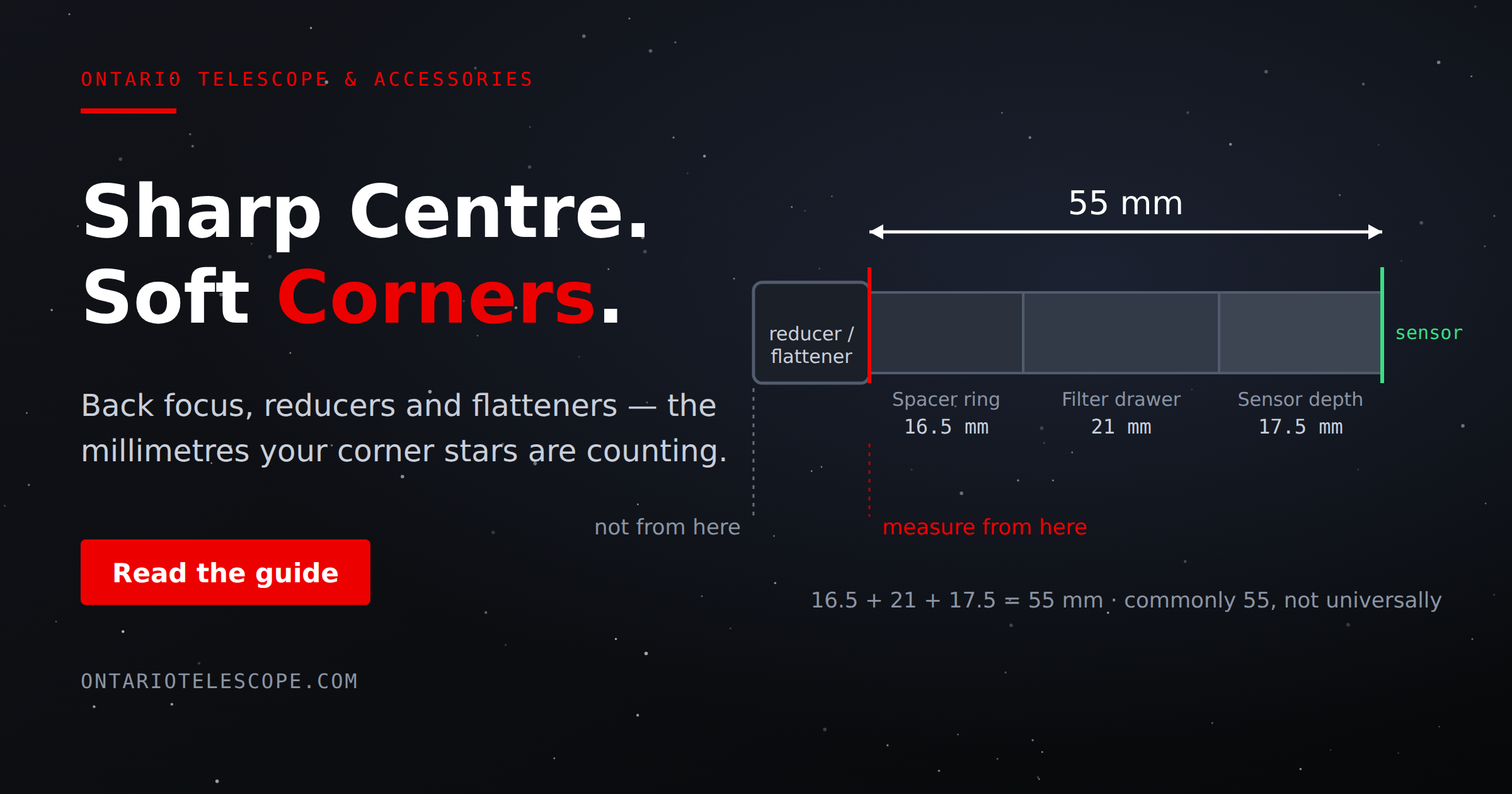
- Back-focus is the specification that governs the result. The adapter contributes a fixed length; the remainder of the distance to the sensor comes from spacers and from the camera itself. Sending us the full list of what sits behind the corrector is the quickest way to get that right the first time.
- It is a narrow-purpose part. It exists for one corrector and one focuser size, which is precisely why it fits well. For any other combination, we would rather check the fit with you than have the wrong part arrive.
- Nothing else is required to use it beyond the corrector and the focuser it was made for — there is no separate clamp, ring or tool involved.
Frequently Asked Questions
Is it difficult to set up?
No — it is a single machined part that goes between the corrector and the focuser and then stays there. There is nothing to align, collimate or calibrate on the adapter itself. The one job that repays a few minutes is measuring the spacing from the back of the corrector to your camera sensor, and we will happily work that out with you.
Does it contain any glass?
No. It is purely mechanical, so it adds no aberrations, no reflections and no light loss of its own.
What does the FFFR507X-00 do?
It is a 3-inch field flattener and 0.7x focal reducer. It flattens the curved focal plane that a refractor naturally produces, so stars stay round toward the corners of a sensor, and it shortens the effective focal length to 0.7 of its native value — a wider field and a faster focal ratio at the same time.
Will it change my back-focus?
Any component in the train contributes length, and this one is no exception. Explore Scientific does not publish its optical path length, so we are not going to quote a figure. Send us the parts list for your train and we will work the spacing through with you.
Does it fit other Explore Scientific focusers?
It is specified for the 2.5-inch hex focuser. If your telescope has a different focuser, send us the model and we will check the interface for you before you order.
Is a camera adapter included?
No. This part joins the corrector to the focuser; the connection from the corrector to your camera is a separate item, chosen to suit the camera and the spacing your train needs.
Can I use it for visual observing?
The FFFR507X-00 it supports is an imaging corrector, so the pairing is aimed at cameras. It is mechanically harmless in a visual train, though there is little for it to do there.
Bottom Line
In short: a mechanical adapter that lets the Explore Scientific FFFR507X-00 3-inch 0.7x flattener and reducer sit on a 2.5-inch hex focuser, with no optics of its own and one job to do properly. Explore Scientific publishes no dimensions for it, so if you would like exact figures before you order, or help laying out the spacing between the corrector and your camera, send us the list of what is in your imaging train and we will map it out with you.
| Item Number | 510366 |
|---|---|
| Type | Mechanical adapter |
| Connects | FFFR507X-00 3" 0.7x field flattener / focal reducer to 2.5" hex focuser |
| Optical Elements | None — mechanical only |
| Thread Specification | Not published by vendor |
| Length / Optical Path | Not published by vendor |
| Outer Diameter | Not published by vendor |
| Material | Not published by vendor |
| Weight | Not published by vendor |
You may also like
Recently viewed
Recent Blog Posts
View all
Your Guide Graph Is Lying to You
Read More
D-Size vs V-Size: A Complete Guide to Telescope Dovetail Systems
Read More
What Is Back Focus in Astrophotography? Telescope Reducers, Flatteners, and Spacing Explained
Read More