

- Description
- Specifications
Product Overview
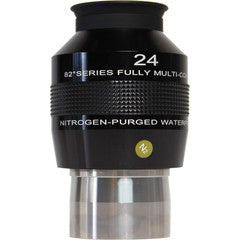
The Explore Scientific 82° Series 24mm is a 2-inch, argon-purged waterproof eyepiece with an 82-degree apparent field, 17.5mm of eye relief and a 33.5mm field stop. Explore Scientific gives its physical dimensions as 110mm long by 70mm wide, weighing 24.8 oz (704 g). It is item EPWP8224-01.
The field stop is the figure that defines what this eyepiece does. At 33.5mm, the true field of view is 33.5 divided by the telescope's focal length, converted to degrees — which works out to 1.92° in a 1000mm telescope, 1.94° in a 988mm f/6.5 refractor, and 0.79° in a 2400mm Schmidt-Cassegrain. In a metre-class refractor that is nearly four full-Moon diameters of sky at 42x, held in an 82-degree apparent field that fills your peripheral vision rather than framing the view in a small porthole.
Twenty-four millimetres is the upper-medium magnification step: 42x in a 1000mm telescope, 32x in a 750mm Newtonian, 79x in a 1900mm Maksutov. The exit pupil is 24 divided by the telescope's focal ratio — 3.7mm at f/6.5, 2.4mm at f/10 — which keeps the sky background dark while surface brightness on extended objects stays high.
Who It's For
- Deep-sky sweepers: almost two degrees of true field in a metre-focal-length telescope covers large open clusters, the sword of Orion and the Veil in single views.
- Dobsonian owners: 82 degrees of apparent field at 24mm buys a long drift time, so the object crosses a wide view slowly instead of shooting through a narrow one.
- Comet observers: a bright comet with an extended tail wants exactly this combination of true field and moderate magnification.
- Observers who wear glasses: 17.5mm of eye relief is generous, and it is enough that a spectacle lens can sit between eye and eyepiece with the field still fully visible.
- Anyone observing in dew: the argon-purged, sealed housing is built for damp air rather than merely tolerant of it.
Key Features & Design
- 24mm focal length in a 2-inch barrel: 42x in a 1000mm telescope, with the barrel size that allows a large field stop.
- 82° apparent field of view: wide enough that the field edge sits outside the eye's comfortable scanning range, which is what produces the sense of looking through an open window.
- 33.5mm field stop: the physical aperture that sets the true field — 1.92° in a 1000mm telescope.
- 17.5mm eye relief: unusually generous for an ultra-wide design, and the reason this focal length works with glasses on.
- Argon-purged and waterproof: the internal air is replaced with dry argon, which has no moisture in it to condense on internal surfaces as the temperature drops.
- Enhanced multi-layer coatings: applied to raise transmission and hold contrast on low-surface-brightness targets.
- 110mm long, 70mm wide, 24.8 oz (704 g): a substantial ocular, sized as ultra-wide 2-inch designs generally are.
- Focal extender compatible: Explore Scientific specify this eyepiece as working with their focal extenders for a higher-power step.
Recommended Uses
- Low and medium-power deep-sky observing — open clusters, large emission nebulae, the brighter galaxies.
- Sweeping the Milky Way from a dark site, where true field is the governing quantity.
- Comet observing, where the object and its tail need room in the frame.
- Framing the full lunar disc with dark sky around it at 42x in a metre-class telescope.
- Undriven and Dobsonian observing, where a wide apparent field lengthens the interval between nudges.
- Serving as the finder eyepiece before switching to higher power on a located target.
Compatibility and Accessory Notes
- 2-inch focusers and diagonals only. The 33.5mm field stop is larger than a 1.25-inch barrel can pass, so this eyepiece is 2-inch by necessity rather than by preference. Telescopes with 1.25-inch focusers cannot take it.
- True field: 33.5 divided by your telescope's focal length in millimetres, multiplied by 57.3, gives the answer in degrees. A 1200mm SCT yields 1.60°; a 1900mm Maksutov yields 1.01°.
- Magnification: telescope focal length divided by 24. A 650mm refractor gives 27x, a 1500mm gives 63x.
- Focal extenders: Explore Scientific list their focal extenders as compatible. A 2-inch 3x extender turns this into an effective 8mm, taking a 1000mm telescope from 42x to 125x while the eye relief and eye position stay as they were.
- Filters: the 2-inch barrel accepts standard 2-inch threaded filters — an ultra-wide field and a broadband nebula filter are a natural pairing from a suburban site.
- Balance: at 24.8 oz this eyepiece shifts the balance point of a Dobsonian or a small refractor noticeably. Magnetic balance weights or a stiffer altitude bearing take care of it, and we stock the weights.
Good to Know Before You Order
- It weighs 24.8 oz and needs a 2-inch focuser. On a small refractor or a Dobsonian, swapping it in will change the balance. A counterweight on the tube or the rings settles it, and we can supply one sized to your telescope.
- The 33.5mm field stop is close to the physical limit of a 2-inch barrel. That is a strength — you are getting close to the widest true field a 2-inch focuser can deliver at this magnification — and it is also the reason there is no 1.25-inch version of this eyepiece.
- Fast telescopes ask more of a wide field. An 82-degree field in an f/4 or f/4.5 instrument shows the outer field more critically than in an f/8, which is a property of every wide-field eyepiece rather than this one in particular. A coma corrector addresses the telescope's own contribution, and we stock them.
- Explore Scientific does not publish the element count for this model, so that row is absent rather than estimated. If it matters to your comparison, we can ask our Explore Scientific rep for the figure.
- Argon purging is about condensation, not depth rating. Its practical value is that a cold night does not fog the inside of the eyepiece, and dew on the outer surface wipes away.
Frequently Asked Questions
Is it difficult to set up?
No. It slides into a 2-inch focuser or diagonal and is ready. The only practical consideration is rebalancing the telescope after fitting an eyepiece of this weight, which is a matter of moving a counterweight or sliding the tube in its rings.
How much sky will I actually see?
The 33.5mm field stop gives 1.92° of true field in a 1000mm telescope — close to four full-Moon diameters — at 42x. In a 2000mm SCT the same eyepiece gives 0.96° at 83x.
Can I use it in a 1.25-inch focuser?
No. The field stop is wider than a 1.25-inch barrel can accommodate, which is why this eyepiece is made in the 2-inch format only. For a 1.25-inch focuser, the shorter focal lengths in the 82° Series are the ones to look at.
Does the eye relief really work with glasses?
17.5mm is generous by ultra-wide standards, and it is in the range where most spectacle wearers can take in the full 82-degree field with their glasses on. The fold-down eyecup is what sets the right distance.
What does argon purging do?
The manufacturer replaces the air sealed inside the eyepiece with dry argon. Argon carries no water vapour, so there is nothing inside to condense on the internal glass when the eyepiece cools below the dew point.
Will it work with a focal extender?
Yes — Explore Scientific specify their focal extenders as compatible. A 3x extender in the 2-inch format makes it behave as an 8mm while keeping the same comfortable eye position.
Bottom Line
In short: a 24mm ultra-wide eyepiece with an 82-degree apparent field, a 33.5mm field stop, 17.5mm of eye relief and an argon-sealed 2-inch body — close to the widest true field a 2-inch focuser can give at upper-medium power. If you would like to know exactly how much sky it will show in the telescope you own, send us the focal length and we will work the figure out with you.
| Description | 24mm 82° Series Argon-Purged Waterproof Eyepiece |
|---|---|
| Item Number | EPWP8224-01 |
| Focal Length | 24mm |
| Apparent Field of View | 82° |
| Barrel Size | 2.00 |
| Eye Relief | 17.5mm |
| Field Stop Diameter | 33.5mm |
| Length | 110mm |
| Width | 70mm |
| Weight | 24.8oz; 704g |
| Coatings | Enhanced multi-layer |
| Housing | Argon-purged, waterproof |
| Element Count | Not published by vendor |
You may also like
Recently viewed
Recent Blog Posts
View all
Your Guide Graph Is Lying to You
Read More
D-Size vs V-Size: A Complete Guide to Telescope Dovetail Systems
Read More
What Is Back Focus in Astrophotography? Telescope Reducers, Flatteners, and Spacing Explained
Read More