

- Description
- Specifications
Product Overview
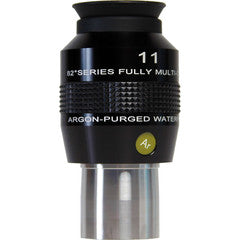
The Explore Scientific 82° Series 11mm is a 1.25-inch barrel wide-field eyepiece with 15.6mm of eye relief and a 15.9mm field stop. Published dimensions are 87mm long and 48mm wide, at 9.8oz; 279g. The barrels are precision-machined metal with flat black internal surfaces to suppress stray light, the glass includes low dispersion types, and the coatings are enhanced multilayer deposition. The body is argon-purged for waterproofing.
11mm is an upper-medium power in most telescopes: 90x in a 988mm refractor, 111x in a 1216mm apochromat, 136x in a 1500mm Maksutov, 68x in a 750mm Newtonian. That is the range where planetary detail, globular cluster resolution and the brighter planetary nebulae all sit.
The 82° apparent field is what separates this from a conventional eyepiece at the same focal length. At 90x the true field is 0.92° — nearly two Moon widths — where a 50° eyepiece at the same magnification would show roughly half that. On an undriven mount that difference is measured in how long a target stays in view before it needs re-centring.
Who It's For
- Dobsonian and undriven-mount users: 0.92° of true field at 90x is drift time, and drift time is what makes high-power observing on a manual mount pleasant rather than fiddly.
- Planetary and lunar observers: 11mm lands in the useful magnification range of almost every aperture, and low dispersion glass with EMD coatings is aimed at the contrast that surface detail depends on.
- Globular cluster and planetary nebula observers: this is the focal length where a globular begins to resolve into stars in a mid-sized telescope.
- Observers who want an immersive view without moving up to a 2-inch eyepiece — at 9.8oz; 279g and 48mm wide it stays a 1.25-inch item.
- Focal extender users: Explore Scientific specifies compatibility with their 2X, 3X and 5X Focal Extenders.
Key Features & Design
- 82° apparent field of view: the field fills enough of the visual field that the edge stops being an obvious frame.
- 15.9mm field stop: the number that fixes the true field — 15.9 divided by telescope focal length, times 57.3.
- 15.6mm eye relief: a workable figure at 11mm, where eye relief is normally the first thing a designer gives up.
- 1.25″ barrel: drops into any 1.25-inch focuser or diagonal, and into a 2-inch focuser with an adapter.
- Precision-machined metal barrels with flat black internal surfaces: internal blackening is what stops a bright object just outside the field from washing contrast out of the one inside it.
- Low dispersion optical glass with enhanced multilayer deposition coatings: both aimed at transmission and colour fidelity across a wide field.
- Argon-purged for waterproofing: an inert internal fill instead of ambient air, so internal fogging is designed out.
- Compatible with Explore Scientific 2X, 3X and 5X Focal Extenders, which turn 11mm into an effective 5.5mm, 3.67mm or 2.2mm.
- Published dimensions: 87mm long, 48mm wide, 9.8oz; 279g.
Recommended Uses
- Lunar and planetary observing at medium to high power.
- Resolving globular clusters and picking out planetary nebulae.
- Splitting double stars where a wide field also keeps the surrounding pattern in view.
- Comet nuclei and small galaxy groups.
- Manual-mount observing at high power, where apparent field converts directly into time on target.
- Solar features with an appropriate front-mounted solar filter fitted to the telescope.
Compatibility and Accessory Notes
- Focuser: 1.25″ barrel, so it fits any 1.25-inch focuser or diagonal. In a 2-inch focuser it needs a 2-inch to 1.25-inch adapter, which we stock.
- Magnification: telescope focal length ÷ 11. A 750mm Newtonian gives 68x; a 1216mm apochromat 111x; a 2000mm SCT 182x.
- True field: 15.9 ÷ focal length × 57.3. A 750mm Newtonian yields 1.21°; a 2000mm SCT 0.46°.
- Exit pupil: 11 ÷ focal ratio. An f/5 Newtonian gives 2.2mm, an f/6.5 refractor 1.69mm, an f/10 SCT 1.1mm.
- Focal extenders: the 2X, 3X and 5X Explore Scientific extenders are specified as compatible. A 2X extender in a 1216mm telescope takes 111x to 222x.
- Weight: 9.8oz; 279g, light enough that balance is rarely affected on any but the smallest tube.
- Filters: Explore Scientific does not publish a filter thread specification for this eyepiece, so that row is absent from the table below rather than estimated.
Good to Know Before You Order
- 15.6mm of eye relief is usable but not generous. Most observers get the full 82° field without difficulty; spectacle wearers who need to keep glasses on sometimes find the field edge cut off. If you observe with glasses, the longer eye relief in the 68° and 72° ED Series is the better match, and we stock both.
- A wide apparent field asks more of the telescope at fast focal ratios. Below about f/5 the outer field of any wide eyepiece shows more of the telescope's own coma, which is a property of the mirror rather than the eyepiece. A coma corrector addresses it, and we stock those.
- 11mm is a medium-high power, so seeing governs the view. On a steady night it shows what the aperture can do; on a turbulent one a longer focal length shows more. That is atmosphere rather than optics.
- Explore Scientific does not publish an element count or a filter thread for this eyepiece, so those rows are absent below rather than estimated. If one of them decides the purchase, ask us and we will put the question to our Explore Scientific rep.
- It is a visual eyepiece. Eyepiece-projection imaging is possible with the right adapter, but the design target is the eye.
Frequently Asked Questions
Is it difficult to set up?
No — it drops straight into any 1.25-inch focuser or diagonal and works immediately. There is nothing to assemble, collimate or adjust.
What magnification will I get?
Divide your telescope's focal length in millimetres by 11. A 1000mm telescope gives 91x.
How much sky does the 82° field actually show?
Divide the 15.9mm field stop by your telescope's focal length and multiply by 57.3. A 1000mm telescope gives 0.91°, close to two Moon widths at 91x.
Will it work with a focal extender?
Yes. Explore Scientific specifies the 2X, 3X and 5X Focal Extenders as compatible. A 2X gives the equivalent of a 5.5mm eyepiece while keeping the 82° apparent field.
Can I use it with glasses on?
15.6mm of eye relief works for many spectacle wearers, though seeing the entire 82° field with glasses is tight. If that is the deciding factor, the longer eye relief of the 68° and 72° ED Series is worth looking at, and we can compare them for you.
How does it compare to the 100° Series?
The 100° is wider and physically much larger; the 82° at 11mm stays a 1.25-inch, 9.8oz eyepiece that any focuser will carry. Which suits you depends on your focuser size and how much weight your mount tolerates — tell us your setup and we will say which fits better.
Bottom Line
In short: an 11mm, 1.25-inch, argon-purged eyepiece with an 82° apparent field, 15.6mm of eye relief and a 15.9mm field stop, at 9.8oz; 279g — medium-high power with enough field to keep a target in view on a manual mount, and specified to work with the 2X, 3X and 5X Focal Extenders. If you would like us to work out where it lands in your telescope alongside the eyepieces you already own, send us the focal length and your current set.
| Item Number | EPWP8211-01 |
|---|---|
| Focal Length | 11mm |
| Apparent Field of View | 82° |
| Length | 87mm |
| Width | 48mm |
| Weight | 9.8oz; 279g |
| Barrel Size | 1.25 |
| Eye Relief | 15.6mm |
| Field Stop Diameter | 15.9mm |
| Housing | Argon-purged, precision-machined metal barrels with flat black internal surfaces |
| Glass and Coatings | Low dispersion optical glass with enhanced multilayer deposition coatings |
| Focal Extender Compatibility | Explore Scientific 2X, 3X and 5X Focal Extenders |
| Lens Elements/ Groups | Not published by vendor |
| Filter Thread | Not published by vendor |
You may also like
Recently viewed
Recent Blog Posts
View all
Your Guide Graph Is Lying to You
Read More
D-Size vs V-Size: A Complete Guide to Telescope Dovetail Systems
Read More
What Is Back Focus in Astrophotography? Telescope Reducers, Flatteners, and Spacing Explained
Read More