
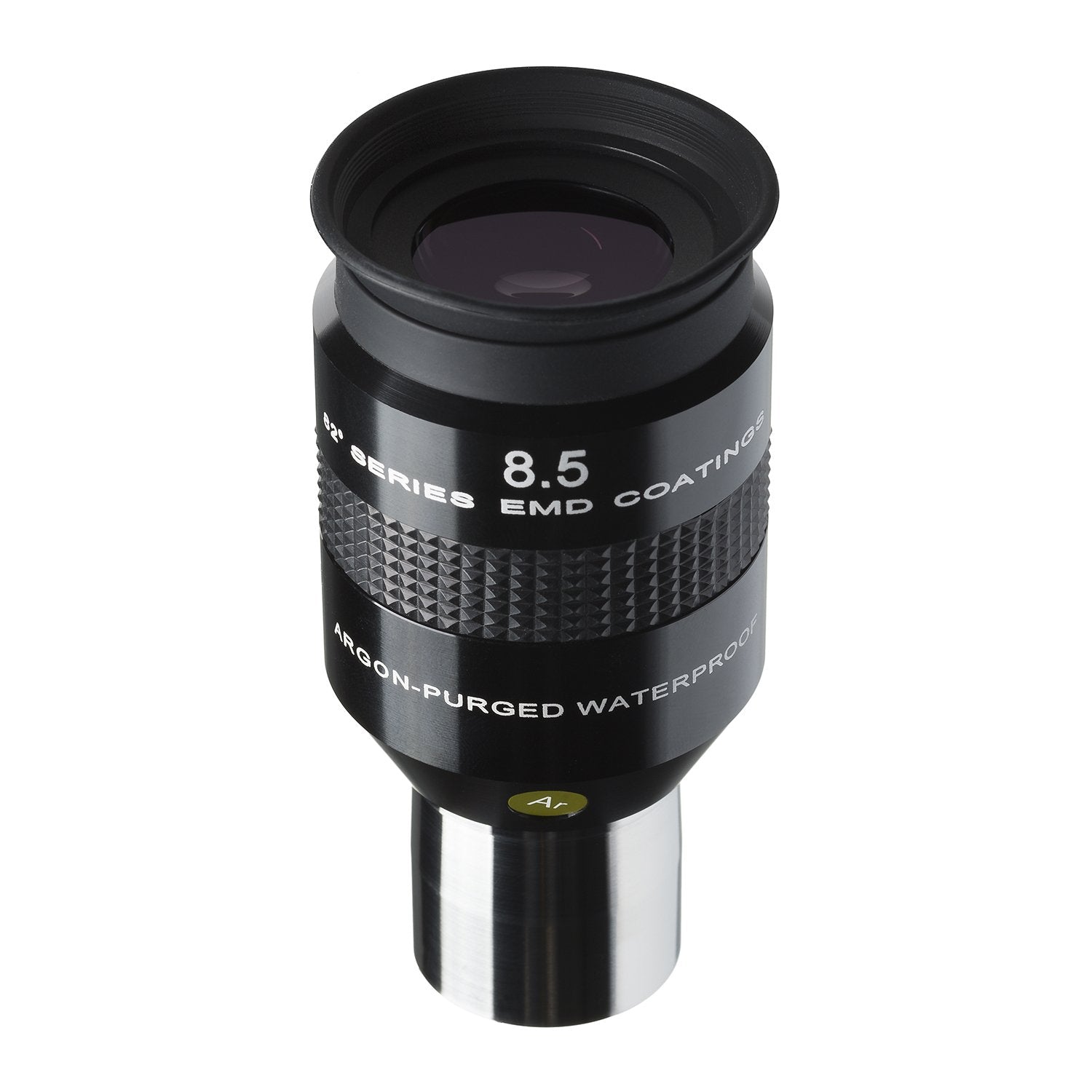

- Description
- Specifications
Product Overview
The Explore Scientific 82° Series LER 8.5mm is a high-magnification eyepiece with an ultra-wide 82° apparent field, built in a 1.25-inch barrel with long eye relief — which is what the LER in the name stands for. Explore Scientific lists 16.3mm of eye relief in its specification table for this eyepiece, and describes the design in its product text as offering roughly 15mm; both figures come from Explore Scientific and both are unusually generous for an 8.5mm focal length.
The eyepiece measures 106mm long and 50mm wide and weighs 9.9oz (280g). At 8.5mm it is squarely a high-power ocular: 97x in an 826mm refractor, 141x in a 1200mm Dobsonian, 235x in a 2000mm SCT. Combining that magnification with 82° of apparent field is the design's whole purpose, because at high power an ultra-wide field is what stops an object crossing the view in seconds.
The housing is O-ring sealed and argon-purged, giving a waterproof body that has no trapped humid air to fog from the inside as the temperature drops, and the optics are multi-coated for contrast at high magnification.
Who It's For
- Lunar and planetary observers: 8.5mm is a working high-power focal length across most apertures, and an 82° field means detail can be studied near the centre without constant renudging.
- Eyeglass wearers observing at high power: eye relief is normally the first casualty at short focal lengths, and the LER design exists specifically to avoid that.
- Dobsonian owners: on an undriven mount, 82° of apparent field at 141x buys meaningfully more drift time than a 52° eyepiece at the same magnification.
- Double-star observers who want magnification without a keyhole view.
- Observers at damp or dewy sites, where the argon-purged sealed housing keeps condensation on the outside where it can be dealt with.
Key Features & Design
- 82° apparent field of view: the classic ultra-wide format, where the field edge sits outside the natural sweep of the eye and the view reads as a window rather than a tube.
- Long eye relief for an 8.5mm: 16.3mm on the Explore Scientific specification table, which is what makes an eyepiece this short usable with glasses.
- 1.25″ barrel: fits any standard 1.25-inch focuser or diagonal directly.
- O-ring sealed, argon gas purged: a waterproof body with an inert fill, so internal fogging has nothing to condense from.
- Multi-coated optics, specified by Explore Scientific for high-magnification observation of the planets, the Moon and deep-sky structure.
- Published dimensions: 106mm long, 50mm wide, 9.9oz (280g) — light enough that a 1.25-inch focuser handles it without rebalancing.
Recommended Uses
- High-power lunar observing, where the wide field lets a whole crater chain stay in view.
- Planetary detail on steady nights.
- Splitting double stars.
- Compact deep-sky targets — planetary nebulae, globular cluster cores, small galaxies.
- High-power observing on an undriven or manually nudged mount.
Compatibility and Accessory Notes
- Fits any 1.25-inch focuser or diagonal. In a 2-inch focuser it goes in through a 2-inch to 1.25-inch adapter, which many 2-inch diagonals already include.
- Magnification: telescope focal length ÷ 8.5. An 826mm refractor gives 97x; a 1200mm Newtonian gives 141x; a 1500mm Maksutov gives 176x; a 2000mm SCT gives 235x.
- Exit pupil: 8.5 divided by focal ratio — 1.8mm at f/4.7 and 0.85mm at f/10. Small exit pupils are normal at high power.
- Focal extenders: pairing an 8.5mm with a 2x extender takes most apertures past the magnification the atmosphere will support on a typical night. A longer focal length is the better partner for an extender.
- Filters: standard 1.25-inch threaded filters are the usual pairing — a neutral density or variable polarising filter for the Moon, colour filters for planetary contrast.
- Balance: at 9.9oz it is a light eyepiece for an 82° design, so swapping it in rarely upsets a telescope's balance.
Good to Know Before You Order
- 8.5mm is a high-power eyepiece, and the atmosphere governs it. On a steady night it will show what your aperture can resolve; on a turbulent one a longer focal length will show more. That is seeing, not optics, and a second longer eyepiece in the bag covers the difference.
- Explore Scientific quotes eye relief two ways for this model — 16.3mm on the specification table and roughly 15mm in the product description. Both are Explore Scientific figures and both are reproduced here as published, and either way it is long for an 8.5mm.
- No field stop diameter, element count or filter thread specification is published for this eyepiece, so those rows are absent from the table below rather than estimated. If one of them matters to your decision, ask and we will put the question to our Explore Scientific contact.
- Ultra-wide fields ask more of fast telescopes. At f/4.7 the outer field of any 82° eyepiece works harder than it does at f/10 — something to weigh if your telescope is a fast Newtonian, and something we can talk through against the alternatives we stock.
- It is a visual eyepiece. Eyepiece-projection imaging is possible with the right adapter, though the design target is the eye.
Frequently Asked Questions
Is it difficult to set up?
No — it drops into any 1.25-inch focuser or diagonal and is ready to use. There is nothing to assemble, collimate or adjust, and at 9.9oz it does not upset the balance of the telescope.
What magnification will I get?
Divide your telescope's focal length in millimetres by 8.5. A 1000mm telescope gives 118x and a 1200mm gives 141x.
What does LER mean?
Long eye relief. Short focal length eyepieces normally place the eye very close to the top lens; this design holds it further back, which is what makes it comfortable and what makes observing with glasses on practical at 8.5mm.
Can I observe with glasses on?
Yes, and that is the point of the design. Explore Scientific publishes 16.3mm of eye relief on its specification table, which is long enough for spectacles at this focal length.
How does it compare with the 100° Series?
The 100° goes further on apparent field and is a considerably larger, heavier 2-inch eyepiece; the 82° LER is a light 1.25-inch design built around eye relief. If you tell us your telescope and what you observe, we will give you a straight comparison.
Does it take filters?
Standard 1.25-inch threaded filters are the usual pairing. Explore Scientific does not publish the thread specification for this model, so if a particular filter is already in your case, send us the make and we will check it against the eyepiece first.
Is 82° noticeable compared with 68°?
Yes — the field edge moves outside the eye's natural sweep, so instead of looking at a circle you are looking into a scene. At high power it also means considerably longer before an object drifts out on an undriven mount.
Bottom Line
In short: a 280g, argon-purged 8.5mm eyepiece with an 82° apparent field, a 1.25-inch barrel and long eye relief on a focal length that usually has none — high magnification you can settle into rather than squint through. If you would like help pairing it with a longer focal length for nights when the seeing does not cooperate, send us your telescope's focal length and we will suggest one.
| Item Number | EPWP8285LE-01 |
|---|---|
| Apparent Field of View | 82° |
| Focal Length | 8.5mm |
| Length | 106mm |
| Width | 50mm |
| Weight | 9.9oz; 280g |
| Barrel Size | 1.25" |
| Eye Relief | 16.3mm |
| Waterproof | O-ring sealed, argon gas purged |
| Coatings | Multi-coated |
| Field Stop Diameter | Not published by vendor |
| Lens Elements/Groups | Not published by vendor |
| Filter Thread | Not published by vendor |
You may also like
Recently viewed
Recent Blog Posts
View all
Your Guide Graph Is Lying to You
Read More

D-Size vs V-Size: A Complete Guide to Telescope Dovetail Systems
Read More

What Is Back Focus in Astrophotography? Telescope Reducers, Flatteners, and Spacing Explained
Read More