


- Description
- Specifications
Product Overview
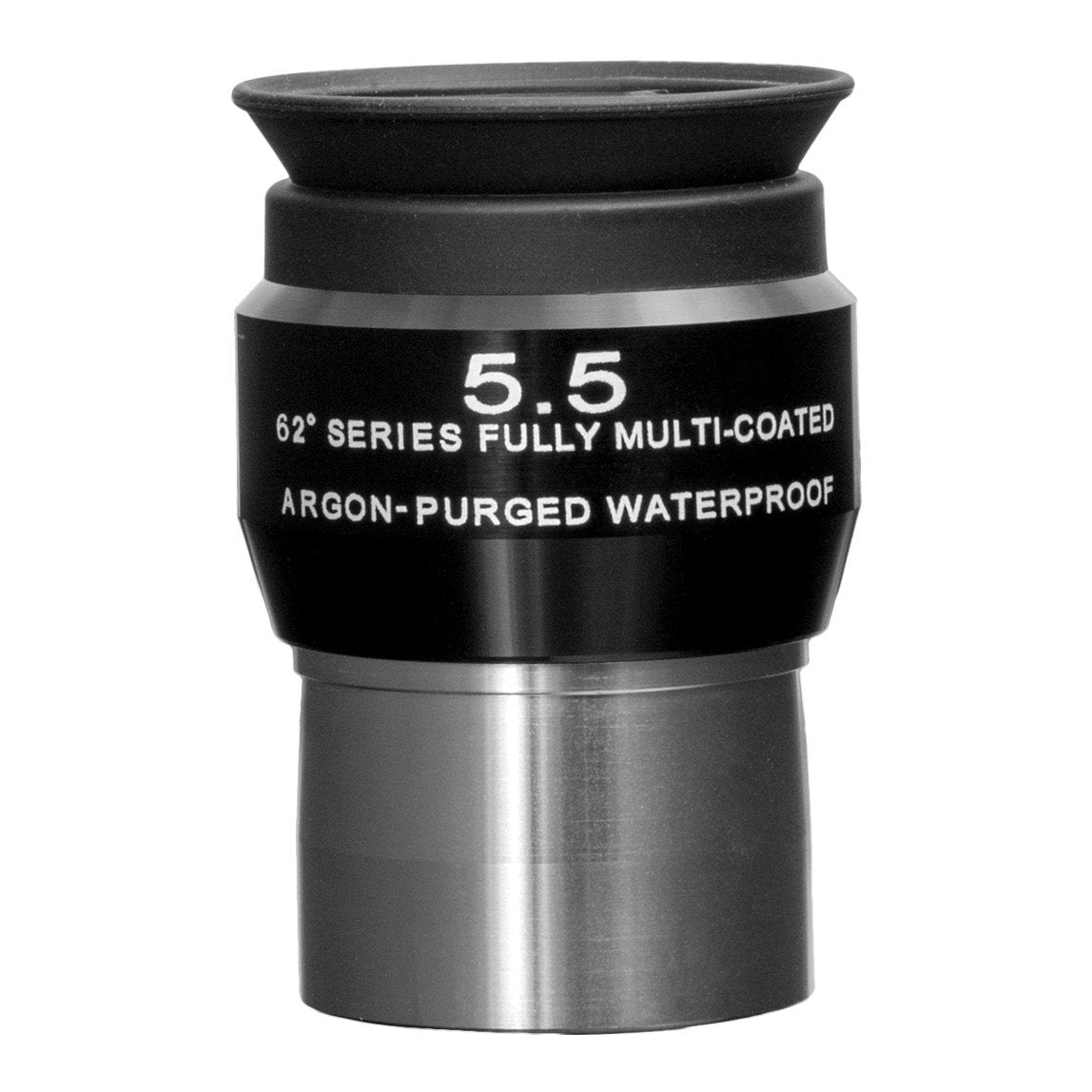
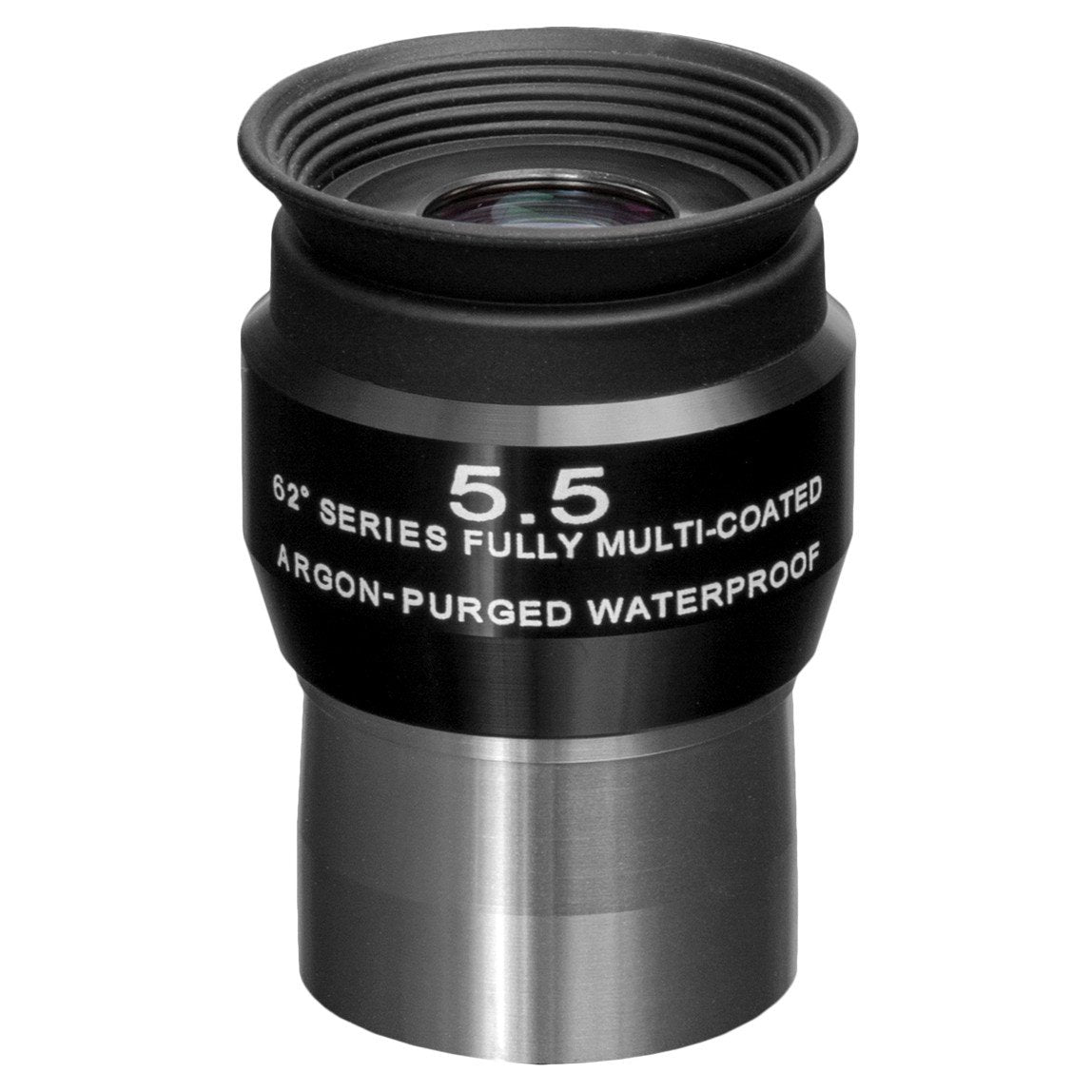
The Explore Scientific 62° Series 5.5mm is a short focal length, argon-purged waterproof eyepiece on a 1.25-inch barrel. Explore Scientific publishes 12.9mm of eye relief for it, and gives the body as 57.5mm long and 38mm across — a compact eyepiece that does not unbalance a small refractor or a lightweight alt-azimuth head.
At 5.5mm this is the high-power end of a focal-length set. In a 480mm f/6 refractor it gives 87x, in a 1000mm telescope 182x, and in a 1400mm Maksutov 255x. The 62° apparent field sits between the flat, conservative 52° designs and the wide 68° and 82° series — enough width that a planet at high power stays in view for a workable stretch on an undriven mount, without asking as much of the outer field as a 100° design does.
The series is described by Explore Scientific as near-parfocal, so moving between focal lengths within the 62° range takes only a small focus correction rather than a full refocus.
Who It's For
- Planetary observers: 5.5mm lands in the range where the Jovian belts, the Cassini division and the Martian polar cap become the subject rather than a hint.
- Lunar observers working at high power along the terminator, where the contrast between lit and shadowed terrain is at its strongest.
- Double-star observers: high magnification widens the apparent separation of a close pair, and a 62° field keeps the pair on view between looks.
- Short-focus telescope owners: in a fast refractor a 5.5mm is the eyepiece that finally reaches planetary magnification — 87x in a 480mm f/6, 136x in a 750mm.
- Observers in damp conditions: the argon-purged, sealed housing is built for dew, humidity and night-long temperature swings.
Key Features & Design
- 5.5mm focal length: a high-power eyepiece in almost any telescope it is used in.
- 62° apparent field of view: wider than a Plössl, narrower and easier on the outer field than the 82° and 100° designs.
- 12.9mm eye relief, which at a 5.5mm focal length is more than a simple design of the same power would give — short eyepieces are where eye relief is normally sacrificed first.
- Argon-purged, waterproof housing: dry inert gas inside the sealed body will not condense on internal surfaces the way trapped humid air does.
- 1.25-inch barrel: drops into any 1.25-inch focuser or diagonal without an adapter.
- 57.5mm long and 38mm wide: small and light enough that it changes nothing about how a telescope balances.
- Near-parfocal across the 62° Series, so a set behaves consistently when you swap between focal lengths in the dark.
- Flat-field multi-element design aimed at contrast, which is what supports averted vision on faint targets.
Recommended Uses
- High-power lunar and planetary observing.
- Splitting close double stars.
- Small, bright deep-sky targets — planetary nebulae, globular cluster cores, compact galaxies.
- Observing from a light-polluted site, where high magnification darkens the sky background against the object.
- Filling the short end of a matched 62° Series set.
Compatibility and Accessory Notes
- Fits any 1.25-inch focuser or diagonal directly. In a 2-inch focuser it goes in with a 2-inch to 1.25-inch adapter, which we stock.
- Magnification: telescope focal length divided by 5.5. A 900mm Newtonian gives 164x; a 1400mm Maksutov gives 255x.
- Exit pupil: 5.5 divided by your telescope's focal ratio. In an f/6 that is 0.92mm, in an f/10 0.55mm — small pupils, which is normal at this magnification.
- Filters: standard 1.25-inch threaded filters are the usual pairing — a lunar or neutral-density filter for the Moon, colour filters for planetary detail.
- Focal extenders: a 5.5mm is already at the high-power end, so adding a 2x or 3x extender pushes past what most apertures can use. Longer focal lengths in the series pair better with an extender, and we can suggest a combination that keeps you inside your telescope's useful range.
Good to Know Before You Order
- Explore Scientific does not publish a field stop diameter or a weight for this eyepiece. Those rows read as unpublished below rather than being estimated. The true field can still be worked out closely from the 62° apparent field divided by your magnification, and if you need the field stop figure itself we will put the question to our Explore Scientific rep.
- Atmospheric seeing governs a 5.5mm eyepiece. On a steady night it shows what your aperture can resolve; on a turbulent night a longer focal length will show more detail. That is the air rather than the optics, and it is why a 5.5mm belongs in a set rather than on its own.
- 12.9mm of eye relief is workable but not generous. Observing with glasses on is possible for some prescriptions and tight for others; the 68° Series 40mm and other long-eye-relief designs carry considerably more if that is the deciding factor, and we are happy to compare them for you.
- The exit pupil is small at this focal length, so floaters in your own eye can become visible. That is a normal effect of high magnification in any eyepiece rather than anything happening in the glass.
- It is a visual eyepiece. Eyepiece-projection imaging is possible with the right adapter, and we can supply one, though the design target here is the eye.
Frequently Asked Questions
Is it difficult to set up?
No — it drops straight into any 1.25-inch focuser or diagonal and is ready to use. There is nothing to assemble, collimate or adjust, and no maintenance between sessions beyond keeping the caps on.
What magnification will I get?
Divide your telescope's focal length in millimetres by 5.5. A 1000mm telescope gives 182x, a 1200mm gives 218x.
Is 5.5mm too much magnification for my telescope?
It depends on aperture and on the night. A rough practical ceiling is about twice the aperture in millimetres, so a 100mm telescope tops out near 200x — 5.5mm sits comfortably inside that at 1400mm focal length and beyond it in a very long-focus instrument. Tell us your aperture and focal length and we will work out where it lands.
Can I use filters with it?
Yes. Standard 1.25-inch threaded filters thread into the base of the barrel — lunar, neutral density, colour and narrowband.
What does argon purging actually do?
The sealed body is filled with dry argon instead of ordinary air. With no moisture inside, the internal surfaces have nothing to fog with when the temperature drops through the night.
How does the 62° field compare to a Plössl?
A Plössl typically shows about 50 degrees. The extra 12 degrees here reads as a noticeably larger window, and it buys drift time at high power on an undriven mount, which is where it matters most.
Bottom Line
In short: a 5.5mm argon-purged waterproof eyepiece with a 62° apparent field, 12.9mm of eye relief and a 1.25-inch barrel, in a compact 57.5mm body — the high-power end of a near-parfocal series built around contrast. If you would like help working out which focal lengths would round out your set for the telescope you own, send us its aperture and focal length and we will map it out with you.
| Description | 5.5mm 62° Series Argon-Purged Waterproof Eyepiece |
|---|---|
| Item Number | EPWP6255LE-01 |
| Focal Length | 5.5mm |
| Apparent Field of View | 62° |
| Length | 57.5mm |
| Width | 38mm |
| Barrel Size | 1.25 |
| Eye Relief | 12.9mm |
| Weight | Not published by vendor |
| Field Stop Diameter | Not published by vendor |
| Element Count | Not published by vendor |
| Waterproofing | Argon-purged, waterproof |
You may also like
Recently viewed
Recent Blog Posts
View all
Your Guide Graph Is Lying to You
Read More

D-Size vs V-Size: A Complete Guide to Telescope Dovetail Systems
Read More

What Is Back Focus in Astrophotography? Telescope Reducers, Flatteners, and Spacing Explained
Read More