


- Description
- Specifications
Product Overview
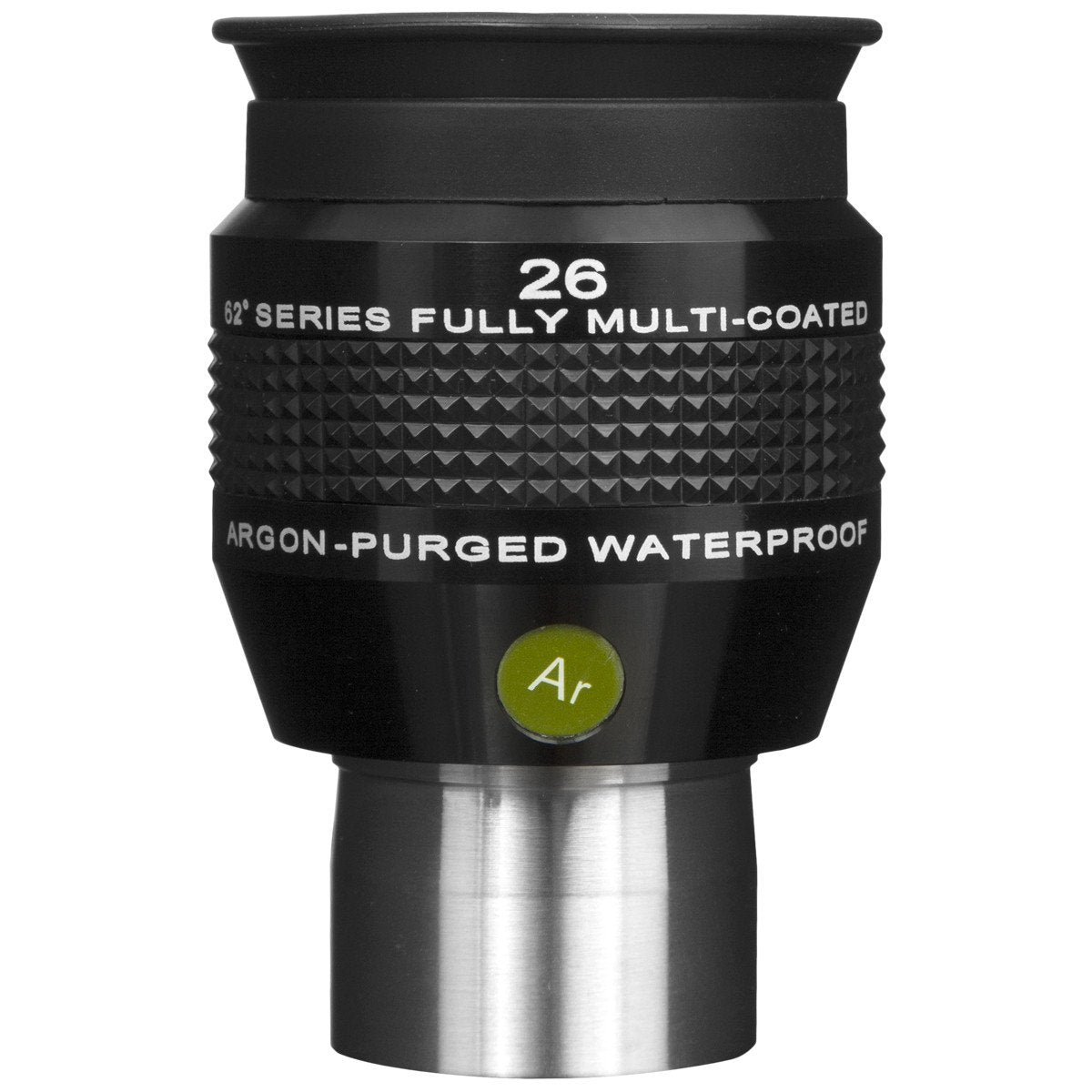
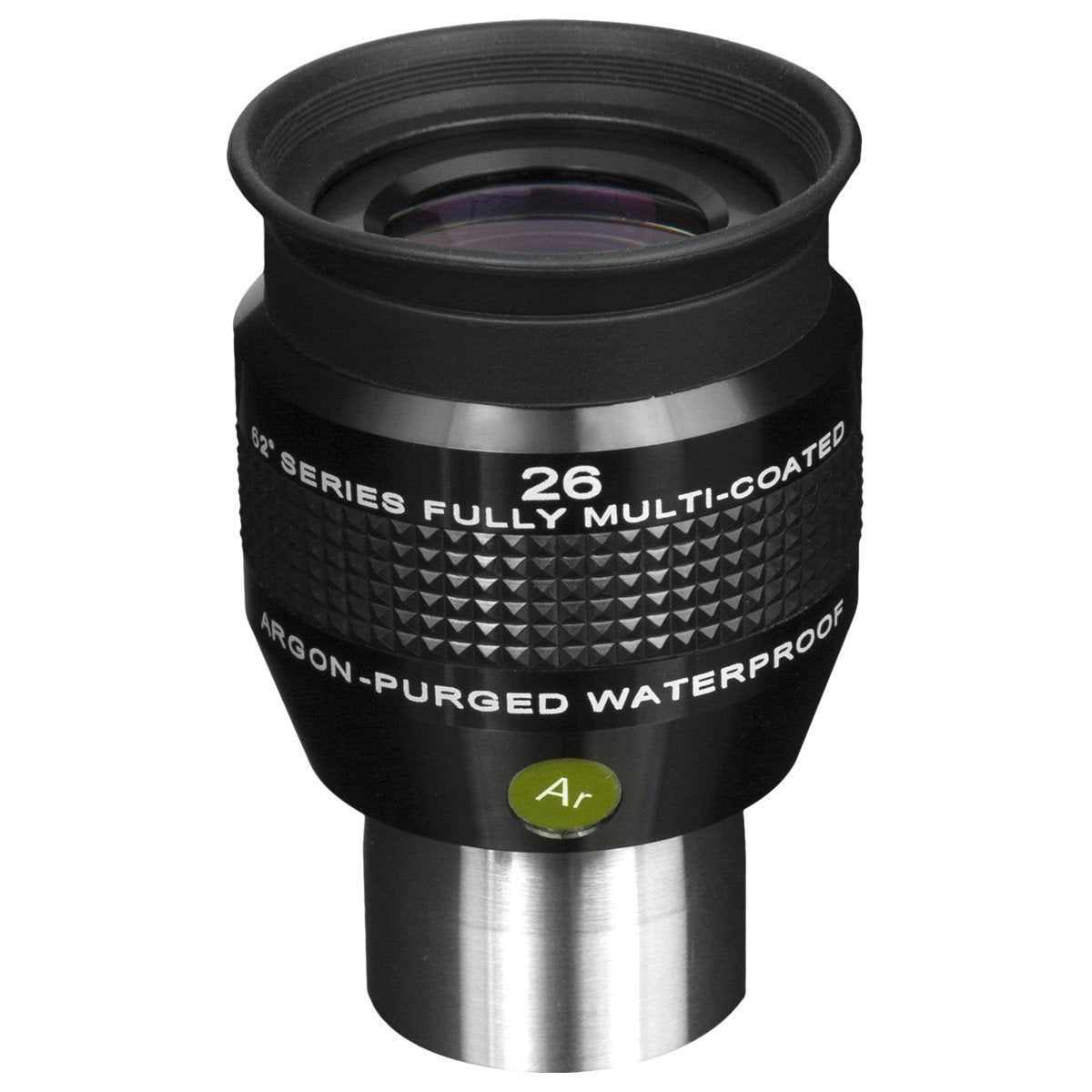
The Explore Scientific 62° Series 26mm is a low-power, wide-field eyepiece in an argon-purged waterproof housing with a 1.25-inch barrel. Explore Scientific publishes a 62° apparent field, 19.3mm of eye relief and a 27.3mm field stop, in a body 76mm long and 50mm wide weighing 8.2oz (323.47g).
That 27.3mm field stop is the figure to pay attention to. The clear aperture of a 1.25-inch barrel puts a hard ceiling of roughly 27mm on how much sky any 1.25-inch eyepiece can pass, so at 26mm and 62° this eyepiece is sitting at the physical limit of the format. There is no wider true field available in a 1.25-inch barrel — going wider means going to 2 inches.
Explore Scientific describes the series as near-parfocal with a flat field, which means swapping between focal lengths in the range needs little or no refocusing, and star images hold their shape from the centre out toward the edge. The 19.3mm of eye relief is generous for the format and makes observing with eyeglasses on practical.
Who It's For
- Deep-sky observers who want the widest true field a 1.25-inch focuser can deliver — large open clusters, the Pleiades, the sword of Orion, sweeping along the Milky Way.
- Dobsonian owners: a wide low-power field is what makes finding and framing objects on an undriven mount workable, and it buys drift time between nudges.
- Eyeglass wearers: 19.3mm of eye relief takes in the full 62° field with spectacles in place.
- Observers assembling a matched set: the near-parfocal design means changing focal lengths within the series barely disturbs focus.
- Anyone observing in dew: the sealed, gas-purged construction is built for damp nights.
- Owners of telescopes with 1.25-inch focusers who want maximum field without moving to a 2-inch focuser and diagonal.
Key Features & Design
- 26mm focal length with a 62° apparent field: a genuinely wide low-power view, noticeably more open than a 50° Plössl of the same focal length.
- 27.3mm field stop: effectively the maximum a 1.25-inch barrel can pass, which is what makes this the widest true field in the format.
- 19.3mm eye relief: long enough for comfortable extended sessions and for observing with glasses on.
- Flat-field optics: Explore Scientific specifies strong contrast and image quality held across the field rather than only at centre.
- Near-parfocal within the series, so focal length changes need minimal refocusing.
- Waterproof, argon-purged construction consistent with the sealed Explore Scientific waterproof eyepiece range.
- 1.25″ barrel fitting any standard focuser or diagonal.
- Published dimensions: 76mm long, 50mm wide, 8.2oz (323.47g).
Recommended Uses
- Low-power sweeping of the Milky Way and large open clusters.
- Locating targets before switching to a higher-power eyepiece — the wide field makes the initial find far easier.
- Large emission nebulae, particularly with a narrowband or UHC filter in the barrel.
- Undriven Dobsonian and alt-azimuth observing, where field width converts directly into time on target.
- Comfortable long sessions and outreach nights where observers cycle through the eyepiece quickly.
Compatibility and Accessory Notes
- Fits any 1.25-inch focuser or diagonal. In a 2-inch focuser it takes a 2-inch to 1.25-inch adapter.
- Magnification: telescope focal length ÷ 26. A 714mm refractor gives 27x, a 1200mm SCT gives 46x, a 1500mm Dobsonian gives 58x.
- True field: 27.3mm field stop ÷ telescope focal length × 57.3. In a 714mm telescope that works out to about 2.2°; in a 1200mm telescope about 1.3°.
- Exit pupil: 26mm ÷ the telescope's focal ratio. In an f/5 instrument that is 5.2mm, which suits a dark site well; in an f/10 instrument it is 2.6mm.
- Filters: Explore Scientific does not publish the filter thread specification for this eyepiece, so we are not quoting one. If you plan to run a UHC or O-III filter in it, ask us and we will confirm the thread with our rep first.
- Within the range: the near-parfocal design across the 62° Series means a set holds focus and eye position from one focal length to the next.
Good to Know Before You Order
- 26mm is close to the practical ceiling for a 1.25-inch eyepiece. A longer focal length in this barrel size would show a larger exit pupil but no more sky, because the 27.3mm field stop is already at the limit of what the barrel passes. If you want a wider true field than this, a 2-inch eyepiece is the route, and we stock those.
- In a fast telescope the exit pupil gets large. At f/4 a 26mm eyepiece produces a 6.5mm exit pupil, which can exceed the dilated pupil of an older eye and effectively waste part of the aperture. A shorter focal length restores it, and we can suggest one for your focal ratio.
- Explore Scientific does not publish the element count, coating specification or filter thread for this model, so those rows read "Not published by vendor" below rather than carrying an estimate. If one of them matters to your decision, ask and we will confirm it with our rep.
- Under bright suburban skies a large exit pupil shows the sky glow as well as the target. That is site conditions rather than optics, and a light-pollution or narrowband filter is the usual answer.
- At 8.2oz it is a moderate weight for a 1.25-inch eyepiece, which is worth a thought on a small refractor where balance shifts easily. Rebalancing the tube in its rings takes a moment and settles it.
Frequently Asked Questions
Is it difficult to set up?
No — it drops into any 1.25-inch focuser or diagonal and is ready to use. Nothing to assemble, collimate or adjust.
What magnification will I get?
Divide your telescope's focal length in millimetres by 26. A 1000mm telescope gives 38x.
How much sky will I actually see?
Take the 27.3mm field stop, divide by your telescope's focal length and multiply by 57.3. In a 900mm telescope that is about 1.7° — roughly three and a half lunar diameters.
Is it better than a 25mm Plössl?
It shows a wider apparent field at 62° against roughly 50°, carries substantially more eye relief at 19.3mm, and is sealed against moisture. Whether that is worth the difference depends on how you observe, and we are happy to talk it through.
Can I use it with glasses on?
Yes. 19.3mm of eye relief is enough to take in the whole field with spectacles in place.
Will it fit a 2-inch focuser?
With a 2-inch to 1.25-inch adapter, yes. Many 2-inch diagonals include one.
Is it good for a Dobsonian?
It is one of the more useful focal lengths for one. The wide field makes finding objects manageable without a driven mount, and a target stays in view longer between nudges.
Bottom Line
In short: a 26mm waterproof eyepiece with a 62° apparent field, 19.3mm of eye relief and a 27.3mm field stop that sits at the physical limit of the 1.25-inch format — the widest true field the barrel size allows, in a sealed body that handles dew. If you would like help pairing it with the focal lengths you already own, send us your telescope's focal length and what is in your case and we will work it out with you.
| Description | 26mm 62° Series Argon-Purged Waterproof Eyepiece |
|---|---|
| Item Number | EPWP6226LE-01 |
| Focal Length | 26mm |
| Apparent Field of View | 62° |
| Length | 76mm |
| Width | 50mm |
| Weight | 8.2oz; 323.47g |
| Barrel Size | 1.25 |
| Eye Relief | 19.3mm |
| Field Stop Diameter | 27.3mm |
| Lens Elements/Groups | Not published by vendor |
| Coatings | Not published by vendor |
| Filter Thread | Not published by vendor |
You may also like
Recently viewed
Recent Blog Posts
View all
Your Guide Graph Is Lying to You
Read More

D-Size vs V-Size: A Complete Guide to Telescope Dovetail Systems
Read More

What Is Back Focus in Astrophotography? Telescope Reducers, Flatteners, and Spacing Explained
Read More