


- Description
- Specifications
Product Overview
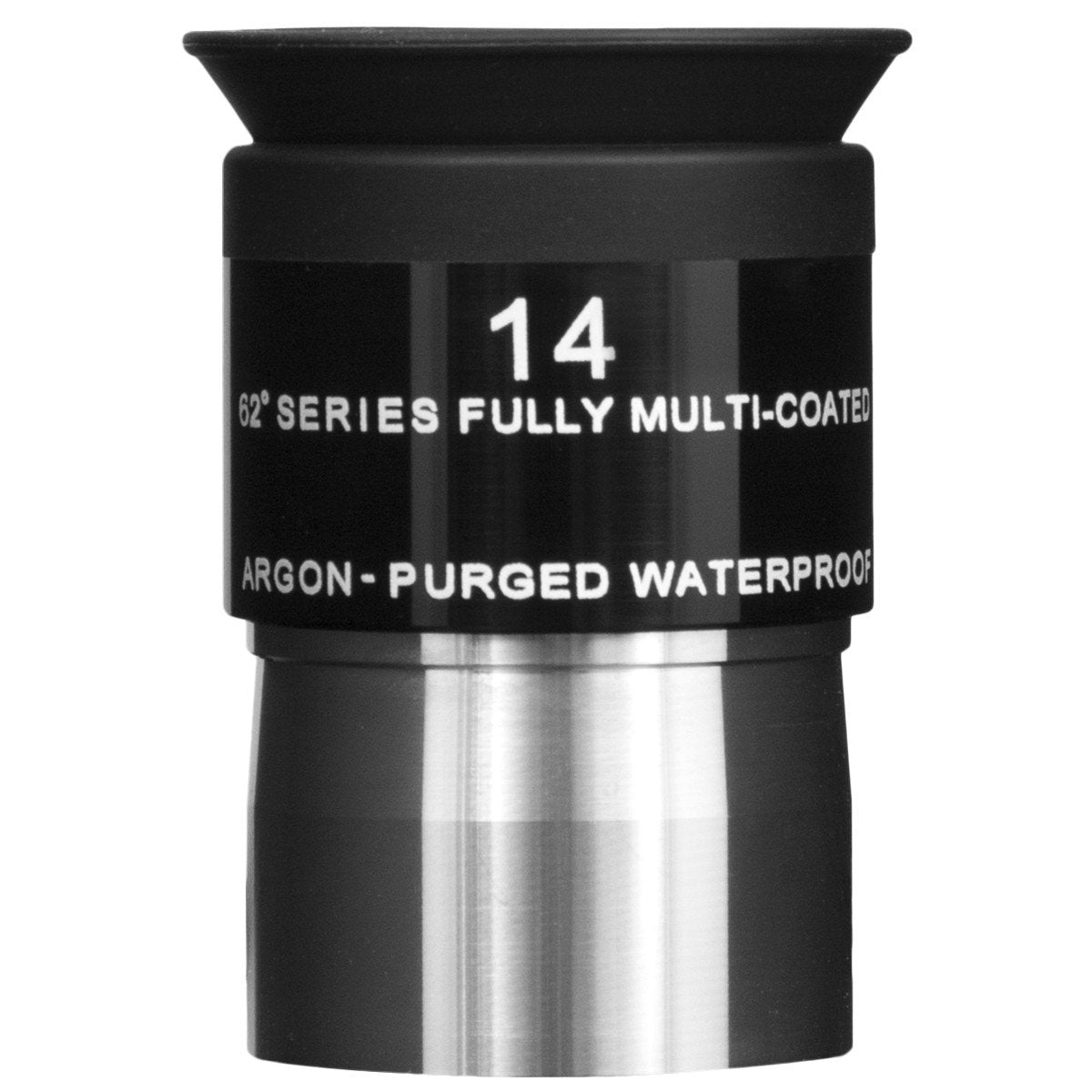
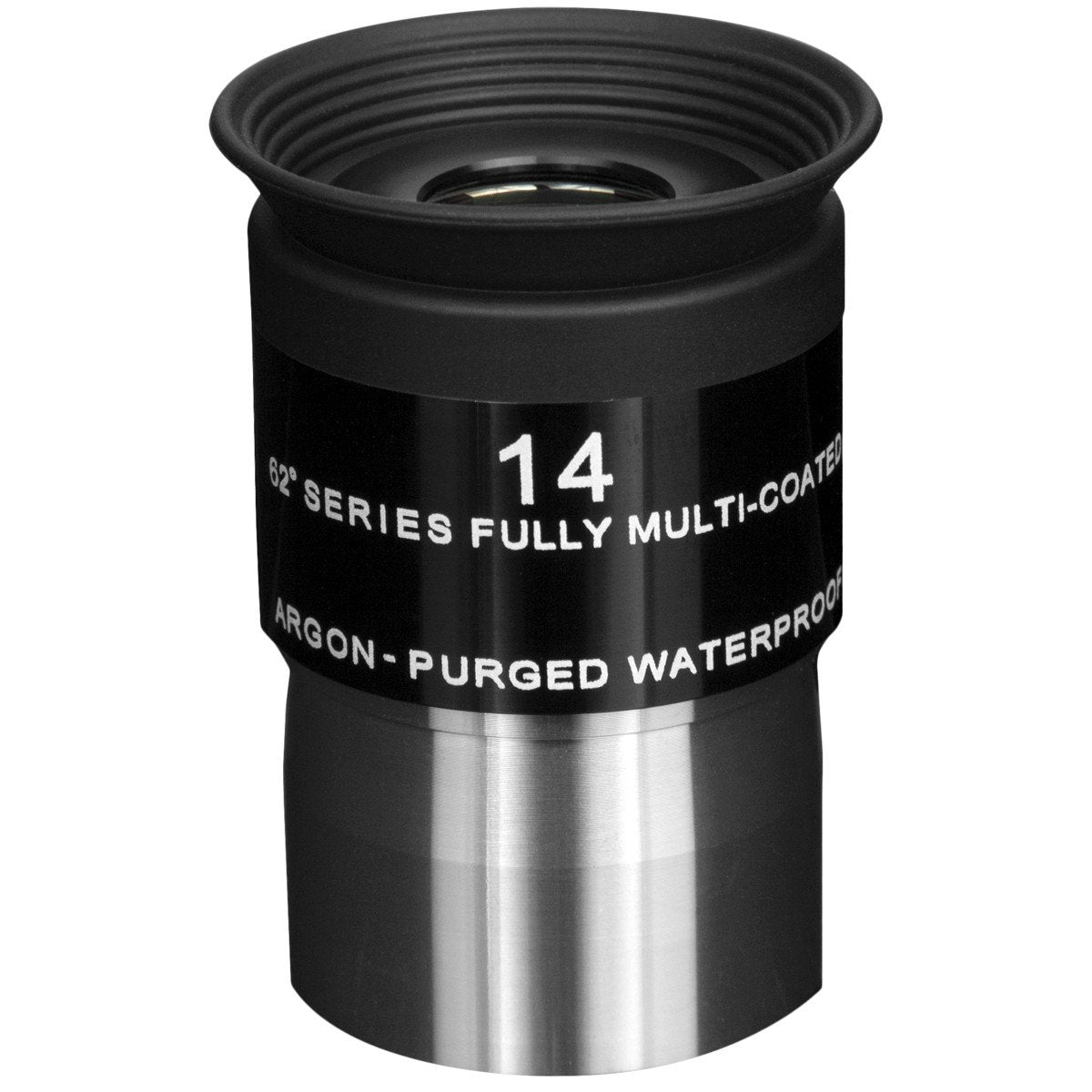
The Explore Scientific 62° Series 14mm is a multi-element waterproof eyepiece with a 62-degree apparent field of view, built near-parfocal with the rest of its series. It carries item number EPWP6214LE-01.
Fourteen millimetres is a medium-power focal length, and that is the whole point of it. In a 1000mm telescope it gives 71x; in a 750mm Newtonian, 54x; in a 1900mm Maksutov, 136x; in a 988mm refractor, 71x. That band — roughly fifty to a hundred and forty times, depending on the instrument — is where most deep-sky observing actually happens. It is high enough to darken the sky background and pull a globular cluster apart into stars, and low enough that the exit pupil stays comfortable and the object does not race across the field on an undriven mount.
The 62-degree apparent field is a genuinely useful width without being an ultra-wide design. Explore Scientific make a specific point about it: the field is wide enough, and the contrast clean enough, that you can look slightly to one side of a faint object and let averted vision do its work. That is not marketing so much as physiology — the rods that detect faint light sit away from the centre of the retina, so a faint galaxy or nebula appears when you look beside it rather than at it. An eyepiece that keeps the field clean out to the edge is what makes that technique usable.
Who It's For
- Deep-sky observers working at medium power: galaxies, globular clusters and the brighter nebulae all respond well in the magnification band a 14mm produces in most telescopes.
- Observers building a matched set: the near-parfocal construction means swapping between focal lengths in the series takes a touch of the focuser rather than a full refocus.
- Anyone who uses averted vision: a clean 62-degree field gives you somewhere to put your gaze while the target stays comfortably inside the view.
- Observers in damp climates: the waterproof housing is built for dew-heavy nights and coastal air.
- Lunar observers who like the whole disc: at 71x in a metre-focal-length telescope the Moon sits within a 62-degree field with room around it.
Key Features & Design
- 14mm focal length: the medium-power slot in an eyepiece set — 71x in a 1000mm telescope, 136x in a 1900mm one.
- 62° apparent field of view: wider than a Plössl's typical fifty degrees, without the outer-field demands of an 82° or 100° design.
- Multi-element optical design: more than the four elements of a simple Plössl, which is what allows a wider field to stay corrected.
- Near-parfocal within the series: changing focal length inside the 62° Series calls for only a small focus correction, which keeps a target in view during the swap.
- Waterproof housing: sealed against dew, damp air and the accidental soaking that comes with observing outdoors.
- Contrast optimised for faint targets: Explore Scientific describe the design around detecting dim objects with averted vision, which is a contrast and scatter question more than a magnification one.
Recommended Uses
- Medium-power deep-sky observing — open clusters, globulars, brighter galaxies and emission nebulae.
- Full-disc lunar observing in telescopes around a metre of focal length.
- Working through a Messier list, where 14mm is often the first eyepiece tried on a new object.
- Observing on an undriven or Dobsonian mount, where a wider apparent field buys drift time between nudges.
- Damp-site and coastal observing where a sealed eyepiece holds up better than an unsealed one.
Compatibility and Accessory Notes
- Magnification: telescope focal length divided by 14. A 650mm tube gives 46x, a 1200mm SCT gives 86x, a 1900mm Maksutov gives 136x.
- Exit pupil: 14 divided by the telescope's focal ratio. In an f/5 instrument that is 2.8mm; in an f/10 it is 1.4mm. Both sit in the range where the eye works comfortably on deep-sky targets.
- Within the series: the near-parfocal design is a real convenience when several focal lengths from the 62° Series share a case — the view stays close to focus through a swap.
- Filters: threaded filters attach to the bottom of an eyepiece barrel, and the thread that fits follows from the barrel size. Explore Scientific does not state the barrel size for this model on their page, so we would rather check it for you than have you order a filter that does not thread on.
- Focal extenders: a 2x extender turns a 14mm into an effective 7mm, which is a straightforward way to add a high-power step without buying a second eyepiece.
Good to Know Before You Order
- Explore Scientific does not publish a specification table for this eyepiece. Barrel size, eye relief, field stop diameter, element count, coating specification and weight are all absent from their product page, so those rows read as unpublished here rather than carrying an estimate. If one of them decides it for you — barrel size and eye relief being the two that usually do — ask us and we will put the question to our Explore Scientific rep and give you their answer.
- 62 degrees is a moderate wide field, not an ultra-wide one. It buys a noticeably roomier view than a Plössl and is easier on the eye position than the widest designs. Observers chasing full immersion look at the 82° and 100° Series instead, and we stock both.
- It is a visual eyepiece. Eyepiece-projection imaging is possible with the right adapter, but the design target is the eye at the eyepiece.
- Waterproof means sealed against weather rather than built for submersion in use. The practical benefit is that dew on the outside of the eyepiece wipes off and nothing has migrated inside.
Frequently Asked Questions
Is it difficult to set up?
No. It slides into the focuser or diagonal, the thumbscrew tightens, and it is working. There is nothing to assemble, collimate or power.
What magnification will I get?
Divide your telescope's focal length in millimetres by 14. A 1000mm telescope gives 71x, a 1500mm gives 107x.
What does near-parfocal mean in practice?
Eyepieces in the same series come to focus at close to the same point, so swapping from one focal length to another needs only a small turn of the focuser instead of hunting for focus again in the dark.
Will it fit my focuser?
Explore Scientific does not publish the barrel size for this model, so we would rather check it with them than tell you something we cannot verify. Send us a note with your focuser size and we will confirm the fit before you order.
How does it compare with a Plössl of the same focal length?
The apparent field is wider — 62 degrees against roughly 50 — and the multi-element design is what makes that width possible while keeping the outer field usable. At the same magnification you simply see more sky at once.
Is the waterproofing worth anything in normal use?
On a dewy night, yes. A sealed eyepiece can be wiped dry and put back to work, and repeated cycles of damp and cold do not gradually fog the interior the way they can with an unsealed housing.
Bottom Line
In short: a 14mm eyepiece with a 62-degree apparent field, near-parfocal with its series and sealed against weather — the medium-power slot in a set, aimed at faint objects and averted vision. Explore Scientific keeps the detailed figures for this one off their page; if you need one of them before ordering, ask and we will get it from them for you.
| Description | 62° Series 14mm Waterproof Eyepiece |
|---|---|
| Item Number | EPWP6214LE-01 |
| Focal Length | 14mm |
| Apparent Field of View | 62° |
| Construction | Multi-element, near-parfocal within the series |
| Housing | Waterproof |
| Barrel Size | Not published by vendor |
| Eye Relief | Not published by vendor |
| Field Stop Diameter | Not published by vendor |
| Element Count | Not published by vendor |
| Coatings | Not published by vendor |
| Weight | Not published by vendor |
| In the Box | Eyepiece only — no additional accessories listed by vendor |
You may also like
Recently viewed
Recent Blog Posts
View all
Your Guide Graph Is Lying to You
Read More

D-Size vs V-Size: A Complete Guide to Telescope Dovetail Systems
Read More

What Is Back Focus in Astrophotography? Telescope Reducers, Flatteners, and Spacing Explained
Read More