
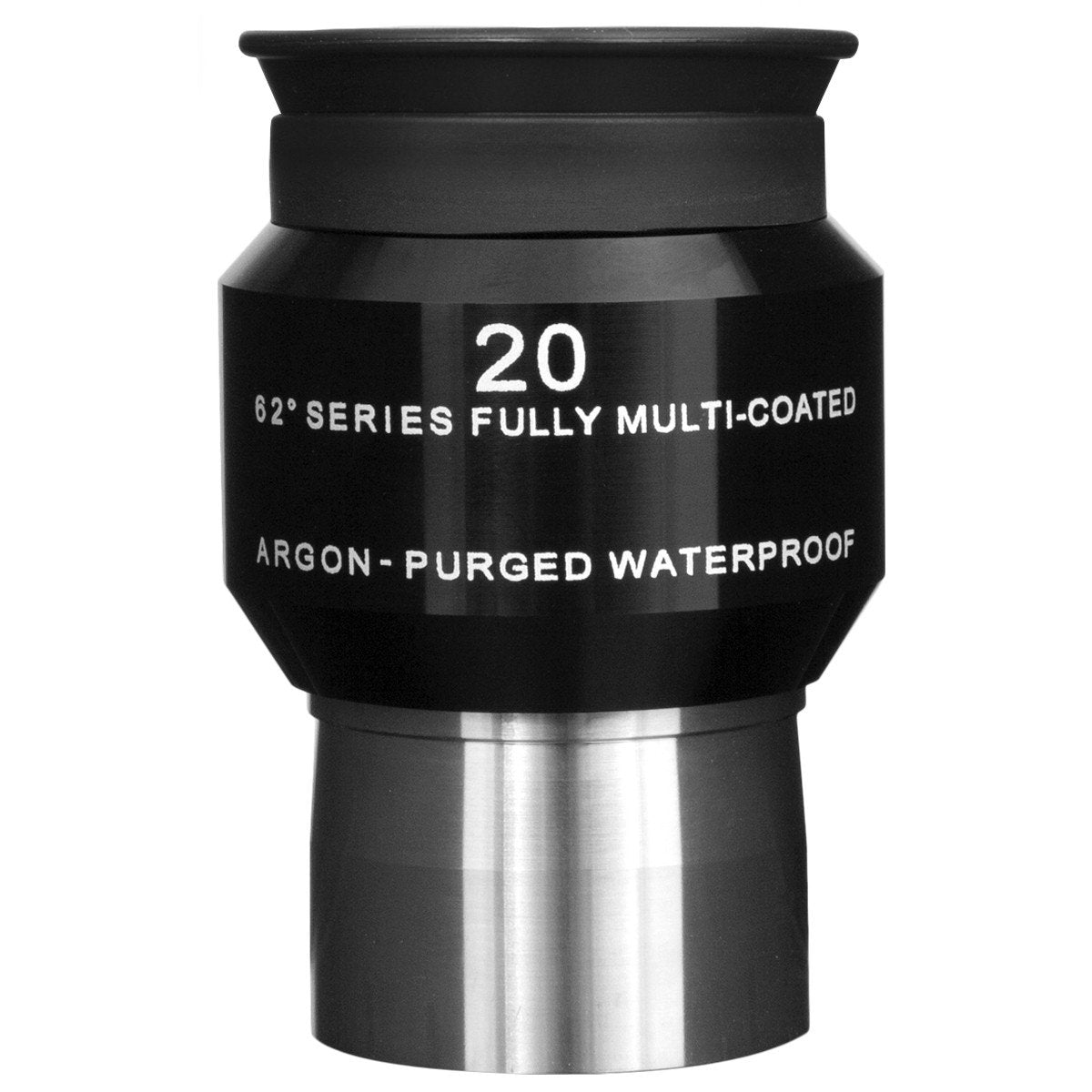
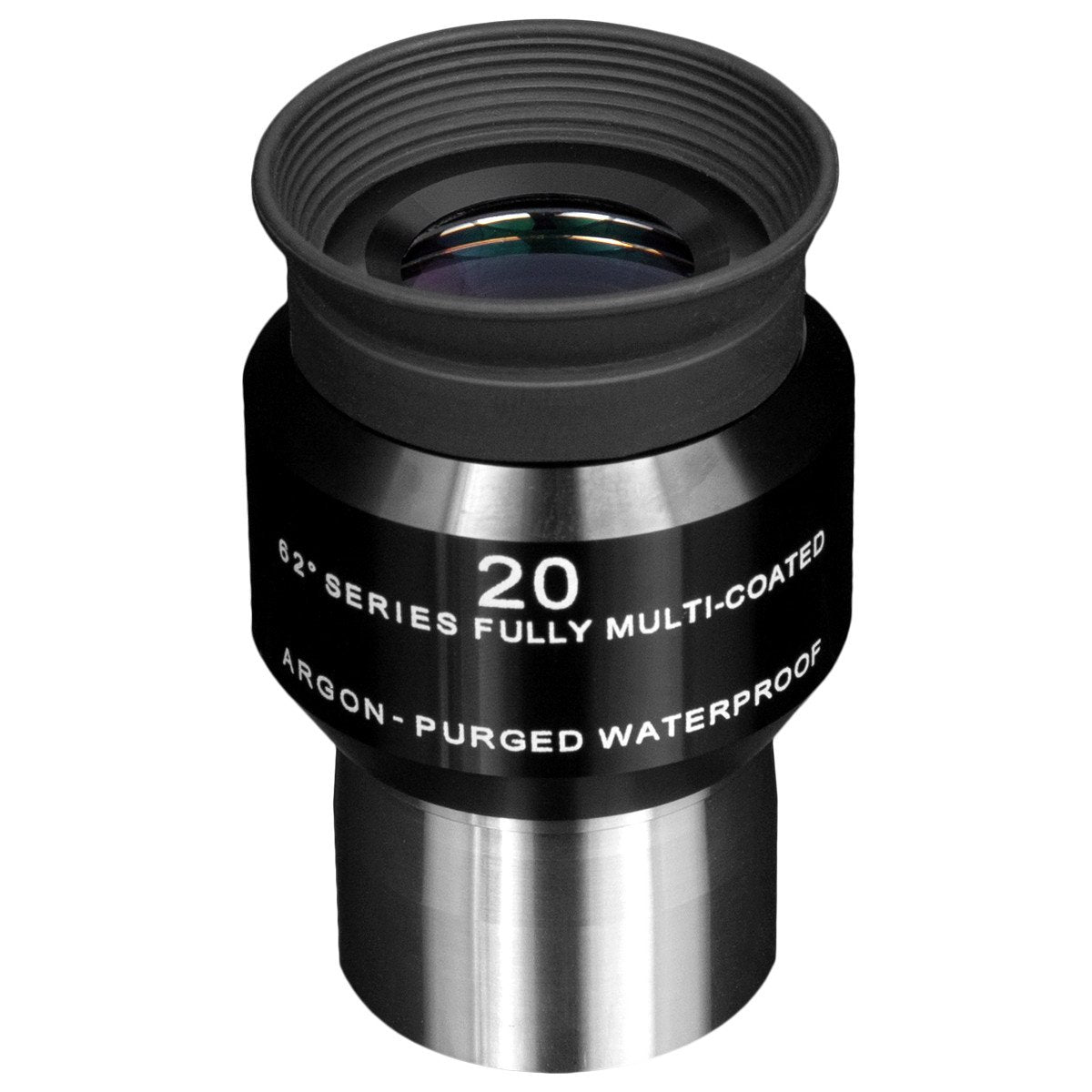


- Description
- Specifications
Product Overview
The Explore Scientific 62° Series 20mm is a mid-focal-length, argon-purged waterproof eyepiece on a 1.25-inch barrel. It presents a 62° apparent field, carries 14.8mm of eye relief and a 20.9mm field stop, and measures 64mm long by 42mm wide at 5oz (141.75g). The design is a flat-field, multi-element long-eye-relief arrangement, and Explore Scientific describes the series as near-parfocal, so changing focal lengths within it calls for only a slight touch of the focuser.
At 20mm this is the low-to-medium power end of most focal-length sets. In a 952mm refractor it gives 48x; in a 1200mm Schmidt-Cassegrain, 60x; in a 480mm short refractor, 24x. The 20.9mm field stop is the number that fixes the true field: divide it by your telescope's focal length and multiply by 57.3 to get degrees. That works out to 1.26° in a 952mm scope and 2.49° in a 480mm one.
The 62° field sits between a classic 50° design and the wide-field 82° and 100° Series. It is wide enough to feel open rather than tunnelled, while staying in a 1.25-inch barrel that fits every standard focuser and diagonal.
Who It's For
- Deep-sky observers working nebulae, clusters and galaxies at moderate power, where 20mm keeps the exit pupil large and the background sky bright enough to frame an object properly.
- Eyeglass wearers: 14.8mm of eye relief in a long-eye-relief design is enough to take in a good part of the 62° field with glasses on, which is not true of most eyepieces at this price.
- Observers building a matched set: the near-parfocal design across the series means swapping focal lengths does not send you hunting for focus in the dark.
- Anyone who uses averted vision: Explore Scientific specifically calls out how easily the eye can wander off-centre in this design, which is exactly the technique that pulls faint detail out of a low-surface-brightness target.
- Damp-climate observers: the argon-purged, sealed body is built for dew, humidity and cold nights.
Key Features & Design
- 20mm focal length: a general-purpose power in most telescopes, useful from wide-field sweeping through to framing a large nebula.
- 62° apparent field of view: noticeably more open than a 50° design, without the outer-field demands a 100° eyepiece places on both the optics and the observer's eye position.
- 14.8mm eye relief in a long-eye-relief layout: comfortable for extended sessions and practical with glasses on.
- 20.9mm field stop: the published figure that defines true field — a number many manufacturers leave out.
- Flat field: the design targets sharpness across the field rather than only at centre, so stars near the edge stay stellar.
- Near-parfocal within the series: minimal refocusing when swapping between 62° Series focal lengths.
- Argon-purged waterproof construction: inert gas inside a sealed body, which does not support the internal fogging that trapped moist air can cause.
- 1.25-inch barrel: the most widely supported eyepiece format there is.
- Compact at 64mm long, 42mm wide and 5oz, so it will not upset the balance of a small refractor or a Dobsonian.
Recommended Uses
- Medium-power deep-sky observing — open clusters, emission nebulae, globular clusters and the larger galaxies.
- General sweeping and finding, where 62° and a 20.9mm field stop give a workable search field before you switch to higher power.
- Lunar observing at moderate magnification, where the whole disc frames comfortably in most telescopes.
- Observing with eyeglasses on, where 14.8mm of eye relief is the enabling figure.
Compatibility and Accessory Notes
- Fits any 1.25-inch focuser or diagonal directly. In a 2-inch focuser it seats in a 2-inch to 1.25-inch adapter, which we stock.
- Magnification: telescope focal length ÷ 20. A 750mm Newtonian gives 38x; a 952mm refractor 48x; a 1500mm Maksutov 75x; a 2000mm SCT 100x.
- True field: 20.9mm ÷ telescope focal length × 57.3. That is 1.6° in a 750mm scope and 0.6° in a 2000mm scope.
- Exit pupil: 20mm divided by your telescope's focal ratio. In an f/6 instrument that is 3.3mm; in an f/10, 2mm. The larger figure is why 20mm suits deep-sky work in fast telescopes.
- Filters: 1.25-inch threaded filters — broadband light-pollution, UHC, O-III, lunar and colour — screw into the bottom of the barrel and are a natural pairing at this focal length.
- Focal extenders: a 2x extender turns this into a 10mm-equivalent power while retaining the eye relief characteristics of the 20mm, which is a genuinely useful trick for eyeglass wearers at high power.
Good to Know Before You Order
- Explore Scientific does not publish an element count or a coating designation for this eyepiece, so those rows read as unpublished below rather than carrying figures we have inferred. If either matters to your decision, ask and we will put the question to our Explore Scientific rep.
- The vendor does not state what ships in the box beyond the eyepiece itself. Caps and eyecup arrangements vary across the range, so we would rather not promise a specific accessory list — ask us and we will check the current packing.
- 62° is a moderate field, not a hyper-wide one. If full immersion is the goal, the 82° and 100° Series are built for that; the 62° Series is built around eye relief, flat field and a compact 1.25-inch format.
- Waterproof means sealed against weather, not built for submersion in use. The sealing exists so dew, rain and a drop into wet grass are non-events.
- In a very long focal length telescope, 20mm is not a wide-field eyepiece. At 2000mm it delivers 100x over 0.6°. If wide fields in a long scope are what you are after, a longer focal length or a 2-inch format eyepiece is the route, and we can suggest one for the telescope you own.
Frequently Asked Questions
Is it difficult to set up?
No — it drops into any 1.25-inch focuser or diagonal and is ready immediately. There is nothing to assemble, collimate or adjust.
What magnification will I get?
Divide your telescope's focal length in millimetres by 20. A 1000mm telescope gives 50x.
How wide will the view be?
Take the 20.9mm field stop, divide by your telescope's focal length, multiply by 57.3. A 1000mm telescope gives 1.2°, which is around two and a half full-Moon widths.
Can I use it with glasses on?
Yes. 14.8mm of eye relief in a long-eye-relief design is usable with glasses, though as with any eyepiece the outermost part of the field is easier to take in with them off.
What does argon purging accomplish?
The body is sealed and the air inside is replaced with dry argon. Because there is no moist air trapped inside, the internal surfaces will not fog when the eyepiece goes from a warm car to a cold field, and moisture cannot work its way in over the years.
How does it compare with the 82° Series at a similar focal length?
The 82° gives a distinctly wider, more immersive field in a larger and heavier body, often in a 2-inch barrel. The 62° Series trades some of that field for eye relief, compactness and a 1.25-inch fit. Tell us what you observe and which telescope you use and we will give you a straight recommendation.
Bottom Line
In short: a 20mm eyepiece with a 62° flat field, 14.8mm of eye relief, a published 20.9mm field stop and an argon-purged waterproof body, all in a compact 5oz 1.25-inch package that suits general deep-sky work and eyeglass wearers alike. If you would like help working out which focal lengths would round out your set for the telescope you own, send us its aperture and focal length and we will map it out with you.
| Description | 20mm 62° Series Argon-Purged Waterproof Eyepiece |
|---|---|
| Item Number | EPWP6220LE-01 |
| Focal Length | 20mm |
| Apparent Field of View | 62° |
| Barrel Size | 1.25 |
| Eye Relief | 14.8mm |
| Field Stop Diameter | 20.9mm |
| Length | 64mm |
| Width | 42mm |
| Weight | 5oz; 141.75g |
| Element Count | Not published by vendor |
| Coating Designation | Not published by vendor |
| Box Contents | Not published by vendor |
You may also like
Recently viewed
Recent Blog Posts
View all
Your Guide Graph Is Lying to You
Read More
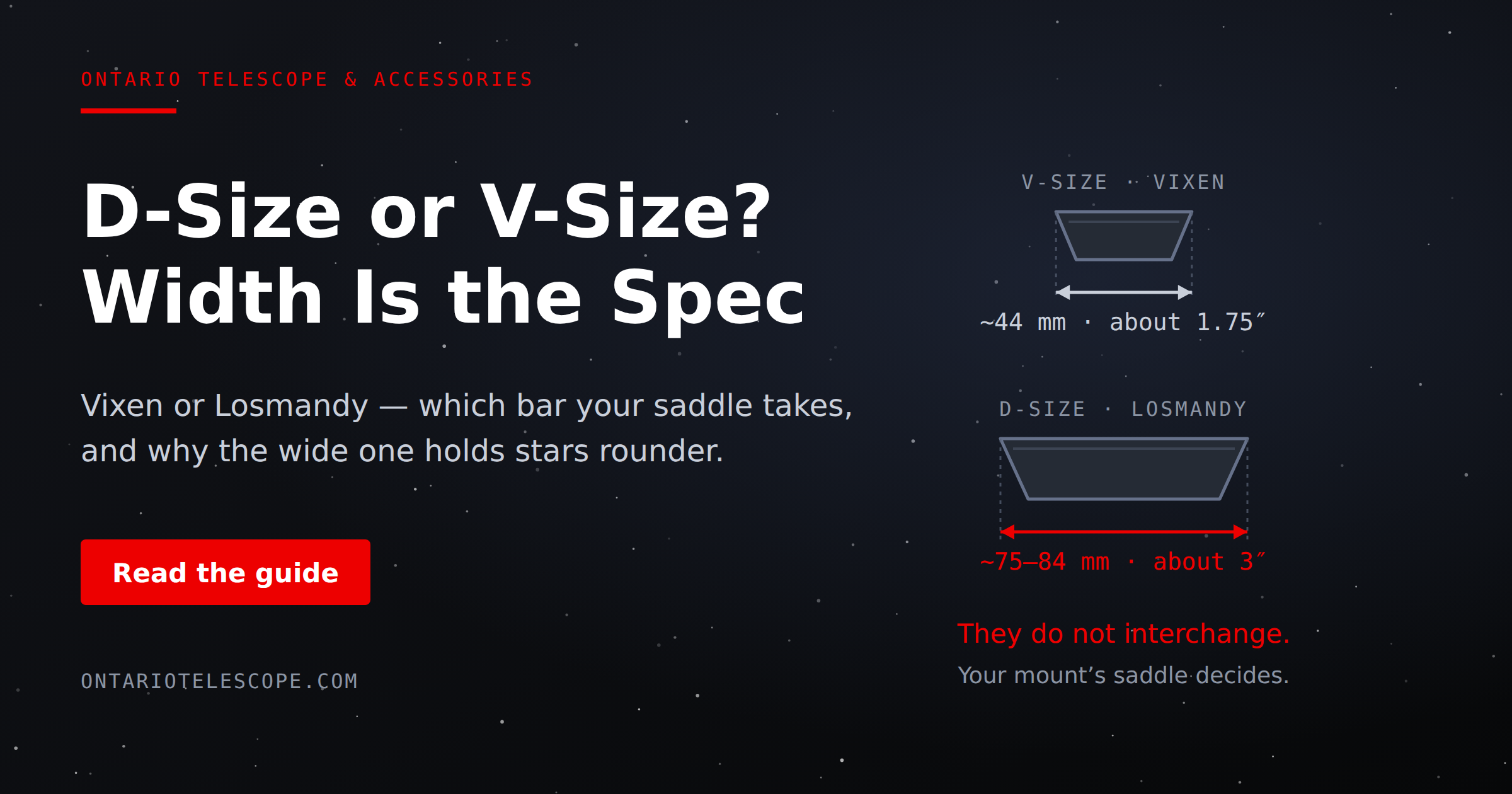
D-Size vs V-Size: A Complete Guide to Telescope Dovetail Systems
Read More
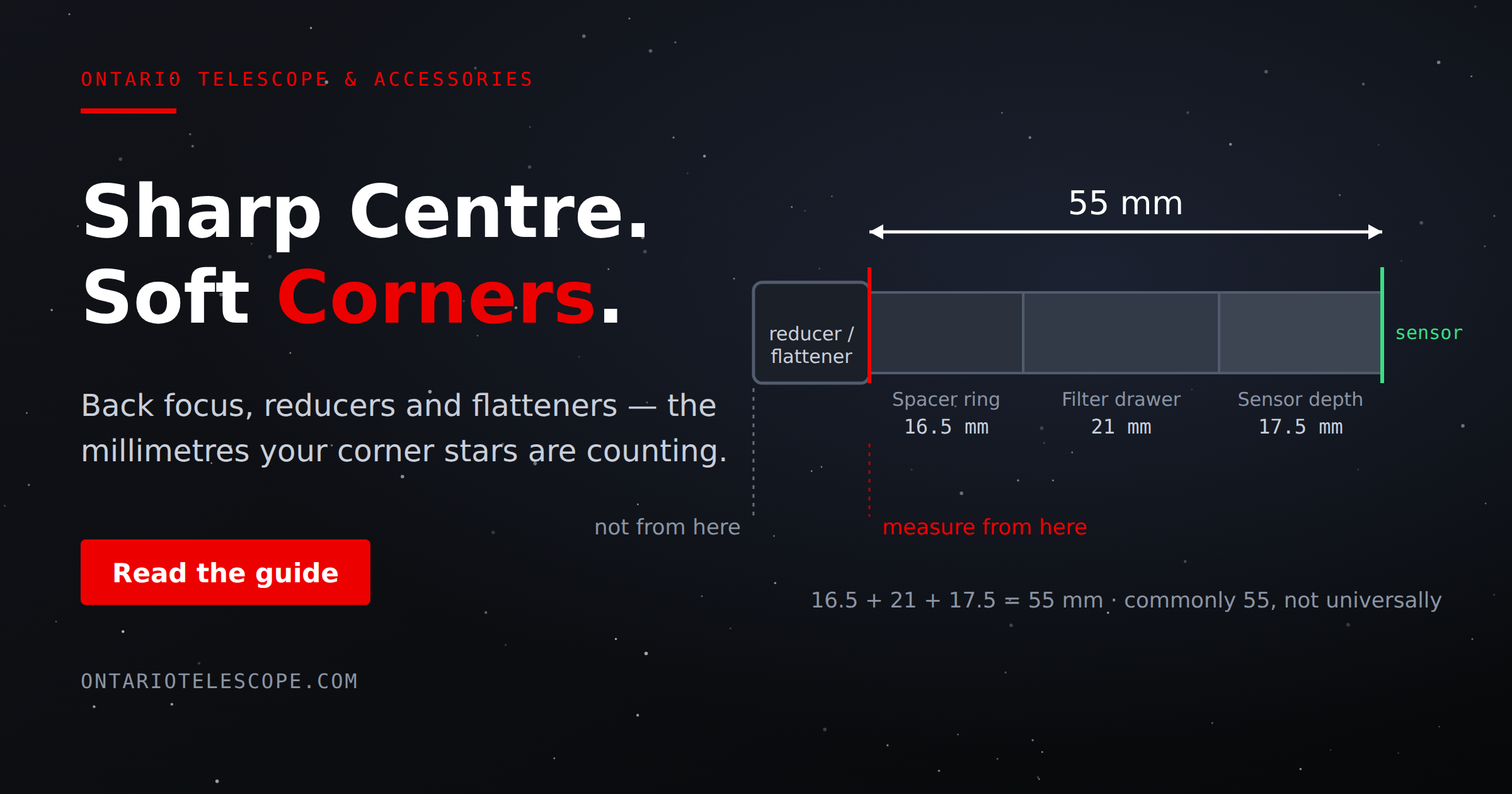
What Is Back Focus in Astrophotography? Telescope Reducers, Flatteners, and Spacing Explained
Read More