


- Description
Product Overview
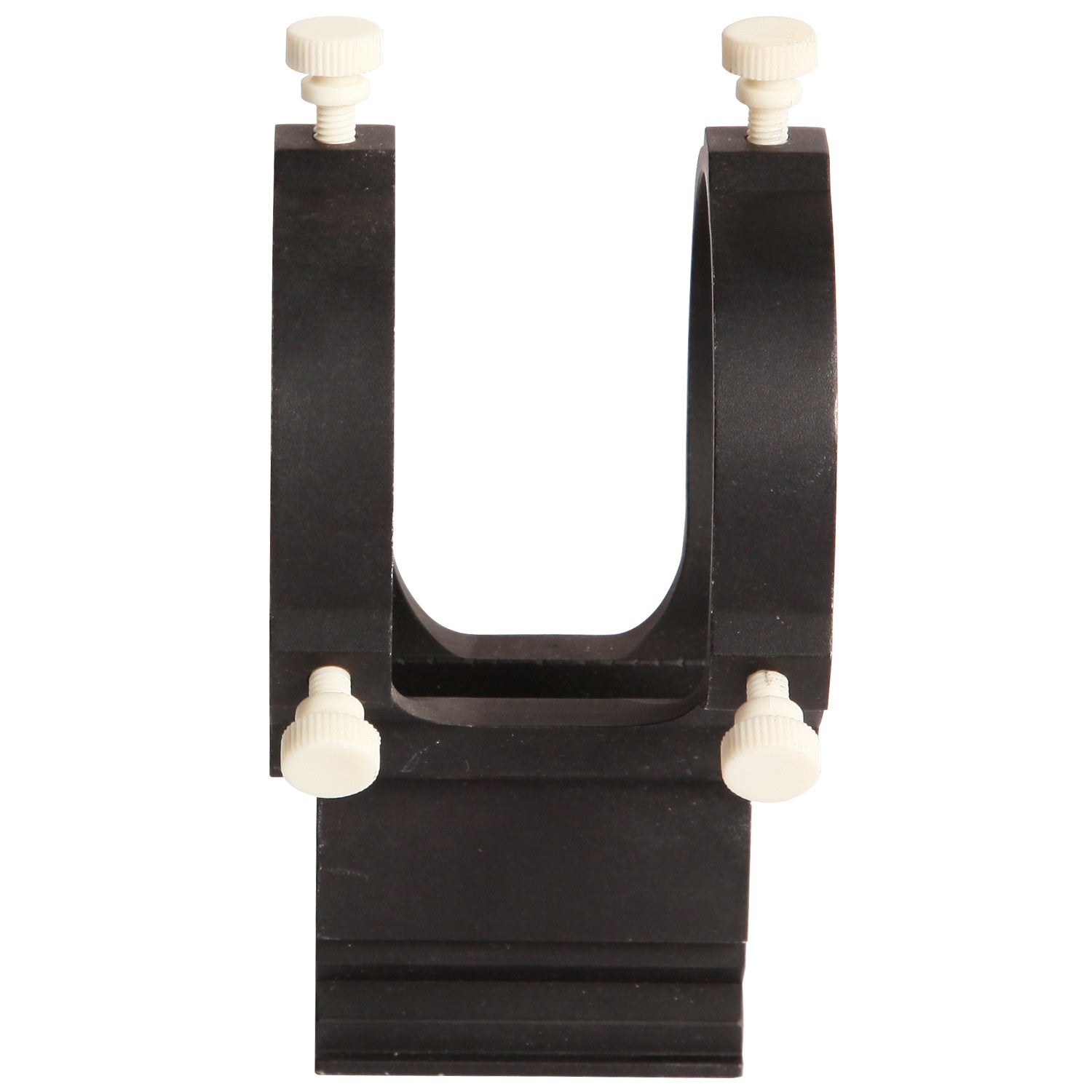
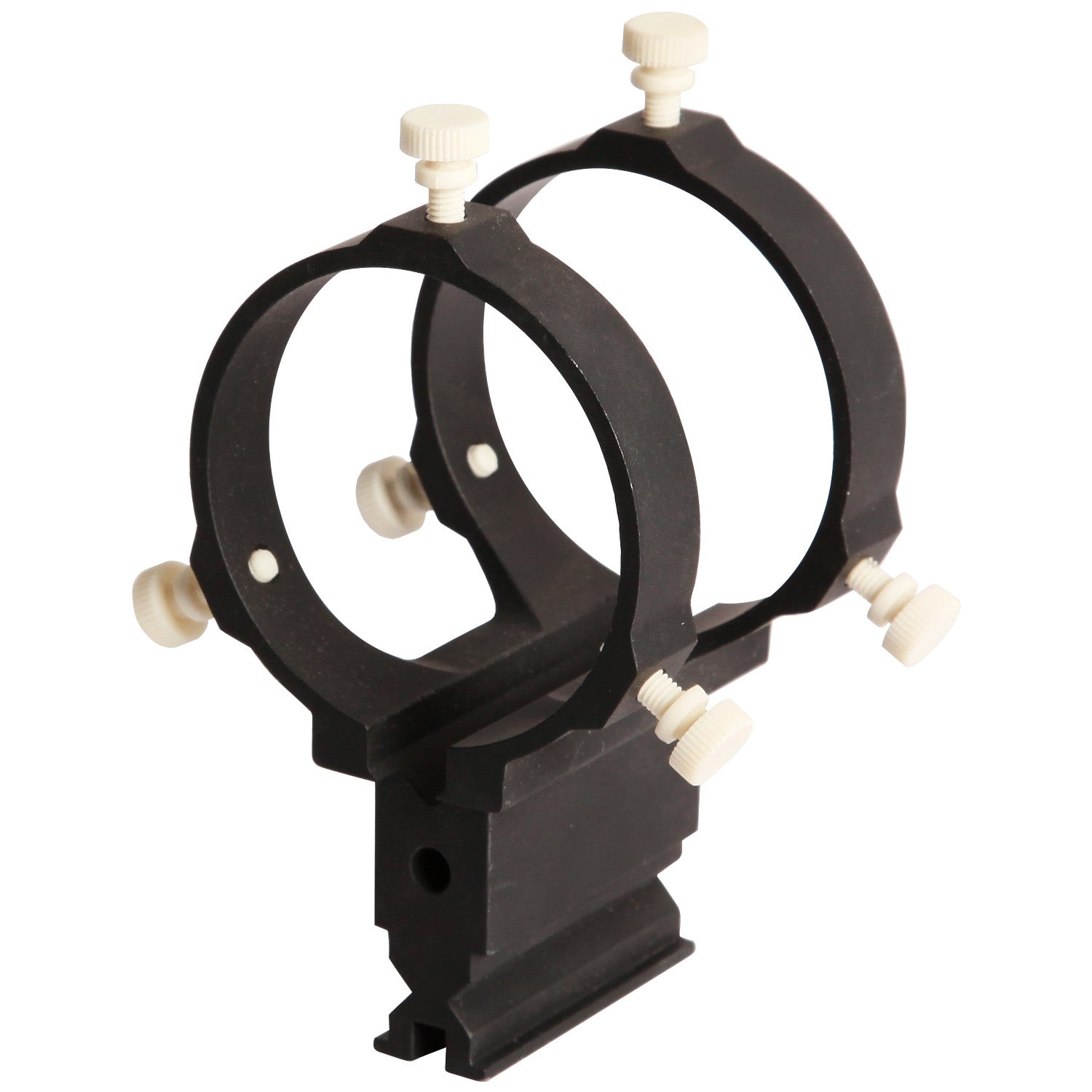
These are Explore Scientific's high-profile finder-scope rings: a two-ring bracket sized for 50 mm finder scopes and built tall enough to clear the body of a right-angle finder. Explore Scientific lists the bracket at 50 mm long, 61 mm wide and 110 mm high, which puts roughly four and a quarter inches of standing height above the finder base. Each of the two rings carries three adjustment points, and heavy-duty plastic thumbscrews with oversized heads are included. The foot is a quick-release dovetail that slides into a finder base. Explore Scientific publishes a weight of 3.9 oz (110.6 g).
Who It's For
A right-angle finder is a different mechanical problem from a straight-through one. The prism housing hangs below the optical axis and the eyepiece stands up at ninety degrees, so a low-profile bracket of the sort that suits a plain 50 mm finder will bury the diagonal against the telescope tube or the dew shield, and leave you with an eyepiece you cannot comfortably get your eye to. That is what this bracket exists to fix. The extra height lifts the finder's optical axis far enough above the base that the diagonal body clears the tube and the eyepiece ends up somewhere your neck agrees with.
The other people who reach for this part are those replacing something. Finder rings get lost in the dark, get cross-threaded, or arrive worn out on a used telescope, and a lot of budget brackets use a single screw working against a spring or an O-ring, which lets the finder rock under its own weight and drift out of alignment between sessions. Three adjustment points per ring is a genuine upgrade over that arrangement: once you have the finder aimed, it stays aimed, because nothing is relying on a spring to hold a position.
Key Features & Design
- Two-ring bracket sized for 50 mm finder scopes, holding the tube at two widely spaced points rather than clamping it at one.
- Three adjustment points on each ring, giving six-screw control over the finder's aim and a mechanically stable rest position.
- High-profile design standing 110 mm tall, specified for the clearance a right-angle finder needs.
- Quick-release dovetail foot, so the finder assembly comes off in seconds when the telescope has to go back in its case.
- Heavy-duty plastic thumbscrews with large heads, sized to be turned while wearing gloves and gentle on the finder's tube finish.
- Overall dimensions of 50 x 61 x 110 mm at a published 3.9 oz (110.6 g), so it adds very little to the balance of a small telescope.
Mechanical Design
The reason three screws per ring matters is geometry. Three points spaced around a circle fully constrain a cylinder in the plane of that ring, so with two rings you have complete control of the finder's position and tilt without any part of the system depending on spring pressure. That is what lets you aim a finder precisely and have it hold: you adjust the front and rear rings differentially, exactly as you would collimate a small refractor, and the tube then sits in a determinate position it cannot creep out of. A single-screw-and-O-ring bracket, by contrast, is always a compromise between enough tension to stop the finder sliding and little enough to avoid squeezing the tube, and it will shift the first time the telescope gets bumped. The tall standoff introduces the one trade-off worth understanding: height is leverage, so a 110 mm bracket is inherently less rigid than a one-inch one, and Explore Scientific compensates by making the base wide and the rings widely separated along the tube. The plastic thumbscrews are a deliberate choice too. Soft screw tips bear against the finder's painted tube without denting or scoring it, which is why they should be brought up snug and no further.
Recommended Uses
- Mounting a 50 mm right-angle or right-angle correct-image finder where a low bracket does not give enough clearance.
- Replacing damaged, worn or missing finder rings on a used telescope.
- Upgrading a single-screw or O-ring finder bracket to a six-point ring set that holds its alignment between sessions.
- Adding a second finder position to a telescope that already carries a red dot sight on its original base.
Compatibility and Accessory Notes
Two questions decide whether this part works for you. First, the finder tube: the rings are made for 50 mm finder scopes, meaning a tube body of about 50 mm outside diameter, which covers most 8x50, 9x50 and 10x50 finders. A 30 mm or 6x30 finder will be lost inside these rings, and a 60 mm or 70 mm finder will not go in at all. Second, the base: the bracket ends in a quick-release dovetail foot that slides into an Explore Scientific finder base, and that base is not included here. If your telescope already carries an Explore Scientific finder shoe, this drops straight in. If it carries a Vixen, Sky-Watcher, Celestron, Meade or Synta-pattern shoe, the dovetail profiles are not interchangeable and you will need either a matching base or an adapter. Finder shoes are the least standardised fitting in amateur astronomy, so the sensible move is to tell our team in Bolton what telescope and what finder you have, and we will confirm the fit before anything ships. If you are replacing a whole finder assembly rather than just the rings, mention that too and we will make sure the base comes with it.
Good to Know Before You Order
This is the bracket and rings only. There is no finder scope in the box, and no finder base either, so if you are starting from a bare telescope tube with no shoe on it you will need both. Explore Scientific does not publish a ring inner diameter beyond the 50 mm finder sizing, so if your finder is an unusual tube diameter it is worth measuring it and checking with us first. The thumbscrews are plastic by design rather than by cost-cutting, which means they should be snugged by hand and not leaned on. Finally, note that this is the high-profile version at 110 mm; Explore Scientific also makes roughly one-inch and 1.5-inch brackets for straight-through finders, and if you do not actually need right-angle clearance, one of the shorter ones will be stiffer.
Frequently Asked Questions
Does this include the finder base that attaches to my telescope? No. The bracket dovetails into a finder base, and that base is sold separately. Many telescopes already have one fitted, but if yours does not, or if it is a different pattern, let us know the model and we will sort out what you need.
Will it hold my 6x30 or 8x50 finder? An 8x50 is exactly what it is designed for. A 6x30 has a much smaller tube and will not be gripped properly by 50 mm rings, so you would want the 30 mm bracket instead.
Why is this one so much taller than the other finder brackets? Because a right-angle finder needs the clearance. The prism housing sits below the optical axis and the eyepiece points up, so the finder has to be lifted away from the telescope tube for the assembly to work and for you to get your eye to it.
Can I take the finder off without losing my alignment? Yes, that is what the quick-release dovetail is for. The finder stays in its rings, the whole bracket slides out of the base, and when it goes back in it returns close enough to aimed that a touch-up is usually all that is needed.
Bottom Line
A high-profile, two-ring, six-screw bracket that gives a 50 mm right-angle finder the clearance it needs and then holds it where you put it. The only thing to settle before ordering is whether your telescope's finder base matches the dovetail, so send us your telescope and finder model and we will confirm the fit for you.
You may also like
Recently viewed
Recent Blog Posts
View all
Your Guide Graph Is Lying to You
Read More

D-Size vs V-Size: A Complete Guide to Telescope Dovetail Systems
Read More

What Is Back Focus in Astrophotography? Telescope Reducers, Flatteners, and Spacing Explained
Read More