
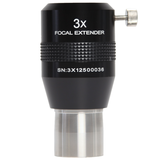

- Description
- Specifications
Product Overview
The Explore Scientific 3x Focal Extender is a 1.25-inch telecentric amplifier that triples the magnification of whatever eyepiece is placed in it. Explore Scientific publishes a length of 93mm, a width of 45mm and a weight of 249 grams (8.7 oz), and describes the optical design as telecentric, using multiple precision lens elements to deliver light rays parallel to the optical axis.
That last point is what separates a telecentric focal extender from a conventional Barlow. In a Barlow, the amplification factor depends on how far the eyepiece field stop sits from the negative lens — add an extension or a diagonal into the train and the stated 2x quietly becomes 2.4x. A telecentric design sends the light out parallel, so the magnification stays at 3x regardless of the spacing behind it. What you calculate is what you get.
The other consequence is eye relief. A 3x extender lets a comfortable long-focal-length eyepiece do the work of a very short one: a 15mm eyepiece behind this unit performs like a 5mm while keeping the 15mm's eye relief. For eyeglass wearers and for anyone who finds short-focal-length eyepieces cramped, that is the main reason to own one.
Who It's For
- Lunar and planetary observers who want to reach high magnification without buying the very shortest eyepieces in a series.
- Eyeglass wearers: the extender preserves the eye relief of the eyepiece in front of it, which is exactly what short eyepieces sacrifice.
- Owners of fast telescopes: at f/4 or f/5 a 3x extender turns the effective focal ratio into f/12 or f/15 at the eyepiece, which eases the demands on eyepiece design at the field edge.
- Double-star observers who need magnification on demand without swapping through a whole case.
- Planetary imagers using a 1.25-inch camera nose, where telecentric output keeps the amplification factor predictable in the image scale calculation.
Key Features & Design
- 3x magnification factor: a full three times, applied to whatever eyepiece is inserted.
- Telecentric optical design: multiple precision lens elements arranged to emit rays parallel to the optical axis, so the amplification does not drift with spacing.
- Eye relief preserved: the eyepiece keeps its own eye relief, so a long eyepiece at high power stays comfortable.
- 1.25-inch barrel: fits any standard 1.25-inch focuser or diagonal.
- Published dimensions: 93mm long, 45mm wide, 249 grams (8.7 oz).
- Consistent scale for imaging: because the factor is fixed, image scale calculations for planetary capture stay reliable.
Optical Design
A conventional Barlow lens is a negative element placed ahead of focus. It makes the converging light cone from the telescope shallower, which pushes focus further back and increases the effective focal length. The catch is that the amount of increase depends on the distance between the negative lens and the eyepiece field stop. Move the eyepiece back — by adding an extension tube, a filter wheel, or a diagonal in the wrong place — and the amplification climbs above the printed figure.
A telecentric design solves this by adding positive elements behind the negative group so that the exit rays leave parallel to the optical axis rather than diverging. Parallel rays mean the effective amplification stops depending on how far away the next component sits. A 3x telecentric extender is 3x with a diagonal in the train, 3x with an extension tube, and 3x with a camera on the back.
The trade with any amplifier is light. Tripling magnification spreads the same photons over nine times the area, so the image is dimmer and the exit pupil shrinks to a third of what the eyepiece alone would give. That is why an extender belongs on bright targets: the Moon, the planets, double stars, and the brighter compact deep-sky objects.
Recommended Uses
- High-power lunar and planetary observing without a dedicated short-focal-length eyepiece.
- Splitting close double stars.
- Planetary and lunar imaging with a 1.25-inch camera, where a predictable amplification factor matters to image scale.
- Extending a modest eyepiece set into a larger range of magnifications.
- Observing with eyeglasses at high power, where a long eyepiece behind the extender keeps the eye relief.
Compatibility and Accessory Notes
- Fits any 1.25-inch focuser or diagonal. In a 2-inch focuser it takes a 2-inch to 1.25-inch adapter.
- Resulting magnification: telescope focal length ÷ eyepiece focal length × 3. A 20mm eyepiece in a 952mm telescope gives 143x; a 15mm in a 1200mm gives 240x.
- Effective focal length: the telescope behaves as though its focal length were tripled — a 714mm f/7 refractor becomes 2142mm at f/21 at the eyepiece.
- Pairing: mid and long focal length eyepieces are the natural partners. A 25mm, 20mm or 15mm behind this unit produces the equivalent of an 8.3mm, 6.7mm or 5mm.
- Where it stops helping: putting a 3mm or 4mm eyepiece behind a 3x extender exceeds the useful magnification of nearly any aperture. The long end of your case is where the gains are.
- Imaging: a 1.25-inch camera nose fits directly. Because the design is telecentric, the amplification stays at 3x whatever the backfocus, which keeps the plate scale calculation honest.
- Filters: Explore Scientific does not publish the filter thread specification for this extender, so we are not quoting one. Filters can also be threaded onto the eyepiece instead, which is the usual arrangement.
Good to Know Before You Order
- 3x is a large step, and the atmosphere has a vote. On a steady night in a well-cooled telescope it opens up the top of the magnification range; on a turbulent night a 2x extender or the eyepiece alone will show more detail. Many observers keep both factors on hand for that reason, and we stock the 2x as well.
- The image gets dimmer as it gets bigger. Three times the magnification means roughly one ninth the surface brightness, which is why bright targets are where an extender earns its place.
- Explore Scientific publishes two slightly different sets of physical figures for this item — 93mm and 249 grams on the current product page, 96mm and 260 grams on the spec sheet supplied with earlier stock. The optical specification is the same; the difference is in production revisions. If the exact dimension matters for a case, ask us and we will confirm it with our rep.
- Element count and coatings are not published beyond the description of multiple precision lens elements, so those rows read "Not published by vendor" below rather than carrying an estimate.
Frequently Asked Questions
Is it difficult to set up?
No — the extender goes into the focuser or diagonal, the eyepiece goes into the extender, and that is the whole procedure. Refocusing after fitting it is normal, since the extender moves the focal point outward.
What is the difference between this and a Barlow?
A Barlow's amplification changes with the spacing behind it. A telecentric extender sends light out parallel to the optical axis, so 3x stays 3x whatever else is in the train — diagonal, extension tube or camera.
Does it reduce eye relief?
No, and that is one of the main reasons to use one. The eyepiece keeps its own eye relief, so a 20mm eyepiece at 3x gives the magnification of a 6.7mm with the comfort of a 20mm.
Which eyepieces should I pair it with?
The mid and long focal lengths in your case. A 25mm, 20mm or 15mm become the equivalent of 8.3mm, 6.7mm and 5mm. Very short eyepieces behind a 3x go past what most apertures can use.
Can I use it for photography?
Yes, for lunar and planetary imaging with a 1.25-inch camera. The fixed telecentric factor is a practical advantage, because the image scale calculation stays correct no matter what spacing the camera ends up at.
Will it work with my telescope?
Any telescope with a 1.25-inch focuser or diagonal takes it, and a 2-inch focuser takes it through an adapter. Whether 3x is the right factor depends on your focal length and aperture — send us those and we will tell you which factor suits.
Bottom Line
In short: a 1.25-inch telecentric 3x focal extender at 93mm and 249 grams that triples magnification with a fixed, spacing-independent factor and leaves the eyepiece's eye relief intact — a straightforward way to turn the comfortable half of your eyepiece case into a high-power set. If you would like a recommendation on whether 2x or 3x suits your telescope's focal length better, send us the figures and we will work it out with you.
| Description | 3x Focal Extender; 1.25-inch O.D. Barrel |
|---|---|
| Item Number | FE03–125 |
| Magnification Factor | 3x |
| Optical Design | Telecentric, multiple precision lens elements |
| Barrel Size | 1.25-inch |
| Length | 93mm |
| Width | 45mm |
| Weight | 249 grams; 8.7 oz |
| Coatings | Not published by vendor |
| Lens Elements/Groups | Not published by vendor |
| Filter Thread | Not published by vendor |
You may also like
Recently viewed
Recent Blog Posts
View all
Your Guide Graph Is Lying to You
Read More

D-Size vs V-Size: A Complete Guide to Telescope Dovetail Systems
Read More

What Is Back Focus in Astrophotography? Telescope Reducers, Flatteners, and Spacing Explained
Read More