


- Description
Product Overview
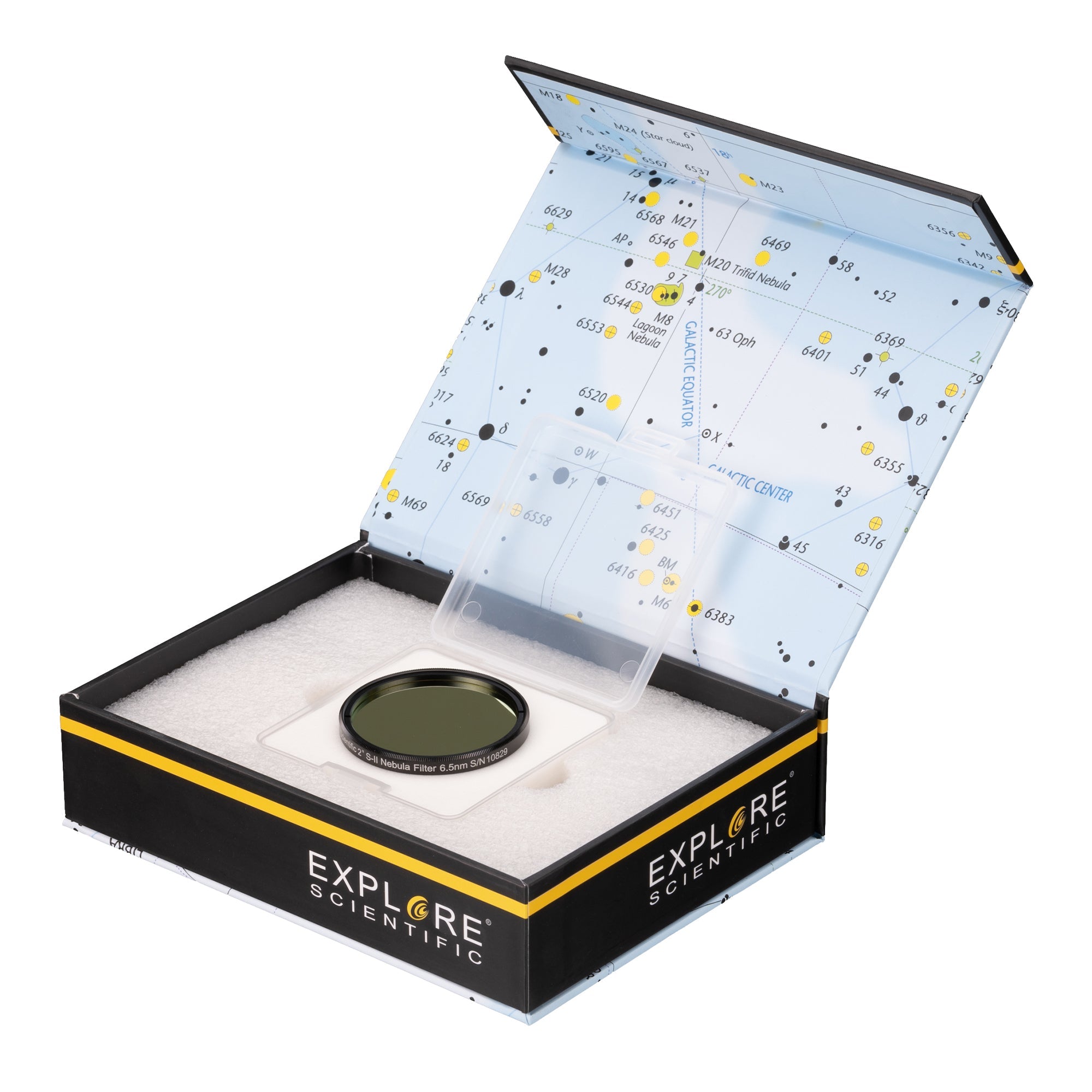
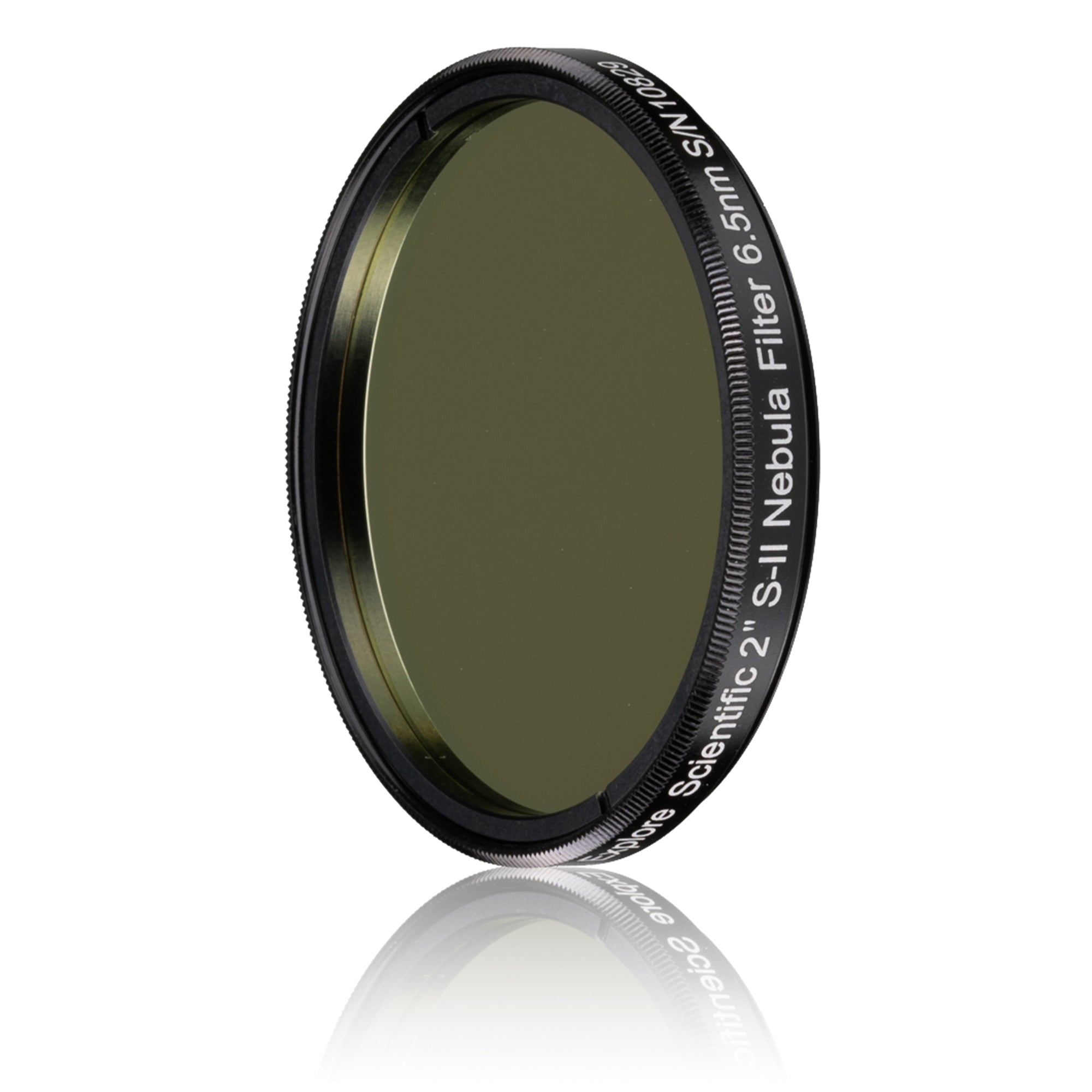
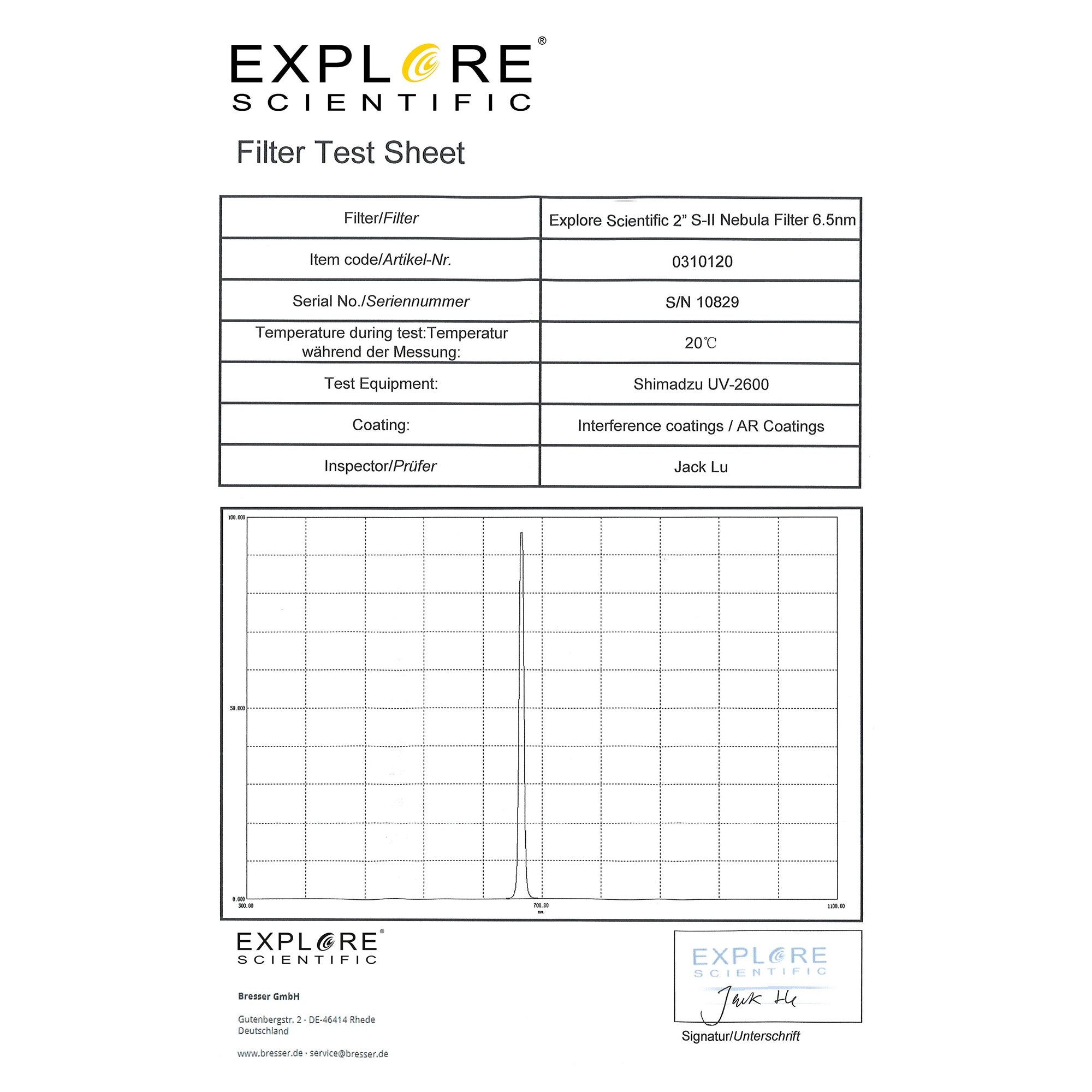
This is the most specialised sulphur filter Explore Scientific offers in the 2-inch format: a 6.5 nm passband centred on the ionised sulphur emission line at 672 nm, in a mounted 2-inch cell. Explore Scientific describes the result as amazing for revealing nebulae in light-polluted urban areas, and frames the filter's job as absorbing interfering emission lines to deliver more contrast and detail for urban observers and astrophotographers. As with the rest of the range, an individual test report for the specific filter is part of the scope of delivery.
Who It's For
Everything in narrowband imaging is a negotiation between contrast and signal, and this filter sits at one extreme of it. Halving the passband relative to a 12 nm filter roughly halves the sky continuum you accumulate in a given exposure while leaving the nebular emission line untouched, so the target sits on a darker background and the contrast in the raw subframe is visibly better. That is exactly what you want when the sky itself is the problem: a white-zone back garden, a rising moon, a target that never climbs out of the light dome to the south.
What you should be clear-eyed about is that this filter stacks the two hardest conditions in the range on top of each other. Sulphur is the weakest of the three lines commonly mapped in narrowband work, and 6.5 nm is the tightest window Explore Scientific puts on it. The result is a filter that demands things of your setup rather than accommodating it: enough aperture that the sulphur channel is not hopeless, a focal ratio around f/5 or slower so the passband does not drift off the line in a steep light cone, a cooled monochrome camera with low read noise so that fifteen or twenty minute subframes actually pay, and a project measured in tens of hours rather than a single clear night. Buy it if you are already producing decent S-II data with a wider filter and you have decided the sky background is what stands between you and a better image. If you are still fighting for signal rather than fighting the sky, the 12 nm 2-inch version is the more sensible instrument.
Key Features & Design
- 6.5 nm passband, the narrowest sulphur window in the Explore Scientific 2-inch range
- Centred on the ionised sulphur emission line at 672 nm
- Roughly half the sky background of a 12 nm filter for the same nebular signal
- Mounted 2-inch cell suited to large sensors, 2-inch filter wheels and 2-inch diagonals
- Blocks the artificial light that dominates urban skies, including sodium and mercury vapour lighting
- Individual test report for your specific filter included
- Intended for planetary nebulae, emission nebulae and supernova remnants
Filter Design
The narrower the window, the more the geometry of your optical system matters. A dielectric interference filter defines its passband for light arriving perpendicular to the coating, and the transmission curve moves toward shorter wavelengths as the angle of incidence grows. In a 2-inch filter feeding a large sensor there are two separate contributors to that angle: the convergence of the beam, set by your focal ratio, and the field position, since light destined for a corner of a full-frame chip crosses the filter differently from light headed for the centre. Both effects push the passband away from 672 nm. In a 12 nm filter that drift eats into the margin. In a 6.5 nm filter, with only about three nanometres either side of the peak to spare, the same drift can move the sulphur line onto the shoulder of the curve, where transmission falls away. The practical consequence is that this filter belongs on moderate focal ratios and rewards a well-collimated, well-spaced imaging train, and it is why the enclosed test report showing where your filter's centre wavelength actually landed is more than a nicety here.
Recommended Uses
- Deep sulphur channels for mapped-colour imaging from heavily light-polluted sites
- Multi-night and multi-season projects on emission nebulae where S-II is the limiting channel
- Imaging through moonlight, when sky background rather than target brightness sets the floor
- Supernova remnants and planetary nebulae photographed with large monochrome sensors
- Moderate focal ratio refractors and reflectors with 2-inch filter wheels or drawers
Compatibility and Accessory Notes
Standard 2-inch filter threads let this screw into a 2-inch nosepiece, a 2-inch star diagonal, the barrel of a 2-inch eyepiece, or most 2-inch filter wheels. It is not a fit for wheels designed around unmounted 36 mm or 50.8 mm discs, and the mounted cell is thicker than an unmounted disc, so check the clearance in a filter drawer before ordering. Mounted glass in the light path also shifts focus slightly rearward, which is worth allowing for when you set the distance between a field flattener or reducer and your sensor. If you are matching this to a hydrogen-alpha and an O-III filter, keeping the whole set at a similar bandwidth makes your exposure planning far easier to reason about. Our team in Bolton will confirm fit against your specific wheel or drawer if you send us the model.
Good to Know Before You Order
Explore Scientific publishes no shipping weight for this item, so we are confirming it on our own scales before the listing goes live. That is why it is currently unpublished. Contact us and we will give you a shipping figure for your address. Two honest caveats beyond that. This is not a visual filter: a 6.5 nm window at 672 nm passes far too little light for the eye, whatever your aperture. And Explore Scientific does not publish peak transmission, substrate specification or an out-of-band blocking range for this filter, so we do not quote figures we cannot source. The measured curve for your individual filter comes with it in the box. The delivery is the filter and that report; no wheel, adapter, diagonal or camera is included.
Frequently Asked Questions
How does this differ from the 12 nm 2-inch S-II? Same line, same format, roughly half the window. You get a darker sky background and better raw contrast, and you pay for it with a filter that is less tolerant of fast optics, large fields and short exposures. The 12 nm is the general-purpose filter; this one is a specialist for bright skies and long projects.
What focal ratio does it want? Explore Scientific does not publish a limit. As a working guide, around f/5 and slower is comfortable, and below roughly f/4 the passband shift across the beam begins to cost you meaningful transmission at 672 nm. If your system sits near that boundary, contact us and we will work through it with you.
How much total integration should I plan for? More than you would for hydrogen-alpha, typically by a factor of two or three on the same target. Sulphur is faint and a tight window is unforgiving, so treat this as a channel you build up across several nights.
Will it cover a full-frame sensor? The 2-inch format is the right choice for large chips, though as with any filter placed in a converging beam close to the sensor, keep an eye on transmission uniformity in the corners at fast focal ratios.
Bottom Line
The 6.5 nm 2-inch S-II is the filter you buy when the sky is the obstacle and you have the aperture, the focal ratio and the patience to meet its terms. It rewards long integration and a well-sorted imaging train, and it will out-contrast a wider filter on any night with a bright background. If you want to talk through whether your rig is the right home for it, contact us and we will give you a straight answer.
You may also like
Recently viewed
Recent Blog Posts
View all
Your Guide Graph Is Lying to You
Read More

D-Size vs V-Size: A Complete Guide to Telescope Dovetail Systems
Read More

What Is Back Focus in Astrophotography? Telescope Reducers, Flatteners, and Spacing Explained
Read More