


- Description
Product Overview
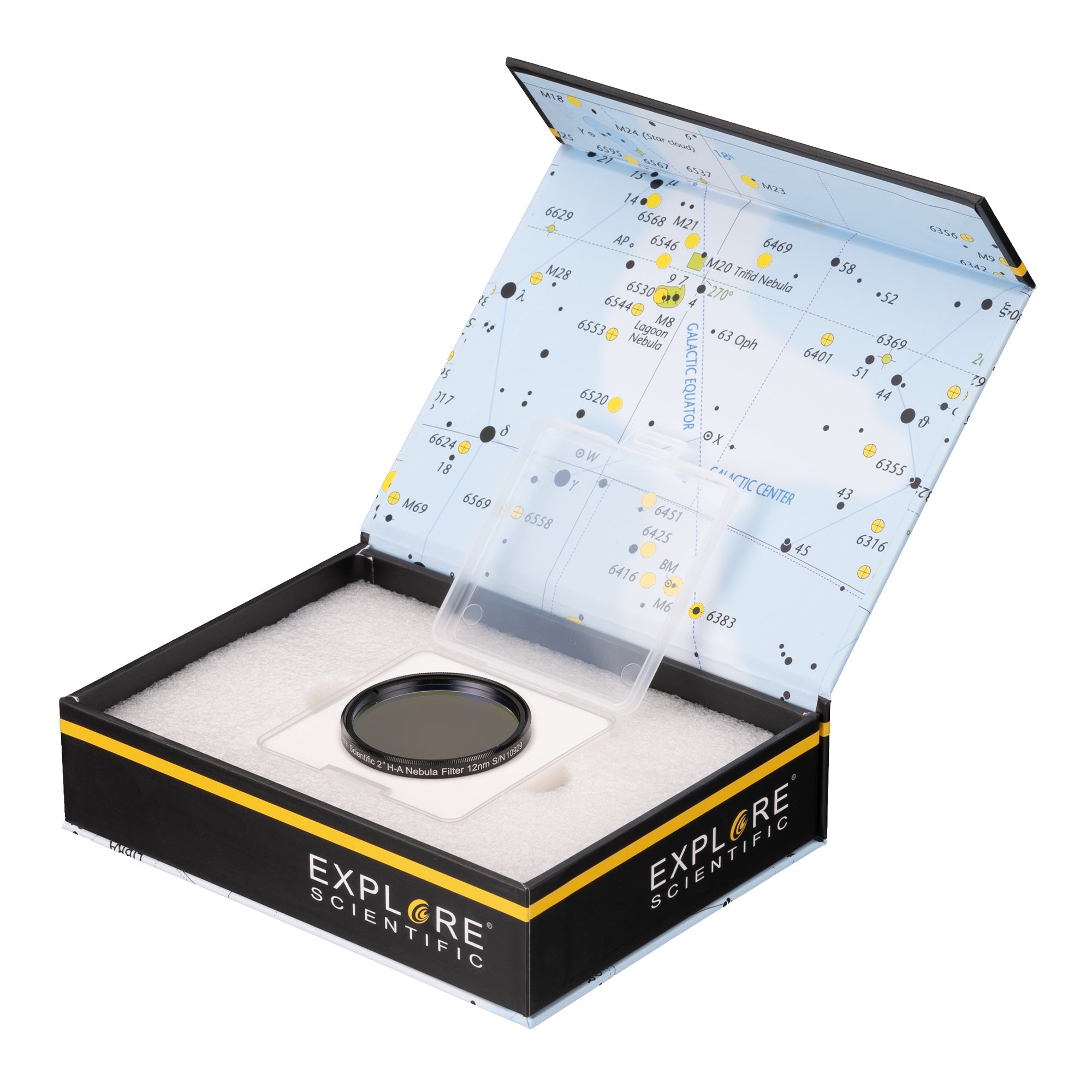
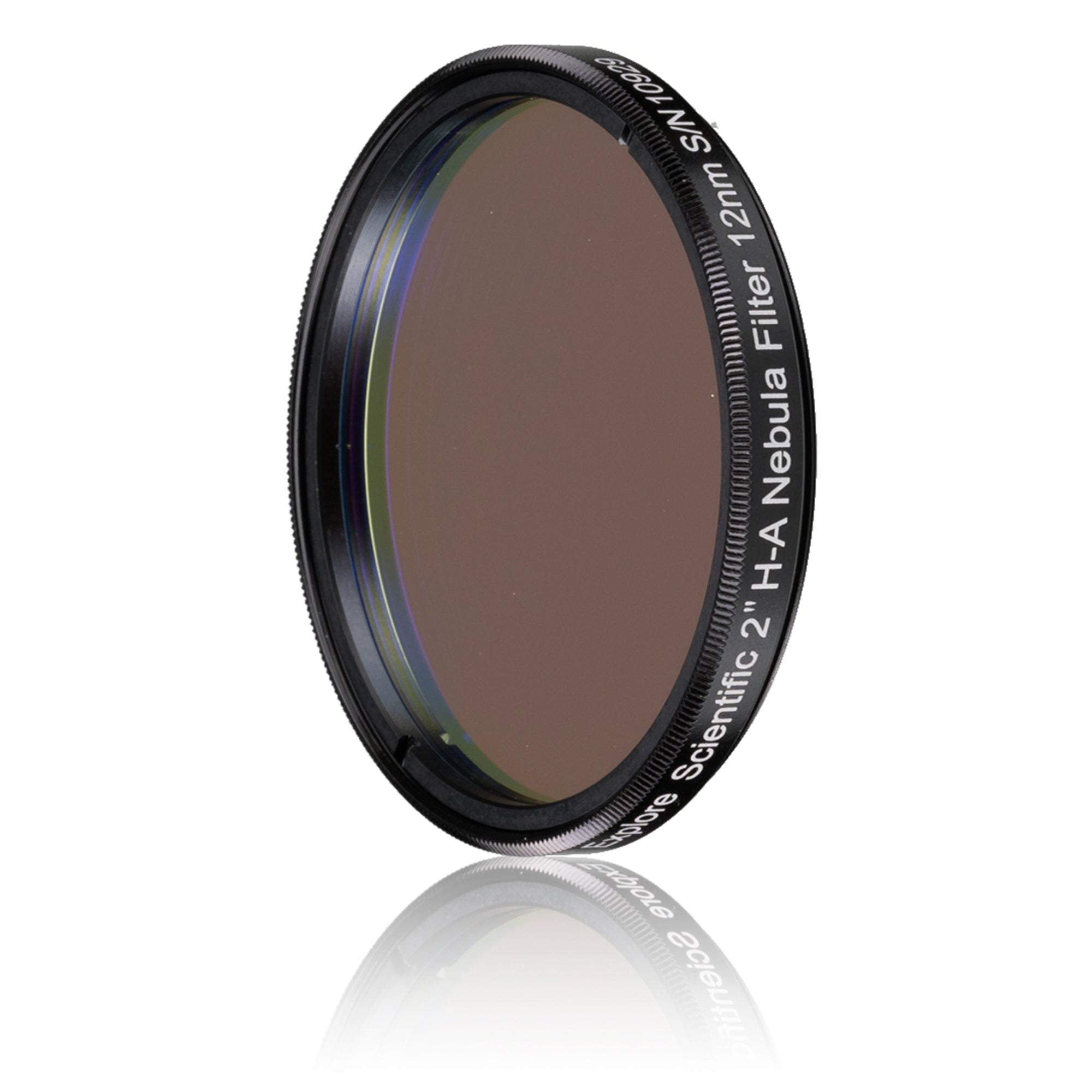
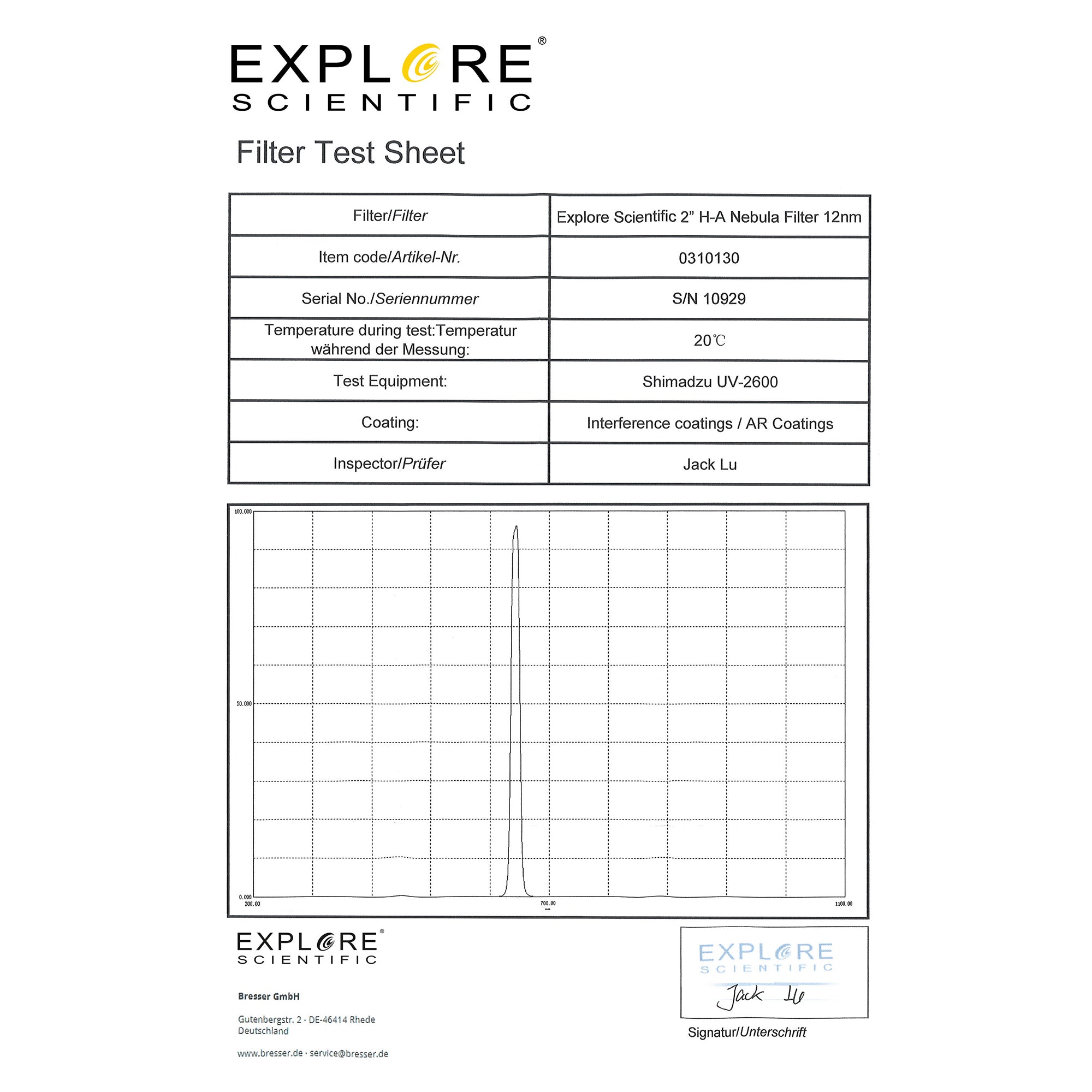
The Explore Scientific 2-inch H-Alpha Nebula Filter pairs a 12 nm passband on the hydrogen emission line with a mounted 2-inch cell, so it covers large sensors and drops straight into 2-inch wheels, drawers and diagonals. Explore Scientific presents it as an answer to artificial light: it passes the hydrogen emission and blocks the interfering wavelengths, including the mercury and sodium vapour lighting that makes deep-sky work from a town so difficult. Explore Scientific specifies it for astrophotography, and each filter is supplied with an individual test report.
Who It's For
This is the filter that stays in the wheel. Hydrogen-alpha is the brightest of the lines narrowband imagers work with, and 12 nm is a generous window, so the combination produces usable signal fast. That has a practical consequence that is easy to overlook when you are comparing bandpass numbers on a page: because the target is bright through this filter, you can work in three to five minute subframes rather than fifteen or twenty. Short subframes mean a satellite trail or a gust of wind costs you one frame instead of a quarter of an hour, and it means you can integrate meaningfully on a night that only offers ninety clear minutes. Under a 12 nm hydrogen window that is a real image; under a 3 nm sulphur window it is a test frame.
The 2-inch format is what makes it a wide-field instrument. On a full-frame or large APS-C monochrome camera behind a short focal length astrograph, you are covering several degrees of sky, and the light heading for the corners crosses the filter at a very different angle from the light heading for the centre. A wide passband is what keeps those two regions transmitting the hydrogen line equally, so mosaics stitch cleanly and gradients are genuinely sky gradients rather than filter artefacts. Choose this if you shoot wide fields at f/4 to f/6, if you build mosaics, if you want a hydrogen luminance layer for broadband colour work, or if you simply want the narrowband filter that asks the least of your mount, your sky and your available hours. If your sky is bright enough that the residual background under 12 nm is still what limits you, step to the 7 nm version instead.
Key Features & Design
- 12 nm passband on the hydrogen emission line at 656.3 nm
- Mounted 2-inch cell for full-frame and large APS-C sensors, 2-inch wheels and 2-inch diagonals
- Explore Scientific states it blocks almost all mercury and sodium vapour lamp light
- Wide enough to transmit evenly from field centre to corner on short focal length astrographs
- Strong enough signal to work in short subframes, which limits the cost of a spoiled frame
- Individual test report for the specific filter included in the scope of delivery
- Records red emission nebulae to their full extent in photographs taken from bright sites
Filter Design
The passband comes from a dielectric interference stack rather than from dye or absorption glass, and the property that governs its behaviour in a real telescope is angular sensitivity. The interference condition that defines peak transmission is satisfied at progressively shorter wavelengths as light strikes the coating further from perpendicular, so the whole curve shifts blueward with angle. In a 2-inch filter mounted close to a large sensor, the range of angles present across the filter is set both by the focal ratio and by how far off-axis a given ray is headed. A 12 nm window is broad enough that even the most steeply inclined rays in an f/4 cone at the corner of a full-frame chip still see 656.3 nm well inside the flat part of the transmission curve. That is the whole argument for a wider band at this aperture: it is not that narrower filters are worse in principle, it is that the geometry of a fast, wide system uses up the margin a narrow filter does not have.
Recommended Uses
- Wide-field hydrogen-alpha imaging on emission nebulae and supernova remnants
- Multi-panel mosaics, where consistent transmission across the frame matters most
- Hydrogen luminance layers blended into broadband colour images
- Continuing to collect data through moonlight and from urban and suburban sites
- Fast astrographs and Newtonians at f/4 to f/6 with large monochrome sensors
Compatibility and Accessory Notes
The cell uses the standard 2-inch filter thread and will screw into a 2-inch camera nosepiece, a 2-inch star diagonal, the barrel of a 2-inch eyepiece, or the carousel of most 2-inch filter wheels. It is not compatible with wheels built for unmounted 36 mm or 50.8 mm discs, and the mounted cell may be too thick for some slim filter drawers, so check that clearance first. Adding a mounted filter to the light path shifts focus slightly rearward, which matters when you are dialling in the spacing between a reducer or field flattener and your sensor. This filter is the usual first purchase in a 2-inch narrowband set, with matching Explore Scientific narrowband filters available in the same format. Send us the model of your wheel or drawer and our team in Bolton will confirm the fit before you order.
Good to Know Before You Order
Explore Scientific publishes no shipping weight for this item, so we are confirming it on our own scales before the listing goes live. That is why it is currently unpublished. Contact us and we will give you a shipping figure for your address. It is also worth being plain that Explore Scientific develops these hydrogen-alpha filters for photography, not for the eyepiece; a 12 nm window in the deep red gives the dark-adapted eye very little to work with, and you should not buy it as a visual nebula filter. Explore Scientific does not publish transmission, substrate or blocking figures on the product page, so we do not repeat numbers we cannot verify. The measured curve for your particular filter is in the enclosed test report. Delivery consists of the filter and that report, with no camera, wheel, diagonal or adapter included.
Frequently Asked Questions
Should I buy this or the 7 nm 2-inch hydrogen-alpha? Ask what limits your images. If it is the sky background, because you are shooting from a bright site or through a full moon, the 7 nm filter will help. If it is field size, focal ratio or available clear hours, the 12 nm filter will produce better data, and it is the more forgiving filter on fast optics.
Can I use it visually? Not productively. Explore Scientific developed the hydrogen-alpha line of filters for astrophotography. For visual nebula observing, an O-III or a broadband nebula filter is the correct tool.
Does it work with a colour camera? Poorly. Only the red photosites of a Bayer sensor contribute, and their own colour filters attenuate the signal further. A monochrome camera gets the full benefit.
How long should my subframes be? Considerably shorter than for the fainter lines. Many imagers find three to five minutes per subframe sufficient with this filter on a cooled monochrome camera, which is one of its practical advantages over a narrower window.
Bottom Line
The 2-inch 12 nm hydrogen-alpha is the workhorse of a large-format narrowband set: bright, forgiving, even across a wide field, and productive on nights that would defeat a tighter filter. It is the one most imagers use the most. Contact us if you would like help deciding between this and the 7 nm version for your optics and your sky.
You may also like
Recently viewed
Recent Blog Posts
View all
Your Guide Graph Is Lying to You
Read More

D-Size vs V-Size: A Complete Guide to Telescope Dovetail Systems
Read More

What Is Back Focus in Astrophotography? Telescope Reducers, Flatteners, and Spacing Explained
Read More