


- Description
- Specifications
Product Overview
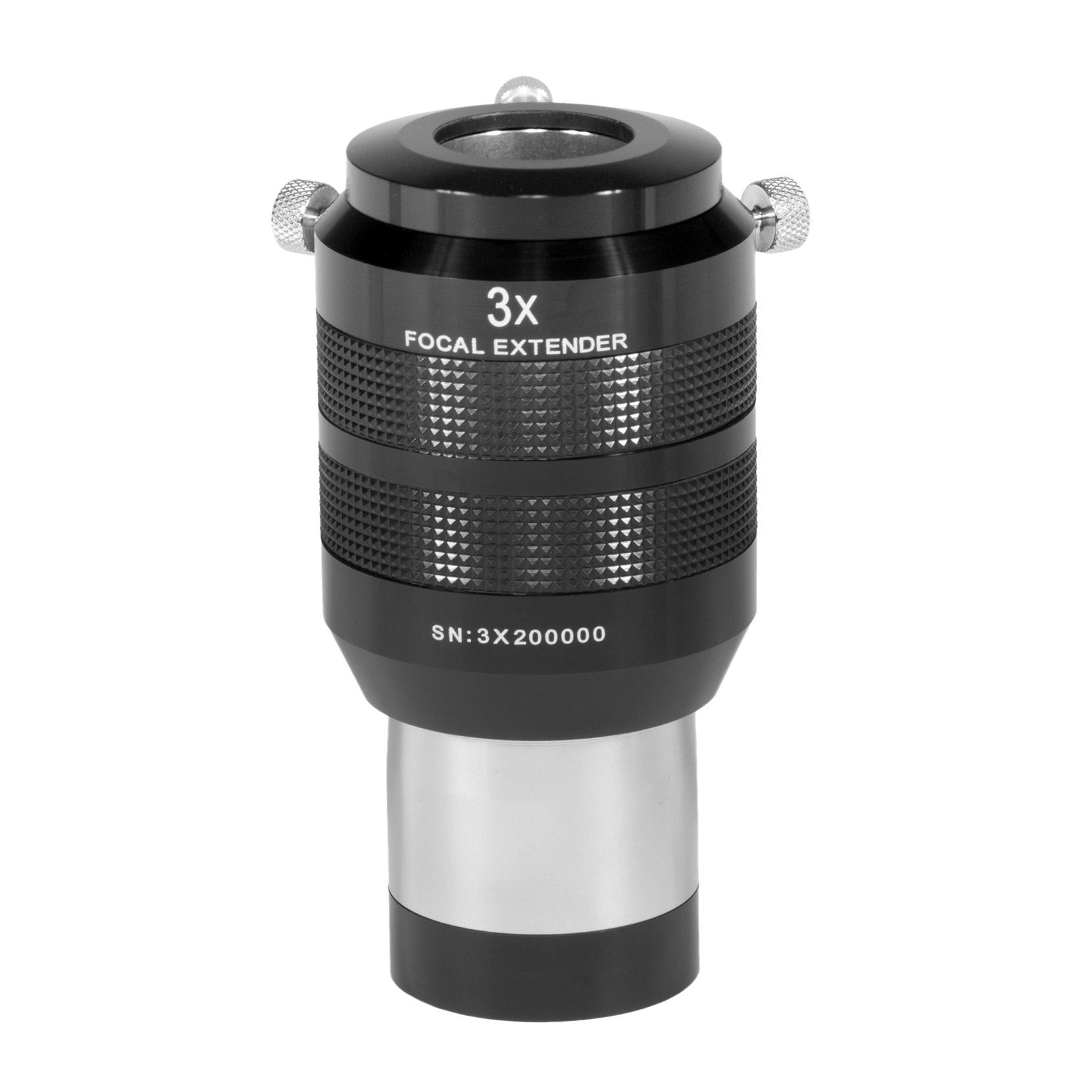
The Explore Scientific FE03-020 is a 3x focal extender in the 2-inch format, 125mm long and 66mm wide. Explore Scientific list its weight two ways — 22 oz on the specification table and 1.7 lbs. on the product page — and both figures are reproduced verbatim below rather than reconciled by us.
A focal extender does what a Barlow does, by a different optical route. It multiplies the effective focal length of the telescope by three, which triples the magnification of whatever eyepiece sits behind it and multiplies the working focal ratio by the same factor. A 1000mm f/8 telescope becomes an effective 3000mm at f/24. A 24mm eyepiece behaves as an 8mm, taking that telescope from 42x to 125x. A 30mm becomes an effective 10mm at 100x.
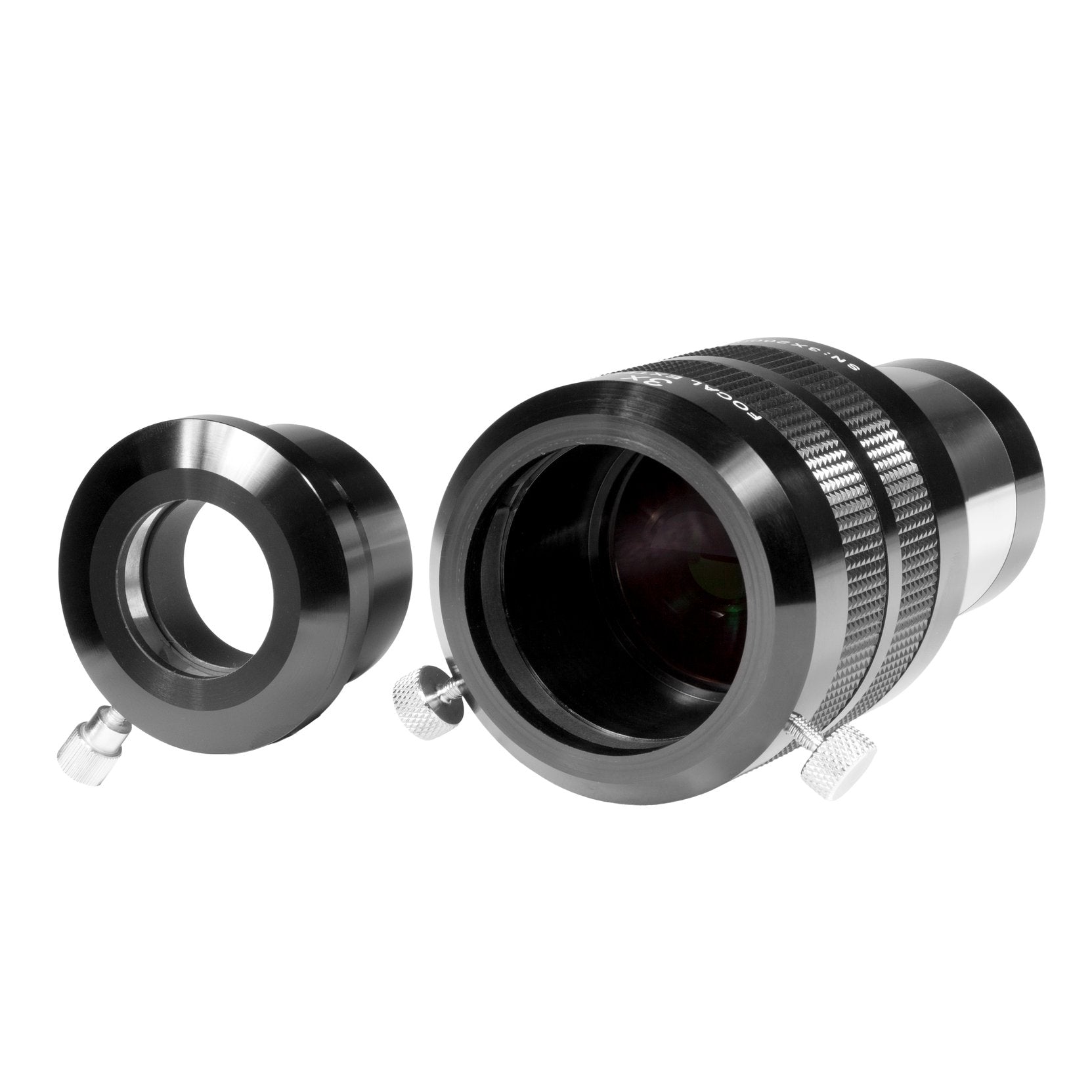
What separates this from a conventional Barlow is the telecentric design. Explore Scientific describe it as using multiple precision lens elements to deliver light rays that remain parallel to the optical axis, which means the magnification factor stays at 3x regardless of how far the eyepiece or camera sits behind it. A simple negative-lens Barlow does not behave that way: its amplification climbs as the spacing grows, so a diagonal or a filter drawer between Barlow and eyepiece changes the factor. Here it does not.
Who It's For
- Planetary and lunar observers: 3x turns a comfortable medium-power eyepiece into a high-power one without giving up its eye relief or apparent field.
- Owners of ultra-wide 2-inch eyepieces: tripling a 24mm or 30mm ultra-wide gives high magnification with the eye position and field of the original eyepiece, which is not something a short focal-length eyepiece can offer.
- Planetary imagers: a fixed 3x that does not drift with spacing makes the image scale predictable when a camera sits at an arbitrary distance behind it.
- Anyone consolidating an eyepiece case: one extender effectively doubles the number of magnifications a set of eyepieces provides.
Key Features & Design
- 3x magnification factor: triples the effective focal length of the telescope and the magnification of every eyepiece used with it.
- Telecentric optical design: multiple precision elements arranged so that emerging rays run parallel to the optical axis, holding the factor at 3x independent of spacing.
- EMD (Enhanced Multi-Layer Deposition) coatings: applied to the lens surfaces to raise transmission and suppress internal reflection through what is a multi-element optical train.
- Edge-blackened elements: the ground edges of the lenses are blackened so that stray light striking them is absorbed rather than scattered into the image.
- 2.0-inch barrel: fits 2-inch focusers and diagonals, and takes 2-inch eyepieces and camera adapters.
- 125mm long, 66mm wide: the published physical dimensions.
- Published weight: 22 oz on the specification table, 1.7 lbs. on the product page — both from Explore Scientific.
Optical Design
A conventional Barlow lens is a negative element placed in the converging beam ahead of focus. It slows the convergence, moving the focal plane further back and increasing the effective focal length. The amplification depends on where the negative element sits relative to the new focal plane, which is why a Barlow's marked factor is only accurate at one particular spacing. Insert a star diagonal, a filter drawer or an extension tube behind it and the true factor rises above the number printed on the barrel.
A telecentric design solves that by adding positive elements after the negative group, arranged so that the chief rays leave the assembly parallel to the optical axis rather than diverging. Once the beam is telecentric, moving the eyepiece or the camera sensor backwards changes the back focus but not the amplification. Three times is three times, whether the eyepiece is seated directly in the extender or sitting behind a diagonal.
That property matters for more than convenience. In imaging, a predictable image scale is what allows a calculated pixel scale to be trusted, and it makes the combination of extender, filter wheel and camera a matter of achieving focus rather than recalculating magnification. The cost of a telecentric group is element count and, therefore, air-to-glass surfaces — which is where the EMD coatings and blackened element edges do their work, and why a telecentric extender is a physically larger object than a simple Barlow of the same nominal power.
Recommended Uses
- High-power lunar and planetary observing using medium focal-length eyepieces.
- Splitting close double stars in apertures that can support the magnification.
- Planetary and lunar imaging, where the fixed amplification keeps image scale predictable.
- Extending the useful range of an existing 2-inch eyepiece set without buying short focal lengths.
Compatibility and Accessory Notes
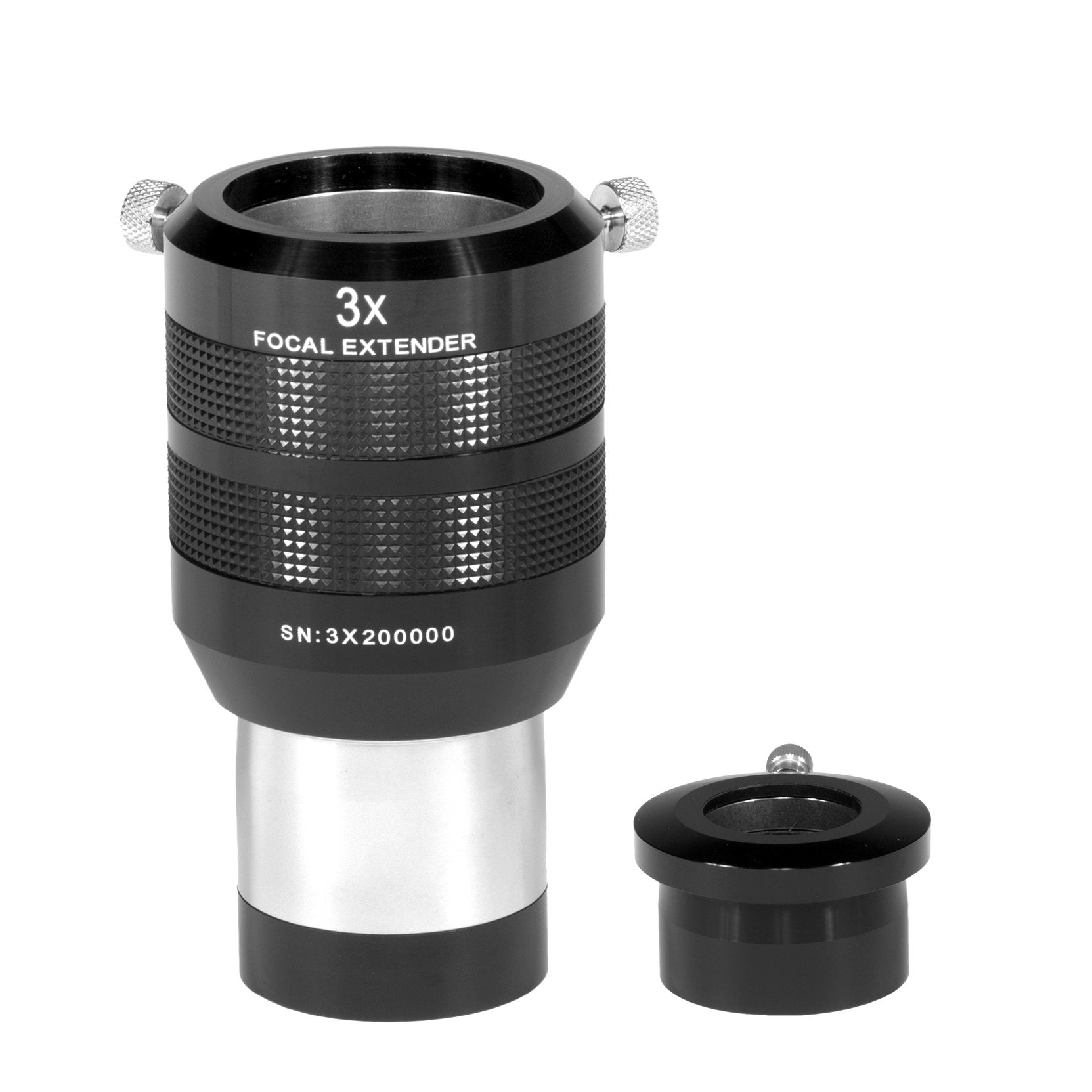
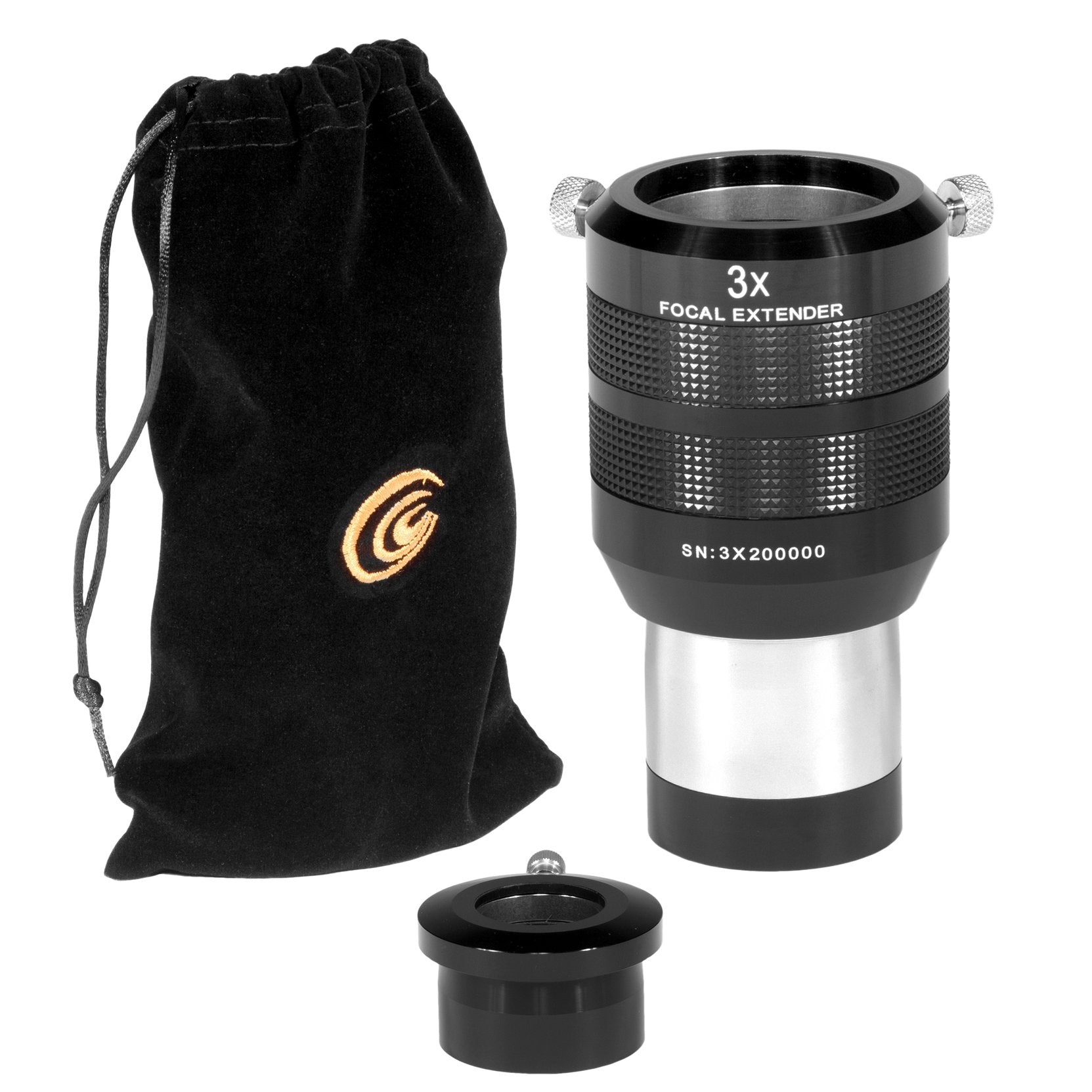
- Fits 2-inch focusers and diagonals. Eyepieces and camera adapters in the 2-inch format go into the top of it. A 1.25-inch eyepiece can be used through a 2-inch to 1.25-inch adapter, which we stock.
- Effective focal length: multiply your telescope's focal length by three. A 750mm Newtonian becomes 2250mm; a 1900mm Maksutov becomes 5700mm.
- Effective focal ratio: also multiplied by three. An f/5 telescope works at f/15 behind this extender, which is worth knowing for exposure planning in imaging.
- Eye relief: unchanged. The eyepiece behaves as a shorter focal length while keeping its own eye relief and apparent field, which is the main reason observers use an extender rather than buying a very short eyepiece.
- Focus travel: adding 125mm of optical train ahead of the eyepiece shifts the focus position outward. Most 2-inch focusers have the travel for it; a telescope already near the end of its inward travel is the one case where it is worth checking, and we can look at that with you.
Good to Know Before You Order
- 3x is a large step. On a 200mm telescope, a 24mm eyepiece behind this extender produces a magnification most nights of average seeing will not support. It is an eyepiece-case tool for the steady nights rather than an every-session accessory — and on those nights it is exactly the right thing to reach for.
- It is a substantial piece of hardware. Explore Scientific publish 22 oz on the specification table and 1.7 lbs. on the product page. Either way, with a 2-inch eyepiece on top of it there is real mass hanging off the focuser, so the drawtube tension is worth setting firmly. A focuser upgrade is the answer where the existing one cannot hold it, and we can advise on that.
- It is 2-inch only. Telescopes with 1.25-inch focusers cannot take it directly; the 1.25-inch focal extenders in the same range are the ones that suit those.
- Explore Scientific does not publish the element count or an optical-length figure for this extender, so those rows are absent rather than estimated. For an imaging train where backfocus has to be calculated, send us the camera and spacers you are working with and we will sort the arithmetic out with you.
- Magnification has a ceiling set by aperture. Roughly twice the aperture in millimetres is the practical limit, and 3x reaches it quickly in smaller instruments. Pairing the extender with a longer eyepiece rather than a short one is how most observers keep it in useful territory.
Frequently Asked Questions
Is it difficult to set up?
No. It goes into the 2-inch focuser or diagonal, and the eyepiece or camera adapter goes into it. Refocusing after fitting it is the only step, and there is nothing to align or adjust.
How is this different from a Barlow?
A Barlow's amplification changes with the distance to the eyepiece, so its marked factor is only correct at one spacing. This is a telecentric design: the rays leave it parallel to the axis, so it stays at 3x whether the eyepiece is seated directly in it or sitting behind a diagonal.
What magnification will I get?
Three times whatever the eyepiece gives on its own. A 24mm eyepiece in a 1000mm telescope gives 42x by itself and 125x through the extender.
Does it change eye relief?
No, and that is the point of using one. The eyepiece keeps its own eye relief and apparent field while behaving as a focal length three times shorter.
Will it work with 1.25-inch eyepieces?
Yes, using a 2-inch to 1.25-inch adapter in the top of it. The extender itself needs a 2-inch focuser or diagonal to sit in.
Bottom Line
In short: a 2-inch telecentric 3x focal extender with EMD coatings and blackened element edges, holding its amplification constant regardless of spacing and leaving the eyepiece's eye relief untouched. If you would like to know which of your eyepieces will still be useful behind it on your telescope, send us the focal length and aperture and we will run the numbers for you.
| Description | 3x Focal Extender (2.0-inch O.D.) |
|---|---|
| Item Number | FE03-020 |
| Magnification Factor | 3x |
| Barrel Size | 2.0-inch |
| Length | 125mm |
| Width | 66mm |
| Weight | 22 oz (Explore Scientific specification table); 1.7 lbs. (Explore Scientific product page) |
| Optical Design | Telecentric, multiple precision lens elements |
| Coatings | EMD (Enhanced Multi-Layer Deposition) |
| Element Edges | Blackened |
| Element Count | Not published by vendor |
| Optical Length / Spacing Requirement | Not published by vendor |
You may also like
Recently viewed
Recent Blog Posts
View all
Your Guide Graph Is Lying to You
Read More

D-Size vs V-Size: A Complete Guide to Telescope Dovetail Systems
Read More

What Is Back Focus in Astrophotography? Telescope Reducers, Flatteners, and Spacing Explained
Read More