
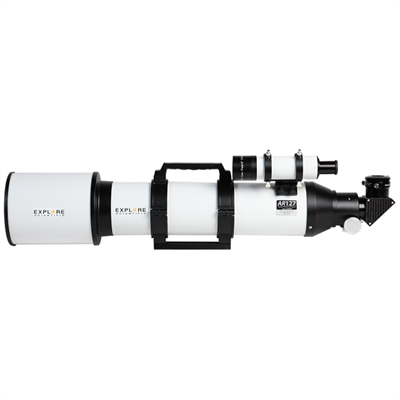

- Description
- Specifications
Product Overview
The Explore Scientific AR127 is a 127mm air-spaced crown-and-flint achromatic doublet refractor with a published focal length of 826mm at f/6.5. That focal ratio is the defining number on this tube: a five-inch achromat built in the classic long-focus tradition would run well over a metre and a half, while the AR127 measures 34″ (863mm) with the dew shield in place and 130mm across the tube.
Explore Scientific publishes a limiting magnitude of 13 and a resolution of .9 arcsec for this objective, and lists the tube assembly at 15.6lb (7.1kg). At 127mm the objective gathers roughly 330 times the light of a dark-adapted eye, which is what puts magnitude 13 within reach on a good night. The tube is aluminium and stainless steel in gloss white, and the optical surfaces carry EMD (Enhanced Multi-Layer Deposition) coatings.
It arrives as an optical tube assembly with its accessory package: a heavy-duty 2-inch dual-speed Crayford-style focuser, a one-piece 2-inch diagonal with 99% dielectric coatings and a 1.25-inch compression-ring adapter, an 8x50 straight-through finderscope with a 6° field and quick-release bracket, and an extruded aluminium cradle ring assembly on a Vixen-style plate. Mount, tripod and eyepieces are chosen separately.
Who It's For
- Wide-field visual observers: 826mm with a 2-inch focuser puts large open clusters, the Double Cluster and the sweep of the Milky Way in a single field. A 30mm eyepiece works out to 27.5x here, which is genuinely low power for five inches of aperture.
- Observers who want aperture without maintenance: a refractor holds its collimation, so there is no mirror to align before a session and no open tube to collect dust.
- This is a good match if you already own a mount with real capacity to spare and want the largest achromat that mount will carry comfortably at 15.6lb before accessories.
Key Features & Design
- 127mm air-spaced doublet: crown and flint elements separated by an air gap rather than cemented together, on research-grade diffraction-limited surfaces.
- 826mm focal length at f/6.5: short for the aperture, which is what keeps the tube to 34″ and the true field wide.
- 2″ dual-speed Crayford-style focuser: coarse and fine motion on concentric knobs, which is what makes focus repeatable at higher magnifications.
- One-piece 2″ diagonal with 99% dielectric coatings, supplied with the telescope along with a 1.25-inch compression-ring adapter.
- 8x50 straight-through finderscope with a wide 6° field, front objective focus and a quick-release bracket.
- Cradle ring assembly and universal adjustable mounting plate: the Vixen-style plate fits saddles from Explore Scientific, Meade, Celestron, Vixen and others.
- User-serviceable lens cell: refractors rarely need collimation after factory adjustment, and the cell design allows it to be done at home.
- Published dimensions: 130mm tube diameter, 34″ (863mm) length with the dew shield, 15.6lb (7.1kg) assembly weight.
Optical Design
An achromatic doublet brings two wavelengths of light to a common focus by pairing a crown-glass element with a flint-glass element of opposing dispersion. Air-spacing the two, rather than cementing them, gives the designer four working surfaces instead of two and removes the cement layer as a thermal variable inside a 127mm lens. It also lets the cell hold each element independently, which is part of why consumer collimation is possible on this tube at all.
An achromat is not an apochromat, and at f/6.5 the difference shows on the brightest targets. Venus, Jupiter, Sirius and the lunar limb will carry a violet edge at high magnification — the behaviour of a two-element crown-and-flint design rather than a fault in this example. On clusters, nebulae and general low-power sweeping, which is the observing an f/6.5 five-inch is built around, it is not a factor. Observers who want it reduced usually add a minus-violet filter to the 2-inch diagonal, and we stock those; observers who want the colour gone rather than reduced are looking at an ED or apochromatic triplet, which we also carry.
Recommended Uses
- Low and medium-power sweeping of open clusters, bright nebulae and the larger galaxies.
- Lunar and planetary observing on steady nights, within the published .9 arcsec resolution.
- Double-star work, where the resolution figure is the governing specification.
- Public outreach, star parties and classroom sessions.
Compatibility and Accessory Notes
- Mount: not included. The published tube weight is 15.6lb before the diagonal, finder and an eyepiece, so the loaded assembly sits above that. A mount rated comfortably beyond the loaded figure is the sensible starting point for visual use, and more again for imaging.
- Dovetail: the Vixen-style universal plate on the cradle rings drops into Vixen saddles and into dual-fit saddles that take both Vixen and Losmandy plates.
- Eyepieces: none supplied. The 2-inch focuser and diagonal accept 2-inch eyepieces directly and 1.25-inch eyepieces through the included compression-ring adapter. At 826mm, a 30mm gives 27.5x, a 25mm gives 33x, a 9mm gives 92x and a 5.5mm gives 150x.
- Imaging: a field flattener is the usual addition for deep-sky work with a fast refractor. Explore Scientific does not publish a corrected image circle or a backfocus figure for this tube, so we are not quoting one — send us the camera and flattener you have in mind and we will work out the spacing with you.
Good to Know Before You Order
- This is an optical tube assembly rather than a complete telescope. A mount, a tripod and at least one eyepiece complete it. We can quote the whole package together if that is simpler.
- It is a 34-inch, 15.6lb tube. That is a two-hands lift onto a saddle and a real presence in a car boot. Levelling and balancing the mount before the tube goes on makes the job easier.
- Achromatic, not apochromatic. Colour on the brightest objects at high power comes with the design at this focal ratio. A minus-violet filter reduces it, and at the low and medium powers this tube is built for it is not the limiting factor.
- Explore Scientific publishes no corrected image circle and no backfocus figure for the AR127, so those rows are absent from the specification table rather than estimated. If you are planning an imaging train, tell us what is in it and we will sort the spacing out with you.
Frequently Asked Questions
Is it difficult to set up?
The optics are the easy part — a refractor arrives collimated and stays that way, so the telescope is ready the moment it is on the mount. The effort is in the handling: 15.6lb and 34 inches is a two-handed lift, and the cradle rings slide onto a Vixen saddle in one motion once the mount is levelled.
What mount does it need?
One rated well beyond the loaded tube weight. 15.6lb bare becomes noticeably more with the 2-inch diagonal, the 8x50 finder and a heavy eyepiece hanging off the back. Tell us what you already own and we will give you a straight answer on whether it will carry this comfortably.
Does it come with eyepieces?
No. The 2-inch dual-speed focuser, the 2-inch dielectric diagonal, the 1.25-inch adapter, the 8x50 finder and the cradle rings are all included; eyepieces are chosen to suit the observing you do.
Will I see colour fringing?
On Venus, Jupiter, Sirius and the edge of the Moon at high magnification, yes. That is what an f/6.5 achromatic doublet does. On clusters, nebulae and galaxies at the powers this focal ratio was designed around, it is not something that intrudes.
Bottom Line
In short: a 127mm f/6.5 air-spaced achromat at 826mm focal length, supplied as a 15.6lb tube assembly with a 2-inch dual-speed focuser, a dielectric diagonal, an 8x50 finder and a Vixen-style dovetail — five inches of low-maintenance aperture built for wide, bright views. If you are matching it to a mount you already have, send us the model and we will confirm the fit with you before anything ships.
| Item Number | DAR127065-02 |
|---|---|
| Optical Design | Air-spaced crown-and-flint achromatic doublet |
| Aperture | 127mm |
| Focal Length | 826mm |
| Focal Ratio | f/6.5 |
| Limiting Magnitude | 13 |
| Resolution | .9 arcsec |
| Tube Length w/ Dew Shield | 34"; 863mm |
| Diameter | 130mm |
| Weight | 15.6lb; 7.1kg |
| Dovetail | Vixen |
| Coatings | EMD (Enhanced Multi-Layer Deposition) |
| Focuser | 2" dual-speed Crayford-style |
| Diagonal | One-piece 2" with 99% dielectric coatings; 1.25" compression ring adapter included |
| Finderscope | 8x50 straight-through, 6° field, quick-release bracket |
| Tube Materials | Aluminum and stainless steel, gloss white finish |
| Mount | Not included |
| Eyepieces | Not included |
| Corrected Image Circle | Not published by vendor |
| Backfocus | Not published by vendor |
You may also like
Recently viewed
Recent Blog Posts
View all
Your Guide Graph Is Lying to You
Read More

D-Size vs V-Size: A Complete Guide to Telescope Dovetail Systems
Read More

What Is Back Focus in Astrophotography? Telescope Reducers, Flatteners, and Spacing Explained
Read More