
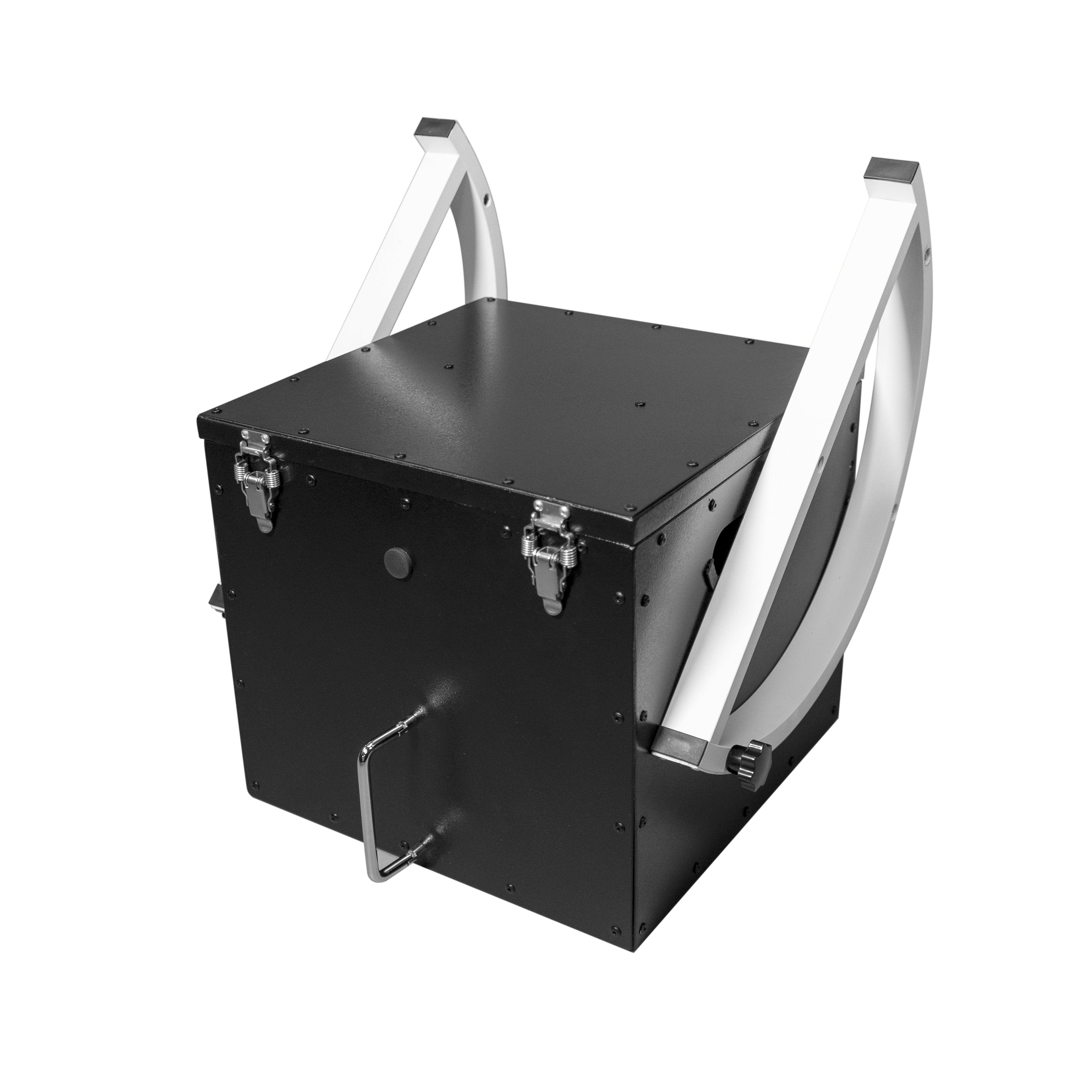


- Description
- Specifications
Product Overview
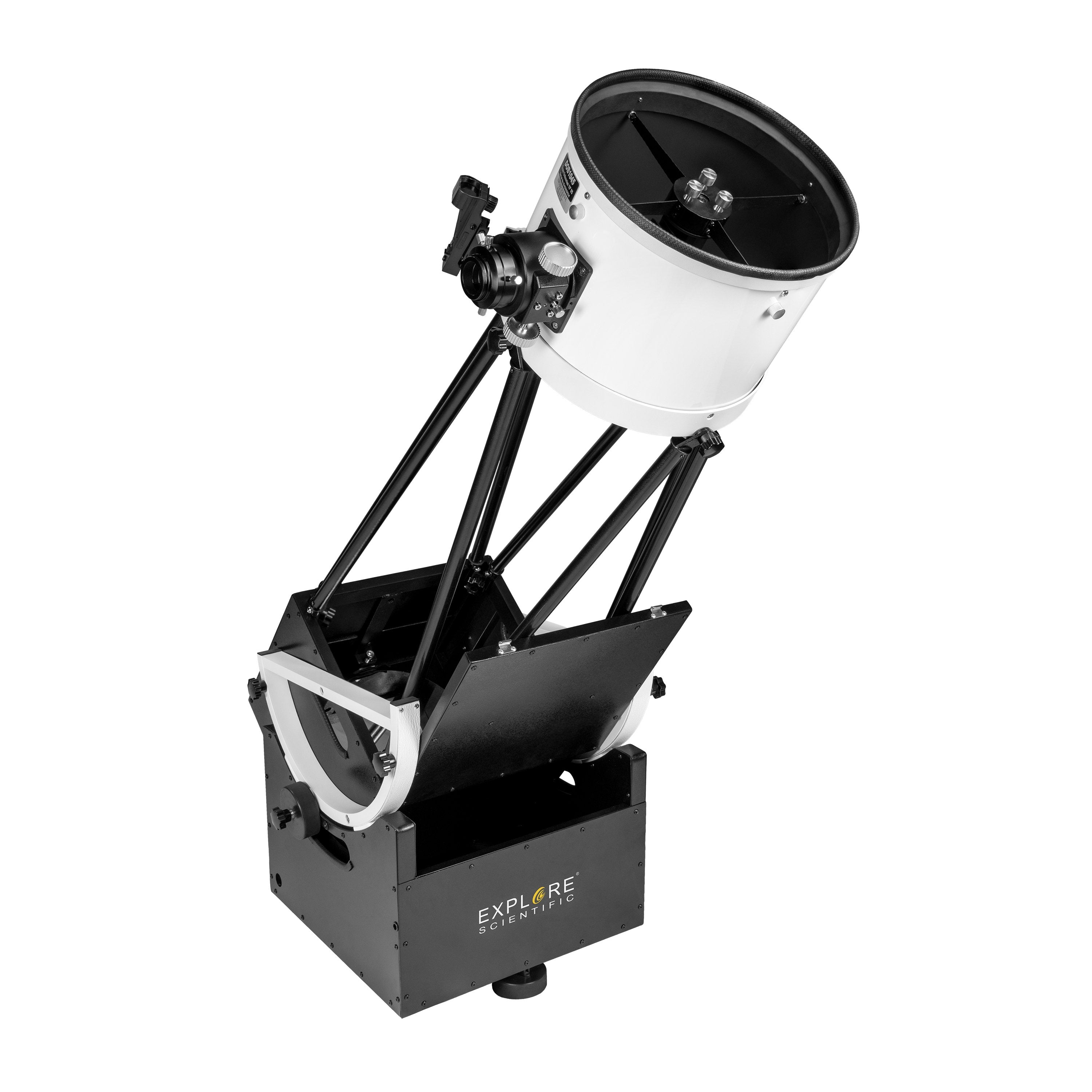
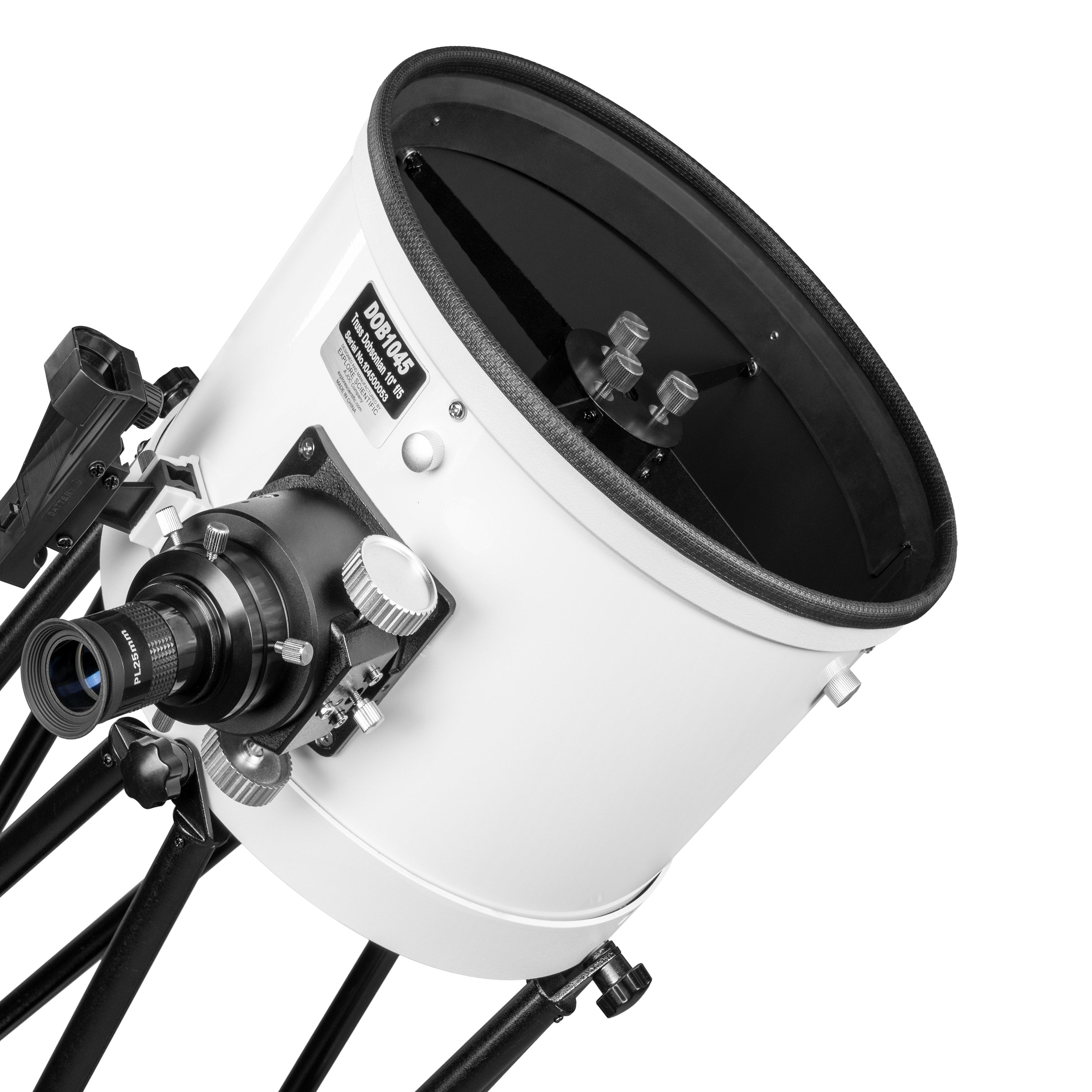
The Explore Scientific 10-inch Hybrid Truss Tube Dobsonian puts a 254 mm primary mirror on a classic Dobsonian base, using a truss structure for the upper tube so the whole telescope breaks down for transport. Focal length is 1270 mm at f/5, theoretical limiting magnitude is 14.7, and the telescope arrives with two eyepieces, a red-dot finder, a collimation tool, a moon filter, a star map, and a planisphere.
Who It's For
Ten inches of aperture is where faint galaxies start to show spiral structure and where planetary detail holds up at high power on a steady night. The hybrid truss design is what makes that aperture practical: the upper cage lifts away from the mirror box, so instead of one long tube you carry two pieces that fit in most vehicles. This suits an observer who wants serious deep-sky reach and is happy to assemble a telescope on site rather than lift a solid tube in one go.
Key Features & Design
- 254 mm (10-inch) primary mirror on a 9-point mirror cell support for accurate figure retention
- 1270 mm focal length at f/5, with a theoretical limiting magnitude of 14.7 and 500x maximum magnification
- Hybrid truss tube with tool-free assembly — the secondary cage lifts off the mirror box for transport
- Secondary obstruction of just 24%, keeping contrast high on planetary detail
- Rigid aluminium construction with large altitude bearings for smooth motion at any magnification
- Complete accessory kit: two eyepieces, red-dot finder, collimation tool, moon filter, star map, and planisphere
Optical and Mechanical Design
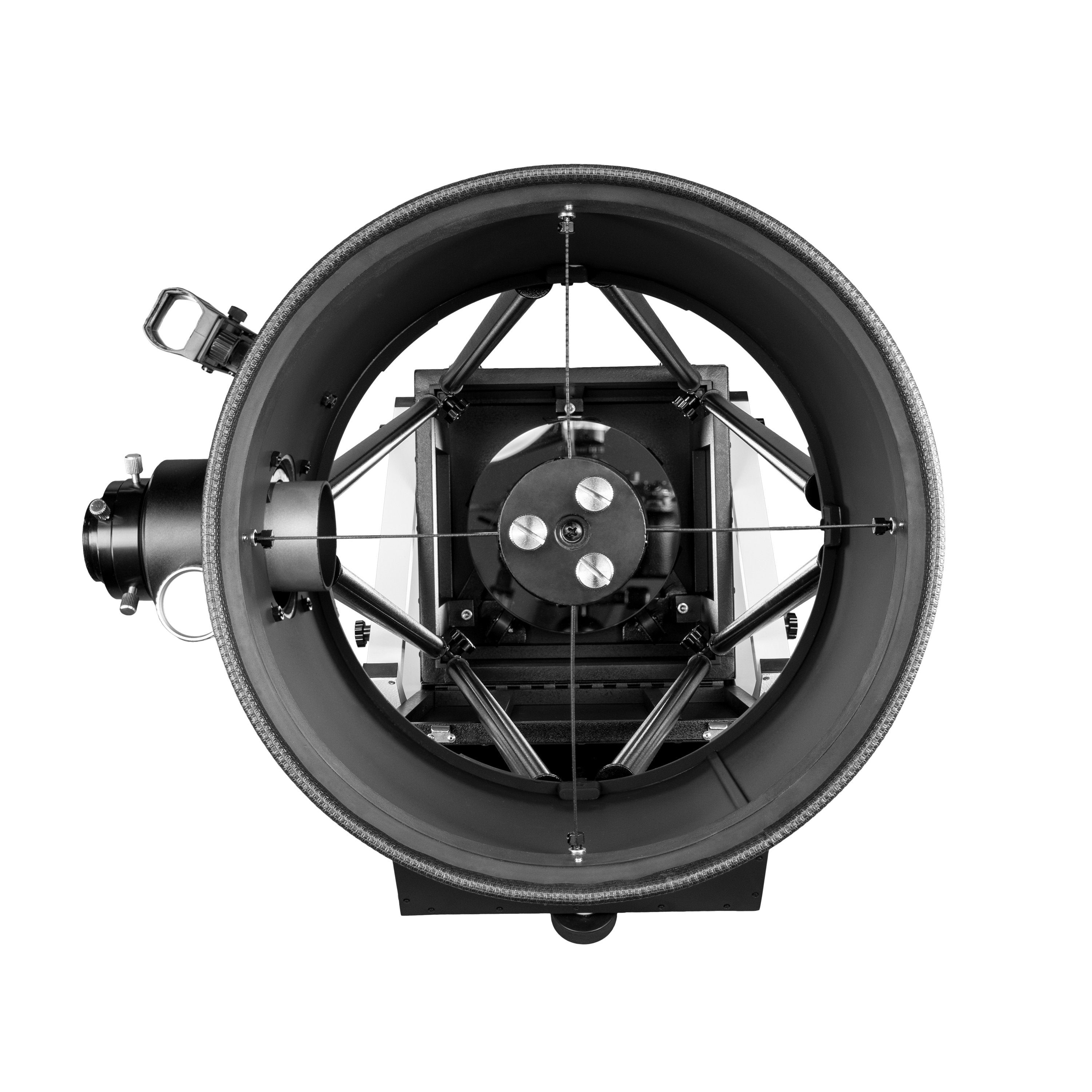
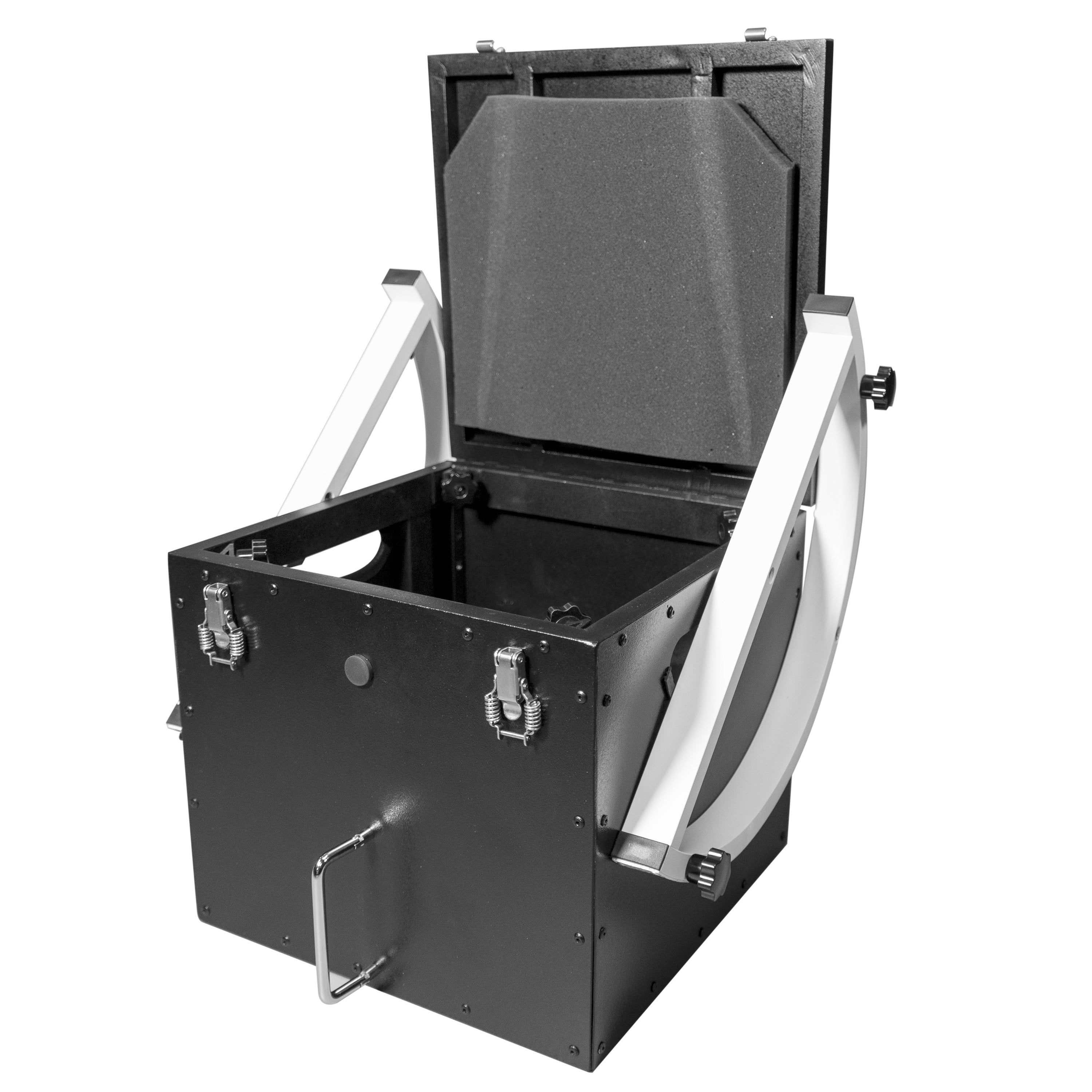
Large mirrors flex under their own weight, which is why the mirror cell here supports the primary at nine points rather than three — it keeps the optical figure true across the whole surface. The 24% secondary obstruction is low for this aperture, and less obstruction means more contrast on fine planetary detail. Theoretical resolution is 0.46 arcseconds with a Rayleigh limit of 0.54 arcseconds. The truss poles are 64 cm long and 20 mm in diameter, the secondary cage measures 38 cm across and 17 cm tall at 6.5 lb, and the mirror box and rocker box stand 42.5 cm. The eyepiece sits 119 cm above the ground when pointed at the zenith.
Recommended Uses
- Faint deep-sky observing — galaxies, planetary nebulae, and globular clusters resolved to the core
- High-power lunar and planetary work, where the low secondary obstruction pays off
- Dark-site trips, with the telescope broken down into transportable sections
- Star parties and outreach, where a 10-inch view draws a queue
Compatibility and Accessory Notes
The supplied accessory kit covers a first night completely, including the collimation tool a truss Dobsonian genuinely needs. Collimation is part of owning this telescope: the truss structure is reassembled each session, so a quick mirror check before observing becomes routine, and the included tool makes it a two-minute job. A 2-inch wide-field eyepiece is the classic upgrade for a 10-inch f/5 — contact us to confirm focuser fit. A light shroud around the truss section improves contrast under stray light and we stock shrouds for this class of telescope.
Good to Know Before You Order
Explore Scientific publishes 6.5 lb for the secondary cage assembly and approximately 35 lb for the mirror box, noting that mirror weight varies with manufacturing, and they publish no total shipped weight. We are confirming the boxed weight on our own scales before this listing goes live, which is why it is currently unpublished — contact us and we will give you the shipping figure for your address. The eyepiece height of 119 cm at the zenith suits standing observation for most adults, with a stool useful for lower targets.
Frequently Asked Questions
Is it difficult to set up? Assembly is tool-free: place the mirror box, fit the truss poles, lower the secondary cage on. It takes a few minutes and becomes quick with practice. Collimating afterwards is fast with the included tool.
How does a truss compare with a solid tube? Optically they are the same. The truss version transports in smaller pieces and cools to ambient temperature faster; a solid tube blocks stray light better, which a shroud addresses.
What will 10 inches show that 8 will not? Around 55% more light. Fainter galaxies become visible, and the ones you already know start to show structure rather than a smudge.
Does it track? No — this is a manual Dobsonian, nudged by hand. The large altitude bearings make following an object at high power straightforward.
Bottom Line
A 10-inch mirror with a low-obstruction optical design and a full accessory kit, in a form that actually fits in a car. It is the aperture at which deep-sky observing stops being a hunt for smudges. Talk to our Bolton team about shrouds and 2-inch eyepieces to get the most from it.
| Item number | DOB1045C |
|---|---|
| Optical design | Newtonian reflector, hybrid truss tube, Dobsonian mount |
| Primary mirror diameter | 25.4 cm (254 mm) |
| Focal length | 1,270 mm |
| Focal ratio | f/5 |
| Secondary obstruction | 24% |
| Mirror cell support points | 9 |
| Theoretical resolution | 0.46 arcsec |
| Theoretical Rayleigh limit | 0.54 arcsec |
| Theoretical limiting magnitude | 14.7 |
| Theoretical maximum magnification | 500x |
| Truss pole length | 64 cm |
| Truss pole diameter | 20 mm |
| Secondary cage assembly diameter | 38 cm OD |
| Secondary cage assembly height | 17 cm |
| Secondary cage assembly weight | 6.5 lb |
| Mirror box / rocker box height | 42.5 cm |
| Mirror box weight | Approx. 35 lb (varies with mirror manufacture) |
| Eyepiece height at zenith | 119 cm |
| Included accessories | Two eyepieces, red dot finder, collimation tool, moon filter, star map, planisphere |
| Tracking or GoTo | None; manual |
You may also like
Recently viewed
Recent Blog Posts
View all
Your Guide Graph Is Lying to You
Read More

D-Size vs V-Size: A Complete Guide to Telescope Dovetail Systems
Read More

What Is Back Focus in Astrophotography? Telescope Reducers, Flatteners, and Spacing Explained
Read More