


- Description
Product Overview
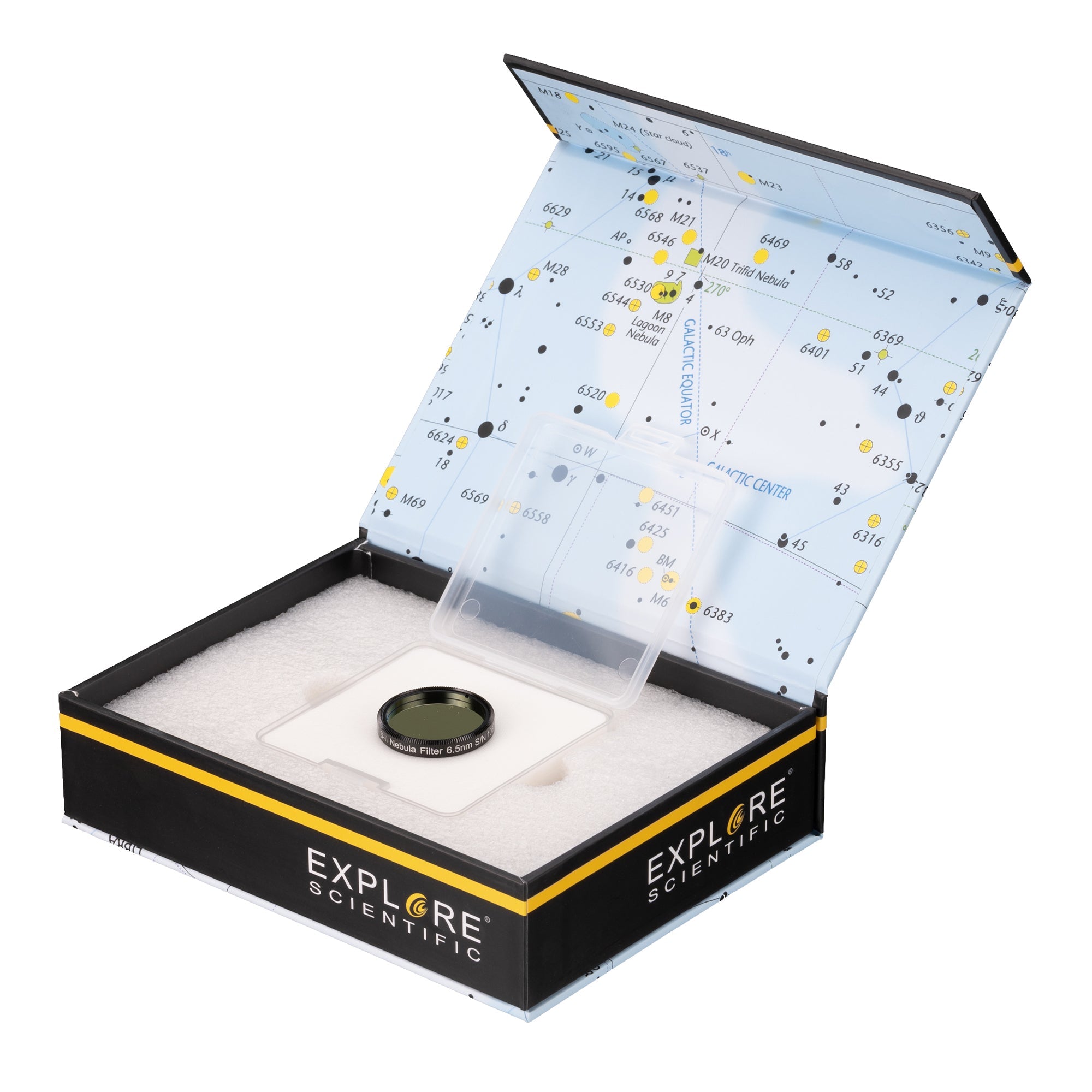
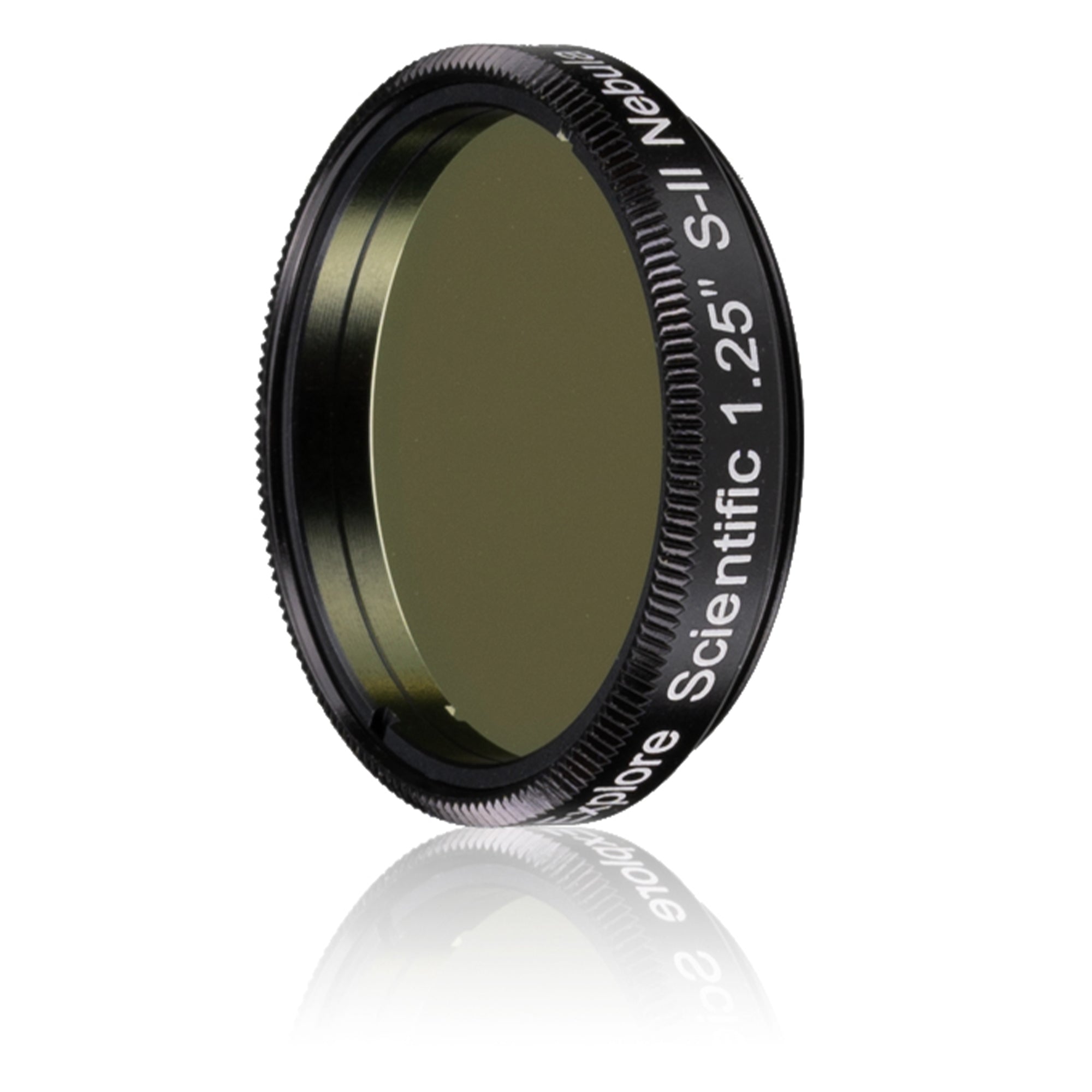
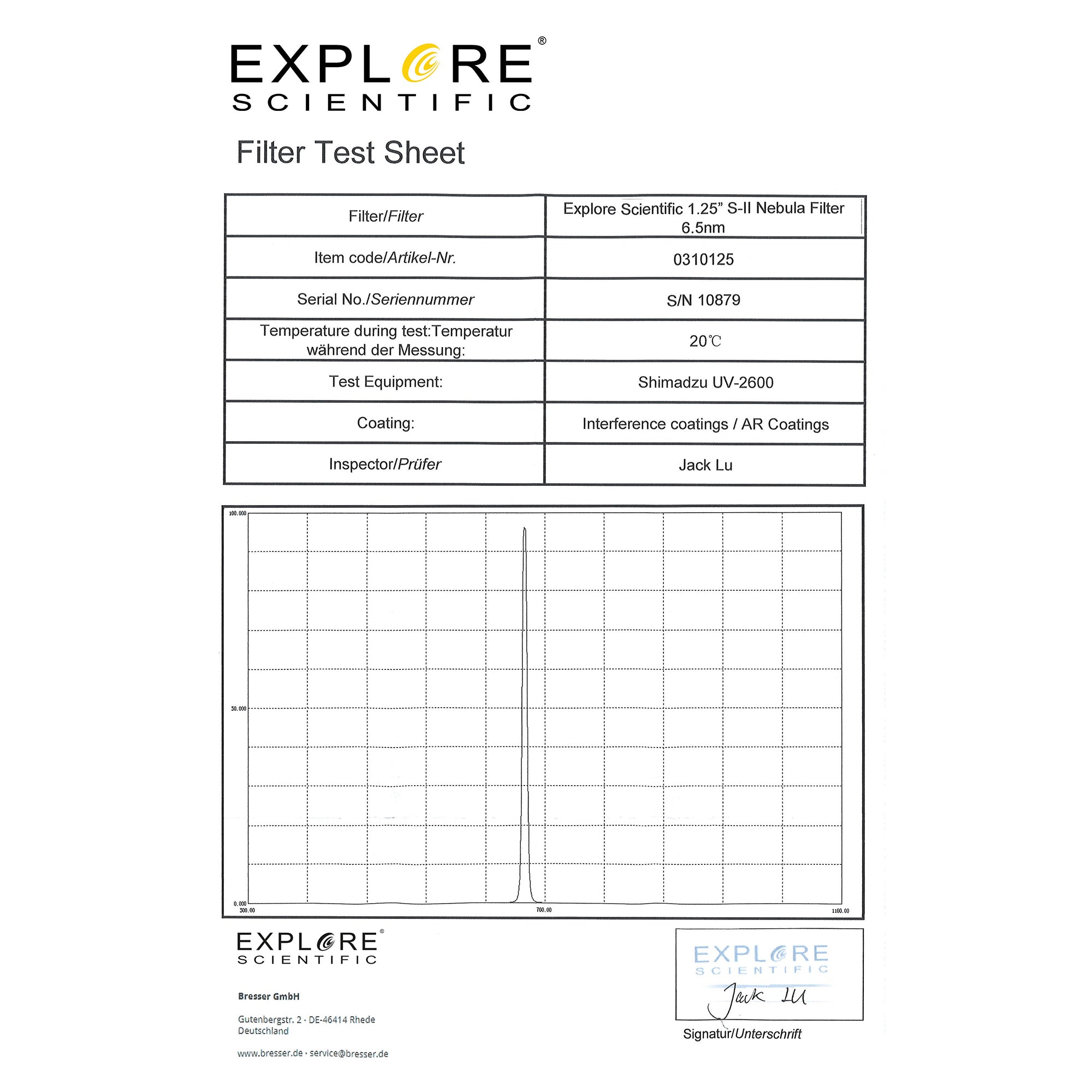
This is the tighter of the two 1.25-inch sulphur filters Explore Scientific builds: a narrowband interference filter with a 6.5 nm passband sitting on the ionised sulphur emission line at 672 nm. Explore Scientific describes the effect in blunt terms, noting that with the filter in place fog becomes visible in places that appear completely empty without one. The filter comes in a standard 1.25-inch threaded cell and is supplied with an individual test report measured on the actual filter you receive rather than a generic curve for the product line.
Who It's For
Halving the passband does something specific and worth being precise about. The emission line you want is a few tenths of a nanometre wide, so narrowing the window from 12 nm to 6.5 nm passes essentially the same nebular signal while cutting the continuum sky background you collect alongside it by close to half. In a background-limited exposure that is a real gain in signal-to-noise, and it is why this filter keeps working on nights when a 12 nm filter is already struggling: near a gibbous or full moon, under a bright suburban dome, or on targets low enough to sit in the worst of the light dome.
The bill comes due elsewhere. Sulphur is the faintest of the three lines normally mapped in narrowband work, and a tighter filter is more sensitive to the angle at which light strikes it. That combination means this filter wants a slower light cone, roughly f/5 and above, a camera with low read noise so that long subframes are not wasted, and an owner willing to spend real integration time on the sulphur channel: ten to twenty minute subframes and several hours per session are normal here, not exceptional. Choose it if you already know your way around narrowband processing, if your sky is genuinely bright and you need the extra rejection more than the extra photons, or if you image with enough aperture that the faintness of S-II is not the limiting factor. If you are still on a fast small refractor and short exposures, the 12 nm sibling is the better tool.
Key Features & Design
- 6.5 nm passband, roughly half the sky background of a 12 nm filter for the same nebular signal
- Centred on the ionised sulphur emission line at 672 nm
- Deep rejection of the rest of the visible spectrum, including mercury and sodium vapour street lighting
- Mounted in a standard 1.25-inch threaded cell for eyepiece barrels, nosepieces and 1.25-inch filter wheels
- Individual test report for the specific filter supplied, included with the product
- Suited to planetary nebulae, emission nebulae and supernova remnants, the three families Explore Scientific names for this filter
- Holds contrast in moonlight where wider narrowband filters begin to lose it
Filter Design
The passband of a dielectric interference filter is set by the optical thickness of its coating layers, and that optical thickness depends on the path a ray takes through them. Light arriving square to the surface sees the design thickness; light arriving at an angle sees a different one, and the whole transmission curve slides toward shorter wavelengths. The shift is not large in absolute terms, but it is measured against the width of your window. A ray tilted enough to move the band by two nanometres is a minor nuisance in a 12 nm filter and a significant loss of transmission in a 6.5 nm one, because the 672 nm line you are trying to record is now sitting on the shoulder of the curve rather than at its peak. This is the physical reason narrower filters are usually specified with a focal ratio limit, and why 6.5 nm is best matched to systems around f/5 and slower rather than to fast astrographs.
Recommended Uses
- Sulphur data for mapped-colour narrowband imaging from bright suburban and urban sites
- Imaging through moonlight, when the sky background rather than the target sets your limit
- Supernova remnants and planetary nebulae where sulphur structure is the point of the exercise
- Long-integration projects on emission nebulae where the sulphur channel needs the most help
- Monochrome cameras on 1.25-inch filter wheels with sensors up to about Four Thirds format
Compatibility and Accessory Notes
Standard 1.25-inch filter threads mean this screws directly into a 1.25-inch camera nosepiece, an eyepiece barrel, or the carousel of a 1.25-inch filter wheel. It is not a match for 2-inch wheels or for the unmounted 31 mm and 36 mm formats used in many larger wheels, and the extra thickness of a mounted cell can matter in tight backfocus arrangements with an off-axis guider. If you already own the matching Explore Scientific hydrogen-alpha filter at a different bandwidth, be aware that mixing widths across a set means each channel reaches a given depth at a different rate, which complicates exposure planning more than it complicates processing. Send us your imaging train and our team in Bolton will confirm the fit and the spacing before you order.
Good to Know Before You Order
Explore Scientific publishes no shipping weight for this item, so we are confirming it on our own scales before the listing goes live. That is why it is currently unpublished. Contact us and we will give you a shipping figure for your address. Two other things are worth saying plainly. First, this is not a visual filter in any practical sense: 6.5 nm at 672 nm leaves far too little light for the dark-adapted eye. Second, Explore Scientific does not publish peak transmission, substrate or out-of-band blocking figures on the product page, so we do not repeat numbers we cannot verify. The individual test report packed with the filter is the authoritative measurement for your copy. The scope of delivery is the filter and that report; camera, wheel, adapters and spacers are not included.
Frequently Asked Questions
Is 6.5 nm always better than 12 nm? No. It is better when the sky background is what limits you, which is most urban and moonlit nights. It is worse when the target itself is what limits you, which is what happens on a fast small aperture with short subframes on a faint line like sulphur. Match the filter to your bottleneck.
What focal ratio can I use it at? Explore Scientific does not publish a limit, but the physics of interference coatings means that below roughly f/4 the passband shift across a converging beam starts to cost you real transmission at 672 nm. Around f/5 and slower this filter is comfortable. If you are near the boundary, contact us and we will talk through your specific optics.
How long should my subframes be? Longer than you are used to. With a cooled monochrome camera, ten to twenty minutes per subframe on the sulphur channel is a reasonable starting point, and expect to need more total integration on S-II than on hydrogen-alpha for the same target.
Does the test report matter? It is genuinely useful. It tells you where the centre wavelength of your particular filter landed and how the transmission curve is shaped, which is the information you need if you are ever troubleshooting a weak channel.
Bottom Line
The 6.5 nm S-II is the version for imagers whose enemy is the sky, not the clock: it trades photons for contrast and rewards patience, aperture and a moderate focal ratio. If you are already producing usable sulphur data and want it cleaner under a brighter sky, this is the upgrade. Contact us if you would like a second opinion on whether your rig will make the most of it.
You may also like
Recently viewed
Recent Blog Posts
View all
Your Guide Graph Is Lying to You
Read More
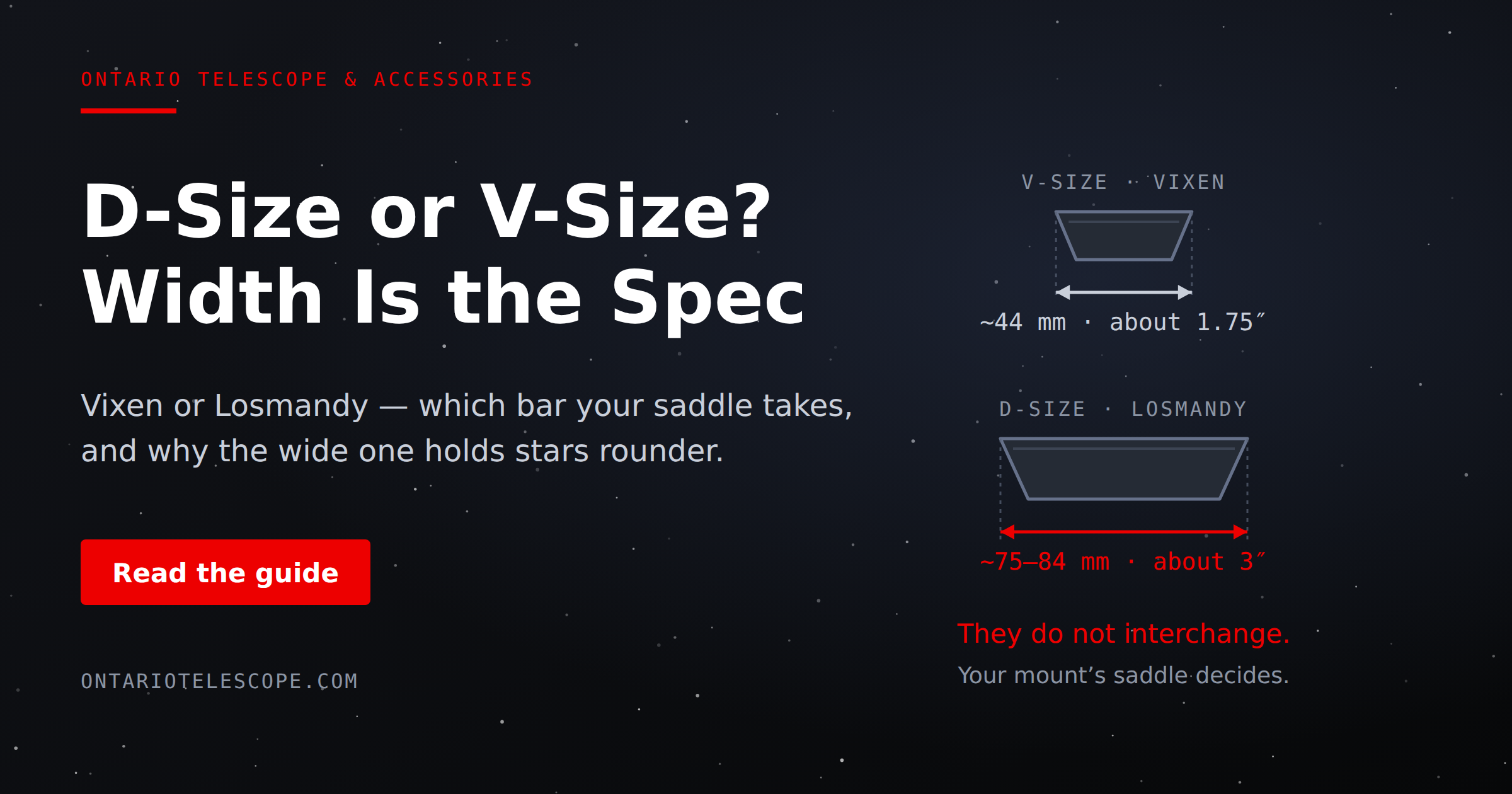
D-Size vs V-Size: A Complete Guide to Telescope Dovetail Systems
Read More
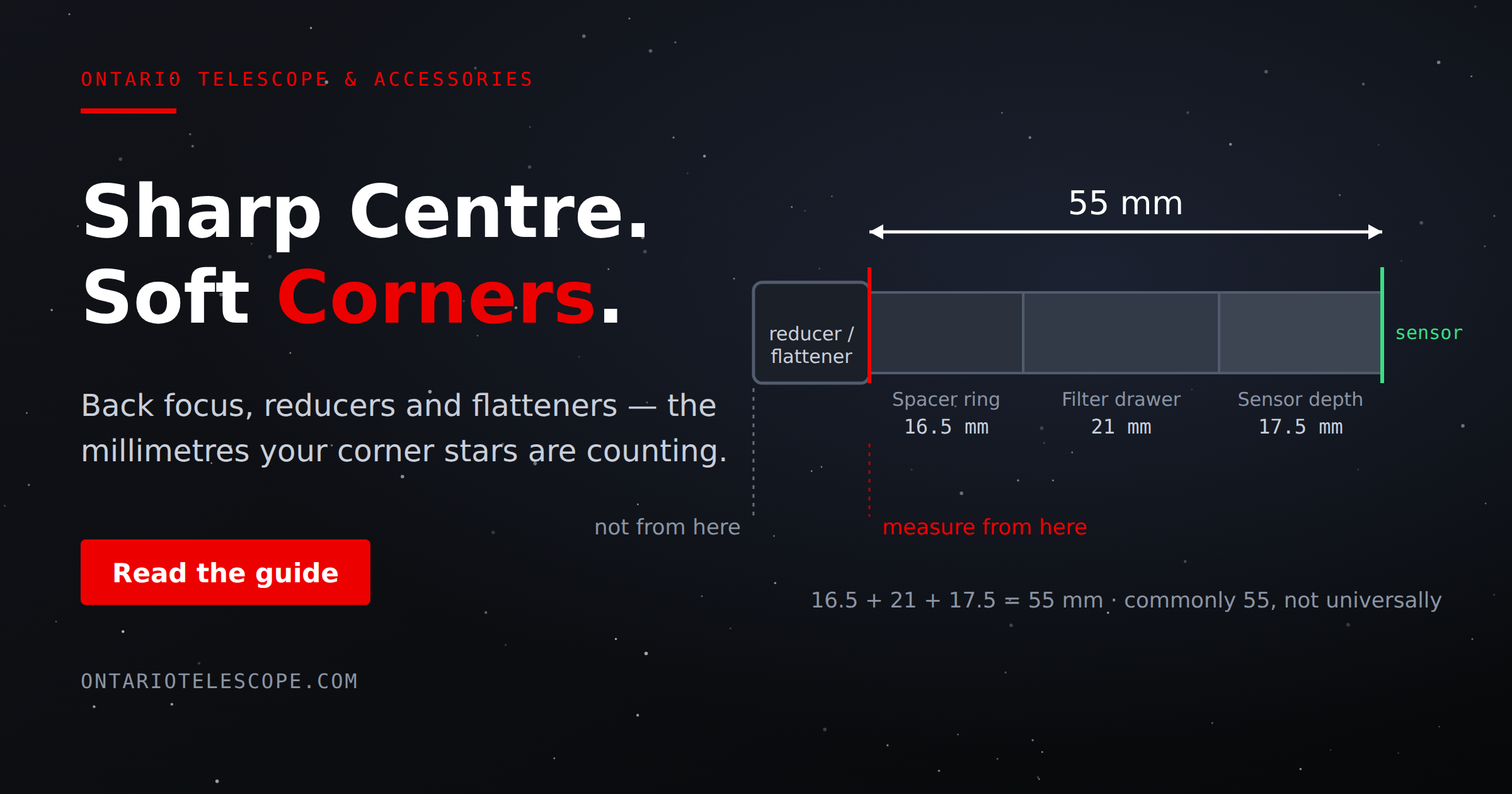
What Is Back Focus in Astrophotography? Telescope Reducers, Flatteners, and Spacing Explained
Read More