


- Description
Product Overview
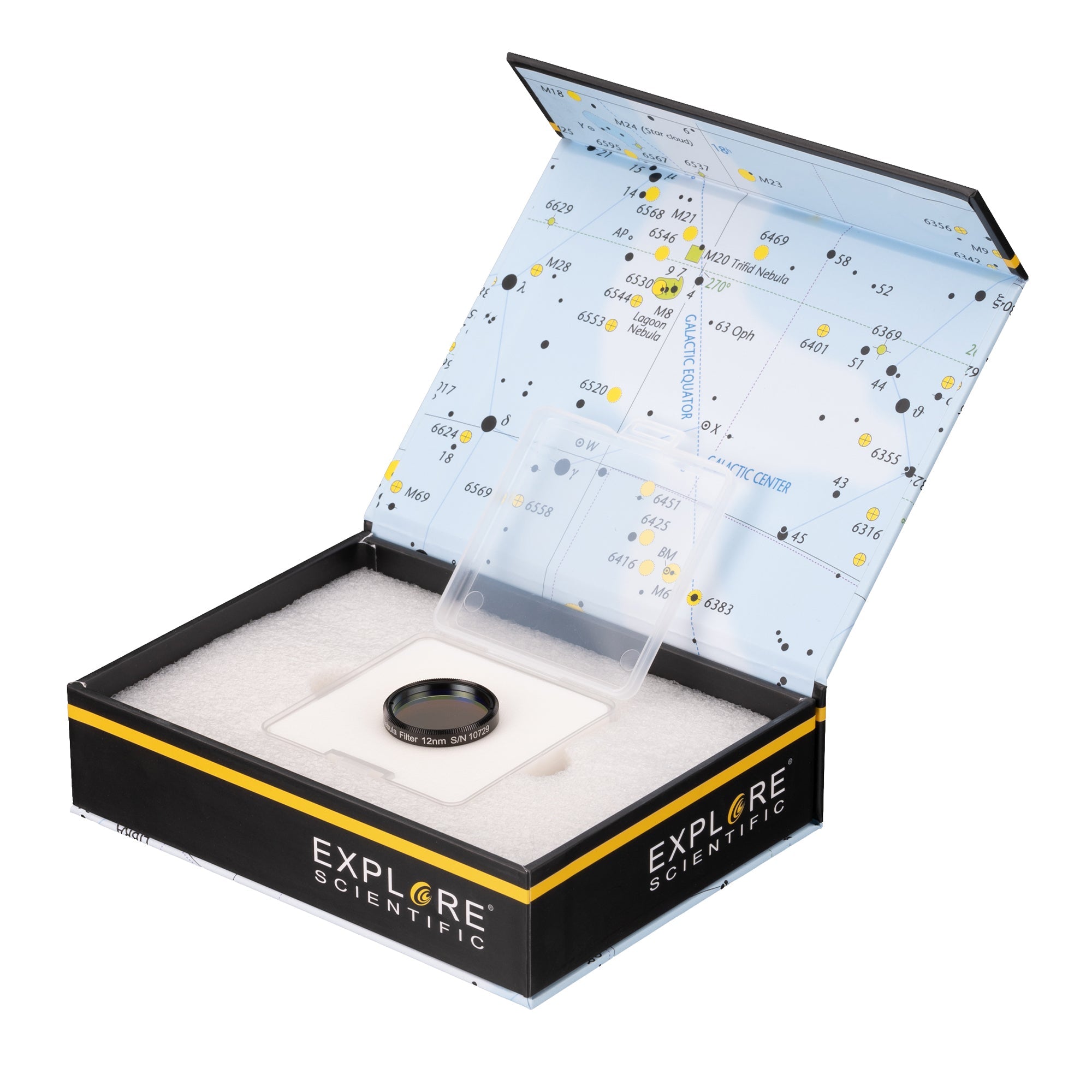
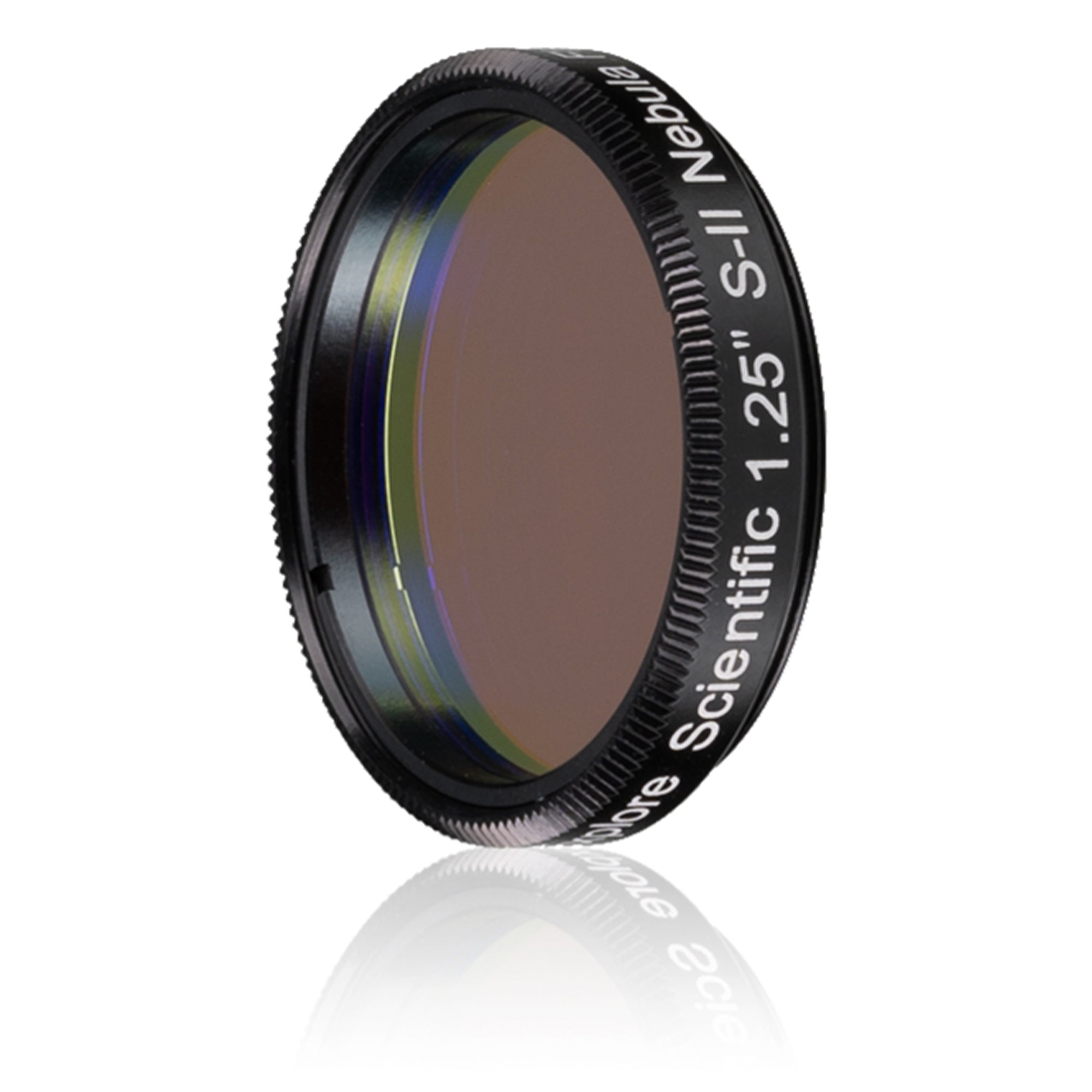
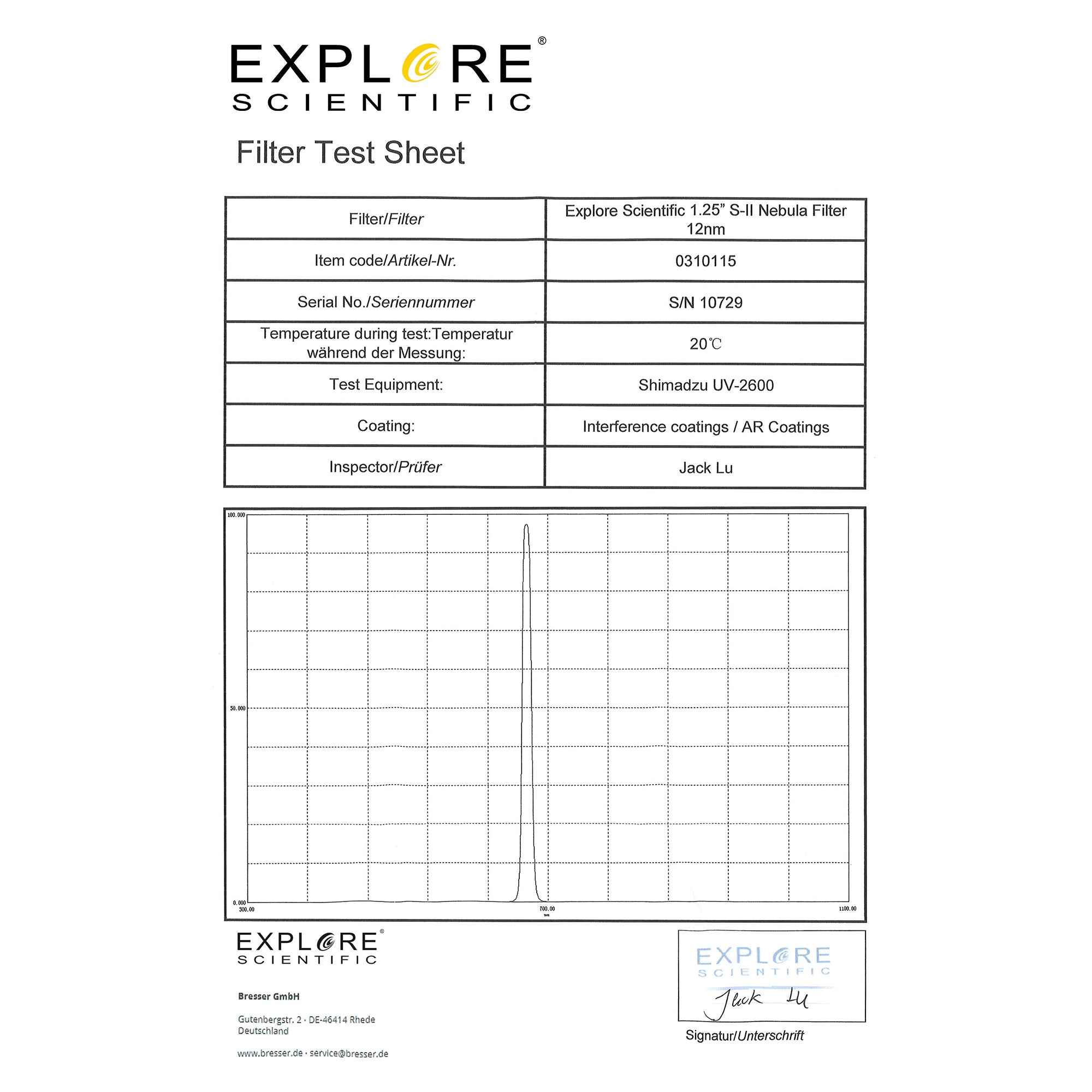
The Explore Scientific 1.25-inch S-II Nebula Filter is a narrowband interference filter with a 12 nm passband centred on the ionised sulphur emission line at 672 nm. Explore Scientific states the design goal plainly: block the rest of the spectrum, and with it almost all artificial light, so that only the sulphur emission from the nebula reaches your eyepiece or sensor. It is supplied in a standard 1.25-inch threaded cell, and like every filter in this Explore Scientific narrowband range it arrives with an individual test report for the specific piece of glass in the cell.
Who It's For
S-II is the difficult member of the usual narrowband trio. In most emission nebulae the ionised sulphur signal is considerably weaker than hydrogen-alpha, and it is frequently weaker than doubly ionised oxygen as well. That changes how you should think about bandpass. Going narrower always buys contrast, because the sky background falls roughly in proportion to the width of the passband while the emission line itself passes through intact. It also costs you, though: a narrower filter is less tolerant of a converging light cone, less tolerant of focus and temperature drift, and it makes an already faint subject fainter on the chip. With S-II you are starting from a weak signal, so 12 nm is the sensible default rather than a compromise.
This is the filter to reach for if you are assembling your first mapped-colour narrowband set, if you image at f/4 to f/6 where a very narrow band begins to shift and lose effective transmission across the field, or if you are working with a 200 mm or smaller aperture and cannot realistically commit twenty-minute subframes to the weakest channel of a three-channel project. It suits 1.25-inch filter wheels and sensors up to roughly Four Thirds or small APS-C format. If your rig is fast and modest in aperture, the extra photons the 12 nm passband lets through will do more for your final image than the extra sky rejection of a 6.5 nm filter would.
Key Features & Design
- 12 nm passband, wide enough to keep the weak S-II signal usable on modest apertures and fast optics
- Centred on the ionised sulphur emission line at 672 nm, deep in the red
- Interference coatings reject the rest of the visible spectrum, including the mercury and sodium vapour lines that dominate urban skyglow
- Standard 1.25-inch threaded cell that fits eyepiece barrels, camera nosepieces and 1.25-inch filter wheels
- Individual test report for your specific filter included in the scope of delivery
- Built for the sulphur channel of narrowband imaging, with useful contrast on bright planetary nebulae in larger visual apertures
- Explore Scientific positions the S-II filter specifically at urban observers and astrophotographers fighting a brightened sky
Filter Design
An interference filter of this kind works through thin-film physics rather than absorption. Many alternating layers of high and low refractive index material are deposited on the substrate, and light at the design wavelength reflects between those layers in phase and is transmitted, while everything else interferes destructively and is rejected. The consequence worth understanding is that the passband is defined for light arriving perpendicular to the coating. As the angle of incidence rises, the effective optical thickness of each layer falls and the whole passband shifts toward the blue. In the converging beam of a fast telescope the edge rays arrive at a meaningful angle, so part of your light cone sees a passband that no longer sits on 672 nm. A 12 nm window has enough margin to absorb that shift at ordinary imaging speeds, which is exactly why it remains a practical choice for f/4 and f/5 systems where a much narrower filter would start to lose transmission toward the edge of the field.
Recommended Uses
- The sulphur channel of mapped-colour narrowband imaging on emission nebulae
- Supernova remnants such as the Veil, where S-II structure is genuinely distinct from hydrogen
- Planetary nebulae, where sulphur often traces the outer shells
- Imaging from suburban and urban sites, or under moonlight, when broadband work is not an option
- Contrast work on bright planetary nebulae visually, with generous aperture
Compatibility and Accessory Notes
The cell uses the standard 1.25-inch filter thread, so it screws into the bottom of a conventional 1.25-inch eyepiece barrel, into a 1.25-inch camera nosepiece, or into the carousel of a 1.25-inch filter wheel. It will not fit a 2-inch wheel or an unmounted 31 mm or 36 mm filter drawer without an adapter, and mounted 1.25-inch filters are too thick for many slim internal drawers. If you are building a full narrowband set, keep it within the same Explore Scientific 1.25-inch family so that your exposure planning stays consistent from channel to channel. If you are unsure whether your particular filter wheel, off-axis guider or backfocus budget will take a mounted 1.25-inch filter, contact our team in Bolton and we will confirm the fit before you order.
Good to Know Before You Order
Explore Scientific publishes no shipping weight for this item, so we are confirming it on our own scales before the listing goes live. That is why it is currently unpublished. Contact us and we will give you a shipping figure for your address. Beyond that, be realistic about visual use: at 672 nm the dark-adapted eye is already well down its sensitivity curve, and on all but the brightest planetary nebulae in a large aperture this behaves as a photographic filter. Explore Scientific does not publish a peak transmission figure, a substrate specification or a full blocking range for this filter, so we will not quote numbers we cannot source; the individual test report in the box gives the measured curve for the filter you receive. Explore Scientific lists the filter and that test report as the scope of delivery, so no eyepiece, nosepiece, filter wheel or adapter is included.
Frequently Asked Questions
Will I see anything through this filter visually? On a large aperture and a bright planetary nebula, sometimes. In general, no. S-II sits deep in the red where the dark-adapted eye is least sensitive, and a 12 nm window passes very little total light. Treat it as an imaging filter and use an O-III or broadband nebula filter for visual work.
Why choose 12 nm rather than the 6.5 nm version? Because sulphur is faint. The narrower filter darkens the sky background further, but it also demands longer subframes, more aperture and a slower light cone to hold its passband. If you image at f/4 to f/6, or your total integration per target is a few hours rather than tens of hours, the 12 nm filter will usually give you the cleaner sulphur channel.
Does it work with a one-shot colour camera or a DSLR? It will pass light, but only the red-sensitive photosites contribute, so most of your sensor sits idle and the Bayer array costs you further transmission. Narrowband filters of this kind are built around monochrome cameras.
How much sensor will it cover? A mounted 1.25-inch filter typically offers a clear aperture near 27 mm, which comfortably covers Four Thirds and smaller sensors. On APS-C and larger, expect vignetting and step up to the 2-inch version.
Bottom Line
The 12 nm S-II is the version of this filter that keeps the weakest narrowband channel practical for ordinary apertures, ordinary exposure budgets and fast optics. If you are building a 1.25-inch narrowband set and want sulphur data you can actually stretch, this is the sensible place to start. Contact us and we will help you match it to your camera, wheel and focal ratio.
You may also like
Recently viewed
Recent Blog Posts
View all
Your Guide Graph Is Lying to You
Read More

D-Size vs V-Size: A Complete Guide to Telescope Dovetail Systems
Read More

What Is Back Focus in Astrophotography? Telescope Reducers, Flatteners, and Spacing Explained
Read More