


- Description
Product Overview
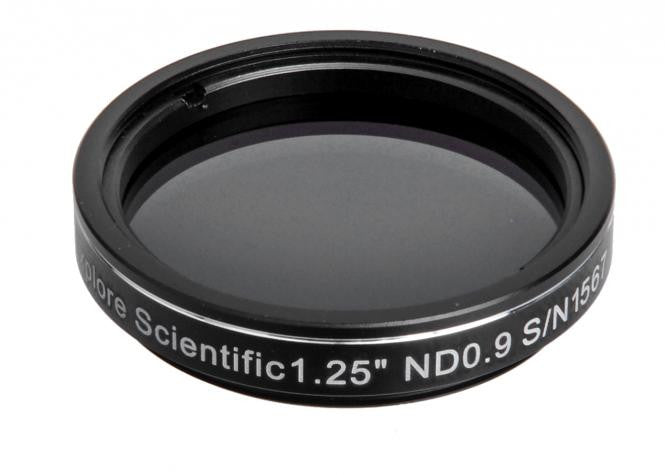
This is the Explore Scientific ND96 neutral density filter in the 1.25-inch size, item 310245, supplied at an optical density of 0.9. Explore Scientific publishes a transmission figure of 13 per cent and describes the filter as transmitting light uniformly across the entire visual spectrum. In practice that means it takes roughly seven eighths of the light out of the view without tinting it, which is exactly what you want when the problem is simply too much brightness. The vendor recommends it for reducing glare and irradiation when observing the Moon with any telescope of 4 inches (10.2cm) aperture and larger, and notes its usefulness in splitting close double stars where one member of the pair is far brighter than the other.
Who It's For
Anyone who has put a 6-inch or 8-inch telescope on a gibbous Moon knows the problem this solves. The Moon is not a faint object; through a decent aperture it is dazzling, and the dazzle is not just uncomfortable. Once the eye is flooded, it loses the ability to discriminate subtle tonal differences, and irradiation, the tendency of a very bright area to visually bleed into the dark area beside it, softens the terminator and washes out the low-contrast detail on crater floors and mare surfaces. You end up seeing a brilliant white disc rather than a landscape. Cutting the brightness back lets the eye work in a comfortable range again, and detail that was always in the image becomes visible.
The second job is double stars. When a bright primary sits close to a much fainter companion, the glare halo around the primary can simply swallow the companion. Dimming both by the same factor shrinks that halo and often lifts the secondary clear of it, which is why experienced double star observers keep a neutral density filter in the case even when the Moon is nowhere in the sky.
Key Features & Design
- Optical density of 0.9, giving a published transmission of 13 per cent across the visual spectrum
- Neutral by design, so lunar and planetary colour and albedo relationships are preserved rather than tinted
- Standard 1.25-inch filter thread that fits the barrel of most 1.25-inch eyepieces and many diagonals
- Recommended by Explore Scientific for telescopes of 4 inches (10.2cm) aperture and larger
- Useful on unequal double star pairs where glare from the primary hides the companion
- Threads onto other 1.25-inch filters if you want to stack density or combine with a colour filter
- Entirely passive, with no power, adapters or maintenance required
Filter Design
Optical density is a base-ten logarithmic measure of attenuation. A density of 0.9 corresponds to ten raised to the power of minus 0.9, which is about 0.126, or the 13 per cent that Explore Scientific publishes. Expressed another way, the filter costs you a little over two magnitudes of brightness. The important word in the name is neutral: the attenuation is intended to be flat with wavelength, so red, green and blue are reduced by the same proportion. That is what separates a neutral density filter from a coloured or so-called moon filter with a green cast, which changes the apparent tone of what you are looking at. Because lunar and planetary observing depends heavily on reading subtle albedo differences, keeping the response flat matters more than it might sound. The other reason density is chosen rather than simply stopping down the aperture is resolution. An aperture mask reduces brightness but also reduces the resolving power and increases the diffraction pattern, whereas a neutral density filter leaves the full aperture and its full resolution intact and only removes light.
Recommended Uses
- Lunar observing near first and last quarter through to full, especially with 4-inch and larger telescopes
- Splitting close double stars where the components differ significantly in brightness
- Taming brightness on Venus, which is dazzling and largely featureless at full aperture
- Comfortable extended lunar sessions and public viewing, where eye fatigue is a real limit
- Stacking with a second filter when the Moon is full and a single density is not enough
Compatibility and Accessory Notes
The cell uses the common 1.25-inch filter thread and screws into the barrel of the great majority of 1.25-inch eyepieces, as well as many 1.25-inch star diagonals and camera nosepieces. Because the front of the cell is also threaded, you can stack this filter with another neutral density or with a colour filter, though every additional glass surface adds a little scatter, so stack only when you need to. If you use 2-inch eyepieces, this filter will not fit them and you will want the 2-inch equivalent. If you are unsure whether your particular eyepiece barrel is threaded, send us the model and our team in Bolton will confirm before you order.
Good to Know Before You Order
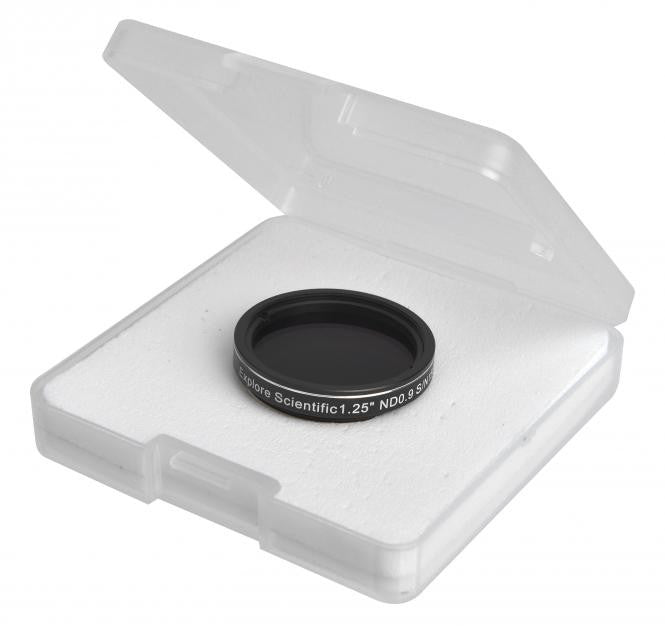
Explore Scientific publishes no shipping weight for this item, so we are confirming it on our own scales before the listing goes live. That is why it is currently unpublished. Contact us and we will give you a shipping figure for your address. Two other things are worth stating plainly. First, this is not a solar filter and must never be used to look at the Sun. Neutral density filters of this type are eyepiece filters, and no eyepiece filter is safe for solar observing; solar work requires a certified full aperture filter fitted at the front of the telescope. Second, 0.9 is a moderate density. On a full Moon through a large aperture some observers still find it bright and prefer to stack a second filter or step up to a variable polarising filter that can be dialled continuously. Only the filter and its case are included.
Frequently Asked Questions
How much does it actually dim the view? To about 13 per cent of the unfiltered brightness, a little over two magnitudes. That is a substantial cut and it is the right order of magnitude for the Moon in a 4-inch to 10-inch telescope.
Will it add a colour cast? It is designed not to. The attenuation is intended to be uniform across the visual spectrum, which is why it is called neutral density and why it suits lunar and planetary work where subtle tonal differences carry the detail.
Can I use it to look at the Sun? No, under no circumstances. Use only a properly certified full aperture solar filter for the Sun. Contact us if you need advice on safe solar equipment.
Is it useful in a small telescope? Explore Scientific recommends it for apertures of 4 inches and larger. In a 60mm or 80mm refractor the Moon is usually manageable without it, although a full Moon can still be bright enough to justify one.
Bottom Line
A neutral density filter is a small, inexpensive accessory that makes the single most-observed object in the sky far more rewarding to look at, and it earns its keep again on tight, unequal double stars. At 0.9 density it is a sensible general-purpose choice for most amateur apertures. Contact our team in Bolton if you would like help choosing between a fixed density like this one and a variable polarising filter.
You may also like
Recently viewed
Recent Blog Posts
View all
Your Guide Graph Is Lying to You
Read More

D-Size vs V-Size: A Complete Guide to Telescope Dovetail Systems
Read More

What Is Back Focus in Astrophotography? Telescope Reducers, Flatteners, and Spacing Explained
Read More