



- Description
- Specifications
Product Overview
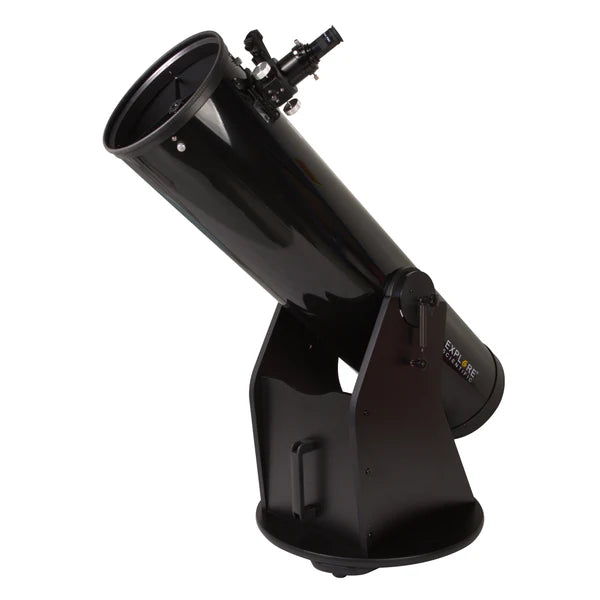
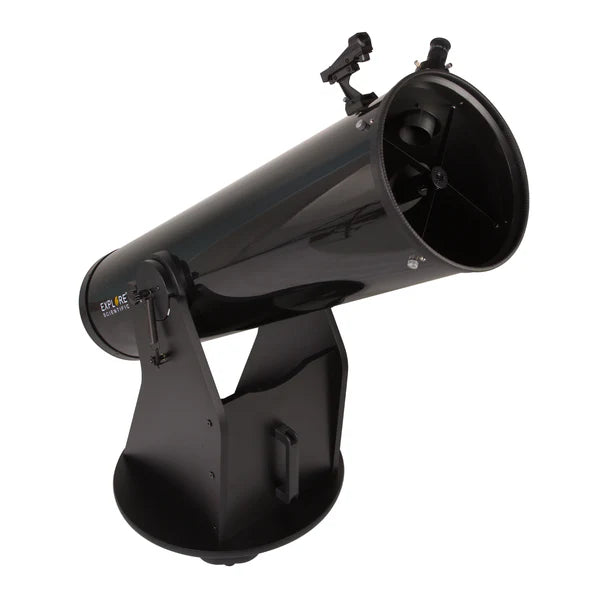
The Explore Scientific 10-inch Dobsonian is a Newtonian reflector on an alt-azimuth rocker box, built around a 254mm primary mirror at 1200mm focal length, which works out to f/4.7. Ten inches of aperture collects on the order of 1,300 times the light a dark-adapted eye does, and that light grasp is the whole argument for a Dobsonian: the design spends almost nothing on the mount so that as much as possible goes into the mirror.
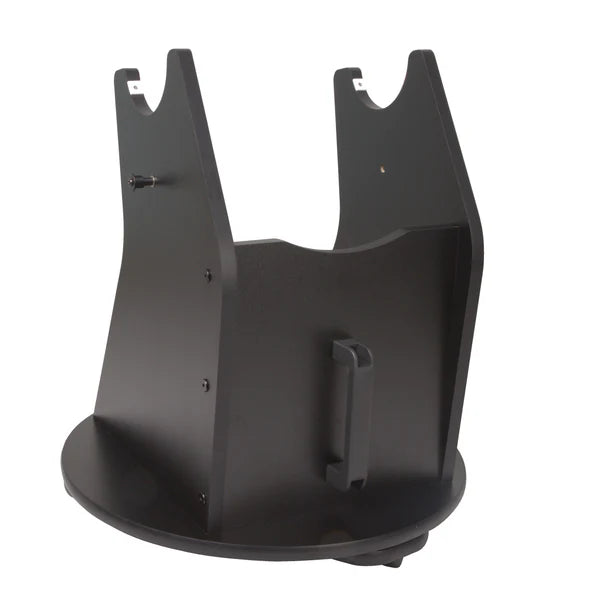
Explore Scientific publishes the tube at 24lbs, 3 oz and the base at 21lbs, 8 oz, which are handled as two separate carries rather than one. The rocker box is designed to stay in balance as accessories are added at the focuser end, so a heavier eyepiece does not send the tube drifting on its own.
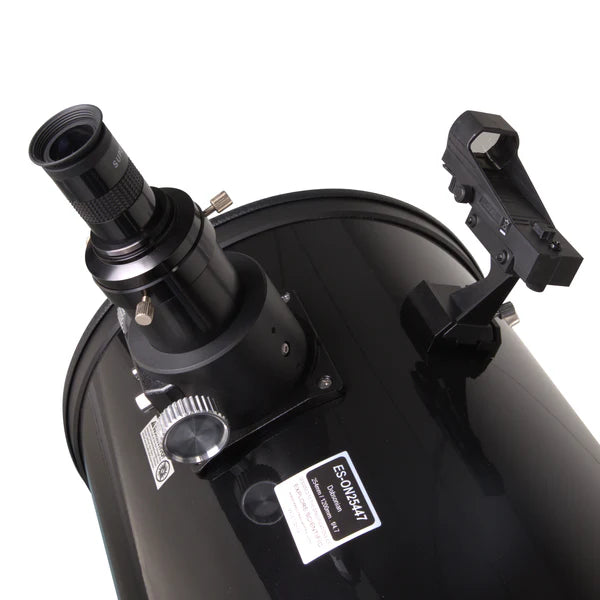
The package includes a 25mm Plössl eyepiece, which gives 48x at this focal length, a red-dot finder, a smartphone imaging adapter and a protective dust cover. At f/4.7 the field is wide and the image is bright, and the same fast focal ratio is why eyepiece quality at the edge shows up quickly here.
Who It's For
- Deep-sky observers: 254mm at f/4.7 is the classic aperture-per-dollar answer for galaxies, globular clusters and nebulae under a reasonably dark sky.
- Observers who prefer pointing to programming: a Dobsonian moves where you push it. There is no alignment routine and no power to arrange before the first object.
- This is a good match if you have a garden, a driveway or a dark site within a short drive, and somewhere to store a tube of 24lbs, 3 oz and a base of 21lbs, 8 oz between sessions.
Key Features & Design
- 254mm primary mirror: the light-gathering figure that governs how faint an object can get before it disappears.
- 1200mm focal length at f/4.7: fast for a ten-inch, which keeps the tube short enough to be a one-person lift and the true field wide.
- Dobsonian rocker box: altitude and azimuth motion by hand, with the balance holding as accessories are added at the focuser.
- 25mm Plössl eyepiece supplied: 48x on this telescope, a useful finding and cluster power.
- Smartphone imaging adapter included, for holding a phone camera steady over the eyepiece.
- Published weights: tube 24lbs, 3 oz; base 21lbs, 8 oz — carried separately, then assembled at the observing spot.
Optical Design
A Newtonian uses a parabolic primary mirror at the bottom of the tube to bring light to a focus, and a flat secondary mirror near the top to fold that cone out through the side wall to the focuser. Because the light is reflected rather than refracted, there is no chromatic aberration at all: colour is recorded as the object presents it, with no violet halo on Sirius or the lunar limb regardless of magnification.
The trade is the secondary mirror and its support vanes, which sit in the light path. That obstruction diffracts a little light out of the star image into the surrounding rings and is the reason four-vane spiders produce the familiar cross-shaped spikes on bright stars. It is a characteristic of the design rather than a defect.
At f/4.7 the light cone is steep, and two things follow from that. The first is that eyepieces are worked harder at the edge of the field than they are in a slow telescope, so eyepiece choice makes a visible difference here. The second is that collimation matters more: the alignment tolerance of a fast mirror is tighter than that of a slow one. Collimation on a Newtonian is a routine, five-minute adjustment with a laser or a Cheshire, done at the start of a session, and it is the one piece of upkeep this design asks for in exchange for the aperture it delivers. We stock collimation tools and are happy to walk you through the first one.
Recommended Uses
- Deep-sky observing — galaxies, globular clusters, planetary and emission nebulae.
- Lunar observing, where ten inches of aperture shows the terminator in real relief.
- Planetary observing on steady nights at higher magnifications.
- Outreach and club nights, where a Dobsonian can be repointed by hand between visitors.
Compatibility and Accessory Notes
- Eyepieces: the 25mm Plössl supplied gives 48x. Magnification is 1200 divided by the eyepiece focal length, so a 15mm gives 80x, a 9mm gives 133x and a 5.5mm gives 218x.
- Fast focal ratio and eyepiece choice: at f/4.7, eyepieces with well-corrected outer fields hold stars tighter at the field edge. The wider Explore Scientific series were designed with fast Newtonians in mind.
- Finder: the supplied red-dot finder is a zero-power sight. An optical or right-angle finder is a common addition for observers who star-hop to faint targets.
- Collimation tools: a laser collimator or Cheshire eyepiece is the usual companion purchase for any fast Newtonian, and we stock both.
- Imaging: the smartphone adapter covers the Moon and bright planets. Explore Scientific does not publish a focuser specification or a backfocus figure for this telescope, so we are not quoting one for camera work — tell us what camera you have and we will look at it with you.
Good to Know Before You Order
- It travels as two pieces. Tube at 24lbs, 3 oz and base at 21lbs, 8 oz, which is what makes a ten-inch manageable by one person — each carry on its own is straightforward, and the tube lifts into the rocker box at the observing spot.
- Newtonians want collimation. At f/4.7 that is a start-of-session habit rather than an occasional job. A laser collimator turns it into a couple of minutes, and we can supply one with the telescope.
- The mount is alt-azimuth, so objects drift with the sky and are nudged back by hand. That suits visual observing directly; long-exposure deep-sky photography needs an equatorial mount instead.
- A ten-inch open tube needs cool-down time. Thirty to forty-five minutes outside before the sharpest high-power views is normal for a mirror of this size, and setting it out early is the whole remedy.
- Explore Scientific does not publish limiting magnitude, resolution or focuser specifications for this model, so those rows are absent from the table below rather than estimated. If one of them is your deciding figure, ask and we will put the question to our Explore Scientific contact.
Frequently Asked Questions
Is it difficult to set up?
No — it goes together in a couple of minutes with no tools. The base carries out first, the tube lifts into the rocker box, the finder and eyepiece go on, and the telescope is pointing. A quick collimation check at the start of the session is the only optical step, and after the first time it takes about as long as focusing does.
What magnification does it give?
1200mm divided by the eyepiece focal length. The supplied 25mm gives 48x; a 12mm gives 100x; a 6mm gives 200x. How far up that range a given night supports is set by the atmosphere rather than by the telescope.
Does it need power or a computer?
No. It is a manual telescope with a red-dot sight, so there is nothing to charge, align or update. A star chart or a phone planetarium app is all the navigation it uses.
Can I photograph with it?
The Moon and the bright planets, yes — that is what the supplied smartphone adapter is for. Long-exposure deep-sky imaging is outside what an alt-azimuth Dobsonian does, because the field rotates as the sky moves.
How often does collimation come up?
A quick check each session and a small tweak when it drifts, particularly after the telescope has been moved in a car. The primary mirror adjusts with thumbscrews at the back of the tube.
Bottom Line
In short: a 254mm f/4.7 Newtonian at 1200mm focal length on a Dobsonian base, supplied with a 25mm Plössl at 48x, a red-dot finder, a smartphone adapter and a dust cover — ten inches of light grasp with nothing between you and the sky but a push. If you would like a collimation tool and a couple of extra eyepieces matched to its f/4.7 optics, tell us what you plan to observe and we will put a shortlist together.
| Item Number | ES-ON25447 |
|---|---|
| Optical Design | Newtonian reflector on Dobsonian alt-azimuth base |
| Primary Mirror Diameter | 254mm |
| Focal Length | 1200mm |
| Focal Ratio | f/4.7 |
| Tube Weight | 24lbs, 3 oz |
| Base Weight | 21lbs, 8 oz |
| Supplied Eyepiece | 25mm Plössl (48x) |
| Finder | Red-dot finder |
| Smartphone Adapter | Included |
| Dust Cover | Included |
| Limiting Magnitude | Not published by vendor |
| Resolution | Not published by vendor |
| Focuser | Not published by vendor |
| Assembled Height | Not published by vendor |
You may also like
Recently viewed
Recent Blog Posts
View all
Your Guide Graph Is Lying to You
Read More

D-Size vs V-Size: A Complete Guide to Telescope Dovetail Systems
Read More

What Is Back Focus in Astrophotography? Telescope Reducers, Flatteners, and Spacing Explained
Read More