


- Description
- Specifications
- Downloads
Product Overview
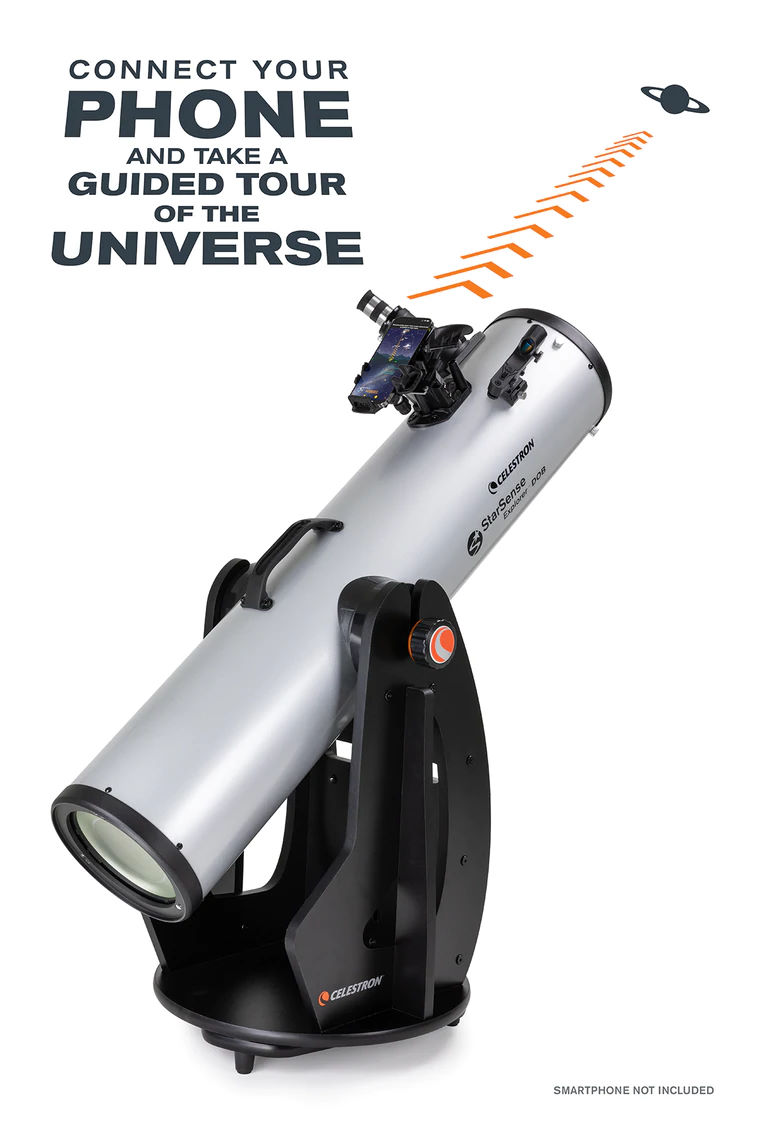
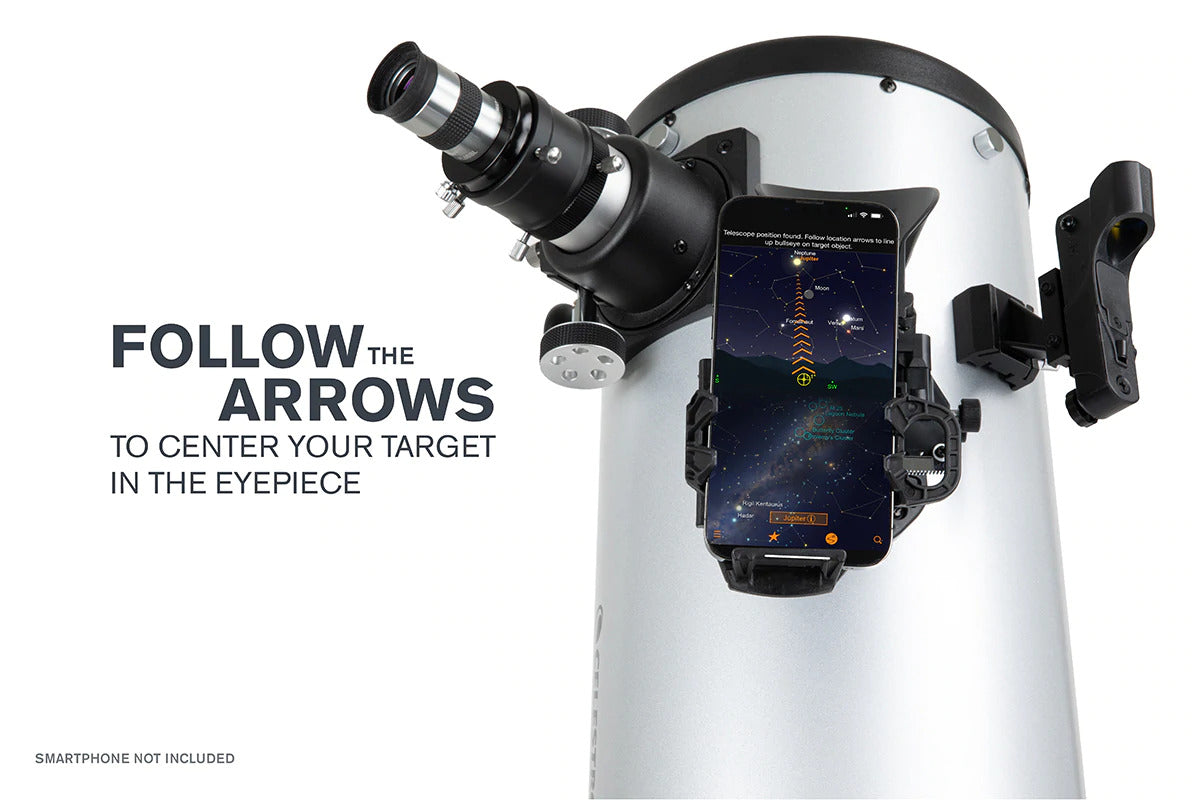
The Celestron StarSense Explorer 8" is a 203 mm (8") f/5.9 Newtonian reflector on a manual Dobsonian altazimuth base, paired with a smartphone dock and Celestron's StarSense Explorer app. The app reads the actual star field through your phone's camera and matches it against its own catalogue to work out where the tube is pointed, then shows on-screen arrows that walk you to a target and turn the bullseye green once it is centred in the eyepiece. At 1200 mm focal length with 841 times the light-gathering power of the unaided eye, this is a full-size visual Dobsonian — the phone replaces the star charts, not the aperture.
Who It's For
This is a good match if you want a large-aperture visual telescope and would rather spend the evening observing than spend it learning to star-hop first. It suits observing from a suburban backyard as well as a dark-sky site, and it works equally well for an experienced observer who wants an 8" that sets up in a few minutes. Because the app handles the finding rather than the pointing, you keep the direct, mechanical feel of a Dobsonian while skipping the part most people find frustrating early on.
Key Features & Design
- 203 mm (8") parabolic primary at f/5.9: 1200 mm focal length, with a highest useful magnification of 480x, a lowest useful magnification of 29x and a limiting stellar magnitude of 14.2.
- XLT coatings on both mirrors: Celestron's reflective coatings with silicon dioxide and tantalum pentoxide protective overcoatings, applied to the primary and the secondary.
- Pyrex-equivalent mirror substrates: a 25 mm thick primary (roughly a 1:8 thickness ratio) and an 8.5 mm secondary with a 47 mm minor axis, in a steel tube.
- 2" Crayford focuser: supplied with a 2" extension tube and a 2"-to-1.25" adapter, so both eyepiece formats drop straight in, plus a thumbscrew to lock focus.
- Dobsonian base with variable altitude tensioning: large-diameter altitude bearings, Teflon azimuth bearings and braced side panels, with an altitude brake that lets you set tension to suit a slightly unbalanced tube.
- StarSense dock and unlock code in the box: the app is unlocked by the supplied code, with no subscription.
- Carry handles at the balance point of tube and base: the optical tube is 20.6 lb (9.34 kg) and the base 22.8 lb (10.3 kg), for 43.4 lb (19.68 kg) assembled.
Optical / Mechanical Design
The optical tube is a straightforward parabolic Newtonian: 203 mm of aperture at f/5.9, giving 1200 mm of focal length in a steel tube measuring 1117.6 mm long by 241.3 mm in diameter (44" x 9.5"). Celestron publishes its resolving power as 0.68 arcseconds by the Rayleigh criterion and 0.57 arcseconds by the Dawes limit, which is the range where close double stars and fine lunar detail start to separate on a steady night. The primary is a thick 25 mm substrate rather than a thin one, which helps it hold figure as the glass cools toward ambient.
Like every Newtonian, it is collimated by the owner rather than sealed at the factory, and a collimation cap is included for that. The 2" Crayford focuser is a friction-drive design, so it moves without the focus shift a rack-and-pinion can introduce at high power.
Recommended Uses
Lunar and planetary observing at high magnification — Jupiter's cloud bands and Galilean moons, the Great Red Spot, the rings of Saturn. Deep-sky observing of brighter nebulae and galaxies, globular and open clusters, and double stars. Guided touring of the night sky using the app's list of currently visible objects and its audio descriptions. Suburban and city observing on the brighter targets, with more within reach at a darker site. Public outreach and star parties, where the app lets someone who has never used a telescope find a target themselves.
Compatibility and Accessory Notes
Eyepieces: the focuser accepts both 1.25" and 2" eyepieces. The supplied 25mm Plössl gives 48x, which is a low-power finding and wide-field eyepiece — a shorter focal length for planetary work is the usual first addition, and the 480x ceiling leaves plenty of room above 48x.
Smartphone: the StarSense Explorer app runs on Android 12 and later and on iOS 18 and newer, including iPhone XR and newer. Celestron notes that owners of older phones can still use the app but will not be able to reinstall it once removed. Celestron maintains the full device list at starsenseexplorer.simcur.com.
Included software: Celestron Starry Night Basic Edition ships with the telescope alongside the StarSense Explorer unlock code.
Power for your phone: Celestron's PowerTank Glow 5000 (sold separately) was designed around the StarSense Explorer Dobsonians — it combines a red flashlight with a USB power bank and straps to the two posts at the front of the dock with the bands supplied with it, keeping the phone charged through a long session.
If you are unsure whether your phone will run the app, send us the model and we will check it against Celestron's list before you order.
Good to Know Before You Order
The app needs real starlight to work. It cannot orient itself in daylight and wants roughly an hour after sunset before there is enough star detail to match on. Cloud cover, haze, a bright Moon and heavy light pollution all reduce what it can lock onto.
It shows tonight's sky only. There is no date or time control in the app, so it plans the session you are about to have rather than one next month.
Tracking is manual. Objects drift across the field as the Earth turns, and you nudge the tube to follow them. The altitude brake and Teflon azimuth bearings are what make that a smooth, one-finger motion rather than a chore.
Some app targets are marked "dark sky viewable." Those need genuinely darker skies than a city backyard, and the app tells you which they are rather than sending you hunting for something invisible.
It arrives as two carries. A 20.6 lb tube and a 22.8 lb base, each with a handle at its balance point, which is what makes an 8" Dobsonian practical to move on your own.
Solar observing needs a purpose-made filter. Viewing the Sun through any telescope requires a proper solar filter fitted to the front of the tube — ask us and we will point you at one that fits this aperture.
Two-year Celestron warranty.
Frequently Asked Questions
Is it difficult to set up?
No. The base assembles once and then the telescope goes together in a couple of minutes — tube into the base, eyepiece in the focuser, phone in the dock. Aligning the phone to the optics is a short one-time procedure per session, and the app's tutorials walk through it. The one job that is genuinely yours is collimation, and the included collimation cap is what you do it with.
Does the app need a subscription?
No. The unlock code is in the box and the app is yours with the telescope.
Which phones does it work with?
Android 12 and later, and iOS 18 and newer including iPhone XR and newer. Celestron's full compatibility list covers the specific models.
What can I expect to see?
Celestron cites Jupiter's four Galilean moons with its cloud bands and Great Red Spot, the rings of Saturn, the Orion Nebula, dust lanes in the Lagoon Nebula, and the Andromeda Galaxy. From a city location the planets, open clusters like the Pleiades, double stars and the brighter nebulae are all within reach; a darker site opens up a great deal more.
Can I use it for astrophotography?
It is built as a visual instrument. The base is manual with no tracking drive, so long-exposure deep-sky imaging is outside what it does. Short-exposure lunar and planetary work held up to the eyepiece is practical.
How is this different from a GoTo telescope?
A GoTo mount drives motors to the object. StarSense Explorer has no motors — the app works out where the tube is actually aimed and shows you which way to push it. That means nothing to power, nothing to align to two stars first, and no loss of position if you bump it.
What does the 8" give me over the smaller StarSense Explorer models?
Light-gathering area, which is what faint objects respond to: 841x the unaided eye, a limiting stellar magnitude of 14.2, and a 480x useful magnification ceiling for planetary and double-star work.
Bottom Line
A full-size 203 mm f/5.9 visual Dobsonian with app-guided pointing: 1200 mm of focal length, a 2" Crayford focuser taking both eyepiece sizes, a manual altazimuth base you follow objects with by hand, and 43.4 lb split into two comfortable carries. Your phone does the navigating, and the aperture does the rest.
| Item number | 22470 |
|---|---|
| Optical design | Newtonian reflector |
| Aperture | 203 mm (8") |
| Focal length | 1200 mm (47.24") |
| Focal ratio | f/5.9 |
| Supplied eyepiece | 25 mm Plössl (48x) |
| Highest useful magnification | 480x |
| Lowest useful magnification | 29x |
| Limiting stellar magnitude | 14.2 |
| Light gathering power | 841x compared to the human eye |
| Resolution | 0.68 arcsec (Rayleigh) · 0.57 arcsec (Dawes) |
| Optical coatings | XLT reflective coatings with silicon dioxide and tantalum pentoxide protective overcoatings |
| Mirror material | Pyrex equivalent, primary and secondary |
| Primary mirror thickness | 25 mm (0.98"), approx. 1:8 thickness ratio |
| Secondary mirror | 8.5 mm thick, 47 mm minor axis |
| Tube material | Steel |
| Focuser | 2" Crayford, with 2" extension tube and 2"-to-1.25" adapter |
| Finderscope | StarPointer red-dot |
| Optical tube dimensions | 1117.6 mm x 241.3 mm diameter (44" x 9.5") |
| Optical tube weight | 20.6 lb (9.34 kg) |
| Mount type | Altazimuth Dobsonian base, manual |
| Base material | Particle board with melamine surfaces and edge trim, CARB compliant |
| Base dimensions | 685.8 x 482.6 x 482.6 mm (27" x 19" x 19") |
| Base weight | 22.8 lb (10.3 kg) |
| Total kit weight | 43.4 lb (19.68 kg) |
| In the box | Optical tube, Dobsonian base, 25 mm Plössl eyepiece, 2" Crayford focuser, StarPointer red-dot finderscope, StarSense Explorer dock, StarSense Explorer unlock code, eyepiece rack, collimation cap, Starry Night Basic Edition software, dust covers |
| Smartphone requirements | Android 12 and later; iOS 18 and newer, including iPhone XR and newer |
| Warranty | 2-year Celestron warranty |
Manuals and Guides
- StarSense Explorer App Manual — Celestron
Reference
- How StarSense Explorer Technology Works — Celestron
- Smartphone Compatibility Checker — Celestron
You may also like
Recently viewed
Recent Blog Posts
View all
Your Guide Graph Is Lying to You
Read More
D-Size vs V-Size: A Complete Guide to Telescope Dovetail Systems
Read More
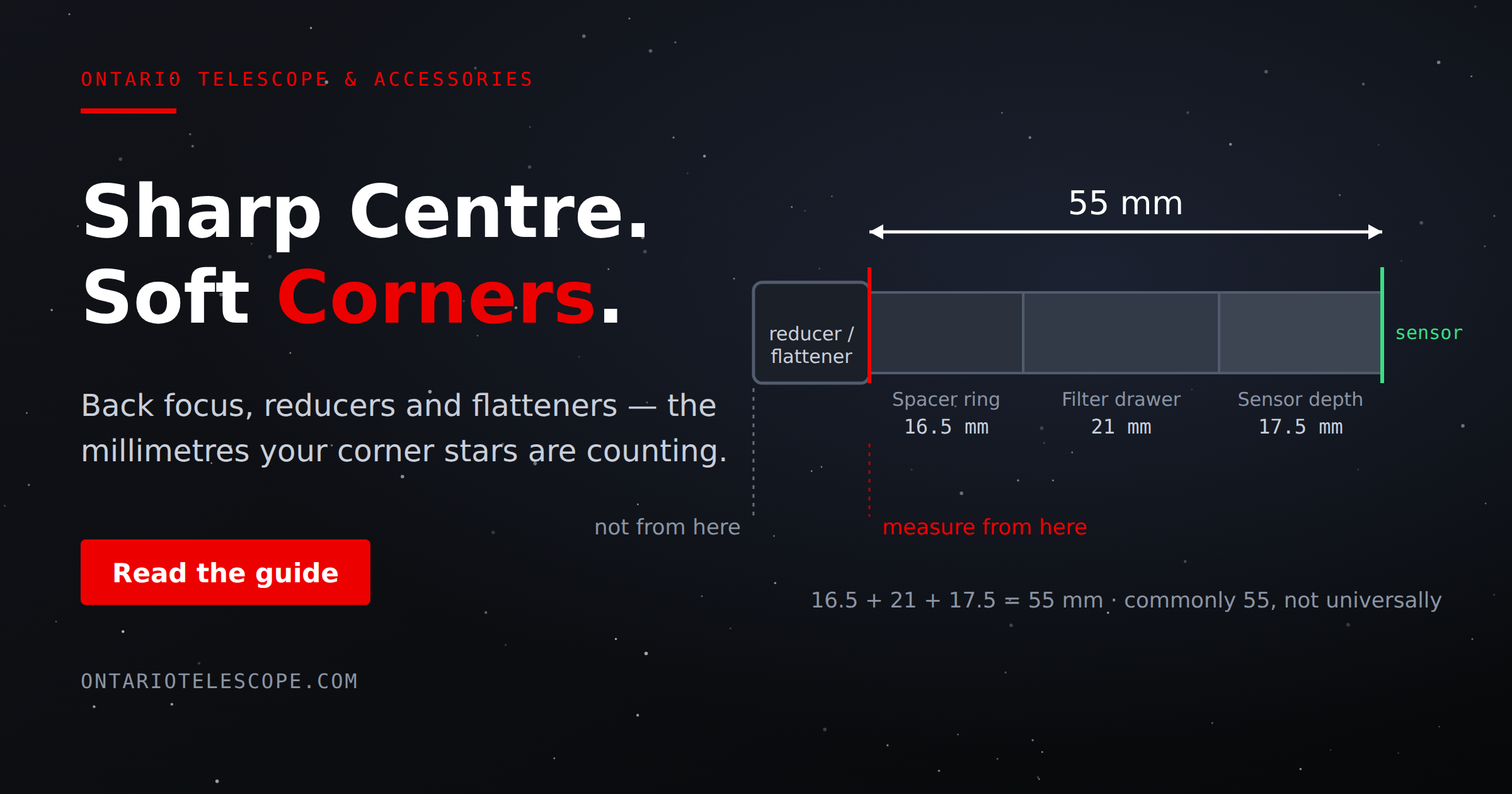
What Is Back Focus in Astrophotography? Telescope Reducers, Flatteners, and Spacing Explained
Read More