


- Description
- Baader Wide-T-Ring to connect Fuji X cameras on the Astro T-2 system
- All Baader Wide-T-rings have an S52 dovetail in addition to the inserted T-2 ring. This allows the T-ring to be modified to an M48 female thread using the S52 / M48 adapter #2958552, or to use the S52 barrel #2958551 without the T-2 reduction. With the S52 / M68 adapter # 2458252, the Wide-T-Ring can be directly attached to an M68 male thread to securely fasten your camera to the widest possible aperture.
- All Baader Wide T-rings can be directly adapted to an UFC (Universal Filter Changer) with the optional Baader UFC S52 dovetail camera-adapter (#2459119), in order to change different filter sizes directly in front of the camera sensor.
- With the ultra-short Backfocus of only 26 mm (17.7 mm camera, 8.3 mm T-2 bayonet ring) many adaptations in combination with reducers / filter wheels are now possible for the first time. Furthermore, the illumination of the camera chips improved significantly, mainly because of the larger clear aperture.
- On the camera side: Fuji X Bayonet
- Telescope side: S52 dovetail clamp incl. S52/T-2 internal thread with 0.75mm pitch
You may also like
Recently viewed
Recent Blog Posts
View all
Your Guide Graph Is Lying to You
You drove ninety minutes to dark sky, PHD2 held 0.4 arcseconds all night, and half your subs still have eggs for stars. Here are the three things your
Read More
Read More

D-Size vs V-Size: A Complete Guide to Telescope Dovetail Systems
What's the difference between D-size and V-size telescope dovetails? Here's everything you need to know.
Read More
Read More
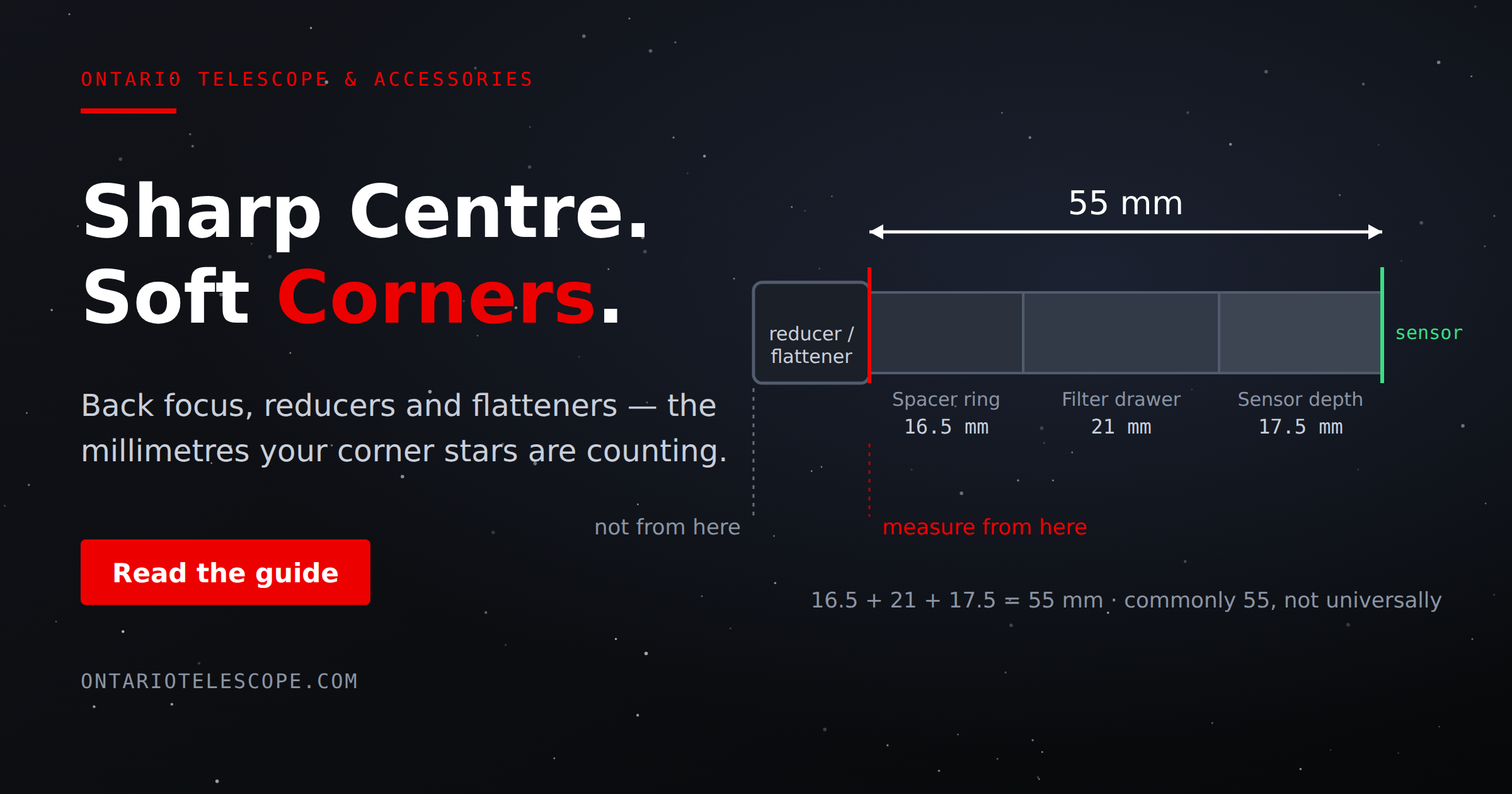
What Is Back Focus in Astrophotography? Telescope Reducers, Flatteners, and Spacing Explained
What Is Back Focus in Astrophotography? Telescope Reducers, Flatteners, and Spacing Explained
Back focus is one of those astrophotography terms that c
Read More
Read More