


- Description
- Specifications
Product Overview
The Astro Devices TeleVue Encoder Kit is the hardware link between your TeleVue mount and a set of digital setting circles. Digital setting circles read your telescope's position from encoders mounted on the altitude and azimuth axes, and without those encoders a DSC has no way to know where the scope is pointed. This kit supplies both encoders, the cabling, and the fitment hardware needed to add that position feedback to a compatible TeleVue mount. The altitude axis reads at 20,480 steps per revolution and the azimuth axis at 311,296 steps, giving your DSC the resolution it needs to place objects accurately across the sky.
Who It's For
This kit fits current-production TeleVue alt-azimuth mounts and is intended for owners who want to pair one of those mounts with digital setting circles for push-to navigation. It fits the TeleVue Telepod, Panoramic, Gibraltar HD4, and Gibraltar HD5. If you already run a DSC on another scope and want to add a TeleVue mount to the setup, this is the encoder set that connects it.
Key Features & Design
- Two matched encoders: one for the altitude axis (20,480 steps) and one for the azimuth axis (311,296 steps).
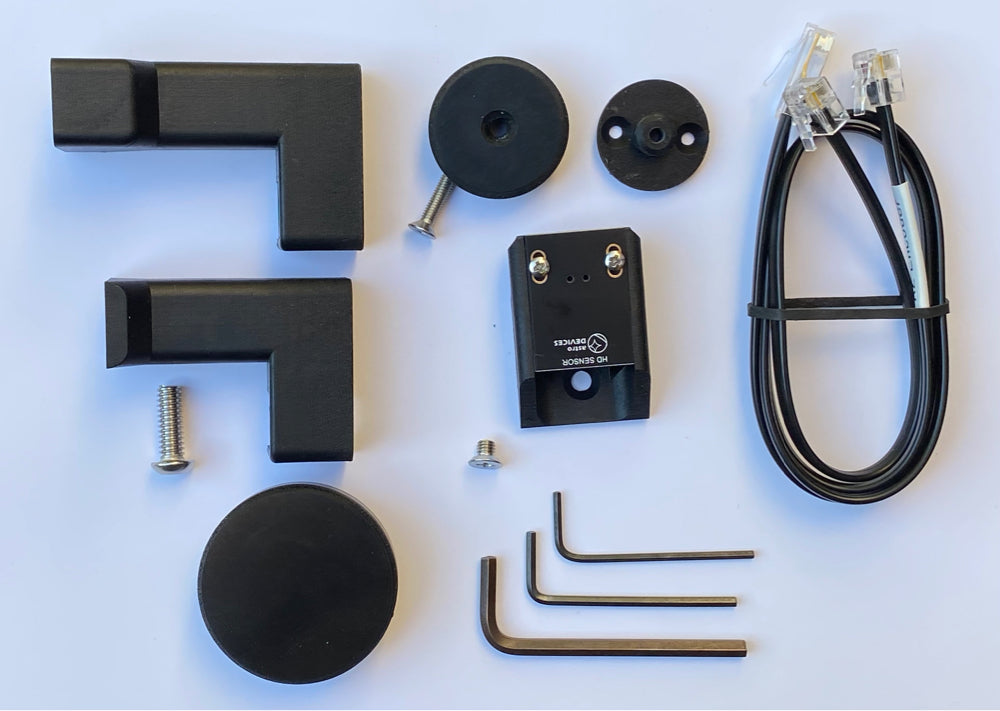
- Complete fitment hardware: an installation hardware set sized for the supported TeleVue mounts.
- 42 cm straight encoder cable: connects the encoders to your digital setting circles.
- Installation booklet: printed instructions walk through mounting the encoders and routing the cable.
- Direct TeleVue fitment: designed around the Telepod, Panoramic, Gibraltar HD4, and Gibraltar HD5 axes.
Design and Electronics
The two encoders are matched to their axes rather than interchangeable. The azimuth encoder's much higher step count (311,296 versus 20,480 for altitude) reflects the wider range of motion that axis covers, so pointing accuracy stays consistent as the scope sweeps across the horizon. Both encoders terminate in the supplied 42 cm straight cable, which carries their signals to the digital setting circles reading them.
Recommended Uses
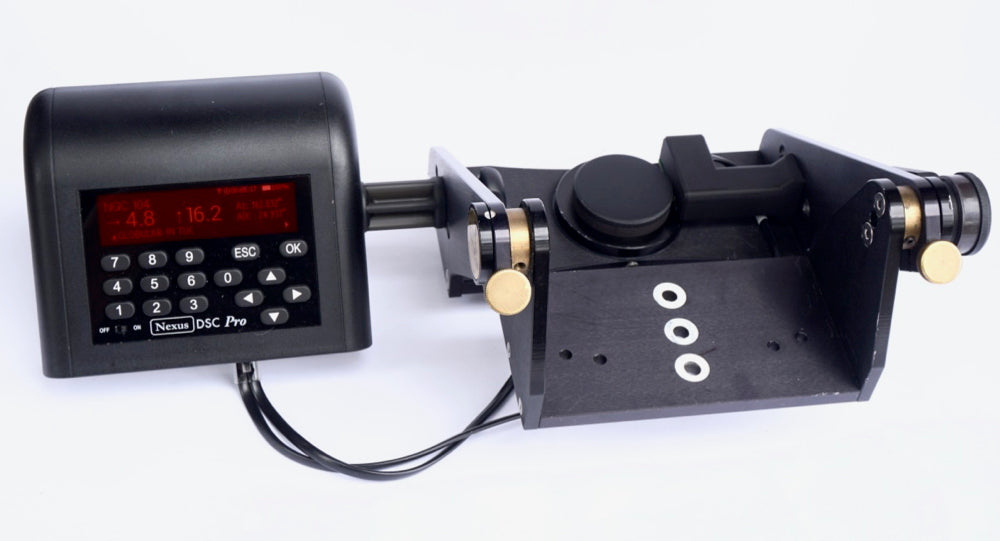
The kit is used to enable push-to observing on a compatible TeleVue mount: with the encoders installed and a DSC connected, you align on a couple of known stars and the display guides you to targets by showing how far to move each axis. It suits visual observing sessions where you want to find deep-sky objects, planets, and double stars quickly without a full star chart in hand.
Compatibility and Accessory Notes
Fitment covers current models of the TeleVue Telepod, Panoramic, Gibraltar HD4, and Gibraltar HD5. The encoders connect to digital setting circles through the included 42 cm straight cable; the encoder set is what mounts on the telescope, and a separate DSC unit reads the encoders and provides the display. Altitude resolution is 20,480 steps and azimuth resolution is 311,296 steps.
Good to Know Before You Order
- Encoders only: this is the encoder and hardware kit. A digital setting circles unit is the companion piece that reads the encoders and shows the display.
- Model coverage: the hardware is sized for current-production Telepod, Panoramic, Gibraltar HD4, and Gibraltar HD5 mounts.
- Cable length: the included encoder cable is 42 cm and straight, which suits the standard routing on these mounts.
- Shipping weight: the kit weighs 300 g, so it packs and ships as a small parcel.
Frequently Asked Questions
Which TeleVue mounts does this kit fit?
It fits current models of the Telepod, Panoramic, Gibraltar HD4, and Gibraltar HD5.
Does the kit include the digital setting circles unit?
No. It provides the encoders, cable, and mounting hardware. The DSC unit that reads the encoders is a separate item.
Is it difficult to set up?
The kit ships with an installation instruction booklet, the required hardware, and a ready-to-use 42 cm cable, so installation follows a defined set of steps: mount each encoder on its axis and route the cable to the DSC.
What resolution do the encoders provide?
The altitude encoder reads 20,480 steps and the azimuth encoder reads 311,296 steps per revolution.
What comes in the box?
Two encoders, an installation hardware set, a 42 cm straight encoder cable, and an installation instruction booklet.
Bottom Line
The Astro Devices TeleVue Encoder Kit adds the altitude and azimuth encoders a compatible Telepod, Panoramic, or Gibraltar HD4/HD5 mount needs to work with digital setting circles. With both encoders, the fitment hardware, a 42 cm cable, and an instruction booklet in the box, it is the complete link between a TeleVue mount and DSC push-to navigation.
| Fits (TeleVue mounts) | Telepod, Panoramic, Gibraltar HD4, Gibraltar HD5 (current models) |
|---|---|
| Encoders included | 2 (altitude and azimuth) |
| Altitude resolution | 20,480 steps |
| Azimuth resolution | 311,296 steps |
| Encoder cable | 42 cm straight |
| Also included | Installation hardware set, installation instruction booklet |
| Weight | 300 g |
You may also like
Recently viewed
Recent Blog Posts
View all
Your Guide Graph Is Lying to You
Read More

D-Size vs V-Size: A Complete Guide to Telescope Dovetail Systems
Read More

What Is Back Focus in Astrophotography? Telescope Reducers, Flatteners, and Spacing Explained
Read More