
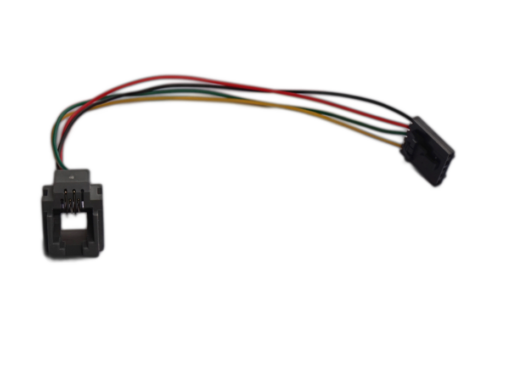
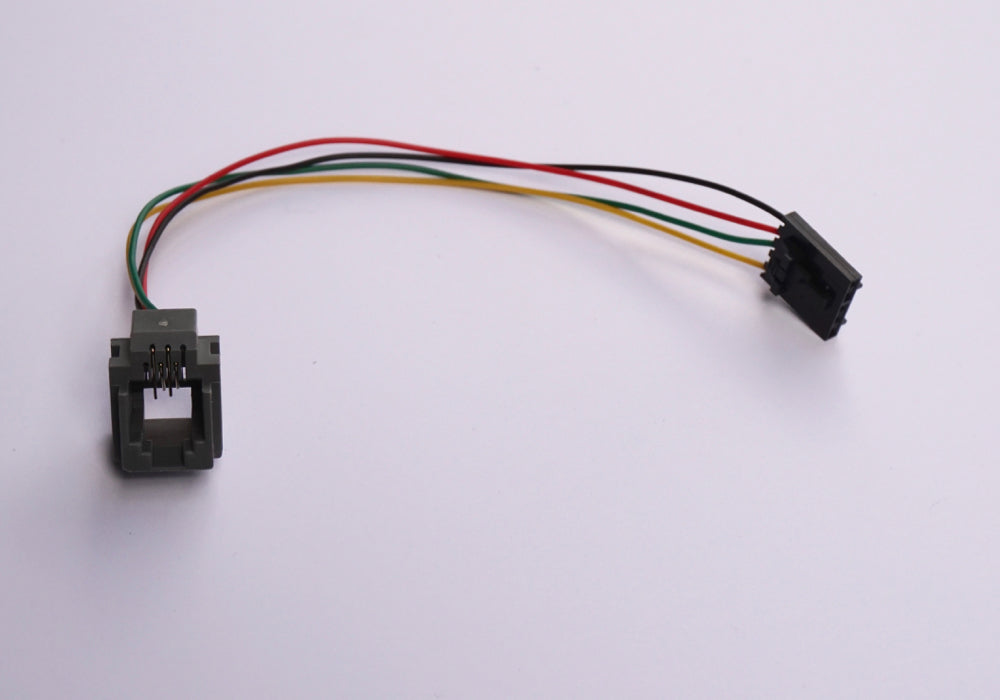


- Description
- Specifications
Product Overview
The Astro Devices RJ11 Encoder Adapter Cable connects an encoder to a digital setting circle (DSC) through a standard encoder cable. One end carries a 5-pin flat polarised connector that mates with US Digital's S1/S2/S5/S6 encoders and CUI's AMT102, while the other end terminates in an RJ11 (6P4C) jack. The assembly is 150 mm (6") long and weighs 30 g, giving you a short, tidy bridge between the encoder and the rest of an RJ11-based encoder harness.
Who It's For
This cable suits push-to telescope and Dobsonian owners running a Nexus DSC or another digital setting circle system that uses RJ11 encoder cabling. It is the right adapter when your encoder uses the flat 5-pin polarised header (US Digital S1/S2/S5/S6 or CUI AMT102) and your DSC harness expects an RJ11 (6P4C) plug.
Key Features & Design
- Dual-standard termination: a 5-pin flat polarised connector on one end and an RJ11 (6P4C) jack on the other.
- Encoder compatibility: works with US Digital S1/S2/S5/S6 and CUI AMT102 encoders.
- Compact length: 150 mm (6") keeps the run short and manageable between the encoder and the encoder cable.
- Light and unobtrusive: 30 g adds negligible weight to a mount.
Recommended Uses
Use this adapter to bring a US Digital or CUI encoder into an RJ11-based DSC wiring setup, whether you are adding encoders to a Dobsonian, wiring a new push-to build, or replacing an adapter in an existing Nexus DSC installation.
Compatibility and Accessory Notes
The 5-pin flat polarised end fits US Digital S1, S2, S5 and S6 encoders and the CUI AMT102. The RJ11 (6P4C) end connects to a DSC or encoder cable that accepts an RJ11 plug. Confirm that your encoder cable and DSC port use the RJ11 (6P4C) standard before ordering.
Good to Know Before You Order
Length: the adapter is 150 mm (6") long, intended as a short jumper rather than a full-length encoder run.
Connector match: the flat 5-pin end is polarised, so it seats in one orientation to keep the encoder wiring correct.
What's in the box: one adapter encoder cable.
Frequently Asked Questions
Which encoders does this adapter work with?
It mates with US Digital's S1/S2/S5/S6 encoders and CUI's AMT102 through the 5-pin flat polarised connector.
What connects to the RJ11 end?
The RJ11 (6P4C) jack connects to a DSC or encoder cable that uses an RJ11 plug.
How long is the cable?
It measures 150 mm (6") end to end.
Is it difficult to set up?
No. Each end uses a keyed connector, so the flat 5-pin plug meets the encoder and the RJ11 jack meets the encoder cable, and the polarised header seats in a single orientation.
Bottom Line
The Astro Devices RJ11 Encoder Adapter Cable is a compact 150 mm bridge that brings US Digital and CUI encoders into an RJ11-based DSC setup, with keyed connectors on both ends for a straightforward, correctly-oriented connection.
| Type | Encoder adapter cable |
|---|---|
| Connector 1 | 5-pin flat polarised connector |
| Connector 2 | RJ11 (6P4C) jack |
| Encoder compatibility | US Digital S1/S2/S5/S6; CUI AMT102 |
| Length | 150 mm (6") |
| Dimensions | 150 mm |
| Weight | 30 g |
| In the box | 1 x adapter encoder cable |
You may also like
Recently viewed
Recent Blog Posts
View all
Your Guide Graph Is Lying to You
Read More

D-Size vs V-Size: A Complete Guide to Telescope Dovetail Systems
Read More

What Is Back Focus in Astrophotography? Telescope Reducers, Flatteners, and Spacing Explained
Read More