



- Description
- Specifications
Product Overview
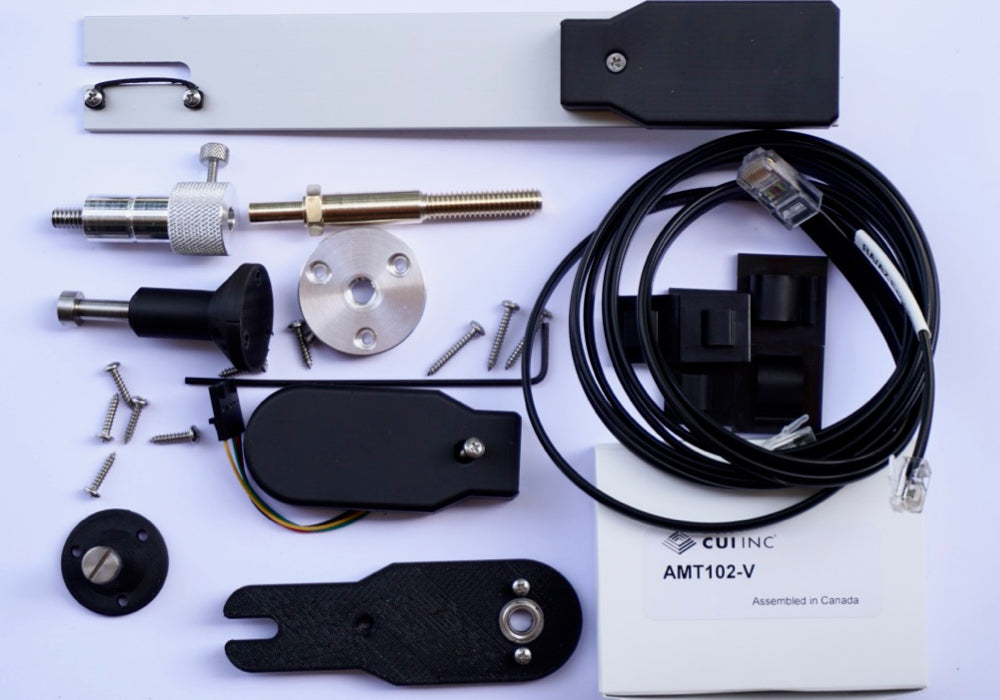
The Astro Devices GSO/Orion Dobsonian Encoder Kit with Spring Tensioners adds the position sensing that a digital setting circle (DSC) system needs to work. When you run digital setting circles, encoders have to be installed on the telescope; without them the DSC has no way to interface with the scope. The two encoders mount on the altitude and azimuth axes and send position signals to your DSC, so it can read where the telescope is pointing and guide you to targets. This particular kit is built for GSO-family and Orion Dobsonians that use spring tensioners on their altitude bearings.
Who It's For
This kit fits Dobsonian telescopes with spring-tensioned altitude bearings manufactured by GSO and its associated brands — Apertura, Bintel, Bresser, Omegon, and Zhumell — as well as Orion Classic Dobsonians (XT4.5, XT6, XT8, XT10). If your Dobsonian holds altitude position with spring tensioners rather than a different friction mechanism, this is the matching version.
Key Features & Design
- Spring-tensioner specific: engineered for altitude bearings that use spring tensioners, which is what distinguishes this kit from the standard GSO/Orion Dobsonian encoder kit.
- Two encoders included: one altitude and one azimuth encoder, each resolving 20,480 steps per revolution for fine pointing resolution.
- Complete installation hardware: the mounting hardware set needed to fit the encoders to both axes is in the box.
- Encoder cable included: a cable to connect the encoders to your digital setting circle.
- Printed instructions: an installation instruction booklet is included, and the instructions are also available as a downloadable PDF.
Encoders & Signal
Each axis carries its own encoder resolving 20,480 steps per revolution. The encoders track the telescope's movement in altitude and azimuth and pass those counts to the DSC over the supplied cable, which is what lets a push-to system calculate the current pointing position and direct you toward a chosen object.
Recommended Uses
Use this kit to bring push-to digital setting circle navigation to a compatible spring-tensioner GSO or Orion Dobsonian. Once the encoders and DSC are in place, you locate and centre objects by following the DSC readout, which is well suited to star-hopping-free deep-sky observing and public or club sessions where quickly finding targets matters.
Compatibility and Accessory Notes
The kit is matched to GSO-manufactured Dobsonians sold under the Apertura, Bintel, Bresser, Omegon, and Zhumell names, and to Orion Classic Dobsonians in the XT4.5, XT6, XT8, and XT10 sizes — in each case the versions using spring tensioners on the altitude bearings. The encoders connect to an Astro Devices digital setting circle via the included cable. A DSC unit itself is a separate item and is not part of this kit.
Good to Know Before You Order
- Spring-tensioner version: this is the spring-tensioner variant. If your Dobsonian uses a different altitude tensioning mechanism, the standard GSO/Orion encoder kit is the matching one instead.
- DSC not included: the kit provides the encoders, hardware, and cable. A digital setting circle unit is required to use them and is purchased separately.
- Shipping weight: the kit ships at 550 g.
Frequently Asked Questions
Is it difficult to set up?
The kit includes an installation hardware set, the encoder cable, and a printed instruction booklet, with the same instructions available as a downloadable PDF. The encoders mount to the altitude and azimuth axes following those steps, and the cable then connects them to your DSC.
What resolution are the encoders?
Both the altitude and azimuth encoders resolve 20,480 steps per revolution.
Does this include a digital setting circle unit?
No. This kit supplies the two encoders, mounting hardware, and cable. The DSC unit is a separate purchase.
How is this different from the standard GSO/Orion encoder kit?
This version is built specifically for Dobsonians that use spring tensioners on the altitude bearings, whereas the standard kit is for other tensioning arrangements.
Bottom Line
This is the encoder kit that turns a compatible spring-tensioner GSO or Orion Dobsonian into a push-to instrument, supplying matched altitude and azimuth encoders at 20,480 steps each, the mounting hardware, and the cable to link them to your Astro Devices digital setting circle.
| Model | GSO/Orion Dobsonian Encoder Kit (Spring Tensioners) |
|---|---|
| Type | Encoder installation kit for digital setting circles |
| Altitude encoder | 20,480 steps per revolution |
| Azimuth encoder | 20,480 steps per revolution |
| Bearing type | Spring tensioners on altitude bearings |
| Compatibility | GSO Dobsonians (Apertura, Bintel, Bresser, Omegon, Zhumell); Orion Classic Dobsonians (XT4.5, XT6/8/10) |
| In the box | 2 encoders, installation hardware set, encoder cable, installation instruction booklet |
| Weight | 550 g |
You may also like
Recently viewed
Recent Blog Posts
View all
Your Guide Graph Is Lying to You
Read More

D-Size vs V-Size: A Complete Guide to Telescope Dovetail Systems
Read More

What Is Back Focus in Astrophotography? Telescope Reducers, Flatteners, and Spacing Explained
Read More