


- Description
- Specifications
Product Overview
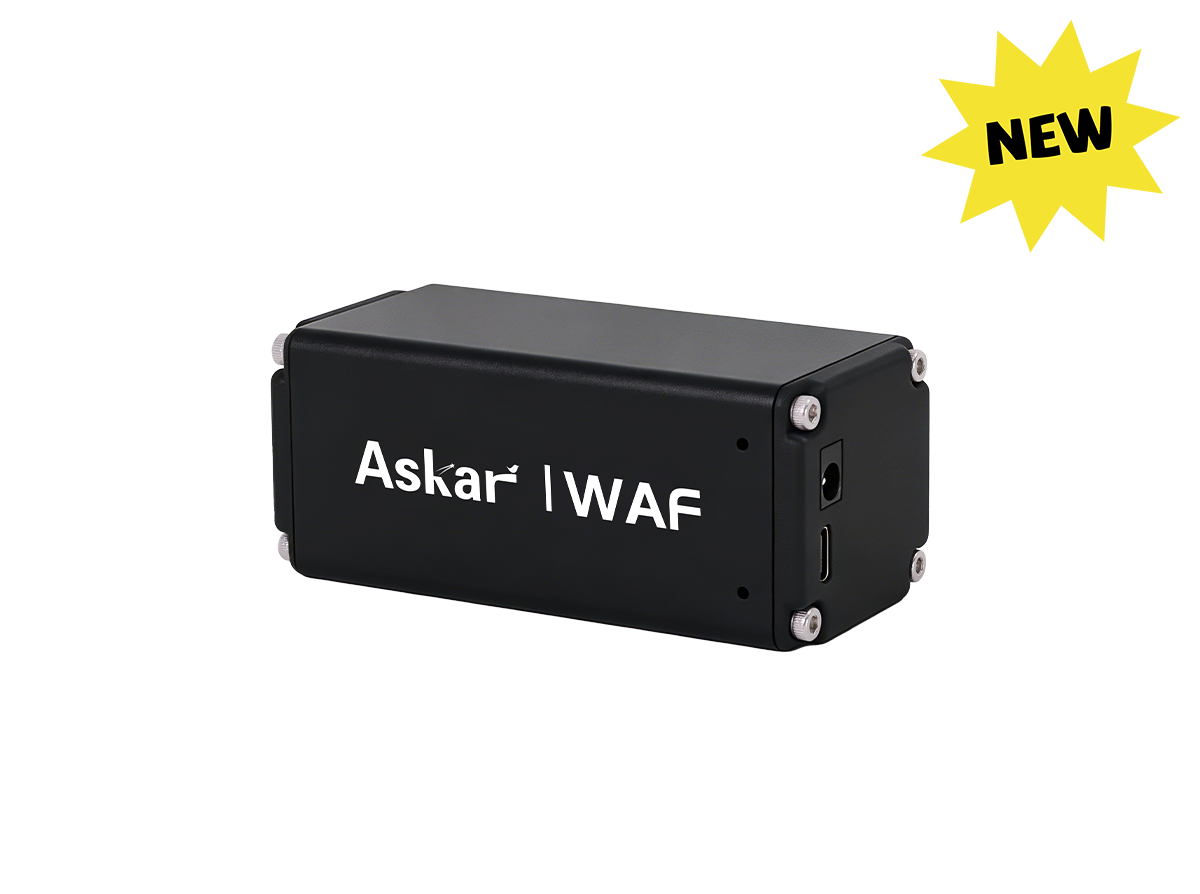
The Askar WAF — Worm-and-Gear Automatic Telescope Focuser — is a motorised focusing unit from Askar, the astronomy brand of Jiaxing Sharpstar Optical Instrument Co., Ltd. It puts focus under software control, so a focus position becomes a value your imaging software can command and return to rather than something set by hand and by eye.
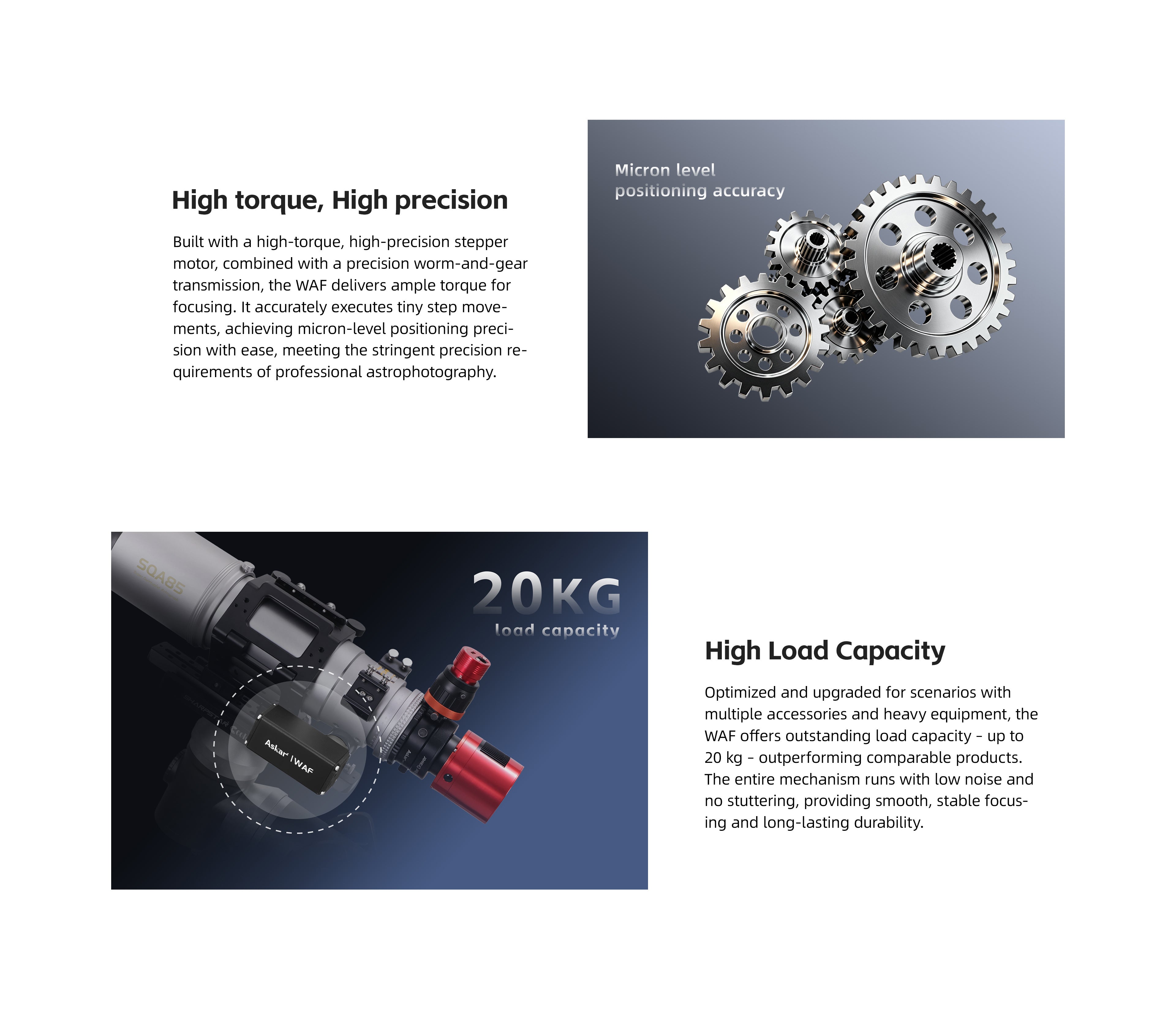
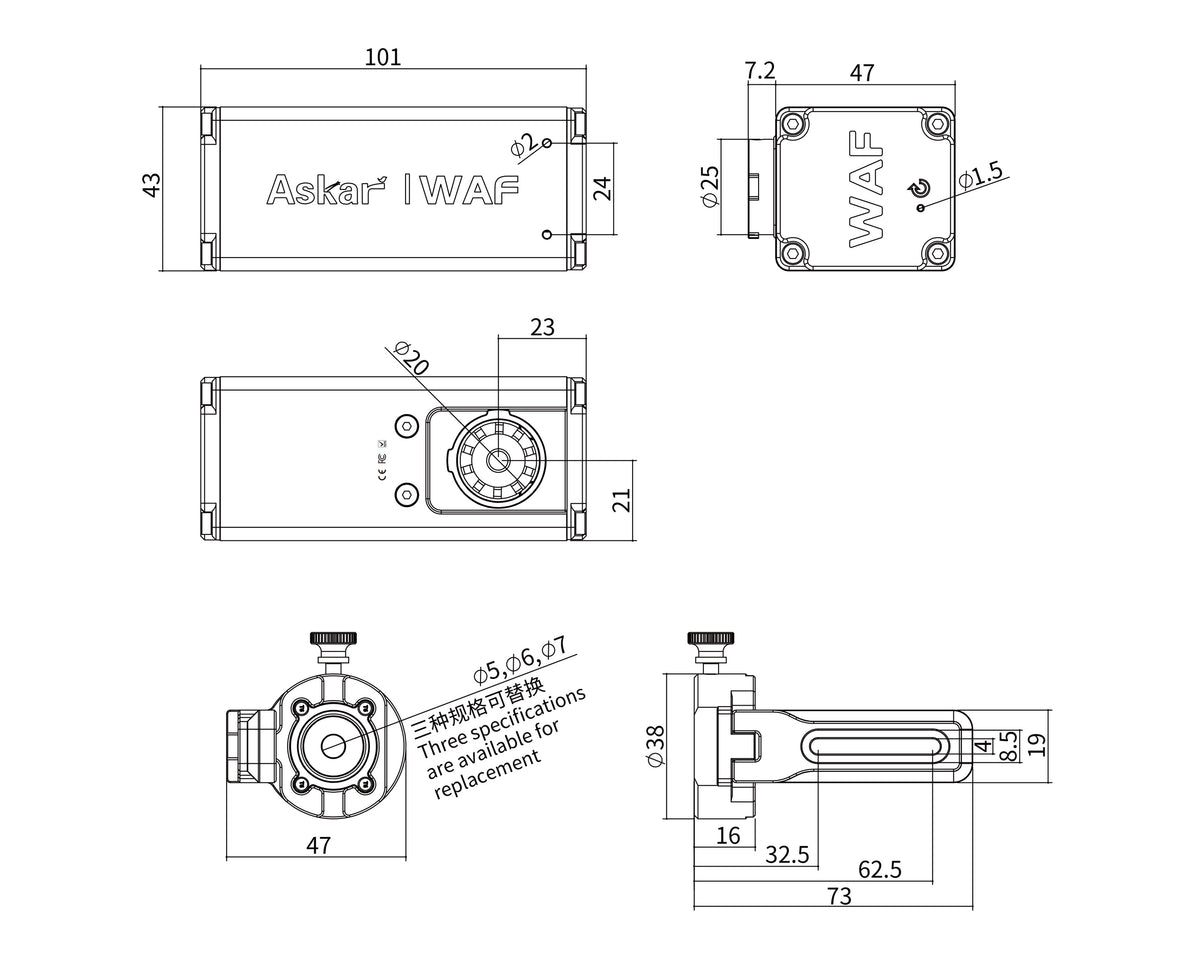
Inside is a stepper motor turning a 1:99 worm-and-gear reduction. That reduction gives a minimum resolution of 0.0182° at the output, a maximum output torque of 20 kgf·cm — which Askar states as an equivalent load of 20 kg — and an output speed of 2.6 rpm. The body measures 101 × 47 × 43 mm and weighs 373 g. Power arrives on a DC-044 12 V jack drawing a minimum of 1 A, with data over USB Type-C. Askar lists the design as patent pending.
Who It's For
This is a good match if you:
- Image deep-sky targets over long sessions: an autofocus routine re-establishes focus as the tube cools through the night, without anyone touching the telescope.
- Run a remote or automated rig: ASCOM Alpaca and INDIGO support puts focus under the same software already running your camera and mount.
- Sequence with N.I.N.A. or similar: Askar lists third-party ASCOM Alpaca platform software, naming N.I.N.A., alongside its own Askar app.
- Carry a heavy imaging train: the 1:99 reduction produces 20 kgf·cm of output torque, stated by Askar as an equivalent load of 20 kg.
Key Features & Design
- Worm-and-gear stepper drive: a worm-gear stepper motor at a 1:99 reduction ratio, in place of the direct couplings and toothed belts used by most focus motors.
- 0.0182° minimum resolution: the smallest commanded increment at the output, which is what sets how finely an autofocus routine can bracket the focus curve.
- 20 kgf·cm maximum output torque: rated by Askar as an equivalent load of 20 kg.
- 2.6 rpm output speed: the rate the output turns at full speed.
- Separate power and data: DC-044 12 V for power at 1 A minimum, USB Type-C for data.
- ASCOM Alpaca and INDIGO: the two communication protocols Askar publishes for the unit.
- Compact body: 101 × 47 × 43 mm, 373 g.
- Patent pending: Askar lists the worm-and-gear focuser design as patent pending.
Mechanical Design
Electronic focusers usually reach the focuser through a direct coupling or a toothed belt and pulley, and the reduction comes from the pulley ratio. The WAF puts a worm and gear inside the unit instead. A worm drive turns rotation through ninety degrees at a high reduction in a single stage — here 1:99 — and that single figure is the origin of both the 0.0182° minimum step and the 20 kgf·cm of output torque. A high-reduction worm drive also resists being back-driven from the output side, which is the property that keeps a loaded drawtube sitting where it was left rather than creeping under the weight of a camera and filter wheel.
The trade for that reduction is traverse speed. The output turns at 2.6 rpm, so running a focuser from one end of its travel to the other takes longer than it would on a low-reduction drive. Autofocus works in small increments around an existing focus point, where the step resolution is what matters.
Askar publishes the following dimensional drawing for the body:

Recommended Uses
- Automated deep-sky imaging: autofocus between filters, between targets, or on a temperature trigger, driven by your sequencing software.
- Remote and unattended operation: refocusing over the network on a rig you are not standing next to.
- Filter-offset workflows: repeatable step positions for narrowband and broadband filters that come to focus at different points.
- Long sessions in changing temperature: recovering focus as the tube contracts through the night.
Compatibility and Accessory Notes
- Software: the Askar app — an Android release is published on Askar's own download page — and third-party ASCOM Alpaca platform software, with N.I.N.A. named by Askar.
- Protocols: ASCOM Alpaca and INDIGO.
- Power: 12 V on a DC-044 barrel connector, 1 A minimum. A supply is not listed among the published specifications.
- Data: USB Type-C.
- Load: 20 kgf·cm of output torque, which Askar states as an equivalent load of 20 kg.
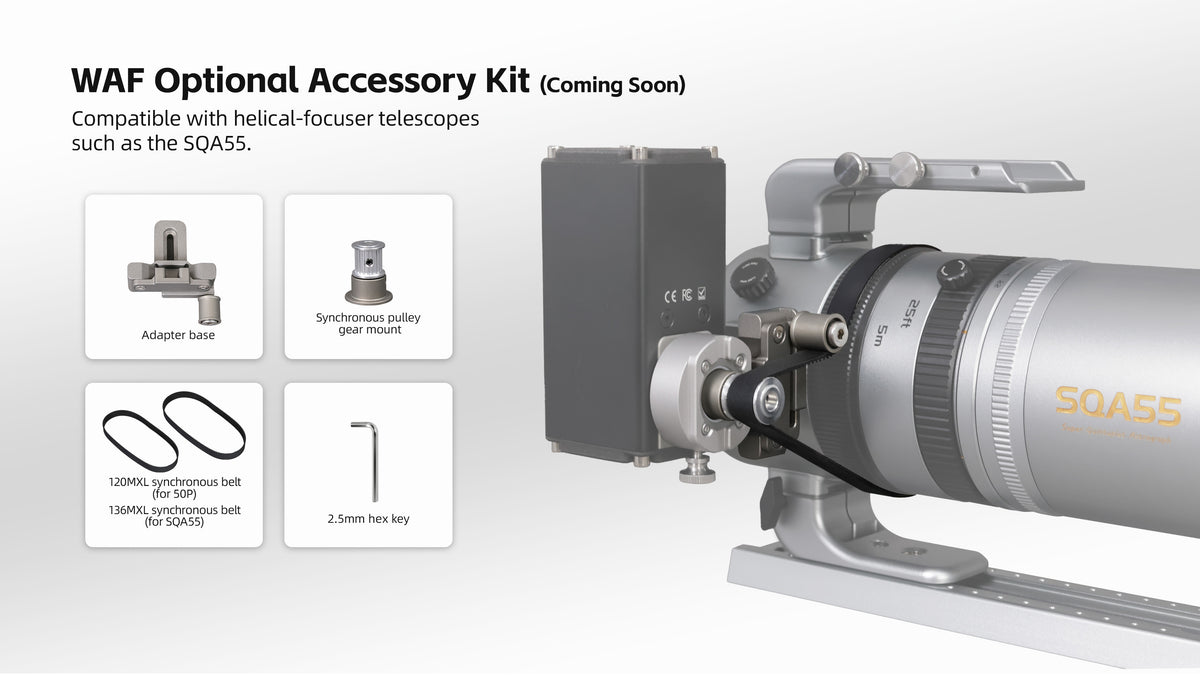
- Telescope fit: Askar does not publish a compatible-telescope list or the mounting interface on its product page for the WAF. Send us the telescope and focuser you are fitting it to and we will confirm the fit with Askar before you order.
Good to Know Before You Order
- The mounting interface is not published. Askar's product page gives the electrical and mechanical specifications but not the bracket or coupling used to attach the unit. We are glad to settle this for your telescope — send us the model and we will check with Askar.
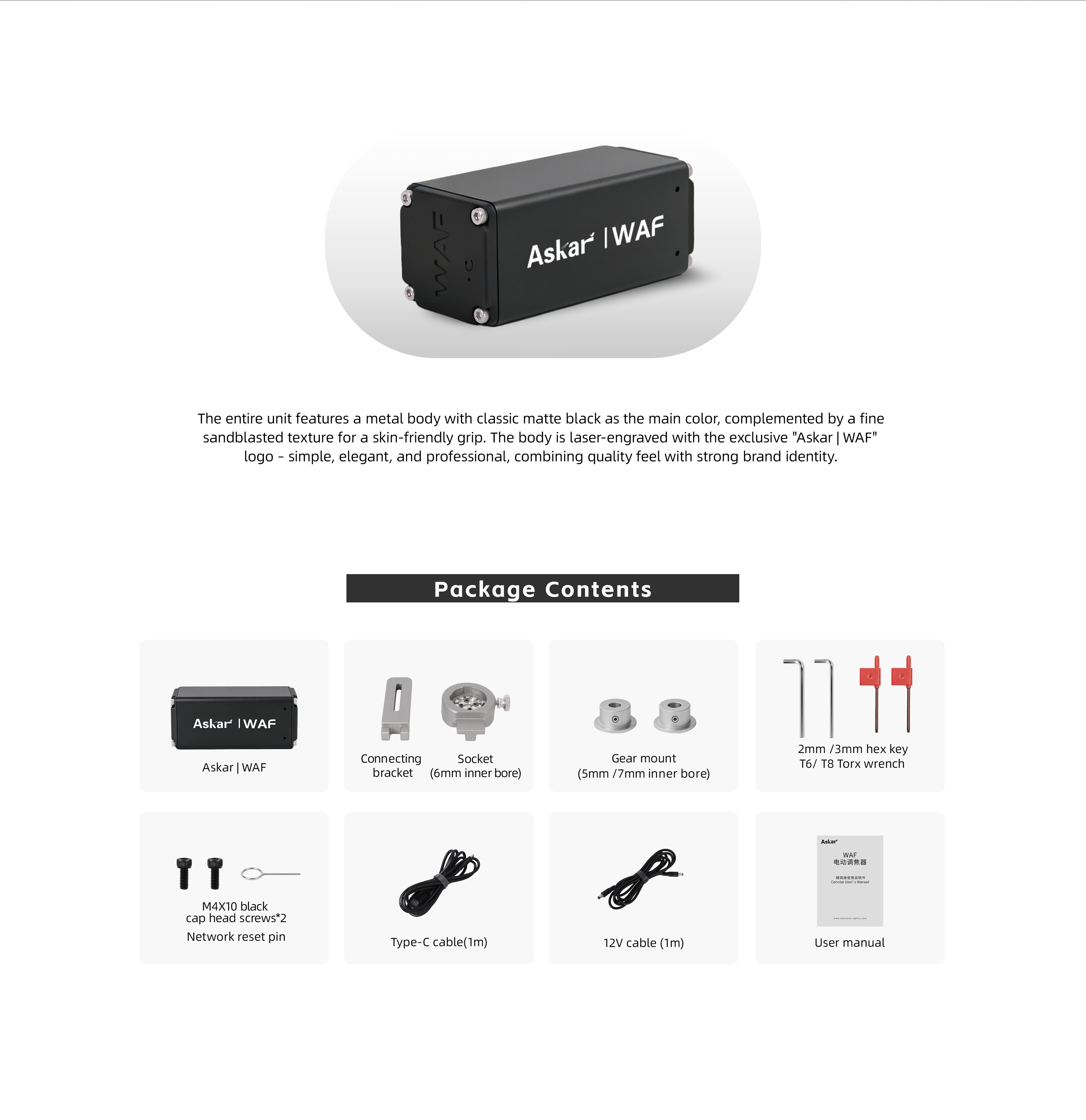
- Package contents are not listed. Askar publishes no box-contents list for the WAF, so we do not state one here rather than guess at it.
- The power supply is separate. The unit takes 12 V on a DC-044 jack at 1 A minimum, and no supply appears in the published specifications.
- It is a focusing device, not an optical component. The WAF changes how focus is driven and does not alter the optical path, backfocus, or image scale.
- Traverse is deliberate rather than quick. The 1:99 reduction that produces the fine step and the holding torque also limits the output to 2.6 rpm, so racking a long focuser end to end takes time. In autofocus, where the routine moves in small increments, that reduction is the advantage.
Frequently Asked Questions
Is it difficult to set up?
The electrical side is direct — 12 V in on the DC-044 jack, USB Type-C for data, then connect through the Askar app or an ASCOM Alpaca client such as N.I.N.A. The mechanical side depends on your focuser, and Askar does not publish the mounting details on its product page. Tell us your telescope and we will confirm what is needed before you order.
What does it actually do?
It motorises focusing, so focus position becomes a number your software can command and return to instead of something set by hand at the eyepiece or on a live view.
Will it work with N.I.N.A.?
Askar lists third-party ASCOM Alpaca platform software, naming N.I.N.A., alongside its own Askar app. INDIGO is published as a supported protocol as well.
How fine is a single step?
Askar publishes a minimum resolution of 0.0182° at the output. How far a drawtube travels for that depends on the focuser it is driving.
Can it hold a heavy imaging train?
Askar rates maximum output torque at 20 kgf·cm, stated as an equivalent load of 20 kg. A 1:99 worm reduction also resists back-driving, which is what keeps a loaded drawtube from slipping.
What makes it different from a belt-drive focus motor?
Belt-drive kits couple a motor to the focuser shaft through a toothed belt and pulley, and the reduction comes from the pulley ratio. The WAF carries a 1:99 worm-and-gear reduction inside the unit, which is where its 0.0182° step and 20 kgf·cm of output torque come from.
Does it replace my focuser, or drive the one I have?
Askar's product page does not state this outright. What it publishes is a drive specification — motor type, gear reduction, output torque, output speed, body size and weight, power and data ports — with no drawtube travel, tube diameter, or optical interface figures. We would rather confirm that with Askar than infer it from the spec sheet, so tell us your telescope and we will get you a definite answer before you order.
Bottom Line
In short: an Askar electronic focus drive built around a 1:99 worm-and-gear reduction, giving a 0.0182° minimum step and 20 kgf·cm of output torque, running on 12 V and USB Type-C and speaking ASCOM Alpaca and INDIGO to N.I.N.A. or the Askar app. Askar has not published the mounting interface for it, so let us know which telescope it is going on and we will confirm the fit with them.
| Motor type | Worm-gear stepper motor |
|---|---|
| Gear reduction ratio | 1:99 |
| Minimum resolution | 0.0182° |
| Maximum output torque | 20 kgf·cm |
| Equivalent load | 20 kg |
| Output speed | 2.6 rpm |
| Power / data interface | DC-044 12V / Type-C |
| Input current | 1 A min |
| Body dimensions | 101 mm × 47 mm × 43 mm |
| Body weight | 373 g |
| Communication protocol | ASCOM Alpaca and Indigo |
| Supported software | Askar APP; ASCOM Alpaca third-party platform software (e.g. N.I.N.A.) |
| Mounting interface | Not published by vendor |
| Package contents | Not published by vendor |
You may also like
Recently viewed
Recent Blog Posts
View all
Your Guide Graph Is Lying to You
Read More
D-Size vs V-Size: A Complete Guide to Telescope Dovetail Systems
Read More
What Is Back Focus in Astrophotography? Telescope Reducers, Flatteners, and Spacing Explained
Read More