

- Description
- Specifications
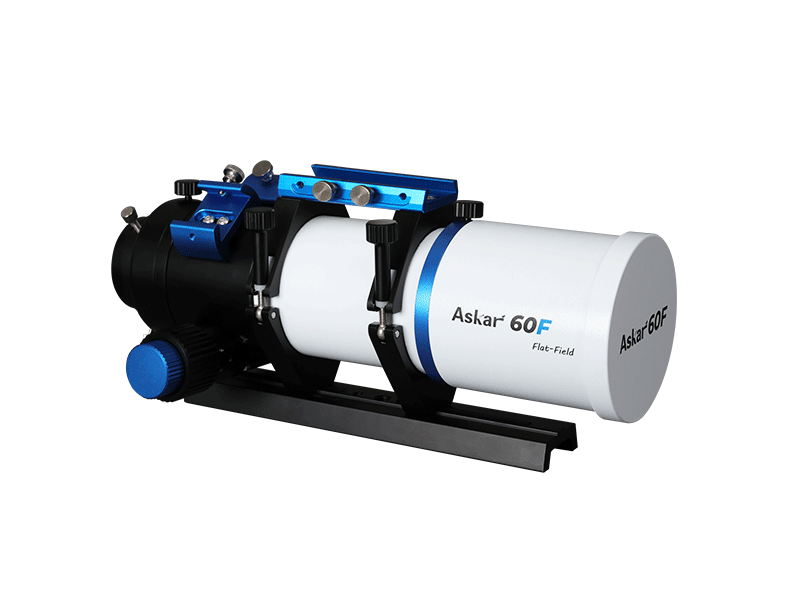
Askar 60F Flat-Field Quadruplet Astrograph — 60mm f/6.8
The Askar 60F Flat-Field is the most compact and portable telescope in the Askar F Series — a 60mm aperture, 408mm focal length quadruplet APO astrograph that weighs just 2.36kg and measures as little as 289mm in total length with the dew shield retracted. Despite its small footprint, it delivers the same self-flattening full-frame performance that defines the entire F Series: a 44mm image circle covering full-frame sensors, no separate flattener required, and no backfocus calculation needed.
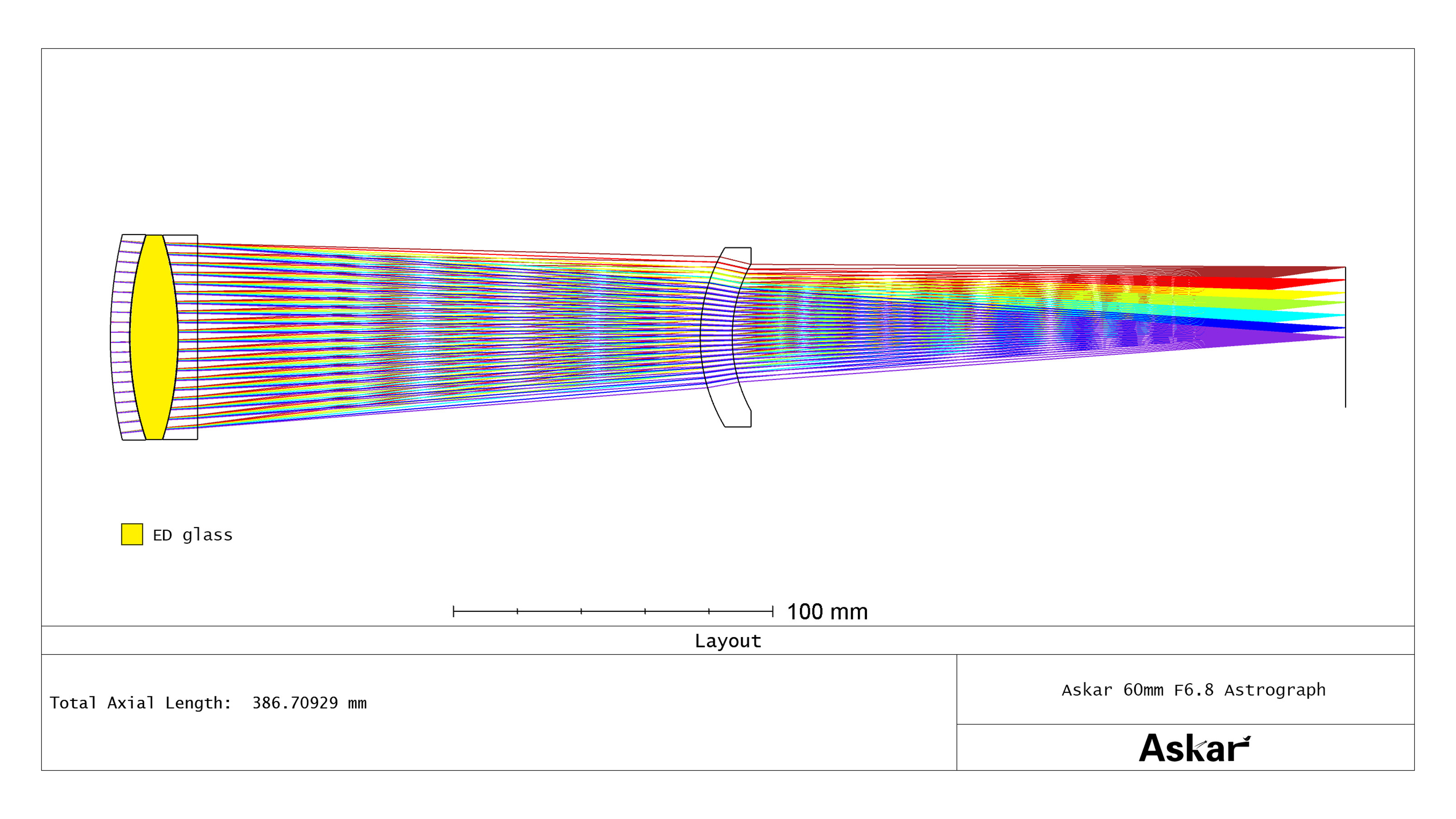
The quadruplet optical design (three front elements, one rear correcting element) includes one piece of ED glass to control chromatic aberration. A 2.4" rack-and-pinion focuser with 1:10 fine adjustment and a 360° rotator handles the imaging side. The matting-felt-lined tube interior reduces stray light, and the signature Askar blue-and-white CNC finish keeps the aesthetic consistent with the rest of the F Series lineup.
The 60F ships with a photographic extension tube featuring a built-in 2" filter thread and M48×0.75 and M54×0.75 adapters, a 230mm Vixen-style dovetail plate with 1/4" and 3/8" tripod screw holes (for direct tripod mounting without any mount), tube rings, and a handle. Two finder base positions on the focuser body plus the handle slot provide three guide scope or accessory mounting positions.
Who Is This Product Best For?
- Travel and portable rig astrophotographers who need a full-featured, full-frame-capable astrograph in the smallest and lightest possible package.
- Beginner to intermediate astrophotographers who want to start with a self-flattening instrument and remove the complexity of external flatteners from day one.
- Photographers using ultralight mounts such as the ZWO AM5, iOptron HEM27, Sky-Watcher Star Adventurer GTi, or any mount where weight is a critical constraint.
- Dual-purpose users wanting a compact refractor for wide-field visual observing with standard 1.25" and 2" eyepieces, as well as astrophotography.
- Astrophotographers on a budget who want the F Series self-flattening design at the most accessible price point in the lineup.
Why Choose the Askar 60F?
- Smallest F Series astrograph — 289mm body length with dew shield retracted and 2.36kg OTA weight; the most portable full-frame-capable astrograph in the Askar lineup.
- Self-flattening quadruplet — no separate flattener needed, no backfocus calculation. Attach and shoot.
- 44mm full-frame image circle — covers all modern full-frame DSLR, mirrorless, and dedicated astronomy camera sensors.
- ED glass chromatic control — one ED element in the quadruplet group suppresses false colour across the full image field.
- Built-in 360° rotator — frame targets at any angle without repositioning the mount.
- 2.4" R&P focuser with 1:10 fine adjustment — rigid, low-flex focuser with anti-slip fine adjustment cover.
- Direct tripod mounting — the 230mm Vixen dovetail includes 1/4" and 3/8" screw holes so the 60F can be used on a camera tripod with no equatorial mount.
- Matting felt tube interior — stray light absorption lining for better contrast.
- Retractable dew shield — compact for transport; extends for field use.
Recommended Uses
- Travel and portable astrophotography on ultralight mounts
- Wide-field deep-sky imaging (large nebulae, star clusters, Milky Way fields)
- Full-frame DSLR, mirrorless, and dedicated astronomy camera imaging
- Narrowband and broadband filter imaging
- Wide-field visual observing with 1.25" and 2" eyepieces
- Beginner and entry-level astrophotography
- Tripod-mounted solar system observing with appropriate solar filter
Compatibility and Accessory Notes
Camera connections: Ships with M48×0.75 and M54×0.75 photographic adapters. DSLR users need a standard T-ring. Dedicated astronomy cameras with M54 or M48 nose threads connect directly. The built-in 2" filter thread accepts standard astronomy filters. Note: the 60F uses M64×0.75 as the primary rear-end thread (vs M64×1 on the 91F), so verify adapter compatibility.
Mount compatibility: The 230mm Vixen dovetail fits any Vixen-compatible saddle. The built-in 1/4" and 3/8" screw holes allow direct tripod use. At 2.86kg gross, compatible with the full range of ultralight mounts — a mount rated for at least 4–6kg payload is recommended for imaging.
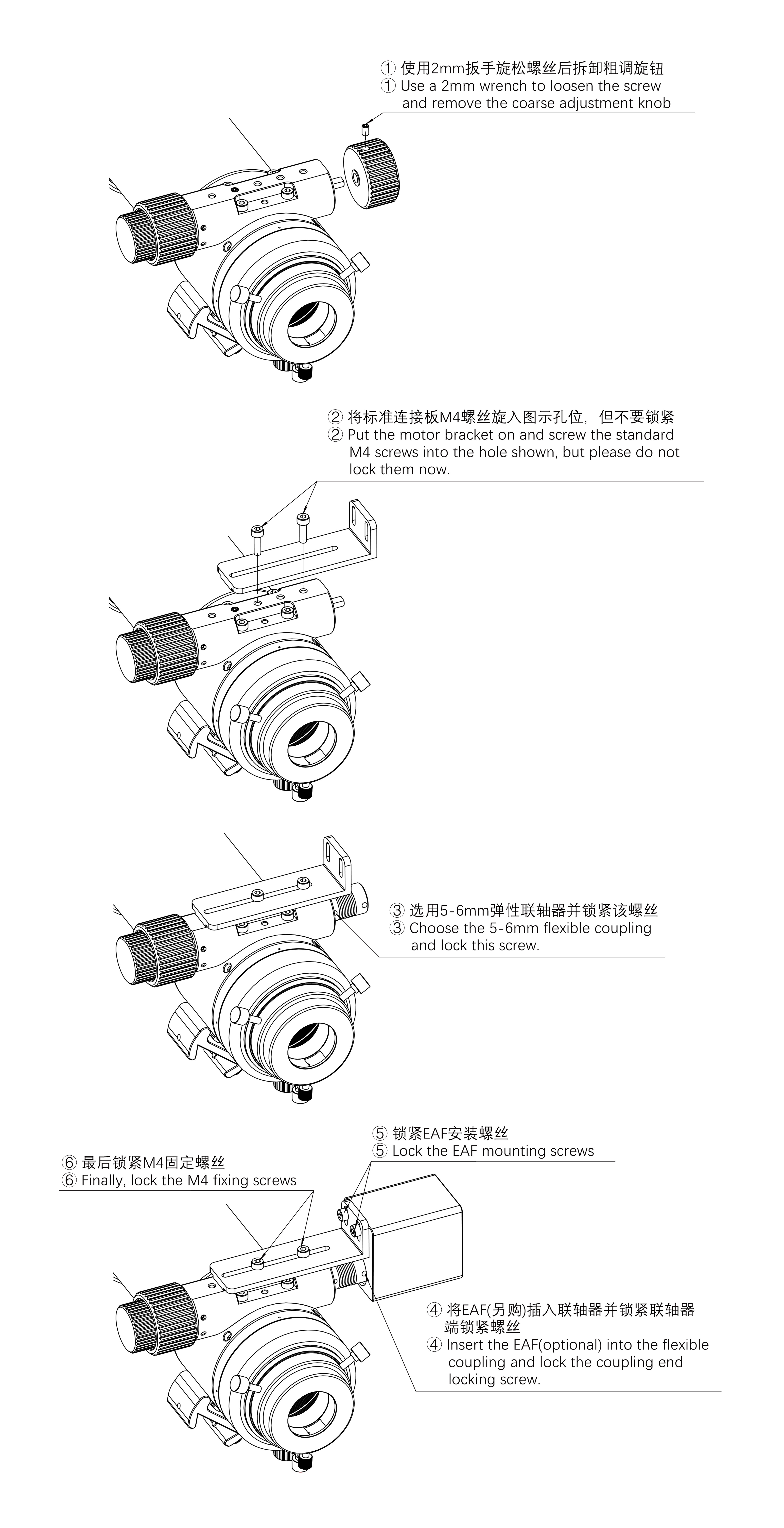
Optional accessories: The Askar 60F 0.75× Reducer (sold separately) reduces the system to f/5.1 and 311mm focal length for an even wider field and faster exposures. An electronic focuser motor is available separately for remote focus control.
Important Limitations
- Smaller aperture than other F Series models — 60mm collects significantly less light than the 91F or larger models. Exposures will be longer on faint targets. The optional 0.75× reducer helps offset this.
- 2.4" focuser (not 3") — the 60F uses a 2.4" focuser rather than the 3" found on the 91F and above. Fully adequate for the optical format, but worth noting for users accustomed to 3" systems.
- Not for planetary imaging — the 408mm focal length is optimized for wide-field deep sky, not high-magnification planetary work.
- No electronic focuser included — motorized focus requires a separately purchased motor.
- No eyepieces included — unlike the 91F, the 60F does not ship with eyepieces. A 1.25" or 2" eyepiece is required for visual use.
Frequently Asked Questions
Do I need a flattener?
No. The self-flattening quadruplet produces a flat field across the 44mm image circle natively.
Does it cover full-frame sensors?
Yes. The 44mm image circle covers all modern full-frame DSLR, mirrorless, and dedicated astronomy sensors.
Is it good for beginners?
Yes — the low weight, simple setup, and self-flattening design make it one of the most beginner-friendly astrographs available. It can also be used on a camera tripod for simple visual observing.
What is the lightest mount that can carry it for imaging?
At 2.86kg gross, even the lightest equatorial tracking mounts — including the Sky-Watcher Star Adventurer GTi, ZWO AM5, iOptron SkyGuider Pro — can carry it for astrophotography.
Is a reducer available?
Yes. The Askar 60F 0.75× Reducer (sold separately) reduces the system to f/5.1 and 311mm focal length.
How does it compare to the 91F?
The 60F is lighter (2.36kg vs 3.92kg), shorter (289mm vs 513mm body), and less expensive. The 91F has more aperture (91mm vs 60mm), a longer focal length (609mm vs 408mm), and includes eyepieces and an erecting prism in the standard package. Choose the 60F for maximum portability; the 91F for more aperture and a more complete out-of-the-box kit.
Our Recommendation
At Ontario Telescope and Accessories, we recommend the Askar 60F Flat-Field for anyone who prioritizes portability above all else without sacrificing flat-field, full-frame optical quality. It is the ideal grab-and-go astrograph for travel, star parties, and ultralight mount setups — and one of the best entry points into serious astrophotography at a highly accessible price. If you need more aperture and aren’t constrained by weight or mount payload, the 91F or 111F will serve you better. But for true portability with no optical compromises, the 60F is in a class of its own in the F Series.
Optical Diagram Reports
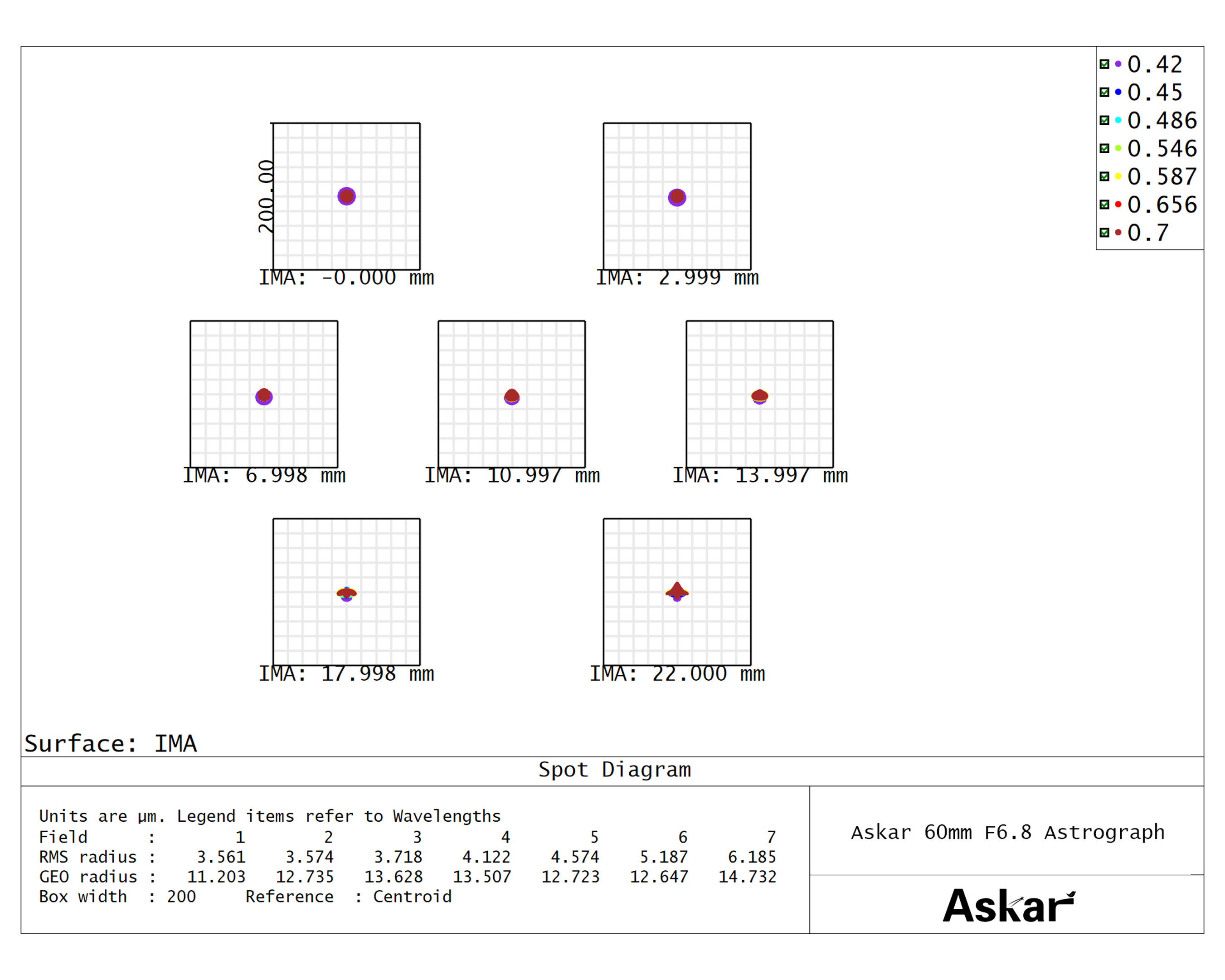
The following optical and mechanical diagrams are provided for customers who wish to review the Askar 60F’s optical performance, mechanical dimensions, connection specifications, and assembly details.
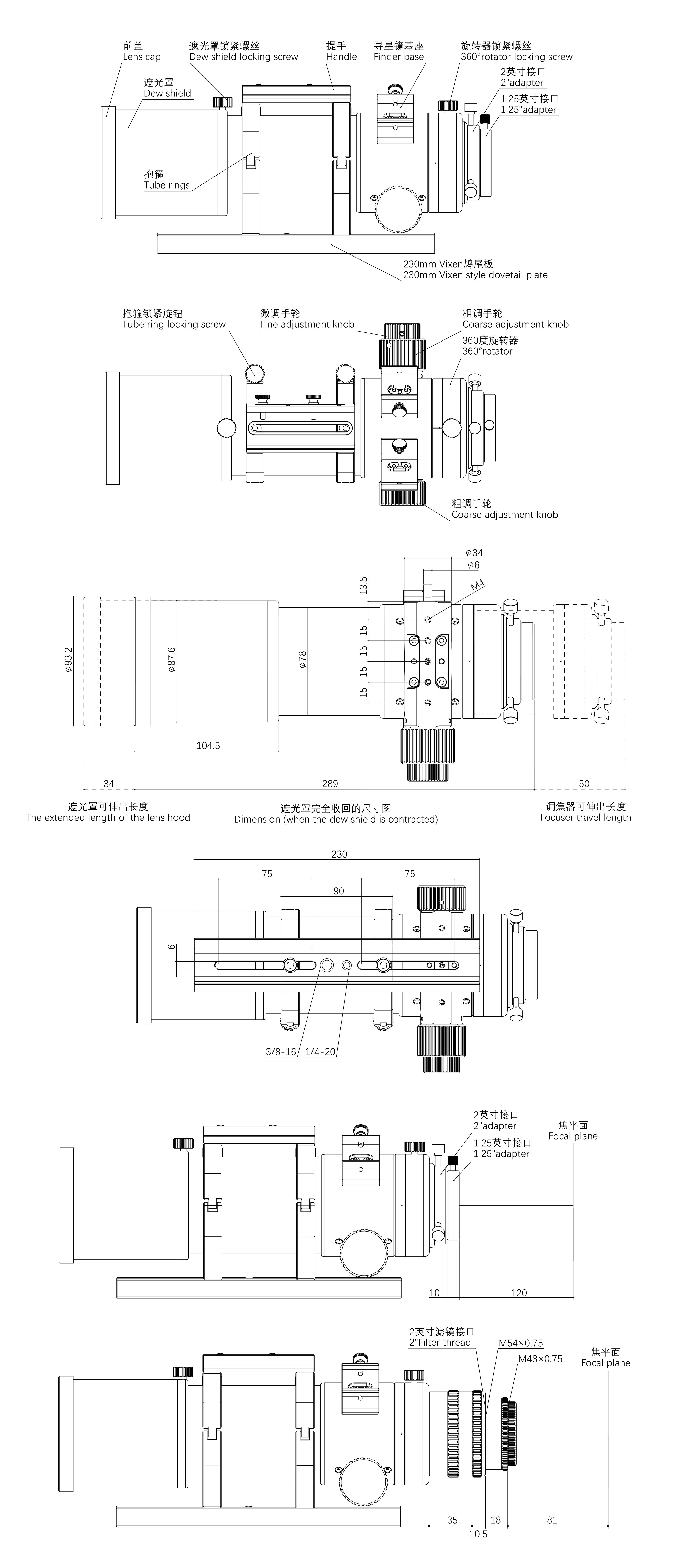
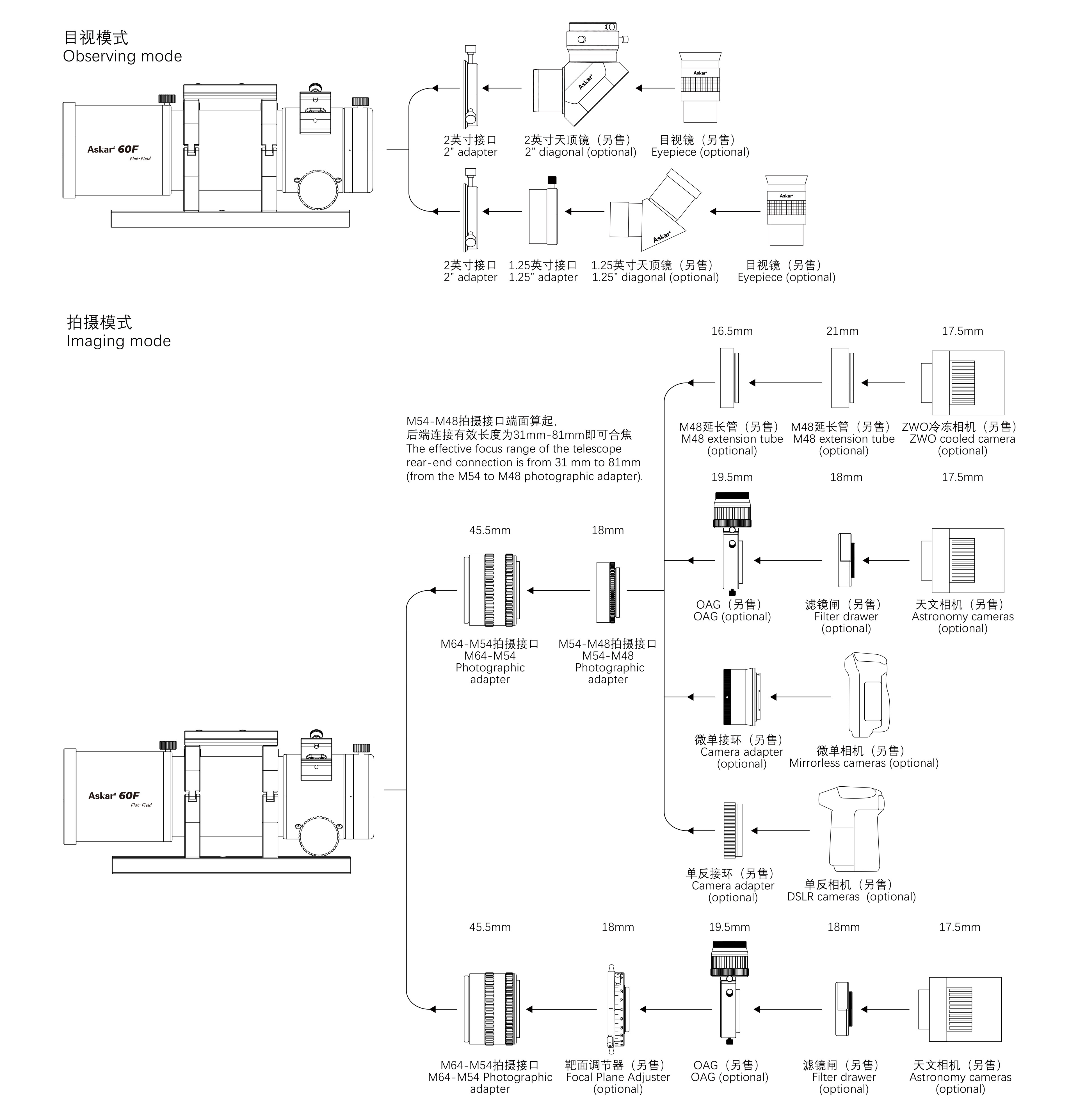
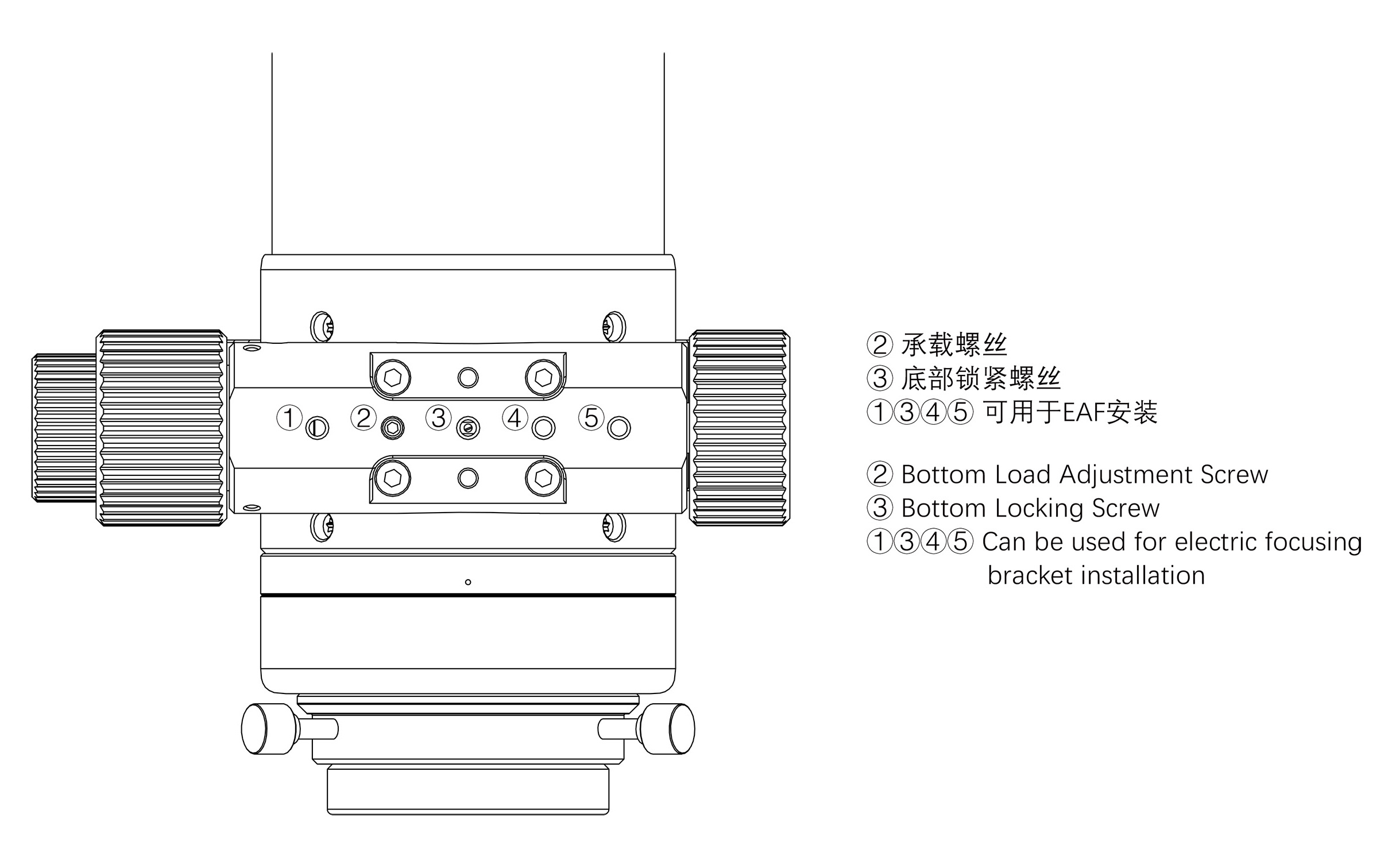
| Specification | Value |
|---|---|
| Aperture | 60 mm |
| Focal Length | 408 mm |
| Focal Ratio | f/6.8 |
| Optical Design | Quadruplet Air-Spaced APO (3 front + 1 rear, including one ED glass) |
| Image Circle | 44 mm (Full Frame compatible) |
| Focuser | 2.4" Rack-and-Pinion with 1:10 fine adjustment |
| Focuser Travel | 50 mm |
| Visual Adapter | 1.25" and 2" eyepiece holders included |
| Rear-End Thread Types | M64×0.75–M54×0.75 / M54×0.75–M54×0.75 / M54×0.75–M48×0.75 (with 2" filter thread) |
| Max Imaging Back Distance (focuser retracted) | 81 mm from M48×0.75 / 99 mm from M54×0.75 |
| Min Imaging Back Distance (focuser extended) | 31 mm from M48×0.75 / 49 mm from M54×0.75 |
| Max Visual Back Distance (focuser retracted) | 120 mm from 1.25" holder / 130 mm from 2" holder |
| Total Length (dew shield contracted, 1.25" adapter) | 289 mm |
| Total Length (dew shield extended, 1.25" adapter) | 323 mm |
| Total Length (dew shield contracted, photo adapter) | 336 mm |
| Total Length (dew shield extended, photo adapter) | 369 mm |
| Net Weight | 2.36 kg |
| Gross Weight (with tube rings and dovetail) | 2.86 kg |
| Dovetail Plate | 230 mm Vixen-style (with 1/4" and 3/8" tripod holes) |
| Camera Rotator | 360° built-in |
| Finder Bases | 3 positions (2 × focuser sides + 1 × handle slot) |
| Standard Package | OTA, tube rings, handle, 230 mm Vixen dovetail plate, 4-piece photographic adapter set |
You may also like
Recently viewed
Recent Blog Posts
View all
Your Guide Graph Is Lying to You
Read More

D-Size vs V-Size: A Complete Guide to Telescope Dovetail Systems
Read More

What Is Back Focus in Astrophotography? Telescope Reducers, Flatteners, and Spacing Explained
Read More