
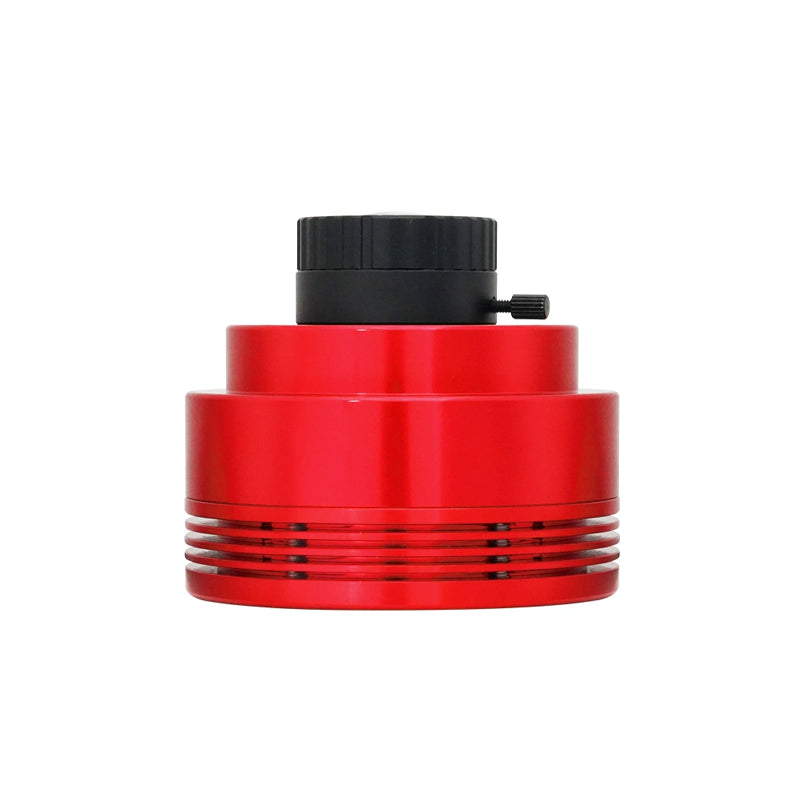


- Description
- Specifications
Product Overview
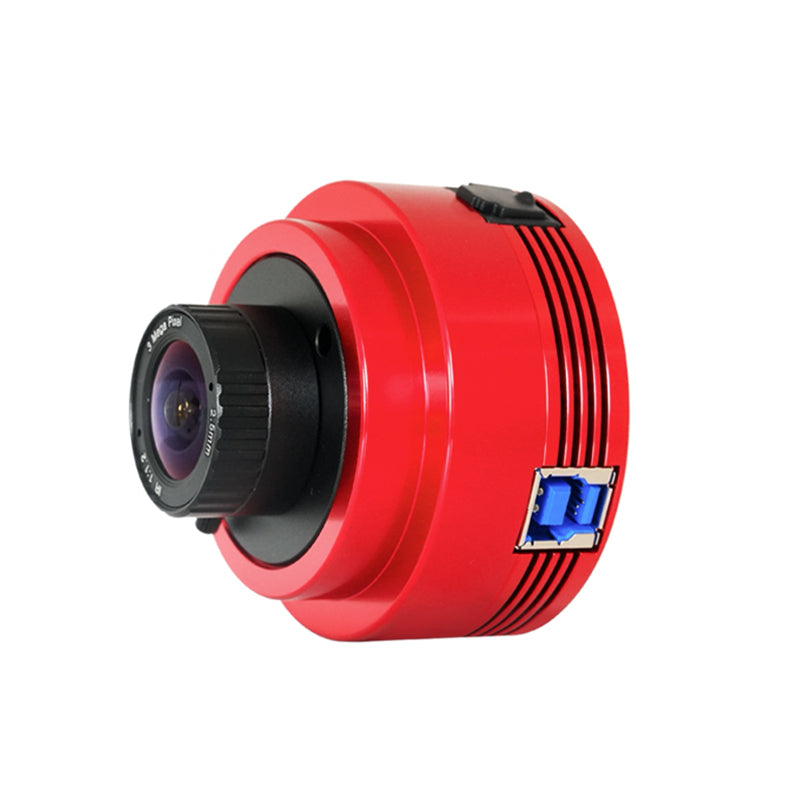
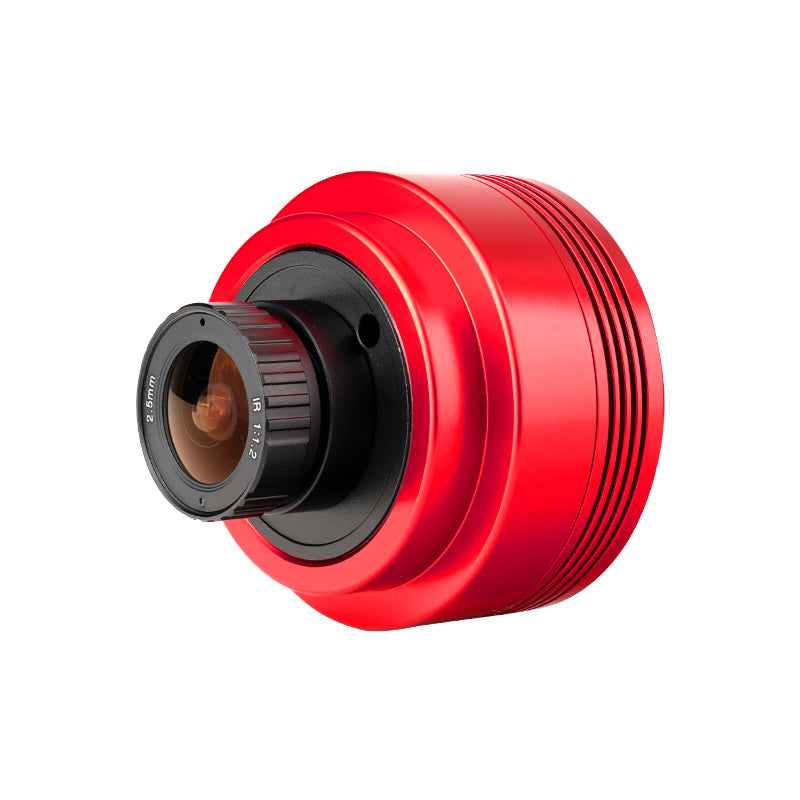
The ZWO ASI676MC is an uncooled, one-shot colour astronomy camera built around the Sony IMX676 back-illuminated CMOS sensor. What sets it apart is the sensor shape: a square 1/1.6″ format measuring 7.104 × 7.104 mm (10.04 mm diagonal) with a 3552 × 3552 array — 12.61 MP of resolution on 2 µm pixels. ZWO positions it primarily as an all-sky camera, and it ships with a fisheye lens fitted to the front of the body, but the same square sensor also works well for high-frame-rate lunar, solar and planetary capture through a telescope.
The sensor uses Sony STARVIS 2 technology, which brings low read noise (0.56e–2.9e), 83% peak quantum efficiency, and improved near-infrared response. The camera connects over USB 3.0 with a 256 MB DDR3 buffer, has an ST4 guide port, and produces no amp glow at any exposure length or gain setting.
Who It’s For
This is a good match if you:
- Want a dedicated all-sky or meteor-patrol camera for an observatory, backyard enclosure or remote site, and want the full sky in a frame that is not wasted on unused corners.
- Shoot the Moon, Sun (with proper filtration) or planets and want a small-pixel, high-frame-rate camera that can also build mosaics without wrestling with a rectangular frame.
- Are running an ASIAIR, mini PC or laptop at the camera — this camera is computer-driven and has no on-board storage or display.
- Are a beginner or intermediate imager: one-shot colour keeps the workflow simple, with no filter wheel and no mono channel registration.
This is not the camera to reach for if you want long-exposure deep-sky imaging as your main use. It is uncooled, and its 12-bit ADC and 10.55 ke– full well are tuned toward short exposures at high frame rates rather than hour-long integrations.
Key Features & Design
- Square Sony IMX676 sensor: 3552 × 3552 on a 7.104 × 7.104 mm die. Equal sides mean mosaic panels tile without tracking a long axis against a short one, and the square frame matches the circular image circle of fisheye and wide-angle lenses far more efficiently than a 16:9 or 3:2 sensor.
- STARVIS 2 back-illuminated architecture: wiring sits behind the photodiodes rather than in front of them, which lifts sensitivity — 83% peak QE — and improves near-infrared response, useful for punching through haze and airglow on all-sky frames.
- 2 µm pixels: fine sampling for lunar and planetary detail at long effective focal lengths; correspondingly modest 10.55 ke– full well.
- HCG mode, automatic at gain 180: drops read noise to 0.56e while holding dynamic range near 11 stops, so high-gain short exposures do not pay the usual noise penalty.
- No amp glow: handled at the hardware level, with no software correction step required.
- 256 MB DDR3 buffer over USB 3.0: absorbs transfer stalls during high-frame-rate capture, which is what prevents dropped frames in a long planetary run.
- 12-bit and 10-bit ADC with ROI: 31.2 fps at full 3552 × 3552 in RAW8 over USB 3.0 (15.6 fps in RAW16), rising to 210.4 fps at 640 × 480.
- UV/IR-cut protective window: φ21 mm × 1.1 mm, sitting in front of the sensor.
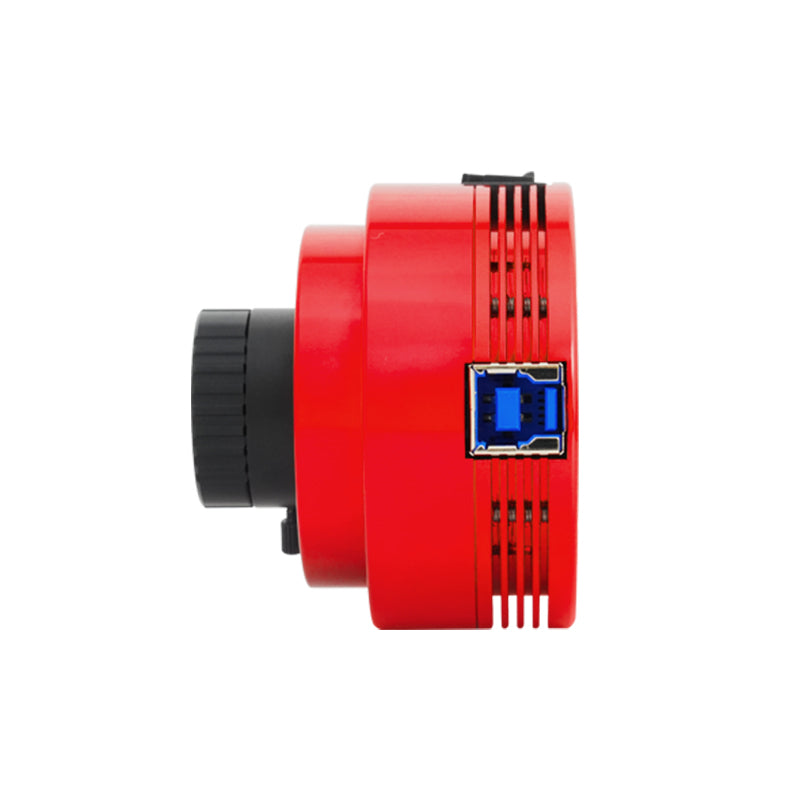
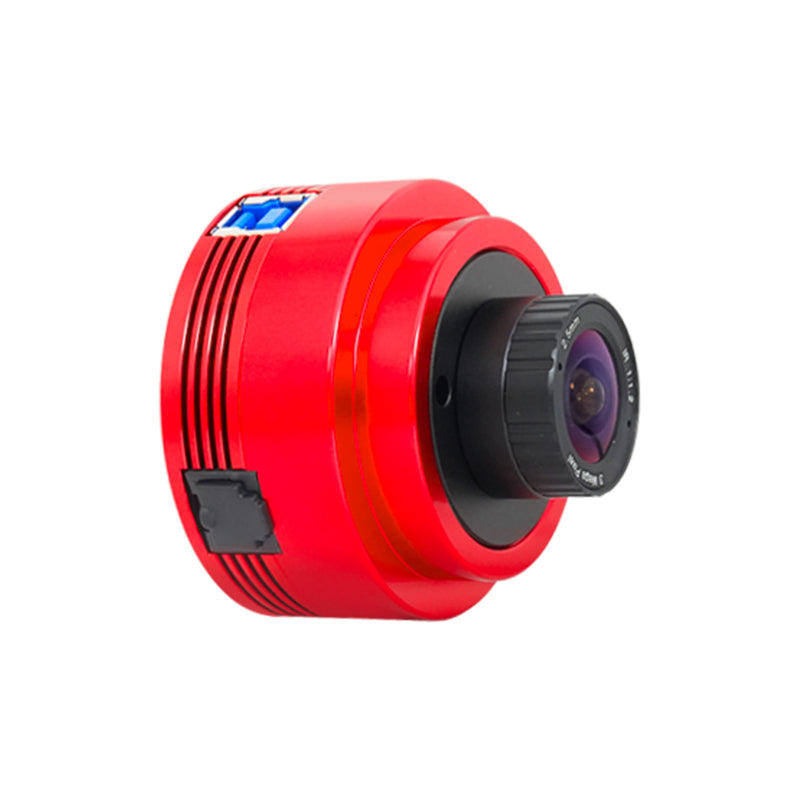
- Compact aluminium body: 62 mm diameter, 126 g, with a 1/4″ tripod screw on the body and an ST4 guide port alongside the USB 3.0 Type-B connector.
Sensor & Mechanical Design
The IMX676 is a rolling-shutter, back-illuminated CMOS sensor. Colour is produced by a Bayer matrix over the pixels, so a single exposure carries full colour information — no filter wheel, no channel alignment. At 2 µm, the pixels are small enough to critically sample a long focal-length instrument, which is exactly what lucky imaging wants. The trade-off is well depth. A 10.55 ke– full well fills quickly on a bright limb, so exposure discipline matters more than it does on a large-pixel deep-sky camera.
Mechanically the camera is a 62 mm barrel weighing 126 g, with 12.5 mm of back focus from the sensor to the front flange. That short back focus is deliberate: it leaves room for the supplied 1.25″ nosepiece, a 1.25″ filter, or an M42 × 0.75 thread to reach focus in most imaging trains. The φ21 × 1.1 mm UV/IR-cut window in front of the sensor blocks infrared leakage that would otherwise bloat star images and desaturate colour on a Bayer sensor.

Recommended Uses
- All-sky monitoring: mounted in a dome or acrylic enclosure with the supplied fisheye lens, running continuously for cloud, aurora and sky-quality monitoring.
- Meteor recording: the square frame plus near-infrared sensitivity suits unattended overnight patrol work.
- Lunar and solar imaging: 2 µm pixels resolve fine detail at long focal length; use ROI to lift frame rate on a limb or sunspot group. Solar work requires a purpose-built solar filter or dedicated solar telescope.
- Planetary capture: high frame rates for lucky imaging on an SCT, Maksutov or long refractor; pair with an ADC when the planet sits low.
- Lunar mosaics: the square format is the practical reason to choose this sensor — panels tile in a uniform grid.
Compatibility and Accessory Notes
- Telescope connection: supplied 1.25″ nosepiece; the body also accepts 2″ and M42 × 0.75 (T2) adapters.
- Back focus: 12.5 mm from the front flange to the sensor. Factor this in when you calculate spacing behind a reducer or flattener.
- Filters: 1.25″ filters thread into the nosepiece. A UV/IR-cut window is already fitted in front of the sensor, so an additional UV/IR-cut filter is redundant for most work.
- Computer connection: USB 3.0 Type-B, with a 2 m cable supplied. USB 2.0 works but frame rates drop sharply (1.7 fps at full resolution in RAW16).
- Software: Windows 7/8/10 (32- and 64-bit), Linux and macOS via ZWO’s ASCOM and native drivers — SharpCap, FireCapture, N.I.N.A. and ASIAIR all recognise ASI cameras.
- Guiding: an ST4 port is fitted, so the camera can send guide pulses directly to a mount’s autoguider input.
- Mounting: a 1/4″ screw hole on the body allows direct tripod or bracket mounting for all-sky installations.
- Remove the fisheye lens from the front of the camera before connecting it to a telescope.

Important Limitations
- Not for visual observing. There is no eyepiece path — a computer or ASIAIR is required to see anything.
- Uncooled. There is no TEC. Dark current rises with ambient temperature, so this is not a substitute for a cooled deep-sky camera on long exposures, even though exposures up to 2000 s are supported.
- Small full well (10.55 ke–) and 12-bit ADC. Suited to short, fast exposures rather than deep, high-dynamic-range integrations.
- USB 2.0 throttles the camera. Full-resolution RAW16 drops to 1.7 fps — a USB 3.0 host port matters here.
- Rolling shutter. Fast-moving foreground subjects can skew; irrelevant for astronomy, relevant if you repurpose the camera for daytime work.
- Colour only. This listing is the MC (one-shot colour) model. The mono ASI676MM is a separate product.
- Working temperature range is -5 °C to 50 °C. Canadian winter all-sky installations need an enclosure with heat.
Frequently Asked Questions
Is this good for beginners?
Yes, for all-sky, lunar and planetary work. One-shot colour means no filter wheel and no per-channel processing, and the camera is plug-and-play with an ASIAIR or a laptop running SharpCap or FireCapture.
What is it best used for?
All-sky and meteor monitoring with the supplied fisheye lens, and high-frame-rate lunar, solar and planetary capture through a telescope. Those two roles are where the square 12.6 MP sensor earns its place.
Can I use it for deep-sky astrophotography?
Only within limits. It is uncooled with a 10.55 ke– full well and a 12-bit ADC. It will record brighter deep-sky objects on a short focal length, but a cooled 16-bit camera is the right tool for serious integration.
Does the all-sky lens come with it?
Yes — the fisheye lens ships fitted to the front of the camera body. Unscrew it before attaching the camera to a telescope.
What is the back focus?
12.5 mm from the front flange to the sensor.
What threads and adapters does it accept?
1.25″, 2″ and M42 × 0.75. A 1.25″ nosepiece is included; 1.25″ filters thread into it.
Do I need a UV/IR-cut filter?
No. A φ21 × 1.1 mm UV/IR-cut window is already fitted in front of the sensor.
What is the difference between the ASI676MC and the ASI676MM?
Same IMX676 sensor and body. The MC is one-shot colour with a Bayer matrix and a UV/IR-cut window. The MM is monochrome with an AR-coated clear window, needing filters and a filter wheel for colour but delivering higher resolution per pixel and full-spectrum flexibility.
Does it need a computer?
Yes. A Windows, Linux or macOS host, or an ASIAIR, is required for control and capture. USB 3.0 is strongly preferred.
When should this camera not be recommended?
When the goal is faint, long-exposure deep-sky imaging, or when the imager wants a large sensor for wide-field framing. Sensor diagonal is only 10.04 mm.
Bottom Line
In short: a 12.6 MP square-format, uncooled one-shot colour camera on a 2 µm-pixel Sony IMX676 STARVIS 2 sensor, supplied with a fisheye lens. It is at its best doing full-sky monitoring and meteor patrol, or high-frame-rate lunar, solar and planetary capture through a long focal length. It needs a USB 3.0 host and a computer or ASIAIR; it does not need cooling for those jobs, and it does not pretend to replace a cooled deep-sky camera.
Optical Diagram Reports
ZWO’s published relative response curve for the ASI676MC colour sensor, showing a peak quantum efficiency of approximately 83%:

| Sensor | Sony IMX676 CMOS, back-illuminated, STARVIS 2 |
|---|---|
| Sensor type | One-shot colour (Bayer matrix) |
| Sensor format | Type 1/1.6" square, 7.104 mm × 7.104 mm |
| Sensor diagonal | 10.04 mm |
| Resolution | 12.61 MP (3552 × 3552) |
| Pixel size | 2 µm |
| Shutter | Rolling shutter |
| Max frame rate | 31.2 fps at full resolution (RAW8, USB 3.0); 210.4 fps at 640 × 480 |
| Exposure range | 32 µs – 2000 s |
| Read noise | 0.56e – 2.9e (0.56e in HCG mode, auto-enabled at gain 180) |
| Peak QE | 83% |
| Full well capacity | 10.55 ke- |
| ADC | 12-bit (10-bit mode also supported) |
| Dynamic range | Approx. 11 stops |
| Buffer | 256 MB DDR3 |
| Amp glow | None (hardware level) |
| Cooling | Uncooled |
| Data port | USB 3.0 / USB 2.0 Type-B |
| Guide port | ST4 |
| Protective window | UV/IR-cut, φ21 mm × 1.1 mm |
| Adapters | 1.25" / 2" / M42 × 0.75 |
| Back focus distance | 12.5 mm |
| Camera diameter | 62 mm |
| Camera weight | 126 g |
| Mounting | 1/4" tripod screw on body |
| Working temperature | -5 °C to 50 °C |
| Supported OS | Windows 7/8/10 (32 & 64-bit), Linux, macOS |
| In the box | ASI676MC camera body with all-sky (fisheye) lens, 1.25" nosepiece, 1.2" cover, ST4 cable, 2 m USB 3.0 cable, quick guide |
You may also like
Recently viewed
Recent Blog Posts
View all
Your Guide Graph Is Lying to You
Read More

D-Size vs V-Size: A Complete Guide to Telescope Dovetail Systems
Read More

What Is Back Focus in Astrophotography? Telescope Reducers, Flatteners, and Spacing Explained
Read More