




- Description
- Specifications
Product Overview
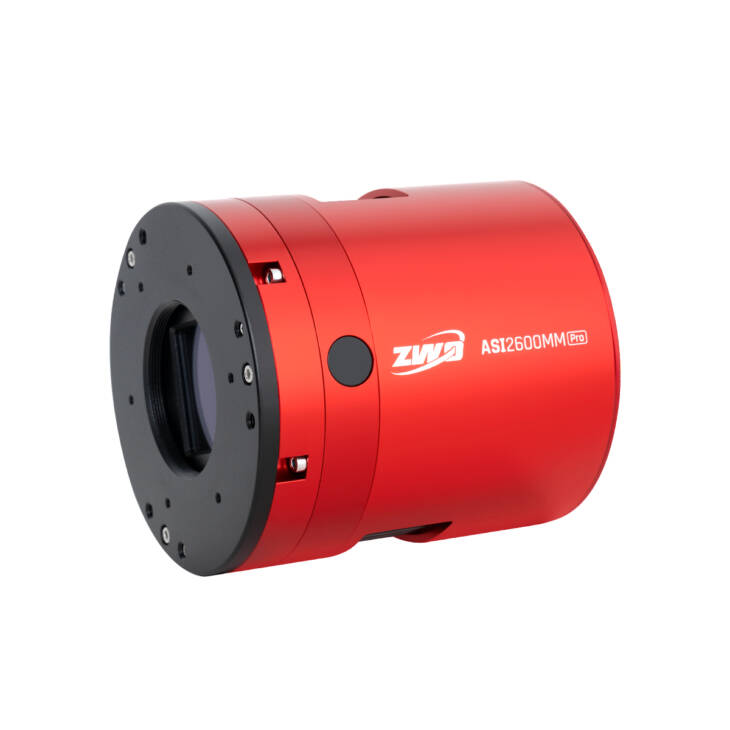
The ZWO ASI2600MM Pro is a cooled APS-C monochrome astronomy camera built around Sony’s IMX571 back-illuminated CMOS sensor. It uses a 23.5 mm × 15.7 mm sensor with a 28.3 mm diagonal, 6248 × 4176 resolution, 3.76 µm pixels, native 16-bit ADC, and up to 14 stops of dynamic range.
This P25 generation is the monochrome version of the ASI2600 Pro platform. It is intended for LRGB, narrowband, and specialist filter workflows where maximum sensitivity and filter control matter more than one-shot-colour simplicity.
Who It’s For
This is a good match if you want an APS-C cooled monochrome camera for deep-sky imaging with filters. It suits systems using a filter wheel or filter drawer, properly spaced optics, and stable 12 V power.
Key Features & Design
- Sony IMX571 monochrome APS-C sensor: 23.5 mm × 15.7 mm format with a 28.3 mm diagonal.
- 26 MP resolution: 6248 × 4176 pixels for detailed deep-sky capture.
- Native 16-bit ADC: Supports smooth tonal gradients and high dynamic range imaging.
- High QE: ZWO lists the ASI2600MM Pro quantum-efficiency peak at 91%.
- Zero amp glow: Cleaner long exposures and easier calibration.
- Two-stage TEC cooling: Lowers sensor temperature by about 30°C–35°C below ambient under ZWO test conditions.
Optical / Mechanical Design
The ASI2600MM Pro uses the APS-C IMX571 monochrome sensor with 3.76 µm pixels. It requires filters for colour or narrowband work, but gives you more control than a colour sensor when building LRGB, SHO, or HOO data sets.
Camera Performance
The ASI2600MM/MC Pro sensor platform delivers up to 14 stops of dynamic range. At gain 100, HCG mode is automatically enabled, reducing read noise while preserving useful dynamic range for deep-sky imaging.

QE / Relative Response
ZWO lists the ASI2600MM Pro monochrome sensor with a 91% peak QE value, making it a strong option for LRGB and narrowband work.

Recommended Uses
- LRGB imaging: High-resolution luminance and colour-channel imaging through filters.
- Narrowband imaging: H-alpha, OIII, SII, SHO, and HOO imaging with suitable filters.
- APS-C deep-sky imaging: Nebulae, galaxies, clusters, and corrected wide fields.
Compatibility and Accessory Notes
External 12 V power is required for cooled-camera operation. For monochrome imaging, plan for a compatible filter wheel or filter drawer, a suitable filter set, and optics corrected for an APS-C field.
Important Limitations
- Requires filters for colour: This is a monochrome camera.
- Requires external power: USB alone does not power the cooled camera.
- Requires careful spacing: Corner quality depends on the telescope, corrector, and backfocus setup.
Frequently Asked Questions
Is the ASI2600MM Pro monochrome?
Yes. It is the monochrome version of the ASI2600 Pro family.
Does it need a filter wheel?
For LRGB or narrowband imaging, yes. A filter wheel or filter drawer is normally part of the setup.
How is it different from the ASI2600MC Pro?
The MM version is monochrome and better for filter-based imaging. The MC version is one-shot colour and simpler to use.
Bottom Line
In short: the ASI2600MM Pro is a 26 MP APS-C cooled monochrome camera for LRGB and narrowband deep-sky imaging, best used with filters, APS-C-corrected optics, and stable 12 V power.
| Product Name | ZWO ASI2600MM Pro |
|---|---|
| SKU | ASI2600MM-P25 |
| Camera Type | Cooled APS-C monochrome deep-sky camera |
| Sensor | Sony IMX571 back-illuminated CMOS |
| Sensor Format | APS-C, 23.5 mm x 15.7 mm |
| Sensor Diagonal | 28.3 mm |
| Resolution | 6248 x 4176 |
| Megapixels | 26 MP |
| Pixel Size | 3.76 microns |
| Full Well | 73 ke |
| ADC | Native 16-bit |
| Dynamic Range | Up to 14 stops |
| QE Peak | 91% |
| Cooling | Two-stage TEC, about 30 C to 35 C below ambient |
| Interface | USB 3.0 |
| Built-in Memory | 512 MB DDR3 buffer |
| Shopify Product Weight | 2 lb |
| Standard Box | 9 x 6 x 6 in |
You may also like
Recently viewed
Recent Blog Posts
View all
Your Guide Graph Is Lying to You
Read More

D-Size vs V-Size: A Complete Guide to Telescope Dovetail Systems
Read More

What Is Back Focus in Astrophotography? Telescope Reducers, Flatteners, and Spacing Explained
Read More