


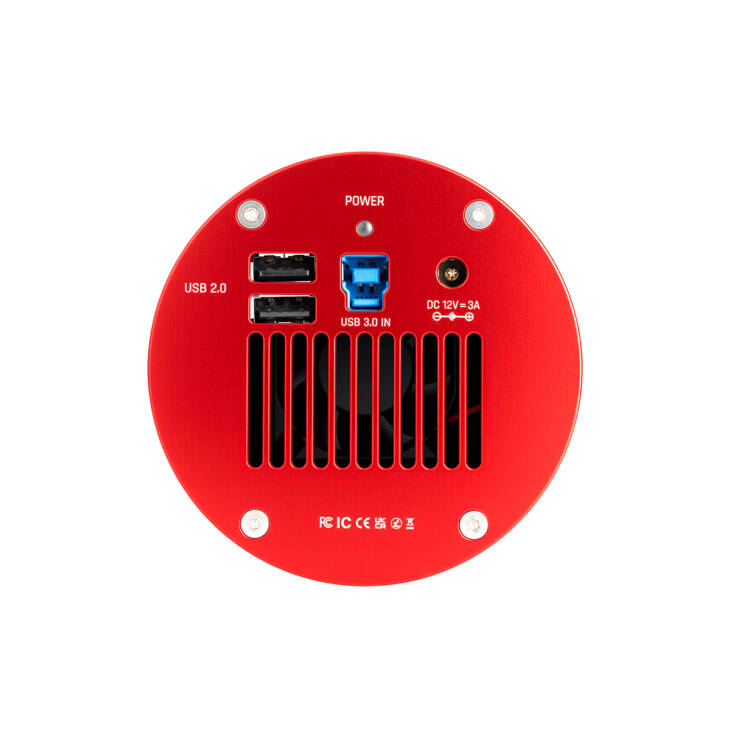


- Description
- Specifications
Product Overview
The ZWO ASI2600MC Pro is a cooled APS-C colour astronomy camera built around Sony’s IMX571 back-illuminated CMOS sensor. It uses a 23.5 mm × 15.7 mm sensor with a 28.3 mm diagonal, 6248 × 4176 resolution, 3.76 µm pixels, native 16-bit ADC, and up to 14 stops of dynamic range.
This P25 generation keeps the ASI2600 Pro deep-sky imaging platform compact while adding the updated body design, 512 MB DDR3 buffer, zero amp-glow circuitry, two-stage TEC cooling, anti-dew heater, and sensor tilt adjustment.
Who It’s For
This is a good match if you want a one-shot-colour cooled camera for APS-C deep-sky imaging without the complexity of a monochrome camera, filter wheel, and LRGB or narrowband filter set.
Key Features & Design
- Sony IMX571 APS-C sensor: 23.5 mm × 15.7 mm format with a 28.3 mm diagonal.
- 26 MP resolution: 6248 × 4176 pixels for detailed deep-sky images.
- 3.76 µm pixels: A practical match for many refractors and astrographs.
- Native 16-bit ADC: Supports smooth tonal transitions and high dynamic range capture.
- Zero amp glow: Cleaner long exposures and easier calibration.
- Two-stage TEC cooling: Lowers sensor temperature by about 30°C–35°C below ambient under ZWO test conditions.
Optical / Mechanical Design
The ASI2600MC Pro uses the APS-C IMX571 sensor with 3.76 µm pixels and a 28.3 mm diagonal. It is well matched to telescopes and flatteners that support APS-C coverage. The camera includes a built-in anti-dew heater and sensor tilt adjustment for cleaner long-exposure imaging and better corner performance.
Camera Performance
The ASI2600MM/MC Pro sensor platform delivers up to 14 stops of dynamic range. At gain 100, HCG mode is automatically enabled, reducing read noise while preserving useful dynamic range for deep-sky imaging.

QE / Relative Response
ZWO lists the ASI2600MC Pro colour sensor with an 80% peak QE value. The relative-response graph below shows the colour-channel response across wavelength.

Recommended Uses
- APS-C deep-sky imaging: Nebulae, galaxies, clusters, and wide corrected fields.
- One-shot-colour capture: A simpler colour workflow than monochrome LRGB imaging.
- Portable imaging rigs: Good fit for cooled-camera setups where size and cable management matter.
Compatibility and Accessory Notes
External 12 V power is required for cooled-camera operation. Use optics corrected for an APS-C image circle and follow the required back-focus spacing for your telescope, reducer, or flattener.
Important Limitations
- Requires external power: USB alone does not power the cooled camera.
- APS-C sensor: Full-frame optics are not required, but small corrected fields may not cover the sensor.
- Colour sensor: Choose the ASI2600MM Pro if you need filter-based monochrome imaging.
Frequently Asked Questions
Is the ASI2600MC Pro a colour camera?
Yes. It is the one-shot-colour version of the ASI2600 Pro camera family.
Does it need a filter wheel?
No. It is a colour camera, although optional filters can still be used depending on the imaging setup.
Is it suitable for beginners?
It is a strong choice once the mount, spacing, power, and software workflow are understood. For a first cooled camera, it is simpler than a monochrome system.
Bottom Line
In short: the ASI2600MC Pro is a 26 MP APS-C cooled colour camera for deep-sky imaging, best used with APS-C-corrected optics, proper backfocus, and stable 12 V power.
| Product Name | ZWO ASI2600MC Pro |
|---|---|
| SKU | ASI2600MC-P25 |
| Camera Type | Cooled APS-C colour deep-sky camera |
| Sensor | Sony IMX571 back-illuminated CMOS |
| Sensor Format | APS-C, 23.5 mm x 15.7 mm |
| Sensor Diagonal | 28.3 mm |
| Resolution | 6248 x 4176 |
| Megapixels | 26 MP |
| Pixel Size | 3.76 microns |
| Full Well | 73 ke |
| ADC | Native 16-bit |
| Dynamic Range | Up to 14 stops |
| Cooling | Two-stage TEC, about 30 C to 35 C below ambient |
| Interface | USB 3.0 |
| Built-in Memory | 512 MB DDR3 buffer |
| Shopify Product Weight | 2 lb |
| Standard Box | 9 x 6 x 6 in |
You may also like
Recently viewed
Recent Blog Posts
View all
Your Guide Graph Is Lying to You
Read More
D-Size vs V-Size: A Complete Guide to Telescope Dovetail Systems
Read More
What Is Back Focus in Astrophotography? Telescope Reducers, Flatteners, and Spacing Explained
Read More