


- Description
- Specifications
Product Overview
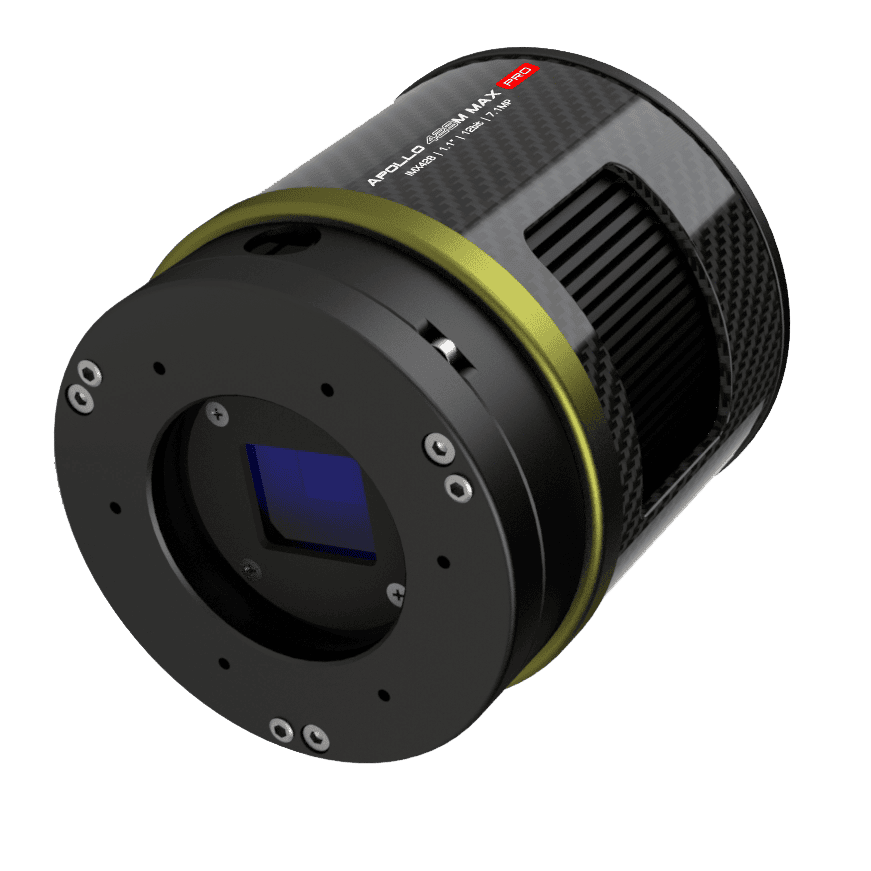
The Apollo 428M MAX Pro is a cooled monochrome astronomy camera from Player One Astronomy, built around Sony's 1.1" IMX428 global-shutter CMOS sensor. It combines a 7.1-megapixel array (3216×2208, 4.5 µm pixels, 17.5 mm diagonal) with two-stage TEC cooling that holds the sensor 35–40 °C below ambient in long-exposure mode. Because it reads every pixel at once, the global shutter captures fast, high-contrast subjects — the solar limb, planetary detail — with no rolling-shutter skew.
Who It's For
This is a good match if you image the Sun in monochrome (Ha, white-light, Ca-K through the appropriate filters), work on high-frame-rate planetary and lunar targets, or want a global-shutter sensor with active cooling for cleaner, lower-noise long exposures. It suits users who already run a filtered monochrome workflow and want the frame integrity a global shutter provides.
Key Features & Design
- Sony IMX428 global-shutter CMOS: every pixel is exposed and read simultaneously, so there is no geometric distortion on moving or rapidly changing subjects.
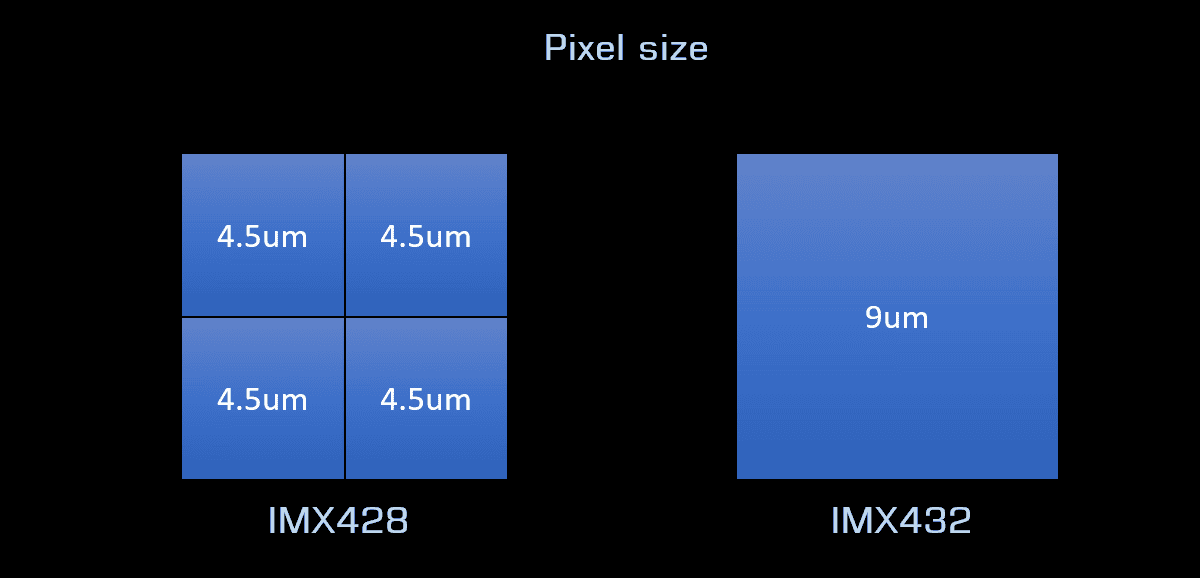
- 7.1 MP resolution: 3216×2208 pixels at 4.5 µm on a 1.1" (17.5 mm diagonal) sensor.
- Two-stage TEC cooling: 35–40 °C below ambient in long-exposure mode (30 °C in video mode), lowering dark current for stacked deep-sky frames.
- Low read noise: 5.5 e− down to 1.4 e− at high gain, with a 25.3k e− full-well capacity.
- 512 MB DDR3 buffer: stabilises the USB3.0 data stream and reduces dropped frames during high-speed capture.
- AR-coated protective window: D32×2 mm multi-layer anti-reflection glass.
Optical / Mechanical Design
The IMX428 is a 1.1" global-shutter monochrome CMOS with 4.5 µm pixels across a 14.5 mm×9.9 mm active area. Full-well capacity is 25.3k e− and read noise ranges from 5.5 e− to 1.4 e− depending on gain, digitised at 12-bit. Peak quantum efficiency is approximately 79%. At full resolution the camera reaches 51 fps in 10-bit (Raw8) mode and 27 fps at 12-bit over USB3.0. The sensor-to-flange backfocus is 17.5 mm, and the two-stage thermoelectric cooler holds the sensor 35–40 °C below ambient in long-exposure mode. The camera body is 78 mm in diameter and terminates in a 1.25" / M42×0.75 interface.
Recommended Uses
- Solar imaging: monochrome capture through Ha, Ca-K or white-light filters, where the global shutter preserves fine surface structure.
- Planetary and lunar: high-frame-rate lucky imaging of Jupiter, Saturn, Mars and the lunar surface.
- Cooled deep-sky: filtered narrowband and LRGB stacking that benefits from reduced thermal noise.
Compatibility and Accessory Notes
The camera presents a 1.25" nosepiece and an M42×0.75 (T-thread) rear, and needs 17.5 mm of backfocus accounted for in the imaging train. Data is over USB3.0 (backward compatible with USB2.0). Cooling draws up to 3 A, so a 12 V DC supply rated to at least 5 A is used to run the TEC. As a monochrome camera it images through external filters — a filter wheel or drawer and the relevant narrowband or LRGB set complete a colour or scientific workflow.
Good to Know Before You Order
- It is a monochrome camera: colour and narrowband results come from imaging through separate filters, so a filter wheel or drawer is part of a full imaging setup.
- Cooling needs its own power: a 12 V DC supply rated to 5 A or more runs the two-stage TEC; USB carries data only.
- Published weight is 420 g: light enough for most focusers, and worth noting once filters and adapters are added to the train.
- 12-bit ADC: the sensor digitises at 12-bit, which suits both high-speed video and stacked long-exposure work.
Frequently Asked Questions
Is it difficult to set up?
No. It threads on through its 1.25" / M42×0.75 interface and connects over USB3.0; the only extra step versus a non-cooled camera is plugging in a 12 V, 5 A power supply to run the cooler.
What is it best used for?
Monochrome solar and planetary imaging where the global shutter matters, plus cooled, filtered deep-sky capture.
Does it need filters?
Yes for colour or narrowband work — it is a mono sensor, so it images through Ha, Ca-K, LRGB or narrowband filters mounted in a wheel or drawer.
What makes it different from the non-cooled Apollo 428M MAX?
The Pro adds two-stage TEC cooling (35–40 °C below ambient) and a larger 512 MB buffer, extending the same IMX428 global-shutter sensor into low-noise long-exposure imaging.
Bottom Line
In short: a 7.1 MP IMX428 global-shutter mono camera with two-stage cooling to 35–40 °C below ambient, a 1.25"/M42 interface and 17.5 mm backfocus — equally at home on the solar limb, on the planets, and on cooled narrowband deep-sky frames.
| Sensor | Sony IMX428, 1.1" CMOS (mono) |
|---|---|
| Shutter | Global shutter |
| Diagonal | 17.5 mm |
| Resolution | 7.1 MP (3216×2208) |
| Pixel size | 4.5 µm |
| Image size | 14.5 mm × 9.9 mm |
| Full well | 25.3k e- |
| Read noise | 5.5~1.4 e- |
| ADC | 12-bit |
| Peak QE | ≈79% |
| Cooling | Two-stage TEC, 35°C-40°C below ambient (long exposure) |
| Max frame rate | 51 fps (10-bit) / 27 fps (12-bit) at full resolution |
| Interface | USB3.0 / USB2.0 |
| Buffer | 512 MB DDR3 |
| Protective window | D32×2 mm AR Plus multi-layer coating |
| Back focal length | 17.5 mm |
| Adapter | 1.25" / M42×0.75 |
| Diameter | 78 mm |
| Power | Max 3 A; 12 V DC, 5 A adapter minimum |
| Weight | 420 g |
You may also like
Recently viewed
Recent Blog Posts
View all
Your Guide Graph Is Lying to You
Read More

D-Size vs V-Size: A Complete Guide to Telescope Dovetail Systems
Read More

What Is Back Focus in Astrophotography? Telescope Reducers, Flatteners, and Spacing Explained
Read More