

- Description
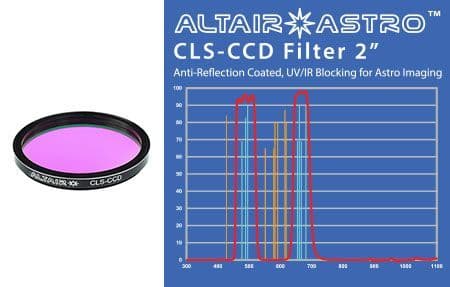
The Altair Astro Premium 2" CLS-CCD Filter is designed for imaging with DSLR, CCD or CMOS cameras however it can be used for visual observation with 6-8" aperture or larger telescopes.
2" filter has 45mm clear aperture to minimise vignetting.
The Altair Astro CLS-CCD Filter Drastically reduces the effects of light pollution and natural moon or skyglow, permitting long exposure imaging, even in urban conditions.
Enhances nebulae with peak transmission of 95% in H 486.1nm; OIII 495.9nm; OIII 500.7nm and H 656.3nm wavelengths.
Artificial Light Pollution wavelengths are very effectively blocked, the primary ones being:
- Hg 435.8
- Hg 546.1nm
- Hg 577.0nm
- Hg 578.1nm
- Na 589.0
- Na 589.6nm
- Na 615.4nm
- Na 616.1nm
Aside from the high qualty Schott German glass and top quality coatings, these filters have some additional enhancements which make them ideal for your astro imaging application.
Advanced UV/IR blocking give small star sizes even with refractor optics, and AR (Anti Reflection) coatings reduce halo effects and internal reflections for more pleasing star images.
Can be used visually on 250mm or larger aperture telescopes for very high contrast. (Do not use for Sun!).
Premium filter features:
- Multi-Layer Anti-Reflection coating to reduce star-halos and reflections from camera optical window.
- Batch-tested for consistency.
- Ultra-flat glass by Schott Germany. 1.85mm Glass 30sec parallel, optical polish to MIL Spec. MIL-O-13830.
- High quality dichroic/dielectric coatings. Electron-beam gun evaporation with Ion-assisted deposition coating technology for durability and resistance to scratching, as well as stability on CWL (central wavelength). No deviation affected by temperature change.
- UV/IR block for imaging - star bloat reduction with refractors.
- Precision CNC machined filter cell for strain-free mounting and freedom from tilt.
You may also like
Recently viewed
Recent Blog Posts
View all
Your Guide Graph Is Lying to You
Read More

D-Size vs V-Size: A Complete Guide to Telescope Dovetail Systems
Read More

What Is Back Focus in Astrophotography? Telescope Reducers, Flatteners, and Spacing Explained
Read More