
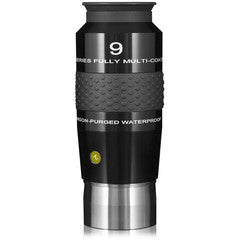

- Description
- Specifications
Product Overview
The Explore Scientific 100° Series 9mm is a 2.00″ barrel ultra-wide-field eyepiece with 12.5mm of eye relief and a 15.7mm field stop. Published dimensions are 145mm long and 60mm wide, at 21.2oz; 602g. The housing is internally sealed and purged with argon gas, tested by submersion to one meter for 30 minutes, and the multi-coated optics use edge-blackened elements to hold contrast.
At 9mm this is a high-power eyepiece: 110x in a 988mm refractor, 135x in a 1216mm apochromat, 167x in a 1500mm Maksutov, 83x in a 750mm Newtonian. The 15.7mm field stop gives 0.91° of true field in a 988mm telescope and 0.74° in a 1216mm one.
The 100° apparent field is the defining figure. At that width the field edge falls outside the eye's natural attention, so the view reads as an open window rather than a circle with a boundary. Delivering it at 9mm is why the eyepiece carries a 2-inch barrel and 145mm of length despite a field stop small enough for a 1.25-inch fitting — the glass required to correct a 100° field at short focal length is simply large.
Who It's For
- Dobsonian owners observing at high power: 0.91° of true field at 110x is roughly double what a 50° eyepiece gives at the same magnification, and that is time before the target leaves the field.
- Globular cluster and planetary nebula observers: 9mm resolves cluster cores and lifts small nebulae to a size worth studying, with sky to spare around them.
- Lunar observers: at 135x in a 1216mm telescope, 0.74° of true field is wider than the Moon, so the whole disc sits inside a high-power view.
- Observers who value immersion: this is the widest apparent field Explore Scientific builds.
- Damp-site observers: the argon-purged, submersion-tested body is designed for dew and rain.
Key Features & Design
- 100° apparent field of view: the widest in the Explore Scientific range, wide enough that the field stop sits at the edge of peripheral vision.
- 15.7mm field stop: combined with 9mm of focal length, it produces a genuinely wide true field at high magnification.
- 12.5mm eye relief: the working figure for this design, and the reason the eyecup position matters when settling in at the eyepiece.
- 2.00″ barrel: the fitting the optics require at this focal length and field.
- Internally sealed and argon gas purged, tested by submersion to one meter for 30 minutes.
- Multi-coated optics with edge-blackened elements: blackened edges stop light bouncing off the rim of a lens and scattering into the field, which is a real contrast issue in a wide-field design with large elements.
- 145mm long, 60mm wide, 21.2oz; 602g: a large eyepiece by any measure, and the size is a direct consequence of the field.
- Backed by a lifetime warranty on registration, with a 30-day return window.
Recommended Uses
- High-power deep-sky observing where field width keeps context around the target.
- Globular clusters, planetary nebulae and compact galaxy groups.
- Full-disc lunar viewing at high magnification in medium focal length telescopes.
- Planetary observing on steady nights, with room for the target to drift on an undriven mount.
- Sweeping rich star fields at power, where the wide field turns a search into a scan.
Compatibility and Accessory Notes
- Focuser: the 2.00″ barrel fits 2-inch focusers and diagonals. There is no 1.25-inch path for it.
- Magnification: telescope focal length ÷ 9. A 750mm Newtonian gives 83x; a 1216mm apochromat 135x; a 2000mm SCT 222x.
- True field: 15.7 ÷ focal length × 57.3. A 750mm Newtonian yields 1.20°; a 2000mm SCT 0.45°.
- Exit pupil: 9 ÷ focal ratio. An f/5 Newtonian gives 1.8mm, an f/6.5 refractor 1.38mm, an f/10 SCT 0.9mm.
- Weight and balance: 21.2oz; 602g at 145mm long is enough to change the balance of a Dobsonian or a small refractor noticeably. A magnetic counterweight or a friction adjustment on the altitude bearing handles it, and we stock counterweights.
- Focuser support: a 602g eyepiece cantilevered out of a focuser asks something of the focuser. A dual-speed or well-built single-speed unit carries it without sag.
- Filters: Explore Scientific does not publish a filter thread specification for this eyepiece, so that row is absent from the table below rather than estimated. If you plan to use a filter with it, ask us and we will check the thread with our Explore Scientific rep.
Good to Know Before You Order
- It needs a 2-inch focuser or diagonal. At 2.00″ the barrel has no 1.25-inch path. Telescopes with 1.25-inch focusers are better matched to the 82° Series at a similar focal length, which we stock and can suggest.
- 12.5mm of eye relief with a 100° field asks for a settled eye position. The whole field comes in once the eye is placed correctly, and the adjustable eyecup is what makes that repeatable. Spectacle wearers generally find longer eye relief designs, such as the 68° and 72° ED Series, easier to use with glasses on.
- 21.2oz; 602g and 145mm of length change how a telescope balances. On a Dobsonian this is the single most common surprise, and it is solved inexpensively with a counterweight rather than by anything more involved.
- Fast focal ratios show their own coma at the edge of a 100° field. That is a property of the mirror rather than of the eyepiece, and a coma corrector addresses it directly.
- 9mm is a high-power focal length, so seeing conditions govern it. Steady nights reward it; turbulent ones favour a longer focal length. This is the eyepiece for the good nights.
- Explore Scientific does not publish an element count, coating designation or filter thread for this eyepiece, so those rows are absent below rather than estimated. Ask us if a particular figure matters and we will put it to our rep.
Frequently Asked Questions
Is it difficult to set up?
No — it goes into any 2-inch focuser or diagonal and is ready to use. The only practical step is rebalancing the telescope after fitting it, since at 21.2oz; 602g it is heavy enough to move the balance point on a light tube.
What magnification and field will I get?
Magnification is your telescope's focal length divided by 9. True field is 15.7 divided by that focal length, multiplied by 57.3. A 1000mm telescope gives 111x and 0.90°.
Why is a 9mm eyepiece this large?
Correcting a 100° apparent field at a short focal length takes a lot of glass, and that glass has to sit in a 2-inch barrel. The 145mm length and 602g weight are what the optical prescription costs.
Can I use it with glasses on?
12.5mm of eye relief is tight for spectacle wearers who want the entire 100° field. If observing with glasses on is a requirement, the 68° and 72° ED Series carry more eye relief, and we can compare the true fields for your telescope.
Will my focuser hold it?
Most 2-inch focusers will, though a 602g eyepiece is a real load on a light single-speed unit. Tell us your telescope and we will say whether the focuser is up to it.
How does it compare to the 82° Series at a similar focal length?
The 100° shows a wider apparent field and a larger true field; the 82° is lighter, smaller and available in a 1.25-inch fitting. Focuser size and mount balance usually decide it — send us your setup and we will give you a straight answer.
Bottom Line
In short: a 9mm, 2-inch, argon-purged eyepiece with a 100° apparent field, a 15.7mm field stop and 12.5mm of eye relief, submersion-tested to one meter for 30 minutes and backed by a lifetime warranty on registration — high power with an unusually wide field, in a 145mm, 602g body. If you would like us to work out the magnification, true field and balance implications for your telescope, send us its focal length and mount and we will run through it with you.
| Description | 9mm 100° Series Argon-Purged Waterproof Eyepiece |
|---|---|
| Item Number | EPWP1009–01 |
| Focal Length | 9mm |
| Apparent Field of View | 100° |
| Length | 145mm |
| Width | 60mm |
| Weight | 21.2oz; 602g |
| Barrel Size | 2.00" |
| Eye Relief | 12.5mm |
| Field Stop Diameter | 15.7mm |
| Waterproof | Internally sealed and argon gas purged; tested by submersion to one meter for 30 minutes |
| Optics | Multi-coated with edge-blackened elements |
| Warranty | Lifetime warranty upon registration; 30-day return window |
| Lens Elements/ Groups | Not published by vendor |
| Filter Thread | Not published by vendor |
You may also like
Recently viewed
Recent Blog Posts
View all
Your Guide Graph Is Lying to You
Read More
D-Size vs V-Size: A Complete Guide to Telescope Dovetail Systems
Read More
What Is Back Focus in Astrophotography? Telescope Reducers, Flatteners, and Spacing Explained
Read More