

- Description
- Specifications
Product Overview
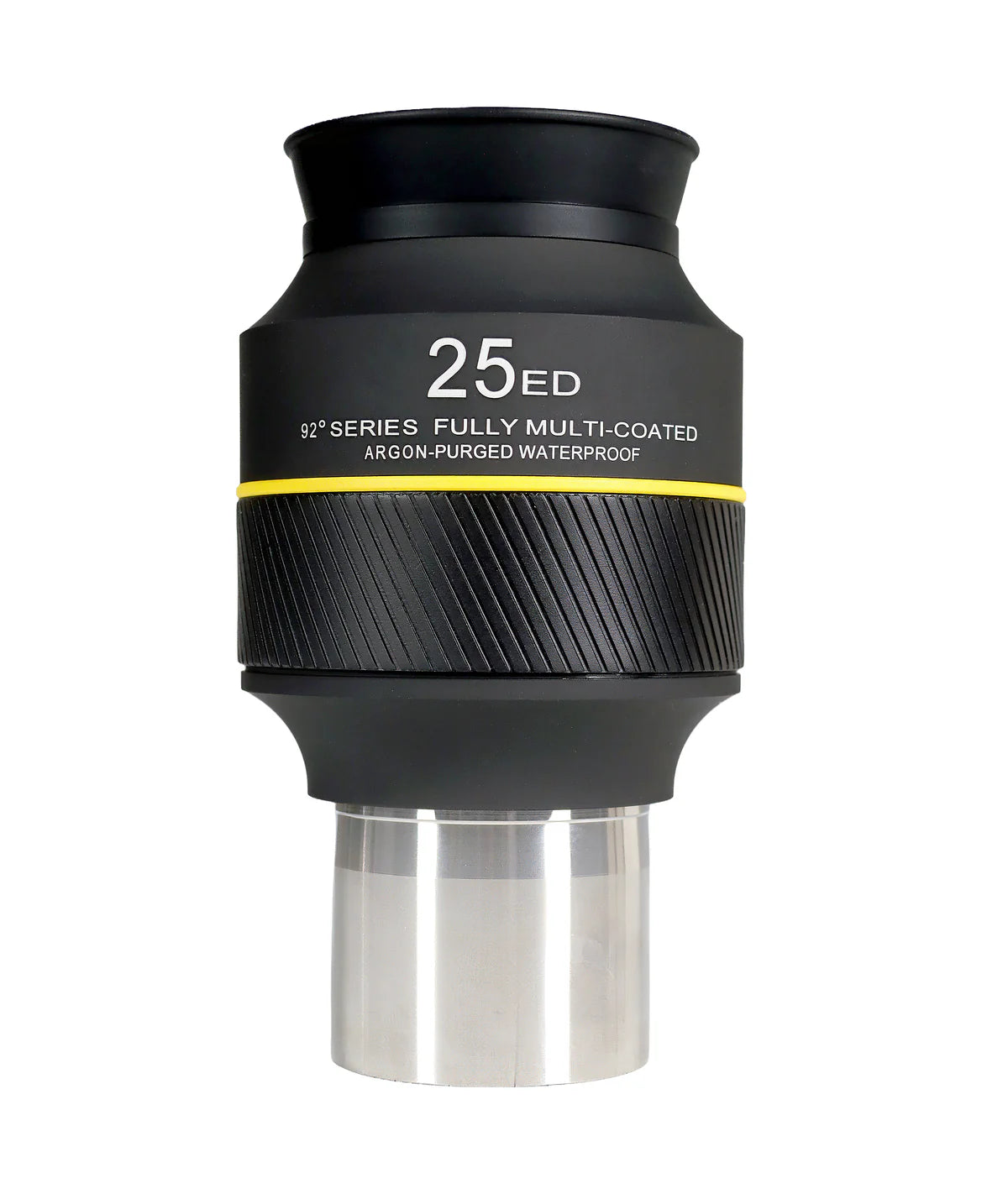
The Explore Scientific 92° ED Series 25mm is the widest-field end of Explore Scientific's eyepiece line: a 2-inch barrel ocular with a 92° apparent field, built around extra-low-dispersion glass. At 25mm it is a low-power, wide-field eyepiece, which is the combination that produces the enveloping views large deep-sky objects reward.
92° is past the point where the field edge sits inside your peripheral vision. In practice the boundary of the view stops registering as a circle and starts behaving like a window, and objects are seen in a surrounding star field rather than isolated in the middle of a dark disc. That effect is the entire design goal of the series, and it is why a 2-inch barrel is necessary — a field this wide at 25mm needs a field stop far larger than a 1.25-inch barrel can pass.
Explore Scientific specifies extra-low-dispersion glass to control colour across that very wide field, extended eye relief for comfort, and waterproof construction. This is a sparsely documented product on the vendor side, and what follows works only from what Explore Scientific actually publishes.
Who It's For
- Deep-sky observers with a 2-inch focuser who want the widest, most immersive low-power view available in the range.
- Observers of large extended objects — the Veil, the Andromeda halo, the North America Nebula, large open clusters — that overflow a narrower field.
- Dobsonian owners: a 92° field on an undriven mount is a long interval between nudges, and at 25mm the drift is slow to start with.
- Observers who value the surrounding star field as part of what they are looking at, rather than treating the target in isolation.
- Anyone already invested in 2-inch eyepieces looking for the widest field in the line to sit at the low-power end of the set.
Key Features & Design
- 92° apparent field of view: the widest in the Explore Scientific range, and wide enough that the field edge falls outside the eye's central attention.
- Extra-low-dispersion (ED) glass: reduces chromatic aberration generated inside the eyepiece itself. In a field this wide, colour control at the outer zones is one of the harder problems to solve, and ED elements are the standard answer.
- 2-inch barrel: the format that allows a field stop large enough for 92° at 25mm. It fits any 2-inch focuser or 2-inch diagonal directly.
- 25mm focal length: low power in most telescopes, which is what makes the very wide apparent field translate into a very wide piece of sky.
- Extended eye relief, specified by Explore Scientific for the series, which is what makes it possible to take in the whole 92° without pressing against the eyepiece.
- Waterproof construction, consistent with the sealed housings Explore Scientific uses across its waterproof eyepiece range.
Recommended Uses
- Low-power deep-sky observing of large nebulae, open clusters and extended galaxies.
- Wide-field sweeping through the summer and winter Milky Way.
- Framing objects that are physically large on the sky — supernova remnants, the Hyades, the Pleiades, the Double Cluster.
- Observing on a Dobsonian or another undriven mount, where apparent field is time on target.
- Nebula-filter observing, where a wide field and a low power make faint extended structure easiest to see.
Compatibility and Accessory Notes
- Focuser: a 2-inch focuser or a 2-inch diagonal is needed. A 1.25-inch focuser will not accept this eyepiece, and no adapter converts downward in that direction — if your telescope is 1.25-inch only, the widest true field available comes from a 1.25-inch design with a maximum-diameter field stop, and we can point you at one.
- Magnification: telescope focal length ÷ 25. A 663mm refractor gives 27x, a 1219mm Dobsonian 49x, a 2000mm Schmidt-Cassegrain 80x.
- Exit pupil: 25 ÷ the telescope's focal ratio. An f/5.9 Dobsonian gives 4.2mm, an f/6.5 refractor 3.8mm, an f/10 Schmidt-Cassegrain 2.5mm. Below about f/5 the exit pupil starts to exceed what many adult eyes dilate to.
- Filters: 2-inch eyepieces normally take 2-inch threaded filters, and a broadband or narrowband nebula filter is the natural partner for a wide low-power field. Explore Scientific does not publish the filter thread specification for this model, so we would rather check it than assume — ask us and we will confirm before you order.
- Balance: 2-inch ultra-wide eyepieces are typically the heaviest items in a case. Explore Scientific publishes no weight for this one, so we are not quoting a figure; on a Dobsonian it is sensible to have some balance adjustment available when swapping into a 2-inch eyepiece.
Good to Know Before You Order
- Explore Scientific publishes no specification table for this eyepiece. Eye relief in millimetres, field stop diameter, element and group count, weight and physical dimensions are not given on their product page, so those rows are absent from the table below rather than estimated. If one of them decides the purchase for you, ask and we will put the question to our Explore Scientific representative before you commit.
- Without a published field stop figure, the true field cannot be calculated exactly. We are not going to quote a number we cannot source. The magnification arithmetic above is exact; the true field is the one figure that has to wait on Explore Scientific.
- A 2-inch focuser is a requirement, not a preference. This is the one compatibility point worth settling first — send us your telescope model and we will confirm the focuser size with you.
- Ultra-wide fields ask more of a telescope's focal ratio. In fast telescopes the outer field of any very wide eyepiece works hardest, which is part of why ED glass is in the design. In slower telescopes it is an easier job.
- It is a visual eyepiece. Eyepiece-projection imaging is possible with the right adapter, but the design target is the eye.
Frequently Asked Questions
Is it difficult to set up?
No — it slides into any 2-inch focuser or 2-inch diagonal and is ready to use. There is nothing to assemble, collimate or adjust.
What magnification will I get?
Divide your telescope's focal length in millimetres by 25. A 1000mm telescope gives 40x; a 1219mm Dobsonian gives 49x.
What does 92° actually look like?
Wide enough that the edge of the field sits at the boundary of where your eye naturally looks. Rather than seeing a bright circle surrounded by black, you see a field of stars that keeps going as your eye moves across it. On large clusters and nebulae that changes the character of the view rather than just the size of it.
Will it fit my telescope?
It needs a 2-inch focuser or a 2-inch diagonal. Most larger Dobsonians and most refractors with a 2-inch focuser take it directly. If you are not sure what your telescope has, send us the model and we will check.
What does the ED glass change?
Extra-low-dispersion glass brings different wavelengths closer to a common focus inside the eyepiece, so colour edges on bright stars stay cleaner across the field. In a 92° design the outer field is where that work shows, because the light is bent hardest there.
How heavy is it?
Explore Scientific does not publish a weight for this model, so we are not going to quote one. As a class, 2-inch ultra-wide eyepieces are on the heavy side. If the exact figure matters for balancing a mount, ask us and we will get it confirmed.
Bottom Line
In short: a 25mm ED-glass eyepiece with a 92° apparent field in a 2-inch waterproof barrel — the widest, most enveloping low-power view in the Explore Scientific range, aimed squarely at large deep-sky objects. Explore Scientific publishes little beyond that, so if there is a figure you need before ordering, tell us which one and we will get it from them for you.
| Item Number | EPWP9225ED-01 |
|---|---|
| Focal Length | 25mm |
| Apparent Field of View | 92° |
| Barrel Size | 2" |
| Optical Glass | Extra-Low Dispersion (ED) |
| Eye Relief | Extended; figure not published by vendor |
| Housing | Waterproof |
| Field Stop Diameter | Not published by vendor |
| Lens Elements/Groups | Not published by vendor |
| Coatings | Not published by vendor |
| Filter Thread | Not published by vendor |
| Weight | Not published by vendor |
| Length / Width | Not published by vendor |
| In the Box | Not published by vendor |
| UPC | Not published by vendor |
You may also like
Recently viewed
Recent Blog Posts
View all
Your Guide Graph Is Lying to You
Read More
D-Size vs V-Size: A Complete Guide to Telescope Dovetail Systems
Read More
What Is Back Focus in Astrophotography? Telescope Reducers, Flatteners, and Spacing Explained
Read More