
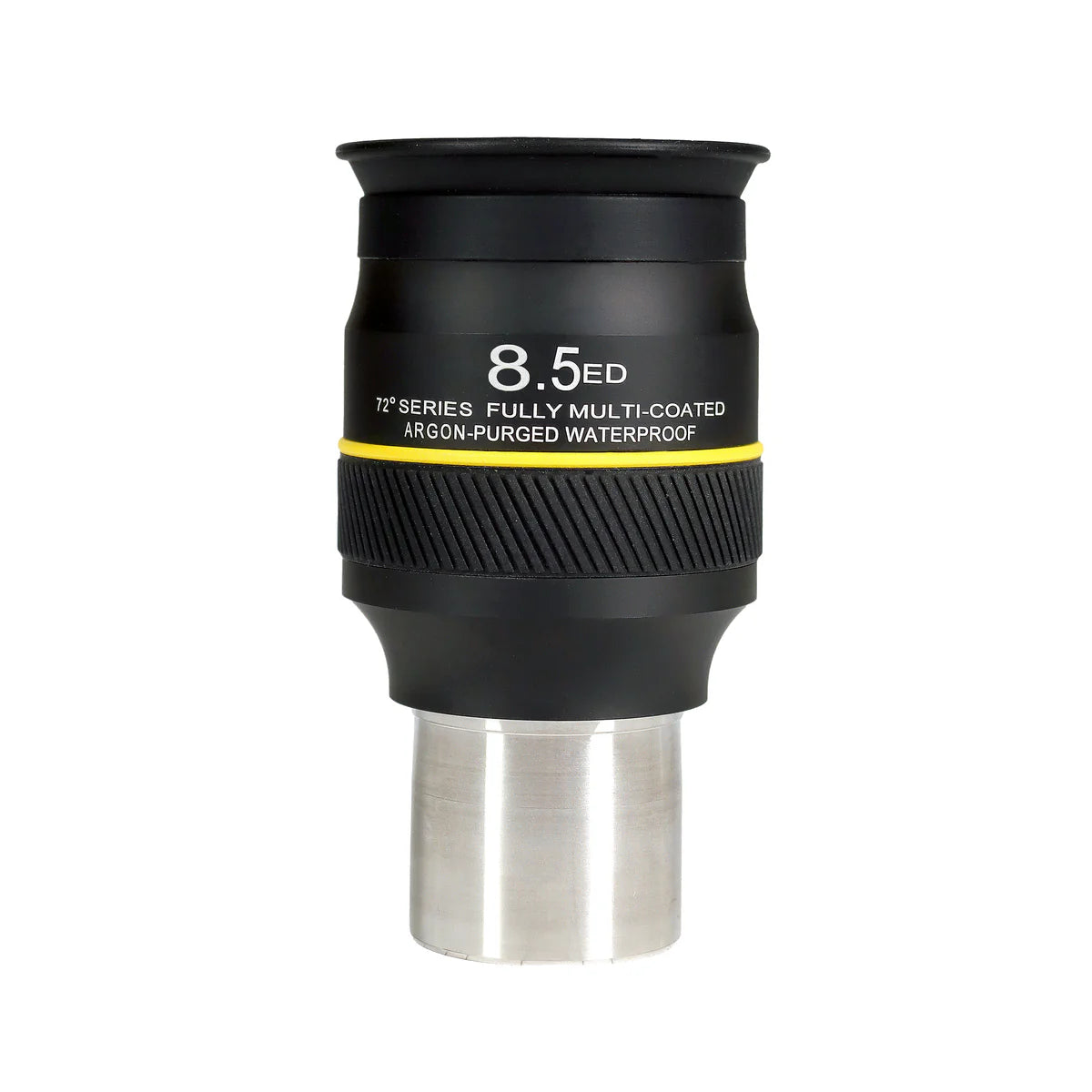

- Description
- Specifications
Product Overview
The Explore Scientific 72° ED Series 8.5mm is a waterproof eyepiece with a 1.25-inch barrel, built around extra-low-dispersion glass and a 72-degree apparent field. Explore Scientific positions the series for planetary work and deep-sky objects alike, and specifies long eye relief as one of its design priorities.
8.5mm is a high-power focal length in nearly any telescope. In a 714mm refractor it works at 84x, in a 1000mm instrument 118x, in a 1500mm Maksutov 176x. That range covers the magnifications where lunar and planetary detail lives without pushing straight into the territory that only exceptional seeing supports.
The 72° field sits between the 68° and 82° Series. It is wide enough that an object at high power stays in a hand-guided field noticeably longer, while keeping the eye position and outer-field correction less demanding than a 100° design.
Who It's For
- Planetary observers: ED glass targets exactly the colour error and contrast loss that fine planetary detail depends on, and 8.5mm reaches the magnification range where that detail appears.
- Eyeglass wearers: Explore Scientific specifies long eye relief for the series, and eye relief is normally the first casualty at short focal lengths.
- Dobsonian and undriven-mount users: a 72° apparent field converts directly into drift time, which is the practical currency of high-power observing without tracking.
- Double-star observers who want magnification without a field so tight that the pair leaves view between looks.
- Observers filling a gap: 8.5mm falls between the more common 9mm and 8mm steps, which makes it useful for splitting the difference in an existing set.
Key Features & Design
- Extra-low-dispersion (ED) glass: reduces chromatic aberration generated inside the eyepiece itself, which shows as cleaner colour edges on bright targets and better-held contrast on subtle planetary shading.
- 72° apparent field of view: more field than the 52° and 62° Series, less demanding at the edge than the 82° and 100° designs.
- Long eye relief specified for the series, which is what makes extended sessions and observing with glasses on practical at a short focal length.
- Waterproof construction, consistent with the sealed housings Explore Scientific uses across its waterproof eyepiece range.
- 1.25-inch barrel fitting any standard focuser or diagonal.
- 8.5mm focal length, a step that sits between the usual 8mm and 9mm offerings.
Recommended Uses
- High-power lunar observing, where ED glass keeps the limb clean.
- Planetary detail on Jupiter, Saturn and Mars at magnifications the aperture supports.
- Splitting close double stars.
- Compact deep-sky targets — planetary nebulae, small galaxies and globular cluster cores.
- High-power observing on a hand-guided mount, where apparent field is what buys time on target.
Compatibility and Accessory Notes
- Fits any 1.25-inch focuser or diagonal. In a 2-inch focuser it seats with a 2-inch to 1.25-inch adapter.
- Magnification: telescope focal length ÷ 8.5. A 750mm Newtonian gives 88x, a 1200mm SCT gives 141x, a 2000mm SCT gives 235x.
- Filters: takes standard 1.25-inch threaded filters, including lunar, colour and narrowband types.
- Focal extenders: a 2x extender makes this an effective 4.25mm, which reaches magnifications that only steady nights and larger apertures support.
- Within the series: the 72° ED Series spans several focal lengths, so a matched set holds the same apparent field and a consistent eye position from low power to high.
Good to Know Before You Order
- Explore Scientific does not publish a specification table for this eyepiece. Eye relief in millimetres, field stop diameter, element count, body dimensions and weight are all absent from their product page, so those rows read as not published below rather than carrying an estimate. If a specific figure decides the purchase for you, ask and we will put the question to our Explore Scientific rep.
- 8.5mm is governed by the atmosphere as much as by the optics. On a steady night in a 6-inch or larger telescope it will show what the aperture can do; on a turbulent night a longer focal length shows more. That is seeing rather than glass.
- True field cannot be calculated precisely without a field stop figure. The 72° apparent field divided by the working magnification gives a close approximation — roughly 0.6° at 118x — and that is the honest way to estimate it here.
- It is a visual eyepiece. Eyepiece-projection imaging is possible with the right adapter, though the design target is the eye rather than a sensor.
Frequently Asked Questions
Is it difficult to set up?
No — it slides into any 1.25-inch focuser or diagonal and is ready to observe with straight away. Nothing to assemble, align or adjust.
What magnification will I get?
Divide your telescope's focal length in millimetres by 8.5. A 1000mm telescope gives 118x; a 1500mm gives 176x.
What does ED glass do in an eyepiece?
Extra-low-dispersion glass spreads wavelengths less than standard optical glass, so the eyepiece brings colours closer to a common focus. In practice that means cleaner edges on bright objects and fine planetary contrast that holds up better than in a conventional-glass design of the same field.
Can I observe with glasses on?
Explore Scientific specifies long eye relief for this series, which is what makes that practical. They do not publish the figure in millimetres, so no number is quoted here — if it is the deciding factor, ask and we will get it confirmed first.
How does it compare to the 82° Series at a similar focal length?
The 82° gives a wider, more immersive field; the 72° ED is built around glass type and eye comfort instead. Which one suits you comes down to whether field width or colour correction and eye relief matters more for what you observe — tell us and we will give you a straight comparison.
Why 8.5mm rather than 8 or 9?
It is a deliberate half-step. In a set that already has a 6mm and an 11mm, 8.5mm lands neatly in between rather than duplicating a power you already own.
Bottom Line
In short: an 8.5mm ED-glass eyepiece with a 72° apparent field, long eye relief and a 1.25-inch waterproof barrel — high magnification with more field and more eye comfort than short focal lengths usually allow. If you are working out how it fits alongside eyepieces you already own, send us the list and your telescope's focal length and we will show you where the gaps are.
| Item Number | EPWP7285ED-01 |
|---|---|
| Description | 72° ED Series 8.5mm Waterproof Eyepiece |
| Focal Length | 8.5mm |
| Apparent Field of View | 72° |
| Glass Type | Extra-low dispersion (ED) |
| Barrel Size | 1.25" |
| Waterproof | Yes |
| Eye Relief | Long eye relief specified; figure not published by vendor |
| Field Stop Diameter | Not published by vendor |
| Element Count | Not published by vendor |
| Length | Not published by vendor |
| Width | Not published by vendor |
| Weight | Not published by vendor |
You may also like
Recently viewed
Recent Blog Posts
View all
Your Guide Graph Is Lying to You
Read More

D-Size vs V-Size: A Complete Guide to Telescope Dovetail Systems
Read More

What Is Back Focus in Astrophotography? Telescope Reducers, Flatteners, and Spacing Explained
Read More