

- Description
- Specifications
Product Overview
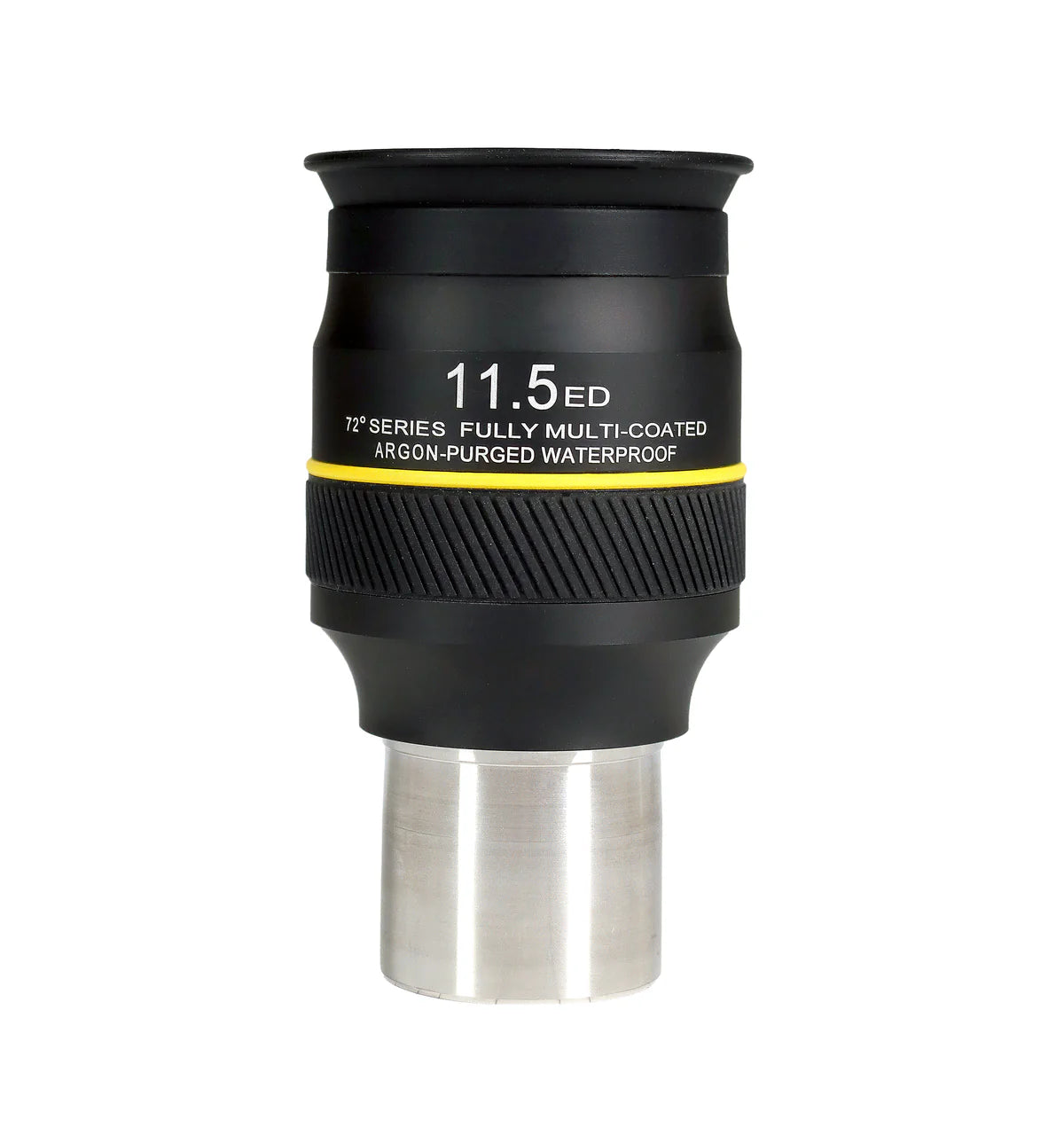
The Explore Scientific 72° ED Series 11.5mm is a waterproof eyepiece with a 1.25-inch barrel, built around extra-low-dispersion glass and a 72-degree apparent field. It carries item number EPWP72115ED-01.
Eleven and a half millimetres lands in an interesting place. It is not the shortest focal length in a set and not a general-purpose medium, but the step where a telescope starts working near its resolution limit while the exit pupil is still large enough to be forgiving. In a 1200mm Schmidt-Cassegrain it gives 104x; in a 1900mm Maksutov, 165x; in a 750mm Newtonian, 65x; in a 1000mm refractor, 87x. On most instruments that is the magnification you settle at once the target is found and the seeing has been assessed — high enough for planetary detail and globular cluster resolution, low enough that a moment of poor seeing does not end the view.
The exit pupil follows from the telescope's focal ratio: 11.5 divided by f/6 gives 1.9mm, divided by f/10 gives 1.15mm. Both are in the range where the eye's own aberrations stay out of the way and a faint galaxy still has enough surface brightness to register.
Who It's For
- Planetary observers: ED glass inside the eyepiece is aimed at exactly the colour errors that blur fine low-contrast detail on Jupiter and Mars.
- Double-star observers: 11.5mm produces working high power in most apertures while leaving enough field that a pair does not vanish between glances.
- Globular cluster observers: this is roughly where a cluster stops being a fuzzy ball and starts resolving into individual stars in a mid-aperture telescope.
- Eyeglass wearers: Explore Scientific specify eye relief for this series as comfortable enough to observe with glasses on, which is unusual at a focal length this short.
- Dobsonian and undriven-mount users: 72 degrees of apparent field translates directly into more seconds on target between nudges at high magnification.
Key Features & Design
- 11.5mm focal length: the high-power working step — 87x in a 1000mm telescope, 165x in a 1900mm one.
- Extra-low-dispersion glass: ED elements inside the eyepiece reduce the eyepiece's own contribution to chromatic aberration, which shows up as cleaner edges on bright targets and better fine contrast.
- 72° apparent field of view: substantially wider than a 52° or 62° design, and less demanding on eye placement than the 82° and 100° Series.
- 1.25-inch barrel: fits any standard 1.25-inch focuser or star diagonal directly, and a 2-inch focuser with an adapter.
- Comfortable eye relief for the focal length: the property that usually gets sacrificed first as eyepiece focal length drops, and the one Explore Scientific calls out for this series.
- Waterproof construction: a sealed housing, consistent with the waterproof eyepiece range Explore Scientific builds.
Recommended Uses
- Lunar detail along the terminator at working high power.
- Planetary observing — belt structure on Jupiter, the Cassini division, Martian surface markings during a favourable opposition.
- Splitting double stars at magnifications where the pair is well separated but still bright.
- Resolving globular clusters and picking out the central stars of planetary nebulae.
- High-power observing on an undriven mount, where apparent field is what buys observing time.
Compatibility and Accessory Notes
- Fits any 1.25-inch focuser or diagonal. In a 2-inch focuser it needs a 2-inch to 1.25-inch adapter, which we stock.
- Magnification: telescope focal length divided by 11.5. A 650mm refractor gives 57x, a 1500mm Maksutov gives 130x, a 2000mm SCT gives 174x.
- Filters: the 1.25-inch barrel takes standard 1.25-inch threaded filters — neutral density and variable polarisers for the Moon, colour filters for planetary contrast, narrowband for nebulae.
- Focal extenders: a 2x extender in front of this eyepiece produces an effective 5.75mm, which is past the useful magnification of smaller apertures. On a large instrument on a steady night it has its place; on most nights the eyepiece on its own is doing the right thing.
- Glasses: the series is specified for comfortable eye relief, and a fold-down eyecup is what lets a spectacle lens sit close enough to take in the whole field. Explore Scientific does not publish the eye relief in millimetres for this model, so we are not going to quote a figure — if it is your deciding factor, we will confirm it with our rep first.
Good to Know Before You Order
- Seeing governs an 11.5mm eyepiece more than the optics do. On a steady night in a mid-aperture telescope it will show what the aperture is capable of; on a turbulent night a longer focal length shows more. That is the atmosphere, not the eyepiece, and it is the reason most observers own several focal lengths.
- Explore Scientific does not publish a full specification table for this model. Eye relief in millimetres, field stop diameter, element count, coating specification and weight are absent from their page, so those rows are blank below rather than estimated. We are happy to put any of them to our Explore Scientific rep if you need the number before ordering.
- 72 degrees is wide, and wide eyepieces reward good eye placement. Taking a moment to settle the eye at the right distance is what brings the field edge into view, and the fold-down eyecup is there to make that position repeatable.
- It is a visual eyepiece. Eyepiece projection onto a camera is possible with an adapter, though the design intent is the observer's eye.
Frequently Asked Questions
Is it difficult to set up?
No. It drops into any 1.25-inch focuser or diagonal and is ready to use immediately — nothing to assemble, nothing to adjust.
What magnification will I get?
Divide your telescope's focal length in millimetres by 11.5. A 1000mm telescope gives 87x, a 1200mm gives 104x.
What difference does the ED glass make?
Extra-low-dispersion glass bends the different wavelengths by more similar amounts than ordinary optical glass, so the eyepiece adds less colour error of its own on top of whatever the telescope delivers. In practice that reads as cleaner edges on the lunar limb and bright planets, and a little more of the fine contrast that planetary detail depends on.
Can I use it with a 2-inch focuser?
Yes, with a 2-inch to 1.25-inch adapter. Most 2-inch star diagonals include one.
How does it compare with the 82° Series at a similar focal length?
The 82° Series gives a wider and more immersive field; the 72° ED Series is built around glass type and eye comfort instead. Which suits you depends on whether field width or colour correction and eye relief matters more for the observing you do — tell us what you look at most and we will give you an honest steer.
Will it work on a Dobsonian?
Yes, and the 72-degree field is one of the reasons to choose it for one. At 11.5mm in a typical Dobsonian focal length the magnification is high, and the wider apparent field is what keeps the object in view longer between nudges.
Bottom Line
In short: an 11.5mm ED-glass eyepiece with a 72-degree field and a 1.25-inch barrel, sealed against weather and specified with enough eye relief to work with glasses on — the high-power step that still leaves room to breathe. If you are filling out a focal-length set for a particular telescope, send us its aperture and focal length and we will map out which focal lengths would actually add something.
| Description | 72° ED Series 11.5mm Waterproof Eyepiece |
|---|---|
| Item Number | EPWP72115ED-01 |
| Focal Length | 11.5mm |
| Apparent Field of View | 72° |
| Barrel Size | 1.25-inch |
| Glass Type | Extra-low-dispersion (ED) |
| Housing | Waterproof |
| Eye Relief | Not published by vendor — described as comfortable and suited to eyeglass wearers |
| Field Stop Diameter | Not published by vendor |
| Element Count | Not published by vendor |
| Coatings | Not published by vendor |
| Weight | Not published by vendor |
| In the Box | Eyepiece only — no additional contents listed by vendor |
You may also like
Recently viewed
Recent Blog Posts
View all
Your Guide Graph Is Lying to You
Read More

D-Size vs V-Size: A Complete Guide to Telescope Dovetail Systems
Read More

What Is Back Focus in Astrophotography? Telescope Reducers, Flatteners, and Spacing Explained
Read More