

- Description
- Specifications
Product Overview
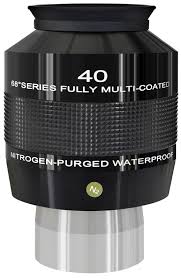
The Explore Scientific 68° Series 40mm is the long focal length end of the 68° range: a 2-inch, argon-purged waterproof eyepiece with a 45.5mm field stop and 31mm of eye relief. Explore Scientific publishes it as 114.2mm long, 80.3mm across and 35.2 oz (998 g).
The 45.5mm field stop is the number that matters most here, because it sets the true field directly. Divide it by your telescope's focal length and multiply by 57.3 and you have the field in degrees: 5.4° in a 480mm refractor, 2.6° in a 988mm, 2.2° in a 1200mm SCT. That is close to the largest true field a 2-inch barrel can physically pass, which is what a 40mm eyepiece in this format is for.
Magnification stays low by design — 12x in a 480mm telescope, 25x in a 1000mm — and the optical design uses low-dispersion glass with multilayer coatings, aimed at holding contrast and flatness right out to the edge of a wide field.
Who It's For
- Wide-field sweepers: a 5.4° field in a short refractor covers the Hyades, the Pleiades with room around them, and long stretches of the Milky Way in one view.
- Observers hunting large, faint objects: the North America Nebula, the Veil and the larger open clusters are objects that need field before they need magnification.
- Eyeglass wearers: 31mm of eye relief is generous by any measure and makes observing with glasses on genuinely comfortable rather than merely possible.
- Anyone who finds targets by star-hopping: a low-power, wide-field eyepiece is the one you locate with before switching to something shorter.
- Observers who want a matched set: the 68° Series is parfocal, so this sits at the long end of a range that behaves consistently.
Key Features & Design
- 40mm focal length in a 2-inch barrel: the format that makes a wide true field possible in the first place.
- 45.5mm field stop: the published figure that sets true field. Divide it by your focal length and multiply by 57.3 for degrees.
- 68° apparent field of view, wider than the 52° and 62° Series while staying easier on the outer field than an 82° design.
- 31mm eye relief: among the most generous figures Explore Scientific publishes across their eyepiece range.
- Low-dispersion glass with multilayer coatings, aimed at high contrast, high resolution and a flat field.
- Argon purged and waterproof, so internal fogging is not part of a long, damp session.
- Removable, foldable silicone rubber eyecup, which folds down for spectacle wearers and back up for observing without.
- Published dimensions: 114.2mm long, 80.3mm wide, 35.2 oz (998 g).
- Parfocal across the 68° Series, so swapping focal lengths in the dark needs only a small focus correction.
Recommended Uses
- Low-power sweeping of the Milky Way and large open clusters.
- Large emission and reflection nebulae, particularly with a narrowband filter fitted.
- Finding and framing targets before switching to a higher power.
- Comet observing, where a wide field and a bright image suit a diffuse tail.
- Observing with glasses on, where 31mm of eye relief removes the usual compromise.
Compatibility and Accessory Notes
- Requires a 2-inch focuser or diagonal. The 45.5mm field stop is why — a 1.25-inch barrel physically cannot pass a field this wide, so there is no 1.25-inch version of this combination.
- Magnification: telescope focal length divided by 40. A 1200mm SCT gives 30x, a 750mm Newtonian gives 19x.
- True field: 45.5 divided by focal length, times 57.3. A 1000mm telescope gives 2.6°.
- Exit pupil: 40 divided by your focal ratio. In an f/10 that is 4mm; in an f/6 it is 6.7mm.
- Filters: takes standard 2-inch threaded filters. A wide-field eyepiece and a narrowband or oxygen-III filter is a well-matched pairing for large nebulae, and we stock both.
- Balance: at 998 g this is a heavy eyepiece. On a small refractor or a Dobsonian it will shift the balance point, which a counterweight or a moved tube ring sorts out easily.
Good to Know Before You Order
- Exit pupil sets a practical limit at fast focal ratios. In an f/6 telescope a 40mm eyepiece produces a 6.7mm exit pupil, which is wider than most adult eyes dilate — some of that light falls outside your pupil, and in an obstructed telescope the secondary shadow can become visible. In an f/8 or slower instrument the figures land comfortably, and if you are unsure where your telescope falls we can work it out with you before you order.
- It weighs 998 g. A 2-inch focuser handles that without complaint, though a lightweight tube may want rebalancing when it goes in. That is a one-time adjustment.
- It is 114.2mm long and 80.3mm wide, so it takes a full-size slot in an eyepiece case rather than a standard one. Worth accounting for if your case is already full — we can suggest a case sized for 2-inch eyepieces.
- Low power is the point. A 40mm eyepiece is not the one for planetary detail; it is the one that frames the object and finds it. It works best alongside shorter focal lengths in the same series.
- It is a visual eyepiece. Projection imaging is possible with an adapter, though the design is aimed at the eye.
Frequently Asked Questions
Is it difficult to set up?
No — it slides into any 2-inch focuser or diagonal and is ready immediately. The only thing worth doing on the first night is rechecking the telescope's balance, since 998 g at the back end is noticeable on a light tube.
What magnification and field will I get?
Focal length divided by 40 for magnification, and 45.5 divided by focal length times 57.3 for true field in degrees. A 1000mm telescope gives 25x over 2.6°.
Will it fit a 1.25-inch focuser?
No — the barrel is 2 inches, and the 45.5mm field stop is wider than a 1.25-inch barrel can pass. A telescope with a 2-inch focuser or a 2-inch diagonal is what this eyepiece is built for.
Can I use it with glasses on?
Yes. 31mm of eye relief is generous, and the silicone eyecup folds down so your glasses sit at the right distance from the lens.
Does it take filters?
Yes, standard 2-inch threaded filters, which thread into the base of the barrel. Wide-field observing and a narrowband filter go together well on large nebulae.
How does it compare with the 82° Series?
The 82° designs show a wider apparent field; this one is built around a very large field stop, 31mm of eye relief and low power. At 40mm the 68° format is what puts the maximum true field through a 2-inch barrel, which is a different goal from maximum immersion.
Bottom Line
In short: a 40mm 2-inch argon-purged eyepiece with a 45.5mm field stop, a 68° apparent field and 31mm of eye relief — about as much true field as a 2-inch barrel will pass, with room for glasses. If you would like us to work out the field and exit pupil it will give in your particular telescope, send us the aperture and focal length and we will run the numbers.
| Item Number | EPWP6840-01 |
|---|---|
| Focal Length | 40mm |
| Apparent Field of View | 68° |
| Length | 114.2mm |
| Width | 80.3mm |
| Weight | 35.2oz; 998g |
| Barrel Size | 2.00" |
| Eye Relief | 31mm |
| Field Stop Diameter | 45.5mm |
| Eyecup | Removable, foldable silicone rubber |
| Waterproofing | Argon purged, waterproof |
| Element Count | Not published by vendor |
You may also like
Recently viewed
Recent Blog Posts
View all
Your Guide Graph Is Lying to You
Read More

D-Size vs V-Size: A Complete Guide to Telescope Dovetail Systems
Read More

What Is Back Focus in Astrophotography? Telescope Reducers, Flatteners, and Spacing Explained
Read More