

- Description
- Specifications
Product Overview
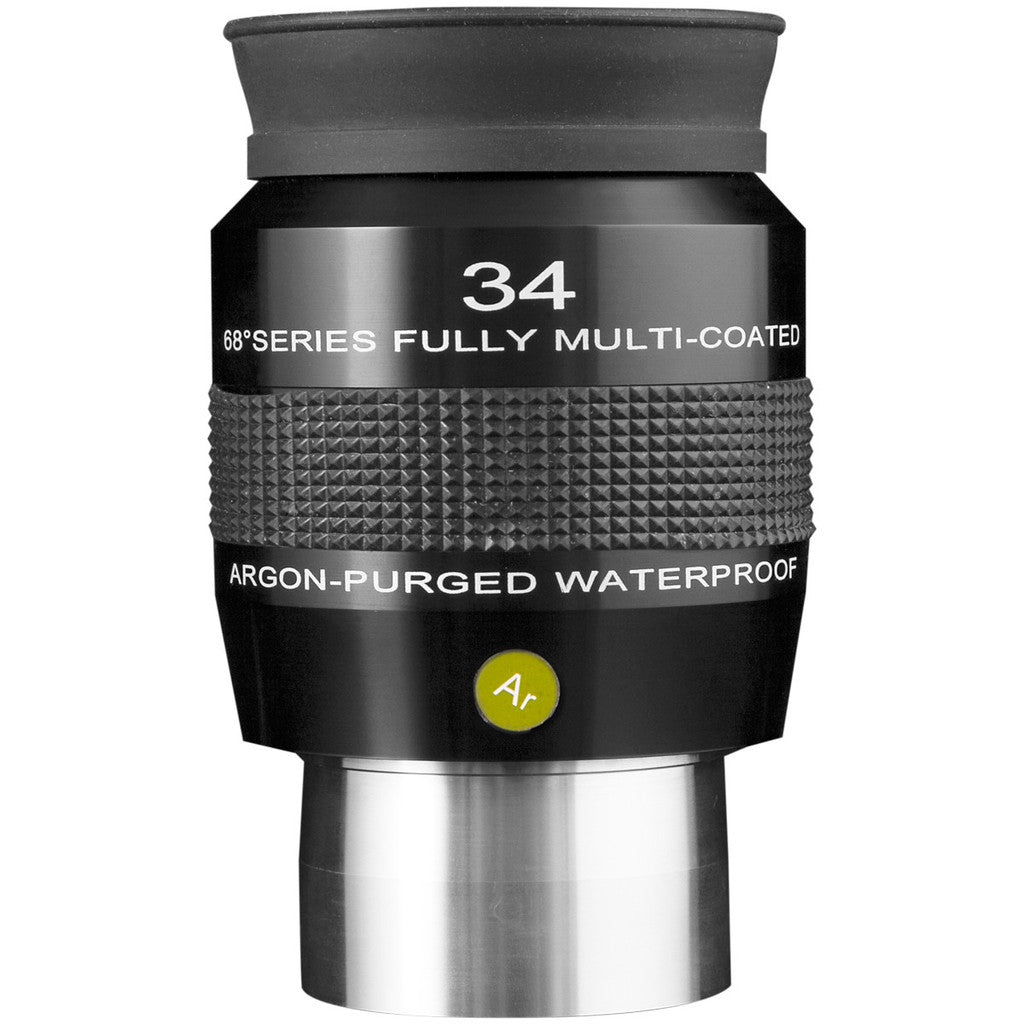
The Explore Scientific 68° Series 34mm is a 2.00″ barrel wide-field eyepiece with a published eye relief of 26.4mm and a field stop diameter of 38.6mm. It measures 100.8mm long and 69.6mm wide and weighs 24.1oz; 685g. The optical design combines low dispersion and high refractive index glasses, and the housing is argon-purged and sealed against internal fogging and contamination.
At 34mm with a 38.6mm field stop, this is the widest true field in the 68° Series. True field is the field stop divided by the telescope's focal length, multiplied by 57.3: 2.24° in a 988mm refractor, 1.82° in a 1216mm apochromat, 1.47° in a 1500mm Maksutov. Magnification is focal length divided by 34 — 29x, 36x and 44x for those same telescopes.
The 68° apparent field sits between the flat, economical 52° Series and the immersive 82°. The practical effect is that at any given magnification the eye takes in noticeably more sky than a 52° eyepiece shows, without asking as much of the outer field as an 82° or 100° design does.
Who It's For
- Wide-field deep-sky observers: 2.24° of true field in a 988mm refractor holds large open clusters, the North America Nebula and the Andromeda halo in one view.
- Eyeglass wearers: 26.4mm of eye relief is enough to see the entire 68° field with spectacles on.
- Observers building a matched set: the 34mm is parfocal with the rest of the 68° line, so swapping focal lengths does not mean refocusing from scratch.
- Filter users hunting faint nebulosity: low power, a large exit pupil and a wide true field is the combination narrowband filters were made for.
- Observers in damp climates: argon purging and sealing keep the internal surfaces clear as the temperature falls.
Key Features & Design
- 68° apparent field: a middle ground that gains substantially over a 52° design without the outer-field demands of an 82° or 100° eyepiece.
- 38.6mm field stop: the widest true field in the series, and the figure that determines how much sky you actually see.
- 26.4mm eye relief: comfortable for extended sessions and practical with glasses on.
- Low dispersion and high refractive index glasses in combination: low dispersion glass restrains colour error, high index glass lets the designer bend light with gentler curves, and gentler curves make the outer field easier to correct.
- Argon-purged and sealed: an inert fill does not carry the moisture that trapped air does, so internal fogging and contamination are designed out rather than managed.
- 2.00″ barrel: fits any 2-inch focuser or diagonal directly.
- Removable, foldable soft silicone rubber eyecup.
- Parfocal with the rest of the 68° line, which keeps focus changes to a nudge when switching eyepieces.
- Published dimensions: 100.8mm long, 69.6mm wide, 24.1oz; 685g.
Recommended Uses
- Low-power deep-sky sweeping through the summer and winter Milky Way.
- Large emission nebulae with a 2-inch narrowband filter in place.
- Framing extended objects — the Pleiades, the Hyades, the Double Cluster, the Veil.
- Comet observing, where the whole coma and a length of tail can share the field.
- Acquiring and centring targets before switching to a higher-power eyepiece in the same parfocal set.
Compatibility and Accessory Notes
- Focuser: the 2.00″ barrel fits 2-inch focusers and diagonals directly. There is no 1.25-inch path for it.
- Magnification: telescope focal length ÷ 34. A 750mm Newtonian gives 22x; a 1216mm apochromat 36x; a 2000mm SCT 59x.
- True field: 38.6 ÷ focal length × 57.3. A 750mm Newtonian yields 2.95°; a 2000mm SCT 1.11°.
- Exit pupil: 34 ÷ focal ratio. An f/5 Newtonian gives 6.8mm, an f/6.5 refractor 5.23mm, an f/8 apochromat 4.25mm and an f/10 SCT 3.4mm.
- Weight and size: 24.1oz; 685g in a 69.6mm-wide body. That is a substantial eyepiece, and on a small refractor or a Dobsonian it can shift the balance point enough to want a counterweight or a friction adjustment.
- Within the series: parfocal with the other 68° focal lengths, so a set built around it keeps a consistent eye position and focus plane.
- Filters: Explore Scientific does not publish a filter thread specification for this eyepiece, so that row is absent from the table below rather than estimated.
Good to Know Before You Order
- This is a large, heavy eyepiece. 100.8mm long, 69.6mm wide and 24.1oz; 685g means a well-supported focuser is worth having, and a small tube may need rebalancing when it goes in. A magnetic counterweight solves that on a Dobsonian and costs very little.
- The 69.6mm body diameter is worth measuring against your eyepiece case. Standard 2-inch eyepiece slots in some cases are cut narrower than that.
- It needs a 2-inch focuser or diagonal. Telescopes with 1.25-inch focusers cannot take a 2.00″ barrel, and the 1.25-inch focal lengths in the 68° Series are the ones to look at instead — we stock those and can suggest the closest equivalent field.
- At f/5 the exit pupil is 6.8mm. That is close to the limit of a well dark-adapted eye and beyond it for many older eyes, so some of the light gathered will fall outside the iris. Between f/6 and f/10 the eyepiece works comfortably.
- Explore Scientific does not publish an element count, a coating designation or a filter thread for this eyepiece, so those rows are absent below rather than estimated. If one of them decides the purchase for you, ask us and we will put the question to our Explore Scientific rep.
Frequently Asked Questions
Is it difficult to set up?
No — it slides into any 2-inch focuser or diagonal and is ready immediately. There is nothing to assemble or align. The one thing worth doing on a light tube is rebalancing after fitting it, since it weighs 24.1oz; 685g.
What magnification and true field will I get?
Magnification is your telescope's focal length divided by 34. True field is 38.6 divided by that focal length, multiplied by 57.3. A 1000mm telescope gives 29x and 2.21°.
Can I use it with glasses on?
Yes. 26.4mm of eye relief covers the full 68° field for most spectacle wearers, and the silicone eyecup folds down.
How does it compare to the 82° Series?
The 82° shows a wider apparent field and a more immersive view; the 68° puts its budget into eye relief and a gentler outer field, and at 34mm it also delivers a very large true field. Tell us what you observe most and we will give you a straight comparison.
Is it parfocal with my other 68° eyepieces?
Yes — Explore Scientific specifies the 68° line as parfocal, so changing focal lengths within the series needs only a small focus correction.
Will it work on a fast Newtonian?
It will, though at f/5 the 34mm produces a 6.8mm exit pupil, which is at the edge of what a dark-adapted eye uses. Shorter focal lengths in the series suit fast optics better, and we can suggest one that keeps a similar apparent field.
Bottom Line
In short: a 34mm, 2-inch, argon-purged eyepiece with a 68° apparent field, 26.4mm of eye relief and a 38.6mm field stop — the widest true field in the series, parfocal with the rest of the line, and comfortable with glasses on. If you would like the magnification, true field and exit pupil worked out for the telescope you own, send us its aperture and focal length and we will do it with you.
| Item Number | EPWP6834-01 |
|---|---|
| Focal Length | 34mm |
| Apparent Field of View | 68° |
| Length | 100.8mm |
| Width | 69.6mm |
| Weight | 24.1oz; 685g |
| Barrel Size | 2.00" |
| Eye Relief | 26.4mm |
| Field Stop Diameter | 38.6mm |
| Housing | Argon-purged and sealed against internal fogging and contamination |
| Glass | Low dispersion and high refractive index optical glasses |
| Eyecup | Removable, foldable soft silicone rubber |
| Parfocal | With the rest of the 68° line |
| Lens Elements/ Groups | Not published by vendor |
| Coatings | Not published by vendor |
| Filter Thread | Not published by vendor |
You may also like
Recently viewed
Recent Blog Posts
View all
Your Guide Graph Is Lying to You
Read More

D-Size vs V-Size: A Complete Guide to Telescope Dovetail Systems
Read More

What Is Back Focus in Astrophotography? Telescope Reducers, Flatteners, and Spacing Explained
Read More