
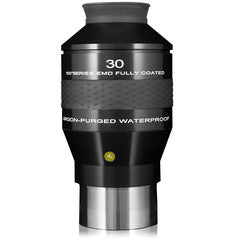

- Description
- Specifications
Product Overview
The Explore Scientific 100° Series 30mm is the hyper-wide, low-power flagship of the range, and it is built on a 3-inch barrel rather than the 2-inch format most eyepieces use. That barrel size is the whole story: a 100° apparent field at 30mm needs a field stop larger than a 2-inch tube can physically pass, so the eyepiece steps up to a format that can carry it.
The construction is argon purged and internally sealed, fully multi-coated for contrast, and waterproof-tested to 1 metre of depth for 30 minutes. Explore Scientific describes the observing experience as panoramic, and specifically calls out how well the very large field supports extended study of faint objects using averted vision — the technique of looking slightly off-centre so the target falls on the more light-sensitive part of the retina. A 100° field gives that technique room to work in a way a narrow field does not.
Explore Scientific publishes no dimensional specification table for this eyepiece. Eye relief, field stop diameter, element count, physical size and weight are all absent from their product page, so those rows read as unpublished below rather than carrying figures we have inferred from elsewhere. What is published — focal length, apparent field, barrel format, sealing and waterproof rating — is given verbatim.
Who It's For
- Dark-site deep-sky observers who want the largest possible expanse of sky at once, with a fully dark-adapted eye and no light pollution to waste the exit pupil on.
- Observers who work faint objects with averted vision: a 100° field gives the eye somewhere to go, which is precisely what the technique needs.
- Owners of large Dobsonians and premium refractors already equipped with a 3-inch focuser or diagonal.
- Anyone observing in dew, frost or humidity: argon purging and a 1-metre, 30-minute waterproof rating are built for weather rather than for marketing.
Key Features & Design
- 100° apparent field of view: beyond the limit of comfortable direct vision, so the field edge sits in peripheral vision and the view reads as a window onto the sky rather than a circle of light.
- 30mm focal length: low power in most telescopes, which is what keeps the exit pupil large and the field genuinely wide.
- 3-inch barrel: the format required to pass a field stop this large. It is what makes a 100° field at 30mm physically possible.
- Argon purged and internally sealed: dry inert gas inside the housing rather than ambient air, so internal fogging is not a failure mode and humidity cannot migrate in over the years.
- Fully multi-coated optics for transmission and contrast, which is where a low-power deep-sky eyepiece earns its keep.
- Waterproof-tested to 1 metre for 30 minutes: a published, specific rating rather than a general claim.
- Backed by a limited warranty and a 30-day return guarantee when returned in original condition.
Recommended Uses
- Wide-field deep-sky observing from a dark site — Milky Way star fields, large emission nebulae, extended supernova remnants.
- Framing objects too large for a conventional field: the Veil complex, the North America Nebula, the Pleiades with their surrounding field.
- Low-power sweeping in a large Dobsonian, where the wide apparent field also lengthens the time an object stays in view.
Compatibility and Accessory Notes
- A 3-inch focuser or diagonal is required. This is the central compatibility question for this eyepiece, and it is worth settling before anything else. Send us your telescope make and model and we will tell you what it takes to accept a 3-inch eyepiece.
- Magnification: telescope focal length ÷ 30. A 1200mm telescope gives 40x; a 1500mm gives 50x; a 2000mm gives 67x.
- Exit pupil: 30mm divided by your telescope's focal ratio. At f/4 that is 7.5mm, at f/5 it is 6mm, at f/10 it is 3mm. In very fast telescopes part of that cone can fall outside a dark-adapted pupil, which is worth thinking about when matching this focal length to a fast instrument.
- True field: set by the field stop diameter, which Explore Scientific does not publish for this eyepiece. Apparent field divided by magnification gives a close working figure, and we can get the exact number from our Explore Scientific rep if it matters to you.
- Filters: the 3-inch format is not the usual filter thread size, so a nebula filter is more often placed elsewhere in the light path. Tell us how your focuser and diagonal are arranged and we will work out where a filter fits in your setup.
- Balance: a 3-inch eyepiece is a substantial object, and it will shift the balance of most telescopes when inserted. Counterweights and adjustable rings are the standard remedy and we stock them.
Good to Know Before You Order
- The 3-inch barrel is the deciding factor. It needs a focuser or diagonal with a 3-inch receiver, and that is a less common fitting than 2-inch. Before you order, send us the telescope you plan to use it in and we will tell you exactly what is involved.
- Explore Scientific publishes no dimensional specifications for this eyepiece. Eye relief, field stop, element count, size and weight are absent from their product page, so those rows below are marked unpublished rather than estimated. If any of them decides the purchase for you, ask and we will put the question to our Explore Scientific rep before you commit.
- 100° is best appreciated under a dark sky. Under heavy light pollution a large exit pupil mostly delivers more sky glow; the same eyepiece at a dark site is a completely different experience. A broadband or nebula filter helps from town.
- Waterproof covers weather, not use underwater. The 1 metre / 30 minute test exists so that dew, rain and a dropped eyepiece in wet grass are recoverable events rather than expensive ones.
Frequently Asked Questions
Is it difficult to set up?
The eyepiece itself takes no setting up — it slides into a 3-inch focuser or diagonal and is ready. The preparation happens before it arrives: your telescope needs a 3-inch receiver, and the balance is worth resetting once the eyepiece is in place. Tell us what you are using and we will settle the fitting side with you ahead of time.
Why a 3-inch barrel?
Field stop diameter sets the true field, and a 100° apparent field at 30mm calls for a field stop larger than a 2-inch barrel can pass. The 3-inch format exists to carry it. It is the reason this eyepiece can do something a 2-inch eyepiece physically cannot.
Will it fit my telescope?
That depends on whether your focuser or diagonal takes 3-inch accessories. Some large Dobsonians and premium refractors do, and others can be upgraded. Send us the make and model and we will give you a straight answer.
What magnification will I get?
Divide your telescope's focal length in millimetres by 30. A 1500mm telescope gives 50x.
How wide is the true field?
Explore Scientific does not publish the field stop diameter, so we would rather not quote a precise number. Dividing 100° by your magnification gives a close approximation, and we can obtain the exact figure from our rep on request.
Is it worth it under a suburban sky?
Some of the benefit is spent on sky glow at a low-power focal length. A nebula filter recovers a good deal of it, and the eyepiece comes into its own at a dark site. If your observing is mostly from town, it is worth a conversation about whether a shorter focal length in the series would serve you better.
Bottom Line
In short: a 30mm eyepiece with a 100° apparent field on a 3-inch barrel, argon purged, fully multi-coated and waterproof-tested to 1 metre for 30 minutes — the panoramic low-power view, in the format that makes it possible. The fitting question is the one worth settling first, so send us your telescope model and we will confirm what it takes to run a 3-inch eyepiece in it.
| Description | 30mm 100° Series Argon-Purged Waterproof Eyepiece |
|---|---|
| Item Number | EPWP10030-01 |
| Focal Length | 30mm |
| Apparent Field of View | 100° |
| Barrel Size | 3-inch |
| Construction | Argon purged, internally sealed, fully multi-coated |
| Waterproof Rating | Tested to 1 metre depth for 30 minutes |
| Warranty | Limited warranty; 30-day return guarantee when returned in original condition |
| Eye Relief | Not published by vendor |
| Field Stop Diameter | Not published by vendor |
| Element Count | Not published by vendor |
| Length | Not published by vendor |
| Width | Not published by vendor |
| Weight | Not published by vendor |
You may also like
Recently viewed
Recent Blog Posts
View all
Your Guide Graph Is Lying to You
Read More

D-Size vs V-Size: A Complete Guide to Telescope Dovetail Systems
Read More

What Is Back Focus in Astrophotography? Telescope Reducers, Flatteners, and Spacing Explained
Read More