

- Description
- Specifications
Product Overview
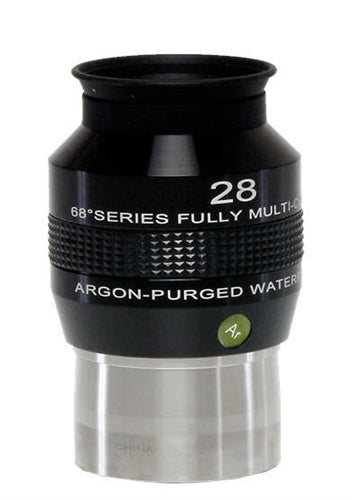
The Explore Scientific 68° Series 28mm is a wide-field, argon-purged waterproof eyepiece in a 2-inch barrel, with a 31.8mm field stop and 21.6mm of eye relief. It measures 91.4mm long and 61.3mm across and weighs 16.1oz (458g), which is substantial in the hand and typical for a 2-inch eyepiece carrying this much field.
The 31.8mm field stop is the specification that matters most here, because it sets the true field independently of apparent field marketing. In a 1200mm telescope it works out to about 1.52°, and in an 826mm refractor about 2.2° — more than four full Moons across. Magnification is the telescope's focal length divided by 28, so 43x at 1200mm and 30x at 826mm.
Explore Scientific builds the series from low-dispersion and high-refractive-index optical glasses with multilayer coatings, aimed at holding contrast and keeping the field flat out to the edge. The housing is sealed and argon-purged, and a soft silicone eyecup is fitted.
Who It's For
- Wide-field deep-sky observers: a 1.5° true field at 1200mm takes in the whole of the Pleiades, the Double Cluster or the North America Nebula in one view.
- Owners of 2-inch focusers who want the wide true field a larger barrel makes physically possible, rather than the 1.25-inch ceiling of around 27mm of field stop.
- Eyeglass wearers: 21.6mm of eye relief is generous by any standard, and comfortably enough to take in the full 68° field with spectacles on.
- Dobsonian and undriven mount users: a wide apparent field buys drift time between nudges, which is time spent observing rather than repositioning.
- Anyone observing in damp air or heavy dew, where the argon-purged sealed housing does real work.
Key Features & Design
- 68° apparent field of view: a step up in immersion from the 52° and 62° Series without the outer-field demands of an 82° or 100° design.
- 31.8mm field stop: the figure that fixes true field. Multiply by 57.3 and divide by your telescope's focal length for the field in degrees.
- 21.6mm eye relief: long enough to keep glasses on, and long enough that eye positioning stops being an effort during a long session.
- 2.00″ barrel: drops into any 2-inch focuser or diagonal, which is what allows a field stop this large.
- Low-dispersion and high-refractive-index optical glasses with multilayer coatings, specified by Explore Scientific for sharp contrast and a flat field.
- Argon-purged sealed housing: waterproof, and resistant to the internal fogging that trapped humid air can produce as temperatures drop.
- Soft silicone eyecup included.
- Published dimensions: 91.4mm long, 61.3mm wide, 16.1oz (458g).
- Warranty registration available through Explore Scientific.
Recommended Uses
- Wide-field sweeping of large open clusters, nebulae and Milky Way star fields.
- Framing large objects that overflow a narrower eyepiece — the Veil, the Rosette, the Andromeda halo.
- Low-power finding before switching to a higher-magnification eyepiece.
- Extended observing sessions where 21.6mm of eye relief keeps things comfortable.
- Observing on an undriven Dobsonian, where apparent field translates into time on target.
Compatibility and Accessory Notes
- Requires a 2-inch focuser or diagonal. The 2.00″ barrel does not step down to 1.25 inches, so a telescope with a 1.25-inch focuser only is outside its range. We are happy to check your focuser before you order.
- Magnification: telescope focal length ÷ 28. A 1200mm Dobsonian gives 43x; an 826mm refractor gives 30x; a 2000mm SCT gives 71x.
- True field: 57.3 × 31.8 ÷ focal length. That is 1.52° at 1200mm and 2.2° at 826mm.
- Exit pupil: 28 divided by the telescope's focal ratio — 6mm at f/4.7, 2.8mm at f/10.
- Filters: 2-inch threaded filters are the match for a 2-inch eyepiece. Nebula filters at this focal length and field are one of the more rewarding combinations in visual astronomy.
- Balance: at 16.1oz this eyepiece shifts the balance of a small refractor or a Dobsonian noticeably. On a Dob, rebalancing with the tube tension or a counterweight sorts it out.
Good to Know Before You Order
- It is a 2-inch eyepiece only. A 2-inch focuser or a 2-inch diagonal is what it goes into. Send us your telescope model if you would like us to check that before it ships.
- 16.1oz is a real weight to hang off a focuser. Light Dobsonians and short refractors will want rebalancing when it goes in, which a counterweight or a friction adjustment handles.
- Explore Scientific does not publish an element count, a group count or a filter thread specification for this eyepiece, so those rows are absent from the table below rather than estimated. If one of them decides the purchase for you, ask us and we will put the question to our Explore Scientific contact.
- 68° is wide, not ultra-wide. The 82° and 100° Series go further if immersion is the goal; the 68° is the balance point between field width, eye relief and weight, and it is the lightest of the three at this sort of focal length.
- It is a visual eyepiece. Eyepiece-projection imaging is possible with an adapter, though the design target is the eye.
Frequently Asked Questions
Is it difficult to set up?
No — it drops into any 2-inch focuser or diagonal and is ready immediately. Nothing to assemble or adjust. The only thing worth a moment is rebalancing a light telescope after 16.1oz goes on the back end.
What magnification will I get?
Divide your telescope's focal length in millimetres by 28. A 1000mm telescope gives 36x and a 1200mm gives 43x.
How much sky does it actually show?
57.3 multiplied by the 31.8mm field stop, divided by your focal length. At 1200mm that is 1.52°, or about three full Moons side by side.
Can I use it with glasses on?
Yes. 21.6mm of eye relief is among the more generous figures at this focal length, and it is enough to take in the whole 68° field with spectacles in place.
Will it fit a 1.25-inch focuser?
No — the barrel is 2.00″. For a 1.25-inch focuser, the 52° Series 30mm covers similar low-power ground within the smaller barrel, and we stock it.
How does it compare with the 82° Series?
The 82° gives a wider apparent field and a more immersive view; the 68° is lighter, easier on eye placement and easier on the outer field of a fast telescope. Tell us what you observe and on what telescope, and we will give you a straight recommendation.
Do nebula filters help at this focal length?
Considerably, on emission nebulae. A 2-inch UHC or O-III threads into the barrel and darkens the background while passing the nebula's own light.
Bottom Line
In short: a 458g, 2-inch, argon-purged 28mm eyepiece with a 68° apparent field, a 31.8mm field stop and 21.6mm of eye relief — wide, comfortable, low-power viewing built on low-dispersion and high-index glass. If you would like us to check that your focuser takes 2-inch eyepieces, or to suggest a nebula filter to pair with it, send us your telescope details and we will take it from there.
| Item Number | EPWP6828-01 |
|---|---|
| Apparent Field of View | 68° |
| Focal Length | 28mm |
| Length | 91.4mm |
| Width | 61.3mm |
| Weight | 16.1oz; 458g |
| Barrel Size | 2.00" |
| Eye Relief | 21.6mm |
| Field Stop Diameter | 31.8mm |
| Optical Glass | Low dispersion and high refractive index glasses |
| Coatings | Multilayer coatings |
| Waterproof | Sealed argon-purged housing |
| Eyecup | Soft silicone |
| Lens Elements/Groups | Not published by vendor |
| Filter Thread | Not published by vendor |
You may also like
Recently viewed
Recent Blog Posts
View all
Your Guide Graph Is Lying to You
Read More

D-Size vs V-Size: A Complete Guide to Telescope Dovetail Systems
Read More

What Is Back Focus in Astrophotography? Telescope Reducers, Flatteners, and Spacing Explained
Read More