
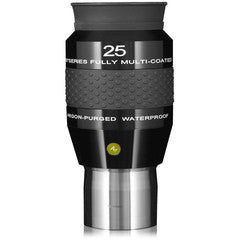

- Description
- Specifications
Product Overview
The Explore Scientific 100° Series 25mm is a 2-inch argon-purged waterproof eyepiece with a 100-degree apparent field, a 41mm field stop and 14.5mm of eye relief. Explore Scientific publish its dimensions as 140mm long by 73mm wide and its weight as 41.5 oz (1177 g). It is item EPWP10025-01, and the housing is tested to withstand submersion at one metre for thirty minutes.
A 41mm field stop is essentially the ceiling of the 2-inch format. True field is field stop divided by telescope focal length, expressed in degrees: 2.35° in a 1000mm telescope, 2.38° in a 988mm f/6.5 refractor, 1.24° in a 1900mm Maksutov. At 40x in a metre-class instrument, that is well over four full-Moon diameters of sky at once — and it is delivered inside a 100-degree apparent field, which is wide enough that the field edge sits outside the range the eye scans without turning.
The exit pupil is 25 divided by the telescope's focal ratio: 5mm at f/5, 3.8mm at f/6.5, 2.5mm at f/10. In a fast telescope that is a large exit pupil, which is what makes low-power ultra-wide observing under a dark sky so effective — the eye receives a bright, wide, well-filled beam.
Explore Scientific also note that the wide field makes objects easier to locate and keeps them in view longer, and that the design supports averted vision, where looking slightly to one side of a faint object brings it out.
Who It's For
- Dark-site deep-sky observers: 2.35° of true field in a metre-focal-length telescope covers the North America Nebula, the Veil complex and the largest open clusters in single views.
- Observers who want immersion: at 100 degrees the field boundary is outside normal peripheral scanning, which is what removes the sense of looking down a tube.
- Dobsonian users: the widest apparent field available buys the longest drift time between nudges, which matters most at the eyepiece you use for finding and framing.
- Observers hunting faint extended objects: a large exit pupil and a clean, wide field are the two things averted vision needs in order to work.
- Anyone observing in heavy dew: the argon-purged body is rated for a metre of water for half an hour, so dew and rain are not events.
Key Features & Design
- 100° apparent field of view: the widest apparent field Explore Scientific build, and the defining characteristic of the eyepiece.
- 41mm field stop: at or very near the physical maximum a 2-inch barrel can pass, which is what turns the apparent field into real sky.
- 25mm focal length: 40x in a 1000mm telescope, 76x in a 1900mm one — a low-to-medium power step.
- 14.5mm eye relief: the published figure, workable for most observers though snug for a wide field of this size.
- Argon-purged and sealed: tested at one metre depth for thirty minutes. Dry argon inside carries no moisture to condense on cooling glass.
- Fully multi-coated: anti-reflection coatings across the optical surfaces, which matters a great deal in a design with this many air-to-glass interfaces.
- 140mm long, 73mm wide, 41.5 oz (1177 g): a large and heavy ocular, which is what an ultra-wide field at 25mm costs in glass.
- Supports averted vision: Explore Scientific describe the field as clean enough to let the observer look beside a faint target while it stays comfortably in the view.
Recommended Uses
- Wide-field deep-sky observing from a dark site — large nebulae, star fields and the biggest open clusters.
- Sweeping the summer Milky Way, where 2.35° of true field is the whole point.
- Locating and framing objects before switching to a higher-power eyepiece.
- Comet observing, where the coma and tail need generous room.
- Undriven and Dobsonian observing at the widest field the telescope can deliver.
- Damp and dew-heavy sites where a sealed, gas-purged eyepiece keeps working.
Compatibility and Accessory Notes
- 2-inch focusers and diagonals only. A 41mm field stop cannot pass through a 1.25-inch barrel, so the format is set by the optics.
- True field: 41 divided by your telescope's focal length in millimetres, multiplied by 57.3. A 1200mm SCT yields 1.96°; a 750mm Newtonian yields 3.13°.
- Magnification: telescope focal length divided by 25. A 650mm refractor gives 26x, a 1500mm gives 60x, a 2000mm gives 80x.
- Filters: the 2-inch barrel takes standard 2-inch threaded filters. A wide field and an O-III or broadband nebula filter is one of the most productive combinations in visual astronomy.
- Focuser strength: 41.5 oz is a lot of mass cantilevered off a focuser drawtube. Rack-and-pinion and quality Crayford focusers handle it; older or lighter focusers can slip under it, and tightening the drawtube tension screw is the usual first adjustment.
- Balance: on a Dobsonian this eyepiece will tip the tube. Magnetic balance weights or a spring-tensioned altitude bearing solve it, and we can supply the weights.
Good to Know Before You Order
- It weighs 41.5 oz (1177 g). That is heavier than many finder scopes, and it will change the balance of most telescopes and load the focuser noticeably. Counterweights and focuser tension adjustments handle it, and we can put the right weight in the box with it if you tell us what you are fitting it to.
- 14.5mm of eye relief with a 100-degree field means eye placement matters. There is a position where the whole field appears at once, and finding it takes a moment at first. The eyecup is what makes that position repeatable once you have it.
- It is 140mm long and 73mm wide. Some eyepiece cases and most binoviewers will not take an ocular of that size, so a case with deep compartments is worth planning for.
- Fast telescopes place more demand on the outer field. At f/4 or f/4.5, coma from the telescope itself becomes visible near the edge of a field this wide — that comes from the primary mirror rather than the eyepiece, and a coma corrector is the answer. We stock them.
- Explore Scientific does not publish the element count for this model, so that row is absent below rather than estimated. If you want it for a comparison, we can ask our Explore Scientific rep.
Frequently Asked Questions
Is it difficult to set up?
No. It goes into a 2-inch focuser or diagonal and works immediately. The two practical steps are tightening the focuser drawtube enough to hold 41.5 oz securely and rebalancing the telescope afterwards.
How much sky does it show?
The 41mm field stop gives 2.35° of true field in a 1000mm telescope at 40x — more than four full-Moon diameters. In a 1500mm telescope it is 1.57° at 60x.
Why is it so heavy?
A 100-degree apparent field at 25mm requires large-diameter elements and a lot of them. The 73mm body width and the 41.5 oz weight are what that optical prescription weighs in glass and metal.
Can I use it in a 1.25-inch focuser?
No — the 41mm field stop is wider than a 1.25-inch barrel. This eyepiece is 2-inch only.
What does the argon purging achieve?
The internal air is replaced with dry argon and the housing is sealed, which is why it survives a metre of water for thirty minutes. In routine use the benefit is that the inside never fogs as the eyepiece cools past the dew point.
How does it compare with the 82° Series?
The 100° Series gives a wider apparent field and, at 25mm, a larger field stop and therefore more true sky. The 82° designs are lighter and easier on eye placement. Tell us what telescope it is going on and we will tell you which trade is the better one in your case.
Bottom Line
In short: a 25mm eyepiece with a 100-degree apparent field, a 41mm field stop at the practical limit of the 2-inch format, 14.5mm of eye relief and an argon-sealed body rated to a metre of water — the widest view Explore Scientific offer at this focal length. If you would like to know how much sky it will show in your telescope, and whether your focuser will hold 41.5 oz comfortably, send us the details and we will work it through with you.
| Description | 25mm 100° Series Argon-Purged Waterproof Eyepiece |
|---|---|
| Item Number | EPWP10025-01 |
| Focal Length | 25mm |
| Apparent Field of View | 100° |
| Barrel Size | 2.00" |
| Eye Relief | 14.5mm |
| Field Stop Diameter | 41mm |
| Length | 140mm |
| Width | 73mm |
| Weight | 41.5oz; 1177g |
| Coatings | Fully multi-coated |
| Housing | Argon-purged, waterproof — tested at one metre for 30 minutes |
| Element Count | Not published by vendor |
You may also like
Recently viewed
Recent Blog Posts
View all
Your Guide Graph Is Lying to You
Read More

D-Size vs V-Size: A Complete Guide to Telescope Dovetail Systems
Read More

What Is Back Focus in Astrophotography? Telescope Reducers, Flatteners, and Spacing Explained
Read More