


- Description
- Specifications
Product Overview
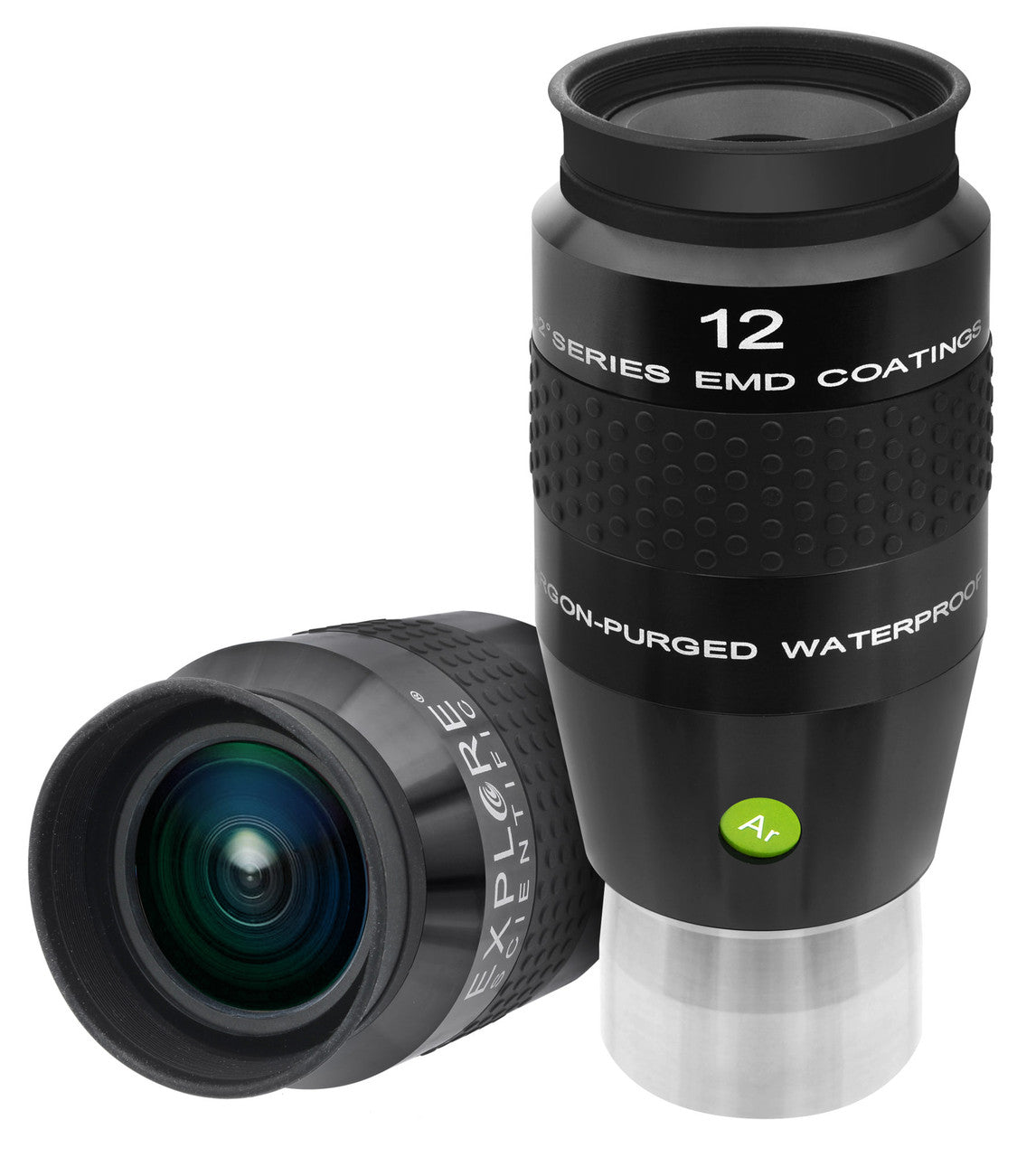
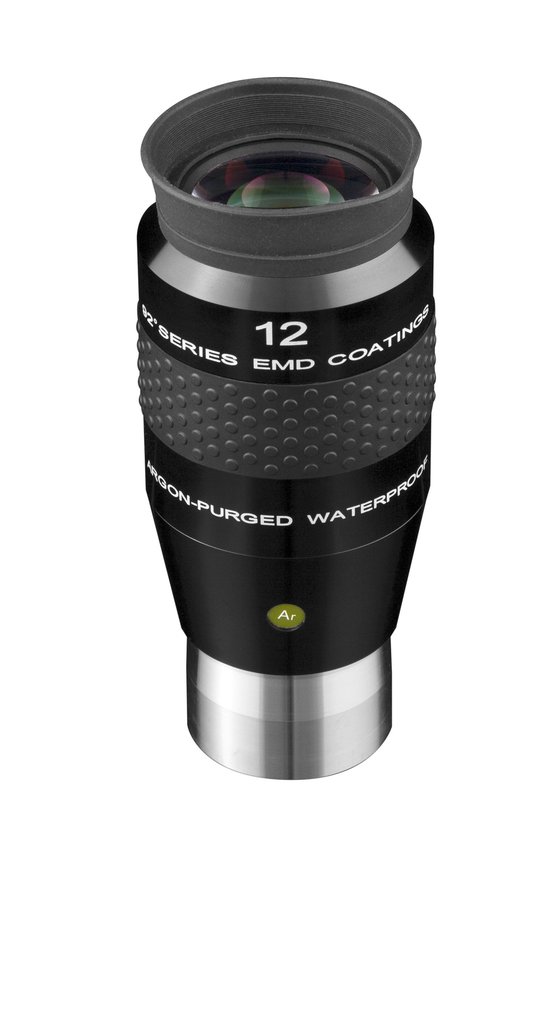
The Explore Scientific 92° Series 12mm is a hyper-wide-field eyepiece in a 2-inch waterproof barrel, published with a 92° apparent field of view, 20.02mm of eye relief and a 27.46mm field stop. It measures 152mm long by 70mm wide and weighs 2.4 lbs.
The combination that makes this eyepiece unusual is 92 degrees of apparent field with more than 20mm of eye relief at a 12mm focal length. Those two properties normally pull against each other — wide apparent fields tend to force the eye close to the lens, and short focal lengths make it worse. Holding 20.02mm here is what the "Long Eye Relief" in the name refers to, and it is what allows the whole 92° field to be taken in comfortably, including with eyeglasses on.
At 12mm the magnification lands in the productive middle-high range: 79x in a 952mm refractor, 100x in a 1200mm SCT, 125x in a 1500mm Dobsonian. Combined with a 92° apparent field, the true field at those powers is far larger than a conventional eyepiece would give — which is the practical reason people buy hyper-wide designs.
Who It's For
- Deep-sky observers who want high enough magnification to darken the sky background while keeping an object and its surroundings in the same view.
- Dobsonian and undriven mount owners: at 92° apparent field an object takes roughly twice as long to cross the field as it would in a 50° eyepiece at the same power, which changes how a session feels.
- Eyeglass wearers who have found most wide-field eyepieces impossible to use with spectacles — 20.02mm of eye relief is what makes it work here.
- Observers using averted vision: a wide field gives the eye room to look slightly off-target, which is how faint detail is picked up.
- Owners of 2-inch focusers and diagonals who want to use the full aperture of the format.
- Observers in damp conditions, where the waterproof housing does its work.
Key Features & Design
- 92° apparent field of view: a hyper-wide class field that fills more of the visual field than the eye can take in at a single glance.
- 20.02mm of eye relief at 12mm focal length: the defining specification, and what makes the field usable with glasses on.
- 27.46mm field stop: the figure that sets true field — divide by the telescope's focal length and multiply by 57.3 for degrees.
- 2.00″ barrel: requires a 2-inch focuser or diagonal, which is what allows the field stop to exceed the 1.25-inch limit.
- Waterproof construction in line with the sealed Explore Scientific waterproof eyepiece range.
- 152mm long, 70mm wide, 2.4 lbs: a physically large eyepiece, which is inherent to holding this field and this eye relief together.
Recommended Uses
- Medium-to-high power deep-sky observing where a dark sky background and a wide surround are both wanted.
- Globular clusters, planetary nebulae, galaxy groups and the brighter emission nebulae.
- Extended lunar observing, where the wide field keeps the whole disc and its surroundings in view at 12mm in a short telescope.
- Undriven Dobsonian work, where field width buys time between nudges.
- Observing with eyeglasses on, which most hyper-wide eyepieces make difficult.
Compatibility and Accessory Notes
- Requires a 2-inch focuser or diagonal. The 2.00″ barrel does not fit a 1.25-inch fitting, and no adapter converts downward, because the field stop is larger than a 1.25-inch barrel can pass.
- Magnification: telescope focal length ÷ 12. A 714mm refractor gives 60x; a 1200mm SCT gives 100x; a 1900mm Maksutov gives 158x.
- True field: 27.46mm ÷ telescope focal length × 57.3. In a 1200mm telescope that works out to about 1.3°.
- Balance: at 2.4 lbs this eyepiece shifts the balance of most telescopes noticeably. On a Dobsonian a counterweight at the rear of the tube settles it; on an equatorial mount it is a matter of rebalancing after fitting. We stock counterweights for both.
- Focuser capacity: a 2.4 lb eyepiece hanging off a focuser drawtube is real load. A rack-and-pinion or a well-tensioned Crayford handles it; a lightly built focuser may need its tension adjusting.
- Filters: Explore Scientific does not publish the filter thread specification for this eyepiece, so we are not quoting one. If a 2-inch narrowband filter is part of your plan, ask and we will confirm the thread with our rep first.
Good to Know Before You Order
- This is a 2-inch eyepiece and it needs a 2-inch focuser or diagonal. A 27.46mm field stop is physically larger than a 1.25-inch barrel can pass, so stepping down is not possible. If your telescope has a 1.25-inch focuser, the 62° and 72° Series cover similar ground in that format, and we stock them.
- At 2.4 lbs it is heavy enough to change the balance of the telescope. Rebalancing after fitting takes a moment, and a magnetic or clamp-on counterweight solves it permanently on a Dobsonian.
- A 92° field is larger than the eye takes in at once. Observers typically scan around the field rather than seeing it all at a glance, which is the intended experience of a hyper-wide design rather than a shortcoming.
- Explore Scientific does not publish the element count, coating specification or filter thread for this model, so those rows read "Not published by vendor" below rather than carrying an estimate. If one of those figures matters, ask and we will get it from our rep.
- It is a physically large eyepiece at 152mm by 70mm, which is worth allowing for in a case designed around conventional oculars. We can suggest a case that fits it if yours is already full.
Frequently Asked Questions
Is it difficult to set up?
No — it slides into any 2-inch focuser or diagonal and is ready to use. The one thing worth doing afterwards is rebalancing the telescope, since at 2.4 lbs it is heavy enough to shift the centre of gravity.
What magnification will I get?
Divide your telescope's focal length in millimetres by 12. A 1200mm telescope gives 100x.
Will it fit a 1.25-inch focuser?
No — the barrel is 2 inches and the 27.46mm field stop is wider than a 1.25-inch barrel can pass. For a 1.25-inch focuser, the 62° and 72° ED Series are the wide-field options, and we carry both.
Can I use it with glasses on?
Yes — that is the point of the 20.02mm of eye relief. Very few eyepieces combine a 92° field with enough eye relief to take the whole field in through spectacles.
How much sky does it show?
Take the 27.46mm field stop, divide by your telescope's focal length and multiply by 57.3. In a 1500mm Dobsonian that is about 1.05° at 125x, which is a lot of sky for that magnification.
How does it compare to the 82° Series?
A wider apparent field at 92° against 82°, and this model is specified around long eye relief. It is also larger and heavier. Which one suits depends on your focuser, your mount and whether you observe with glasses — tell us your setup and we will help you choose.
Is it good on an undriven telescope?
Particularly so. The wide apparent field is what keeps an object in view between nudges at a magnification that would otherwise need constant attention.
Bottom Line
In short: a 12mm eyepiece with a 92° apparent field, 20.02mm of eye relief and a 27.46mm field stop in a 2-inch waterproof barrel — hyper-wide field at a working magnification, with enough eye relief to use it through glasses. If you would like us to confirm it suits your focuser and check whether a counterweight would help your balance, send us your telescope model and we will work it out with you.
| Description | 92° Series 12mm Long Eye Relief Waterproof Eyepiece |
|---|---|
| Item Number | EPWP9212–01 |
| Focal Length | 12 mm |
| Apparent Field of View | 92° |
| Length | 152 mm |
| Width | 70 mm |
| Weight | 2.4 lbs |
| Barrel Size | 2.00″ |
| Eye Relief | 20.02 mm |
| Field Stop Diameter | 27.46 mm |
| Construction | Waterproof |
| Lens Elements/Groups | Not published by vendor |
| Coatings | Not published by vendor |
| Filter Thread | Not published by vendor |
You may also like
Recently viewed
Recent Blog Posts
View all
Your Guide Graph Is Lying to You
Read More

D-Size vs V-Size: A Complete Guide to Telescope Dovetail Systems
Read More

What Is Back Focus in Astrophotography? Telescope Reducers, Flatteners, and Spacing Explained
Read More