
Wide-field imaging
Astrophotography with the camera you already own
A star tracker turns your camera at the same rate the sky turns, which is the single change that takes you from 15-second frames to five-minute ones. No telescope, no adapters, no back focus - your body, your lenses, and a mount that keeps them pointed.
The whole idea, in three parts
You already own the expensive half
A star tracker is not a telescope. It is a small motorised wedge that turns your camera at the same rate the sky turns, and that one change is what separates a grainy handheld Milky Way shot from an image with colour and depth in it.
The Earth turns. The tracker turns back.
Stars drift roughly 15 arcseconds a second. On a fixed tripod that limits you to a handful of seconds before they smear into streaks - and the fix everyone reaches for, cranking the ISO, just buys noise. A tracker rotates the camera at exactly the opposite rate, so a two-minute exposure lands with round stars.
Your lens is already an astrograph
A fast 50, 85 or 135 mm prime is optically better than most entry-level telescopes and covers a field no telescope here can match. Nothing needs adapting, nothing needs spacing to a fraction of a millimetre. The lens you use for wildlife at dawn is the lens that shoots Cygnus at midnight.
Polar alignment is the only new skill
Sight Polaris through the mount's own polar scope and set the reticle. That is it - everything else is photography you already know. At wide focal lengths the alignment can be rough and still give you minutes. It only gets fussy past 200 mm, which is exactly where the GoTo mounts and autoguiding on this page start to make sense.
The honest limit: a tracker moves in one axis and carries about 5 kg. It will not carry a big telescope, and it will not point itself unless you buy one of the GoTo models below. What it will do is turn a camera bag you already own into a wide-field astrophotography rig for the price of a decent lens - and, unlike a smart telescope, everything you learn on it carries straight over to a full rig later.
Who buys these
Four people we sell these to every week
If one of these is recognisably you, the recommendation at the bottom of the card is where we would start you. If none of them is, call us - the four below cover most of it but not all of it.
You already have the two expensive things: a body with a clean sensor and fast primes or telephotos you know intimately. A tracker is the cheapest meaningful upgrade available to you, because it does not replace any of that - it just removes the exposure-time limit that has been quietly capping what you can photograph after dark. The 200 mm you use for birds is a serious astrograph.
Start with the Star Adventurer 2iYou have tried the Milky Way on a tripod, seen the trailing and the noise, and want to know what the next step is without buying a telescope and learning back focus. This is it. One new object in the bag, one new skill to learn, and the results jump immediately - the first tracked frame you take will be better than anything you have shot untracked.
Start with the Star Adventurer 2iWhether it is a clear gap between clouds or a night away from home, the rig that gets used is the one that sets up fast. A tracker on a tripod is out of the bag, aligned and running before a telescope has finished cooling down - and the GTi adds GoTo, so the finding step disappears too.
The Star Adventurer GTiYour imaging rig is superb at things a degree across and useless at things thirty degrees across. Half the best targets in the sky - the Milky Way core, Cygnus, Rho Ophiuchi, the whole Andromeda field - are too big for it. A tracker and a 50 mm prime cover all of them, and it is a second rig you can leave assembled while the main one is set up on something else.
The GTi, or the EQ-AL55i if it also has to carry a small scopeBefore you buy anything
What your lens will actually do
Pick the lens and body you already own. This shows how much sky you capture, how long you can expose on a fixed tripod before the stars trail, and how long the same lens will run once it is tracked. The untracked figure is the classic 500 rule; the tracked figure is what a well-aligned mount gives unguided, which is the number that changes what you can photograph.
Two caveats worth knowing. The 500 rule is generous - pixel-peep a modern high-resolution sensor and you will see trailing before it says you should. And the tracked figure assumes the tracker is carrying a load it is comfortable with and pointed at the pole properly; a rushed alignment costs you exposure time before it costs you anything else.
Three ways in
From a tracking head to a GoTo equatorial
Three mounts, in the order people usually move through them. Every card assumes you are bringing your own camera and lenses, so what you are choosing is how it stands up, whether it points itself, and whether it guides. Prices update as you tick. Canadian dollars.
 Tracking head
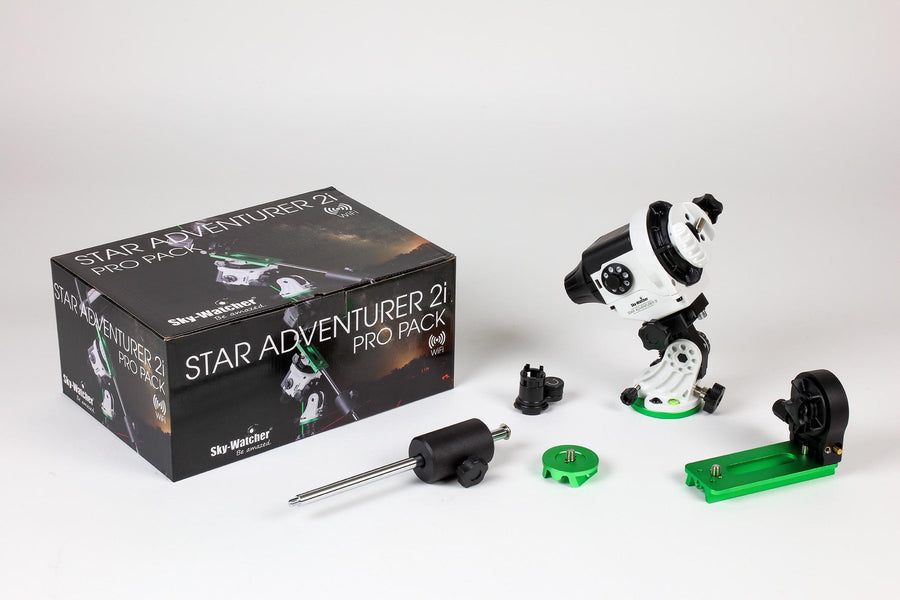
Sky-Watcher Star Adventurer 2i Pro Pack
A tracking head small enough to live in a camera bag, with an 11 lb payload that swallows a full-frame body, a fast 135 or 200 mm lens and a ball head. The Pro Pack is the complete configuration - dec bracket, latitude EQ base, counterweight kit and ball head adapter are all in the box, so nothing has to be ordered afterwards to make it work.
It turns gear you already own into an astrophotography rig, tonight, for less than the price of a decent lens. Four AA cells run it for 24 hours, the SNAP port fires your camera on a programmed sequence with no intervalometer in the chain, and the whole thing goes back in the bag in a minute.
It tracks; it does not point. There is no GoTo, so you find targets yourself - which is genuinely fine at 50 mm and genuinely tedious at 200. One axis only, so past a couple of minutes the declination drift from an imperfect polar alignment is what limits you.
What it will carry11 lb / 5 kg total above the saddle plate - body, lens and ball head together. A full-frame body with a 200 mm f/2.8 and a mid-size head sits comfortably inside that. A 300 mm f/2.8 does not. Send us the exact combination and we will work out the loaded weight with you.
In the package
What it stands on
The mount threads onto a 3/8 inch stud, with a 1/4-20 adapter in the box for the smaller standard. Stability matters more than the thread: the tripod is carrying the mount, the lens and the camera together, and a light travel tripod that is fine for daylight will wobble here.
Power. Four AA cells give 24 hours. A USB power bank on the 5 V mini-USB port removes the limit, and is what we would use for an all-night session.
 GoTo tracker
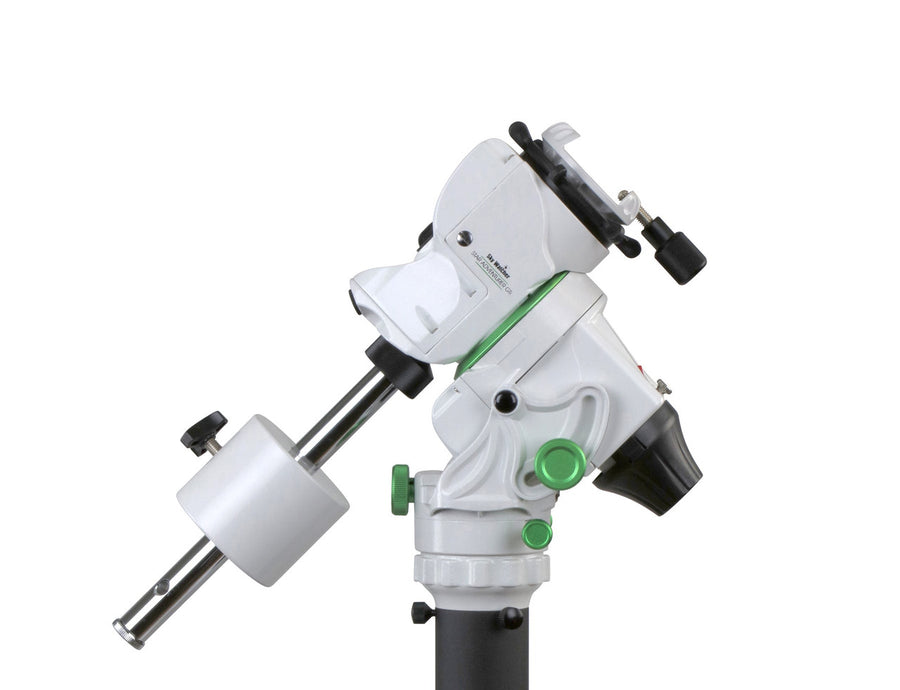
Sky-Watcher Star Adventurer GTi
The same 11 lb payload as the 2i with a second motorised axis and a GoTo database behind it. You align it, tap a target in SynScan Pro, and the mount puts it in the frame. The ST-4 port is the real difference for imaging: this is the first mount here that can be autoguided, which is what turns two-minute frames into five-minute ones.
It finds things. At 135 mm and up, hunting for a faint nebula by star-hopping is most of what makes a session frustrating, and GoTo deletes that problem. Add the guide package and it will hold a target across a whole night without you touching it.
Heavier and pricier than the 2i, and the payload is the same 5 kg - you are paying for pointing and guiding, not for carrying capacity. Eight AA cells will not last a long winter night, so plan on a 12 V supply.
What it will carry11 lb / 5 kg, same as the 2i. Count the camera, the lens, the ball head or dovetail, and the guide scope if you add one - a 32 mm guide scope and camera together are about 0.6 kg of that budget.
In the package
What it stands on
The two work out to the same money, and the mount kit throws in the pier extension - so if you are buying a tripod at all, buy it this way rather than as a separate item. Take the head on its own only if you already have a tripod you trust.
Autoguiding
Power. Eight AA cells, or 12 V DC through the 2.1 mm barrel jack. For a full night, or any night you are also running an ASIAIR and a dew strap, use a 12 V supply or a telescope power pack.
 GoTo equatorial
Sky-Watcher EQ-AL55i Pro
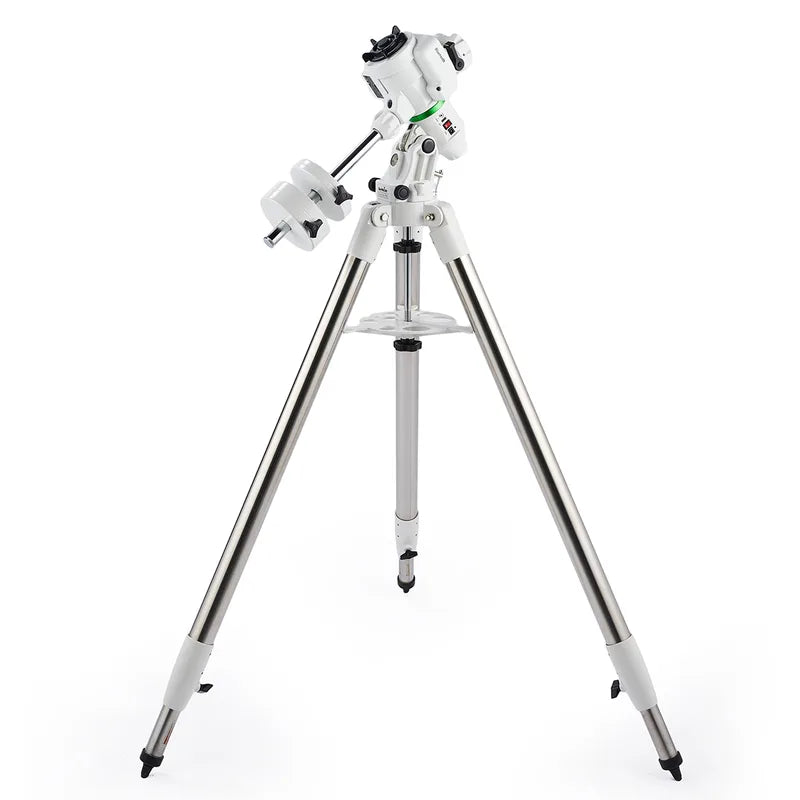
A proper German equatorial rather than a tracking head, and the point where wide-field work stops being the ceiling. Twice the payload of the Star Adventurers, a steel tripod and two counterweights in the box, and a counterweight bar that mounts in two positions so the head clears the legs anywhere from the equator to the pole.
Ten kilos of payload means the long lens, the guide scope, a dew controller and a power box all fit inside the budget with room to spare - and the same mount will still be useful when you buy a telescope. Finer worm gearing on the tracking axis than anything else here.
It is a mount you set up rather than one you pick up: head, tripod and counterweights go out in separate trips, and it wants 12 V power with no battery option. Worm-drive backlash is corrected by autoguiding rather than engineered out, so treat the guide package as part of the purchase, not an extra.
What it will carry10 kg / 22 lb excluding counterweights. For camera-lens work that is enormous headroom - a 600 mm f/4 with a guide scope and a power box is still inside it, which is not true of anything else on this page.
In the package
The tripod is in the box. The adjustable-height steel tripod, both counterweights (3.5 kg and 1.8 kg) and the DC power cord all ship with the mount. The pier extension and the SynScan hand controller are the two things sold separately, and neither is needed unless you are working at a very low latitude or prefer physical buttons to the app.
Autoguiding
Power. 12 V DC, and there is no internal battery. The cord is in the box but the supply is not - the Player One 12 V 5 A below runs it from the wall, and a telescope power pack runs it in a field. Whatever you use, it needs to hold voltage through a slew.
Not sure which
Tell us what is in your camera bag
Send us the body, the lenses and the tripod you already own and we will tell you which of these three is right - including telling you that the cheapest one is enough, which is the answer more often than not.
- Your camera body and the lenses you already own
- Whether you have a tripod, and how heavy it is
- Nightscapes, or single targets at 200 mm and up
- Whether you want it to point itself
Worth adding
The small things that save a night
None of these are in the packages above. The first few are the ones people come back for.

The Sky-Watcher tripod, if you would rather not tie up your photo tripod or do not own one solid enough. Steadier than most travel tripods, and it means the night rig can stay assembled.
$150
Raises the mount so a long lens swings clear of the tripod legs, and puts the polar scope at a height you can actually kneel to. Included in the GTi mount kit; worth adding to anything else.
$60
A second counterweight for heavier lenses. Balance is what keeps the drive from fighting the load, and a tracker carrying an unbalanced 200 mm will show it in the stars.
$60
The piece that bridges a photographic ball head onto the mount's Vixen saddle. One is already in the 2i Pro Pack - this is the spare, or the one to add to a GTi.
$30
120 mm of focal length in a 342 g package, built for exactly this kind of mount. Choose the version matched to your guide camera - the GTi and EQ-AL55i packages above add the ASI120MM Mini pairing for you.
$135
The standard guide camera. Plugs into an ASIAIR or a laptop running PHD2, and it is what lets the mount correct itself instead of you throwing frames away.
$279
Runs the mount, plate solves so targets land centred, and autoguides without a laptop. Shutter control covers select Canon, Nikon and Sony bodies - send us your model and we will confirm yours before you order.
$559
The 2 inch USB dew heater, for smaller lens barrels. Dew heaters are sized to the outside diameter of the lens, not the filter thread - measure yours or ask us.
$84.99
12 V 5 A supply with the 5.5 x 2.1 mm plug the GTi and EQ-AL55i use. Pick the North American version at checkout.
$41
ADM's dovetail adapter for the GTi saddle, in D or V profile. The tidy way to carry a camera plate and a guide scope on the same mount.
$114
Pegasus power puck for the GTi saddle. Distributes 12 V to the mount, the dew strap and a guide camera from one input, which is three cables fewer to snag in the dark.
$66
A 166 mm Vixen dovetail bar. The usual way to carry a camera and a guide scope side by side on a tracker - tell us your body and lens and we will confirm the bar and shoe you need.
$39.99
The finder shoe the 32 mm guide scope drops into. Cheap, and the thing people discover they are missing at the wrong moment.
$25When you outgrow a tracker
You will know, because you will find yourself wanting a target that is too small for 400 mm. That is the moment to look at a telescope on a proper equatorial mount - our first photos page covers the modest end of that, and the advanced packages the other end. Nothing you learn here is wasted: polar alignment, calibration frames and stacking are the same job on a $12,000 rig.
Tell us what you own and we will check it fits
Send us the camera body, the lenses and the tripod you already have, and before you order we will confirm the combination works together - the payload, the thread sizes, and which bracket carries a guide scope alongside your particular lens. Everything ships factory-sealed. If you would rather learn it with someone, our imaging courses start at the polar scope.