


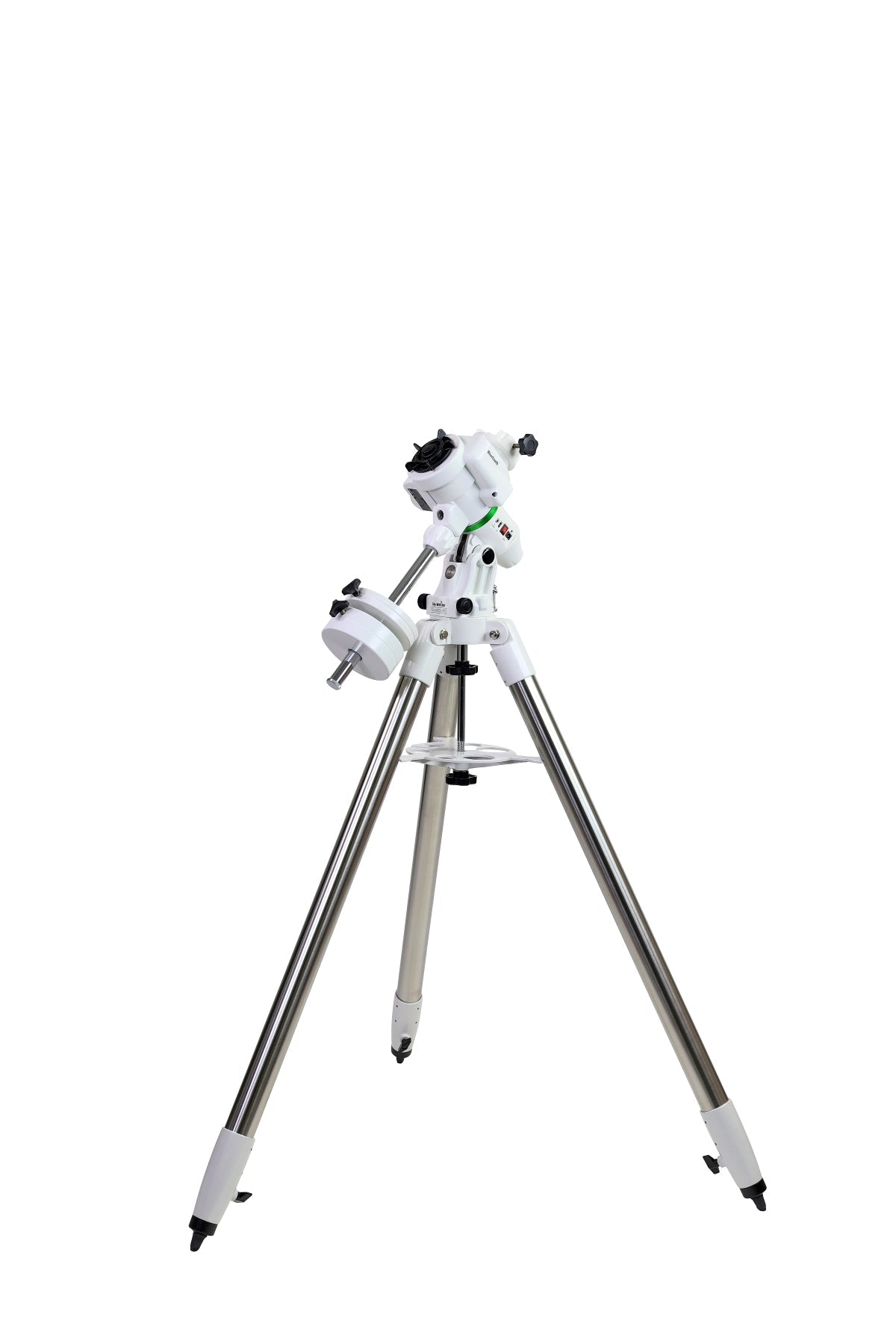
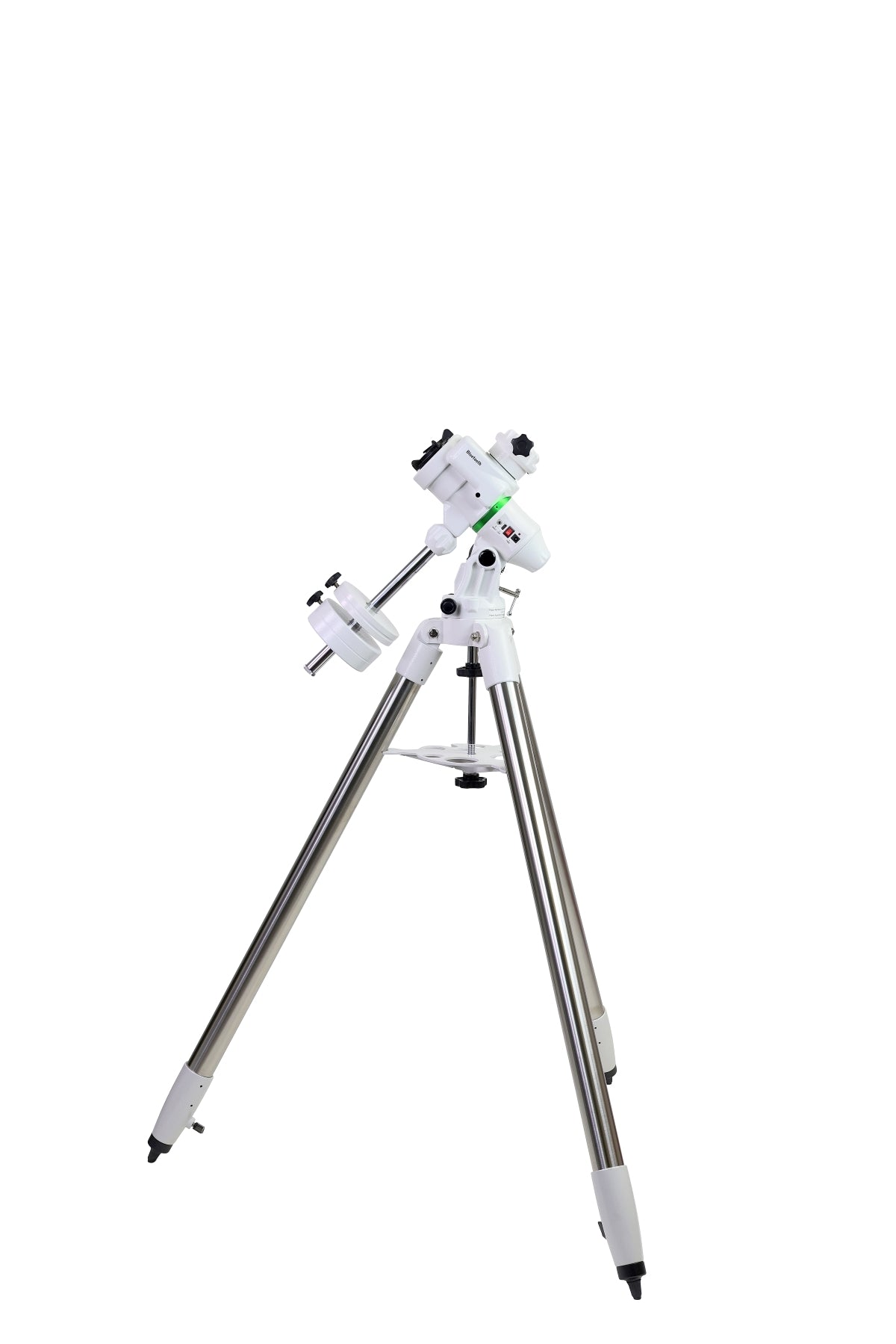
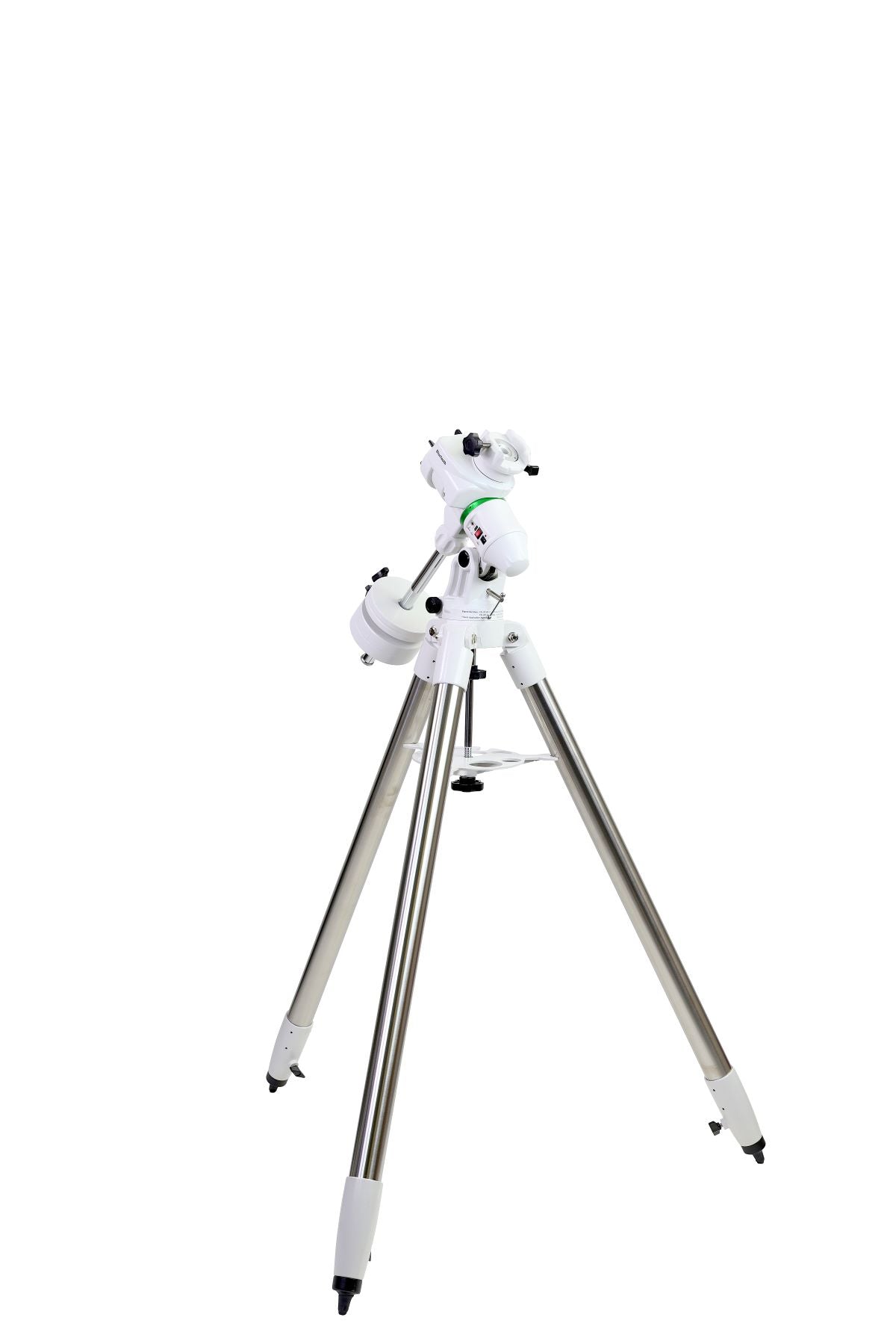
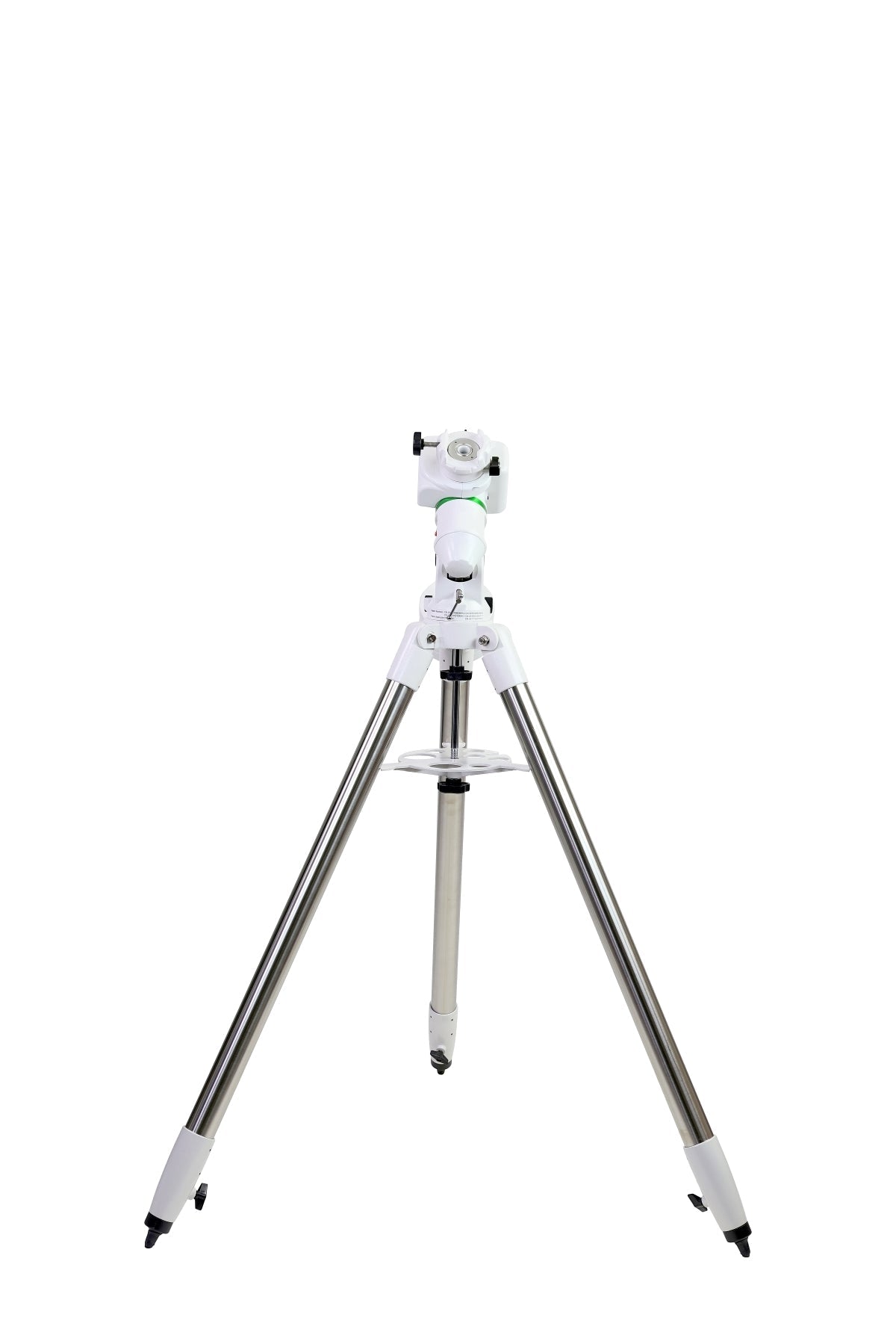
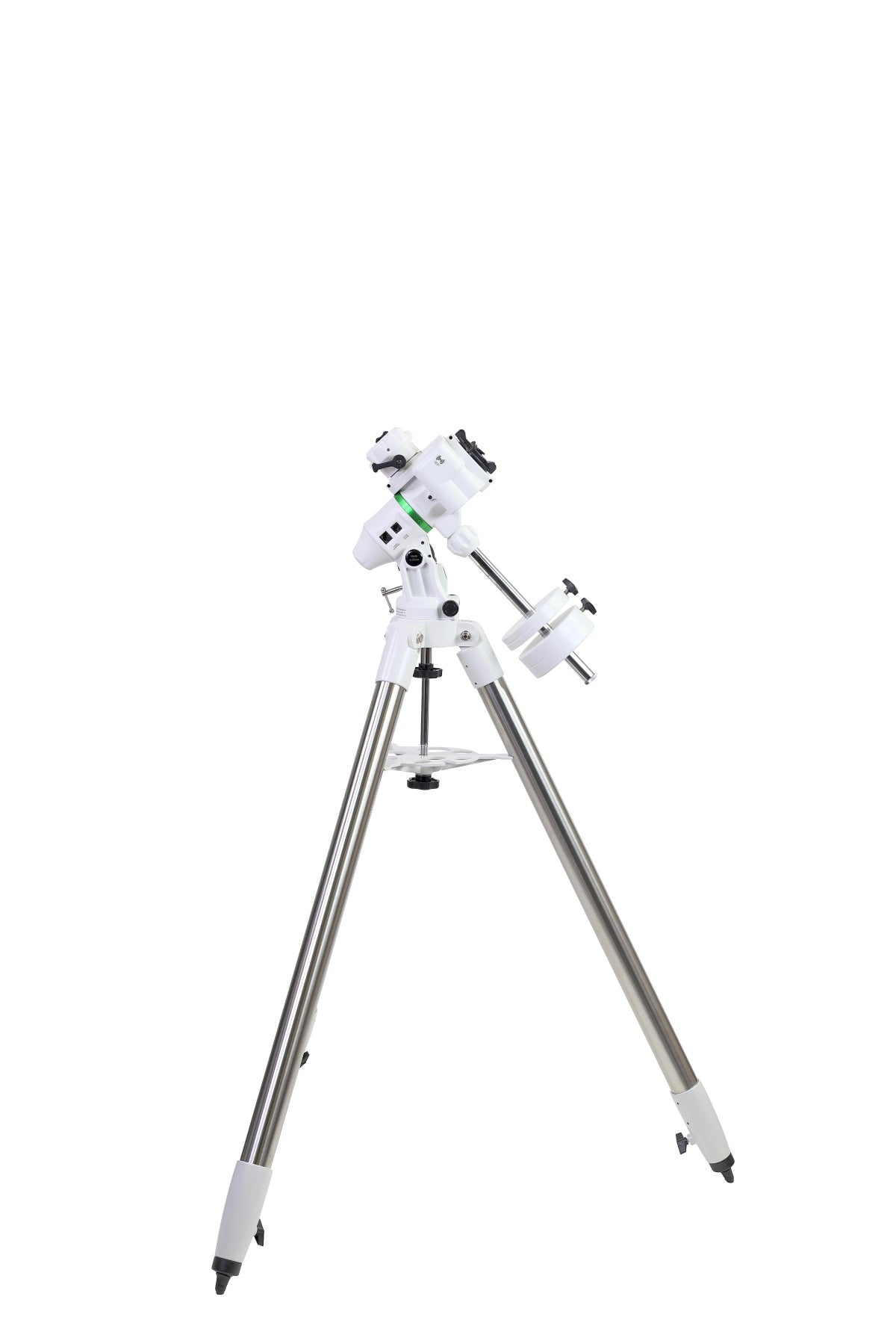
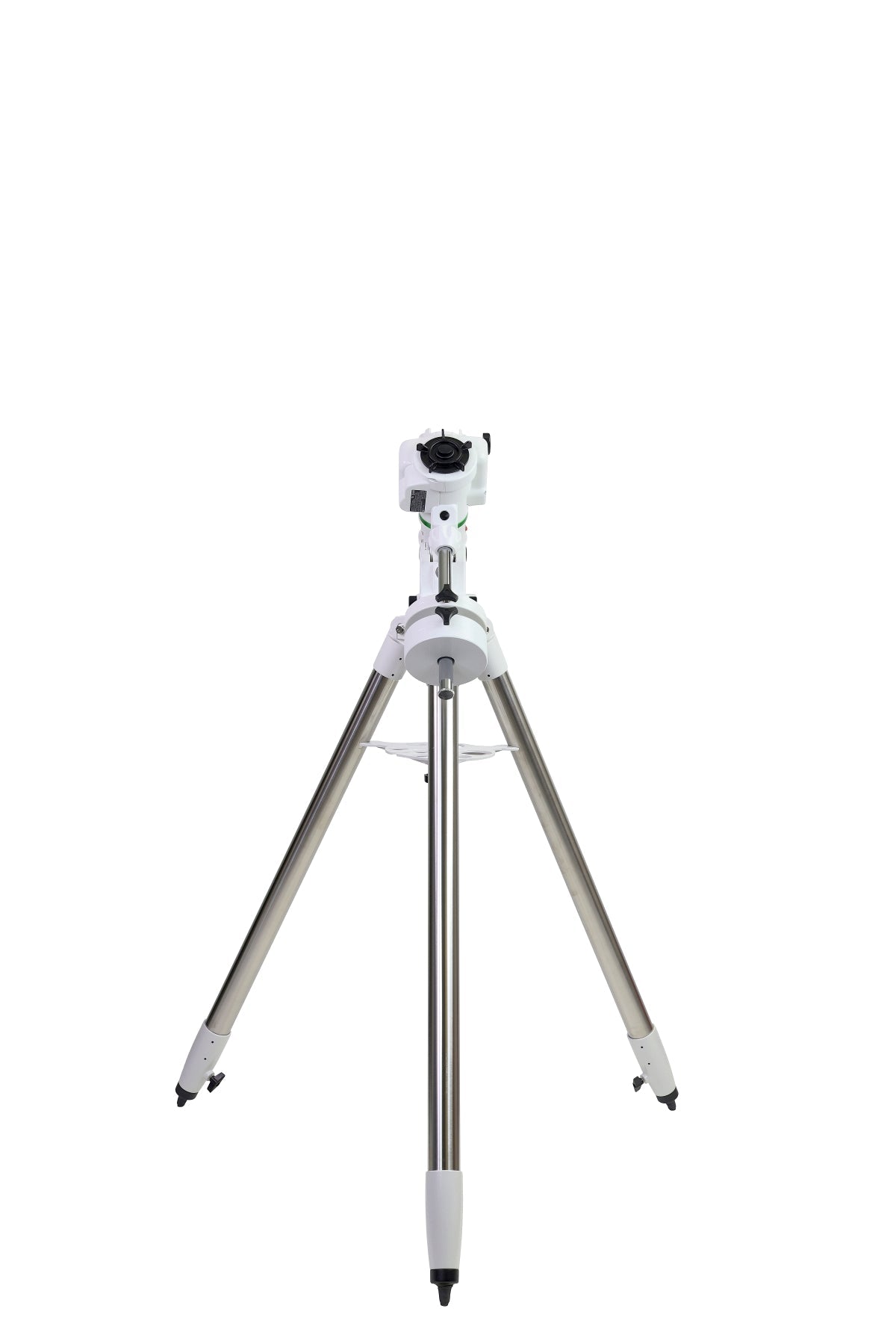
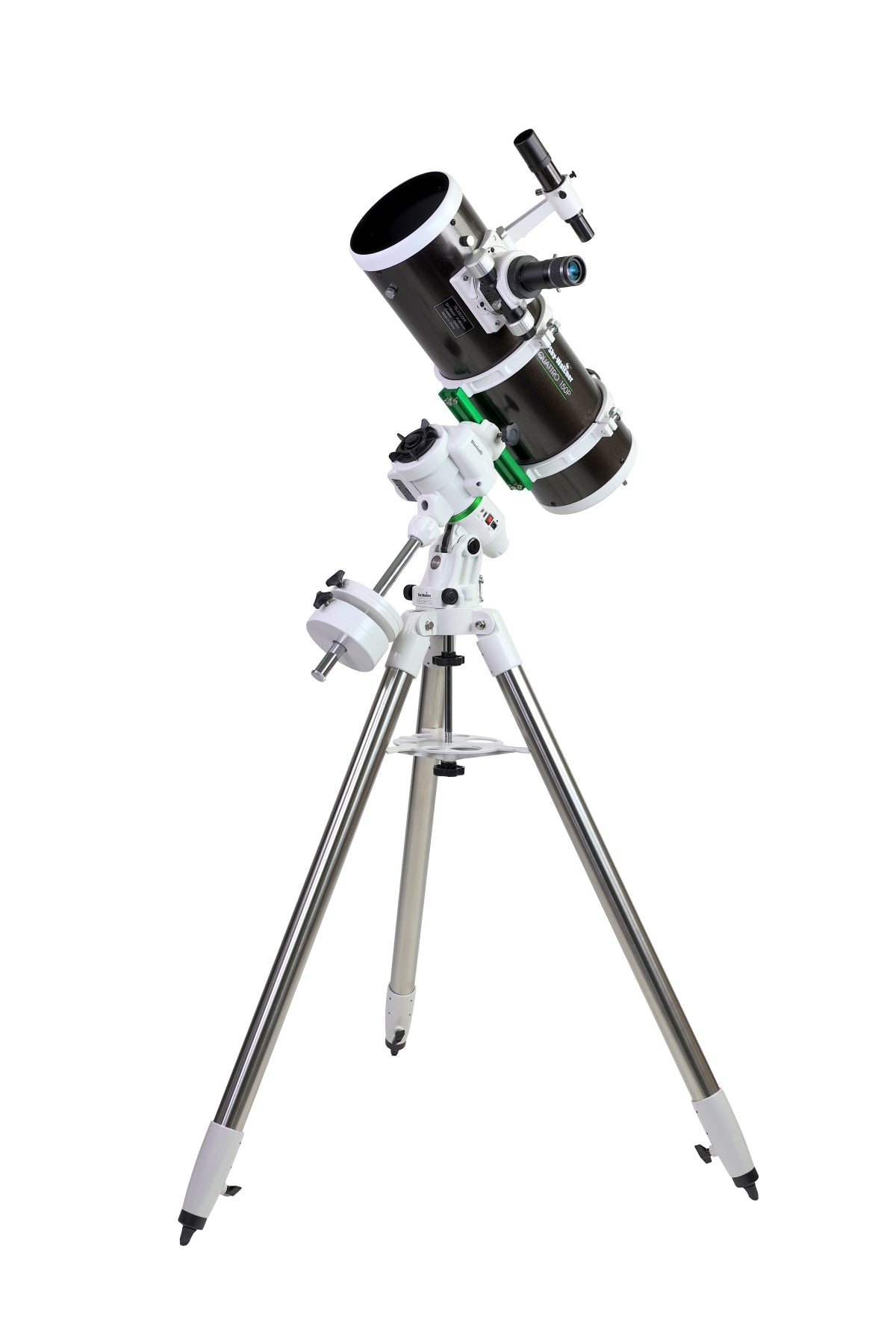
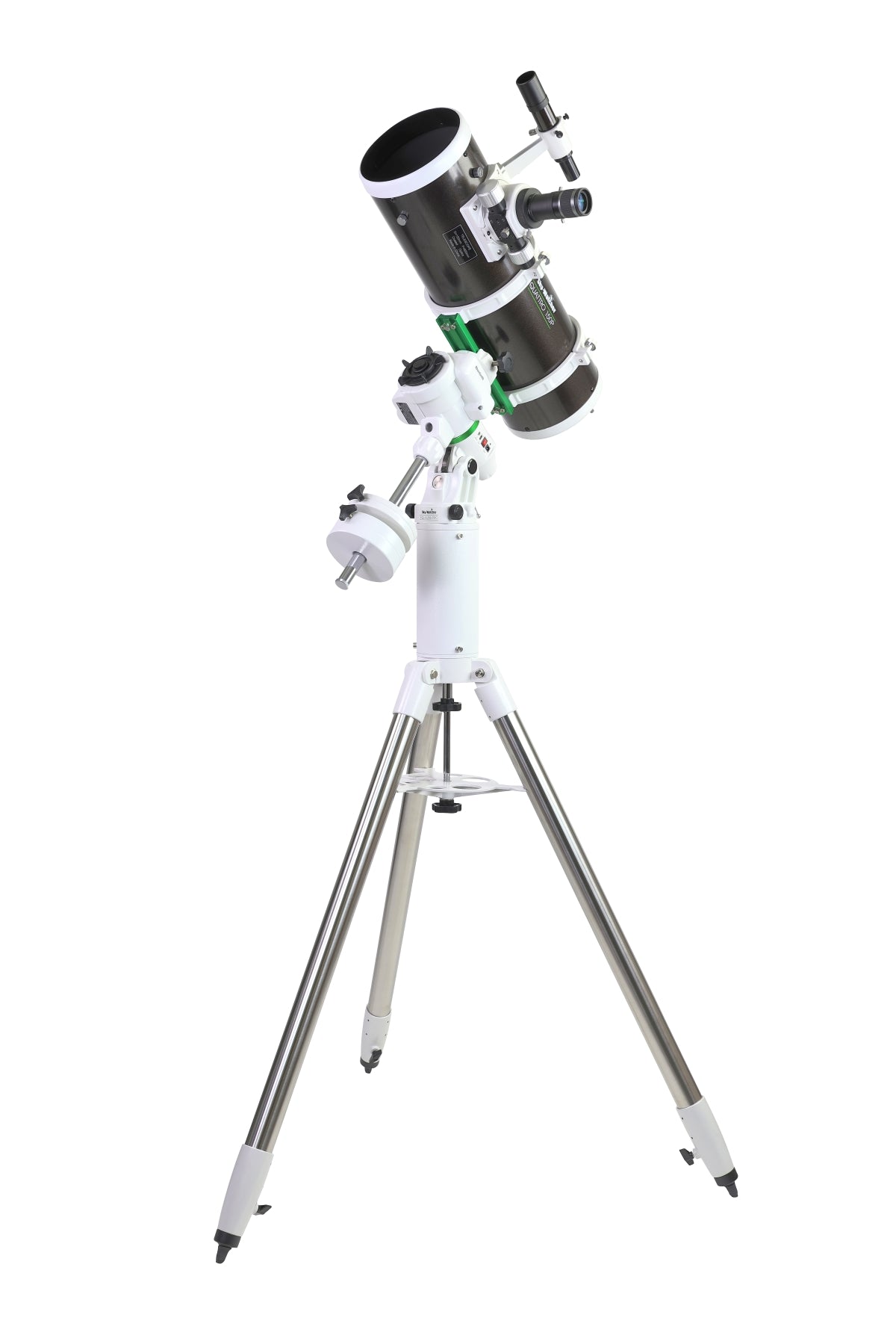
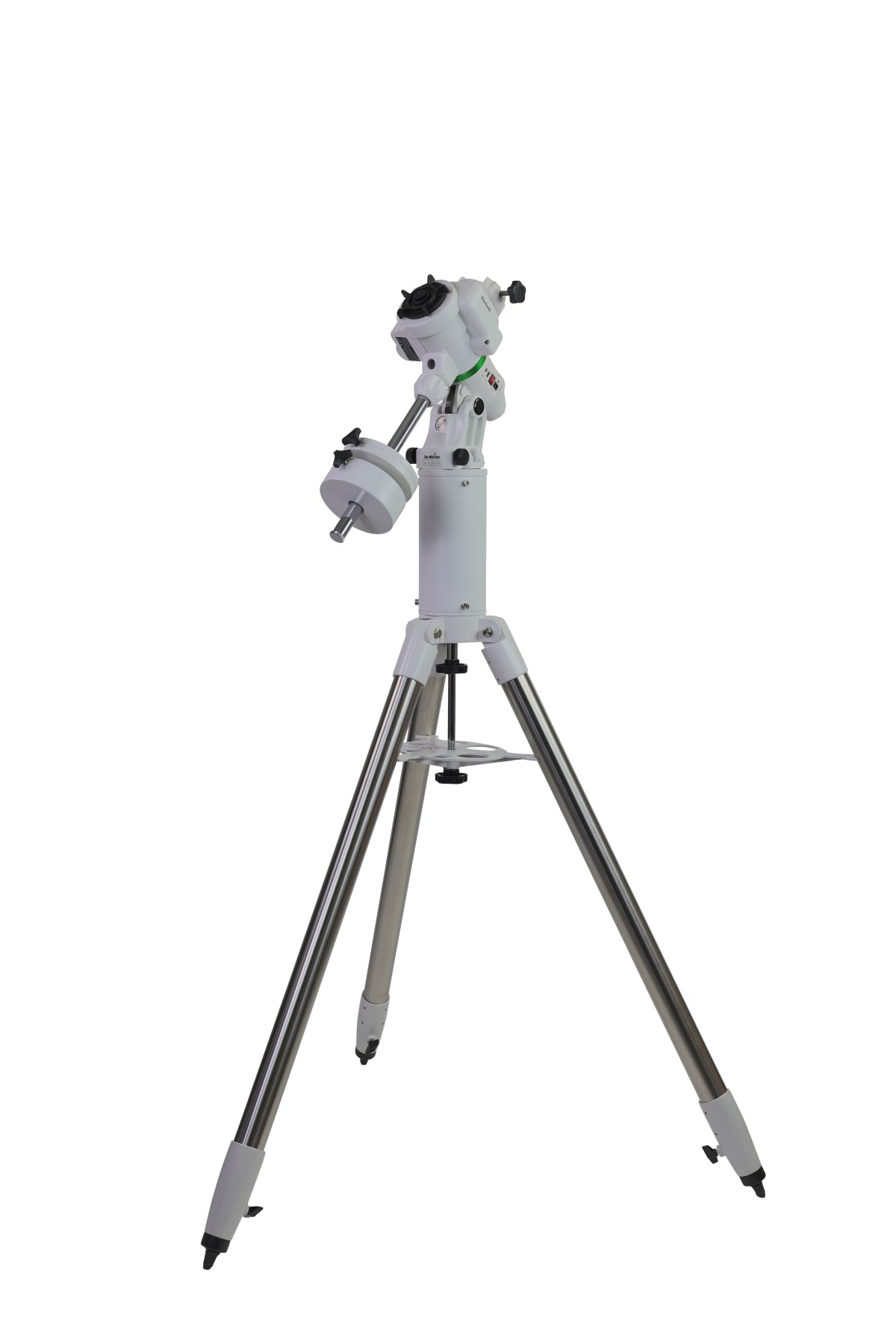


- Description
- Specifications
Product Overview
The Sky-Watcher EQ-AL55i Pro is a motorized German equatorial GoTo mount built for observers and astrophotographers who need a genuinely portable platform without giving up tracking accuracy. It carries a 10 kg (22 lb) payload excluding counterweights, points and tracks through the SynScan GoTo system with a 42,900+ object database, and is controlled over the mount's own built-in Wi-Fi using the free SynScan Pro app for iOS and Android. A redesign of the EQM-35, it adds fully encased motor housings and a dual-position counterweight bar that lets the head be set anywhere from 0° to 90° latitude.
The mount ships as a complete platform: mount head, adjustable-height steel tripod, two counterweights, built-in illuminated polar scope, and a DC power cord. The optical tube, hand controller, and pier extension are sold separately.
Who It's For
This is a good match if you are moving up from a star tracker or a manual equatorial and want guided, long-exposure deep-sky imaging with a small refractor, a compact Newtonian, or a 6″ SCT. It also suits you if you observe or image away from home and need a mount that breaks down into a car, or if you observe from low or high latitudes where a fixed counterweight bar position becomes a clearance problem.
It is a reasonable first equatorial mount if you are comfortable with polar alignment and balancing. If you intend to run a heavy imaging train — large SCT, big camera, off-axis guider, filter wheel — the 10 kg payload will be the limiting factor and a heavier mount is the better choice.
Key Features & Design
- 10 kg (22 lb) payload capacity: quoted excluding counterweights, which covers most 4″ refractors and reflectors or Schmidt-Cassegrains to roughly 6″.
- Dual-position counterweight bar: the bar and optional pier extension mount in two positions, giving a usable 0°–90° latitude range where a single-position bar would foul the tripod at low latitudes.
- Fully encased motor housings: a change from the EQM-35, closing the drive assemblies against dust and knocks.
- SynScan GoTo, 42,900+ objects: complete Messier, NGC, and IC catalogues plus stars and planets, with two- and three-star alignment routines.
- Built-in Wi-Fi and Bluetooth SynScan: the mount raises its own network; the SynScan Pro app handles alignment, slewing, and tracking rates with no cable to the mount.
- ASCOM telescope control: connect over Wi-Fi or USB-C for planetarium and capture software.
- Dual-axis tracking: sidereal, solar, and lunar rates driven by DC servo motors on both axes.
- Built-in illuminated polar scope: nighttime polar alignment without a separate accessory.
- Two counterweights included: 3.5 kg (7.72 lb) and 1.8 kg (3.97 lb), so light camera-lens rigs and heavier OTAs can both be balanced.
- Adjustable-height steel tripod: included, with an accessory tray/spreader.
Mechanical Design
The EQ-AL55i Pro is a German equatorial: a single polar axis is set to your latitude and aligned on the celestial pole, so one motor tracks the sky and the field does not rotate during an exposure. That is the reason an equatorial is chosen over an alt-azimuth mount for long-exposure imaging, and it is why the built-in illuminated polar scope matters more here than on a visual alt-az head.
Drive accuracy comes from the worm gearing. The right ascension axis — the one that carries the tracking load — uses a 73.4 mm worm gear with 144 teeth, while declination uses a smaller 51.6 mm, 100-tooth worm wheel; both run on an 11 mm worm shaft. The finer RA gearing is deliberate: RA is doing continuous sidereal work, so it gets the larger, higher-tooth-count wheel, and declination only needs to make corrections. The drive is a conventional worm-and-wheel arrangement rather than a spring-loaded or strain-wave design, so backlash and periodic error are corrected by autoguiding rather than eliminated mechanically. In practice that means the ST-4 port and a guide camera are what unlock the mount's long-exposure performance.
Slew rates run to 4°/second (1000×). Telescopes attach through a 45 mm Vixen-style dovetail saddle with a single knurled locking bolt; the counterweight bar is 20 mm diameter. The complete system — head, tripod, counterweights, and bar — comes in at 14.8 kg.
Recommended Uses
- Guided deep-sky astrophotography with a short-to-medium focal length refractor and a cooled or DSLR/mirrorless camera.
- Wide-field imaging with a camera lens and a small guide scope, where the 1.8 kg counterweight allows fine balance.
- Visual observing of planets, clusters, nebulae, and galaxies with GoTo pointing and sidereal tracking.
- Travel and dark-sky trips where the mount head, tripod, and weights need to be carried separately and reassembled.
- Observing from low latitudes or near the equator, where the second counterweight-bar position provides tube clearance.
- DSLR/mirrorless intervalometer-free sequencing through the mount's SNAP port.
Compatibility and Accessory Notes
- Telescope attachment: 45 mm Vixen-style dovetail saddle. Losmandy-style (D-plate) bars require a saddle that accepts them or a Vixen-profile bar on your OTA.
- Payload: 10 kg (22 lb) excluding counterweights. Count your camera, guide scope, filter wheel, and focuser against that figure, not just the tube.
- Autoguiding: ST-4 autoguider port, so a standalone guide camera or a guiding computer running PHD2 will drive the mount directly.
- Camera control: SNAP port for triggering a DSLR shutter from the mount.
- Computer control: USB-C to a PC, plus ASCOM support over Wi-Fi or USB for planetarium and capture applications.
- Power: 12 V DC through the supplied cord. There is no internal battery — a regulated 12 V supply or a telescope-grade portable power pack is required.
- Hand controller: the mount is designed to be run from the SynScan Pro app. A SynScan hand controller connects through the dedicated port and is sold separately.
- Pier extension: sold separately. It adds clearance between the optical tube and the tripod legs and is effectively required if you plan to work at very low latitude settings.
- Counterweights: the supplied 3.5 kg and 1.8 kg weights cover most payloads; a heavier 5 kg weight is offered separately by Sky-Watcher for loads at the top of the range.
Important Limitations
- Optical tube is not included. This listing is the mount head, tripod, and counterweights only.
- Hand controller and pier extension are sold separately. Control is by smartphone or tablet out of the box.
- No internal battery. A 12 V DC power source is required and is not supplied.
- Equatorial only. This is not an alt-azimuth mount and does not offer an alt-az operating mode.
- Polar alignment is required. GoTo pointing and tracking accuracy both depend on it; the illuminated polar scope gets you close, and the app's advanced routine or a plate-solve/drift method gets you the rest of the way for long exposures.
- Worm-drive backlash. The drive is not spring-loaded; expect to autoguide for exposures of several minutes or longer.
- Payload ceiling. At 10 kg it is not intended for large SCTs, heavy Newtonians, or observatory-class imaging trains.
Frequently Asked Questions
Is this a good mount for beginners?
Yes, provided you are ready to learn polar alignment and balancing. The SynScan Pro app removes the hand-controller learning curve, and the illuminated polar scope makes the alignment step straightforward. It is a step up from a star tracker rather than a first-night-out purchase.
Does it work in the southern hemisphere?
Yes. The 0°–90° latitude range covers both hemispheres, and the SynScan Pro app includes southern-hemisphere alignment routines. You align on the south celestial pole rather than Polaris.
What telescopes will it carry?
Anything up to 10 kg (22 lb) of total payload excluding counterweights. In practice that means refractors to roughly 4″, and reflectors or Schmidt-Cassegrains to roughly 6″, with imaging gear counted in.
Do I need the hand controller?
No. The mount is designed to be operated from the SynScan Pro app over its built-in Wi-Fi. The hand controller is an option if you prefer physical buttons or want to avoid running a phone or tablet in the field.
Can I autoguide it?
Yes. The ST-4 autoguider port accepts a guide camera or guiding computer directly, and ASCOM control over Wi-Fi or USB-C supports guiding through capture software. Autoguiding is recommended for exposures beyond a couple of minutes.
What power supply does it need?
12 V DC through the supplied cord. There is no internal battery. A regulated 12 V supply or a telescope power pack works; run it from a source that can hold voltage through a slew.
Do I need the pier extension?
Only if you are working at low latitude settings or using a long optical tube, where the tube or camera can strike a tripod leg. At mid-northern latitudes with a short refractor it is optional.
How is this different from the EQM-35 it replaced?
The motor housings are fully enclosed, the counterweight bar has a second mounting position that extends the usable latitude range to 0°–90°, and control moves to built-in Wi-Fi with the SynScan Pro app rather than a hand controller as the default interface.
When is this not the right mount?
When your payload is near or above 10 kg, when you want an alt-azimuth mode for casual visual sessions, or when you need a permanent observatory mount. In those cases look at the HEQ5-R Pro or EQ6-R Pro.
Bottom Line
In short: a 10 kg-payload German equatorial GoTo mount, controlled by phone over its own Wi-Fi, that needs a 12 V supply, a polar alignment, and an autoguider on the ST-4 port to give its best on long exposures. The tube, hand controller, and pier extension are separate purchases.
| Model | EQ-AL55i Pro |
|---|---|
| SKU | S30515 |
| Mount type | German equatorial, motorized GoTo |
| Payload capacity | 10 kg (22 lb), excluding counterweights |
| Latitude range | 0°–90° (dual-position counterweight bar) |
| GoTo system | SynScan, 42,900+ object database (Messier, NGC, IC) |
| Control | Built-in Wi-Fi, Bluetooth SynScan, SynScan Pro app (iOS/Android), ASCOM |
| Tracking rates | Sidereal, solar, lunar — dual-axis |
| Motors | DC servo, fully encased housings |
| Slew speed | Up to 4°/second (1000×) |
| R.A. worm gear | 73.4 mm diameter, 144 teeth |
| DEC worm wheel | 51.6 mm diameter, 100 teeth |
| Worm shaft diameter | 11 mm |
| Saddle | 45 mm Vixen-style dovetail |
| Counterweight bar | 20 mm diameter, two mounting positions |
| Counterweights supplied | 3.5 kg (7.72 lb) and 1.8 kg (3.97 lb) |
| Polar scope | Built-in, illuminated |
| Ports | USB-C, ST-4 autoguider, SNAP, DC power, SynScan hand controller |
| Power input | 12 V DC (DC power cord included; no internal battery) |
| Tripod | Adjustable-height steel tripod with accessory tray |
| Total system weight | 14.8 kg (head, tripod, counterweights, bar) |
| Included | Mount head, steel tripod, two counterweights, counterweight bar, DC power cord |
| Sold separately | Optical tube, SynScan hand controller, pier extension, 5 kg counterweight |
You may also like
Recently viewed
Recent Blog Posts
View all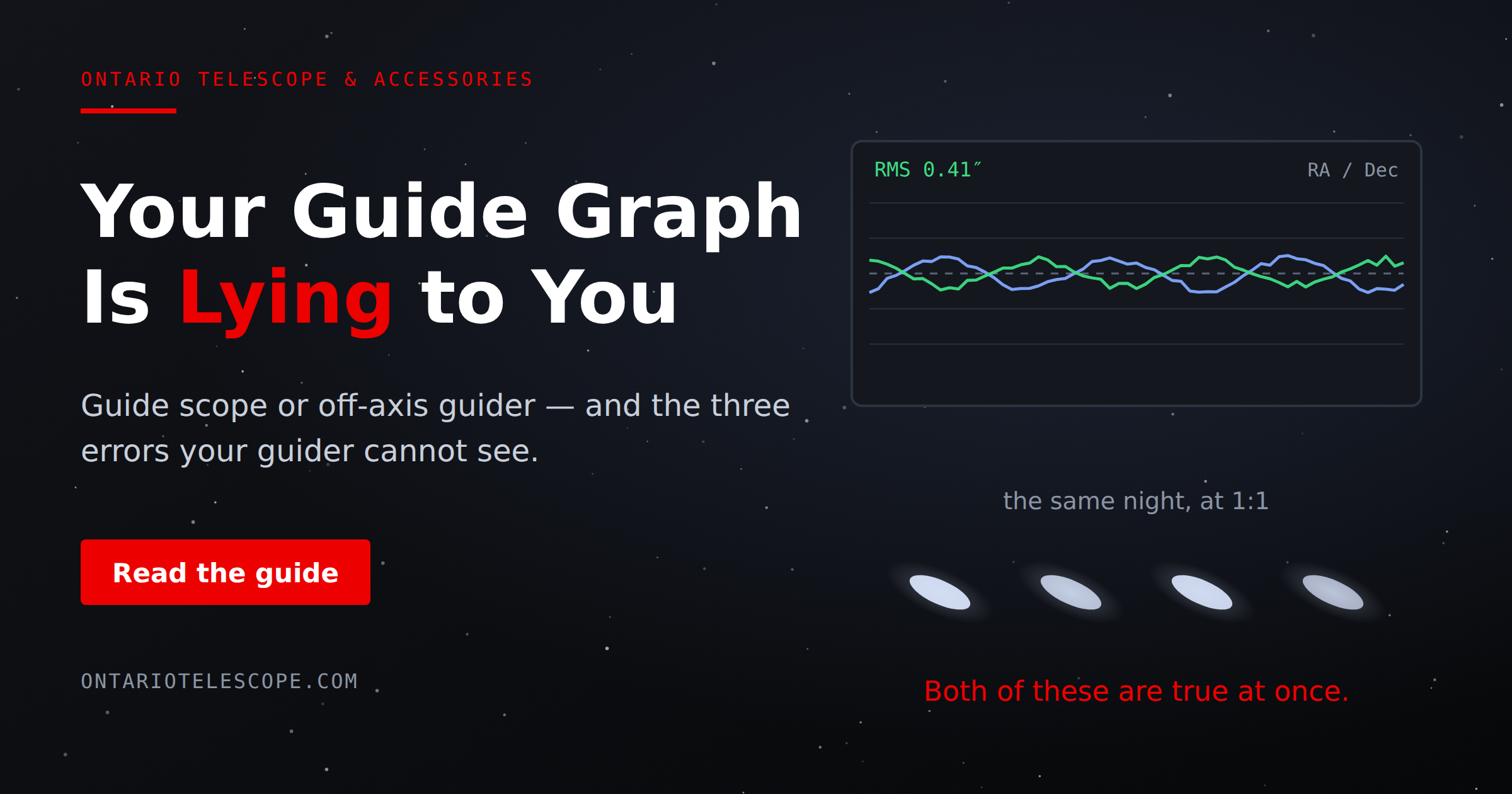
Your Guide Graph Is Lying to You
Read More
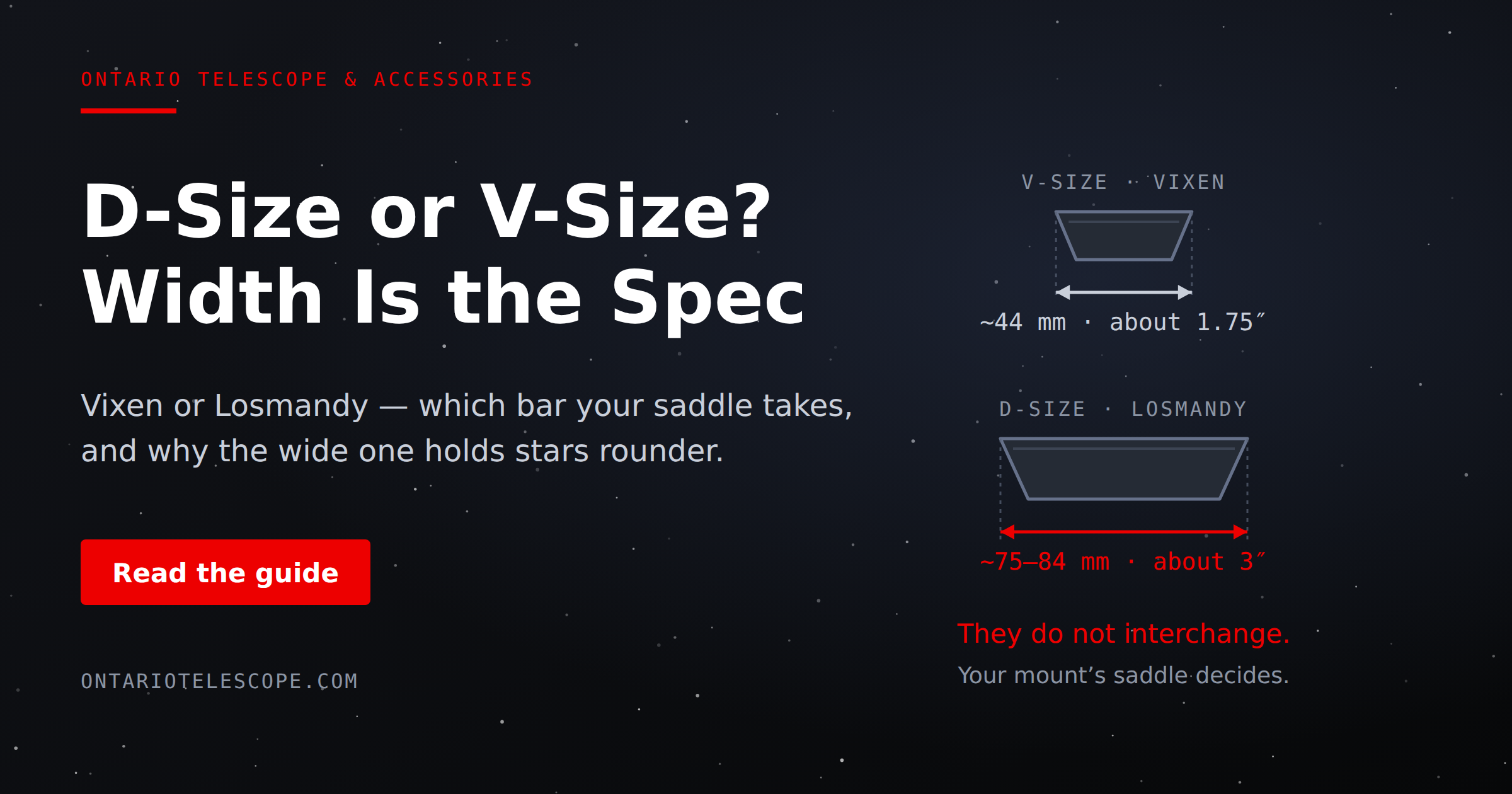
D-Size vs V-Size: A Complete Guide to Telescope Dovetail Systems
Read More
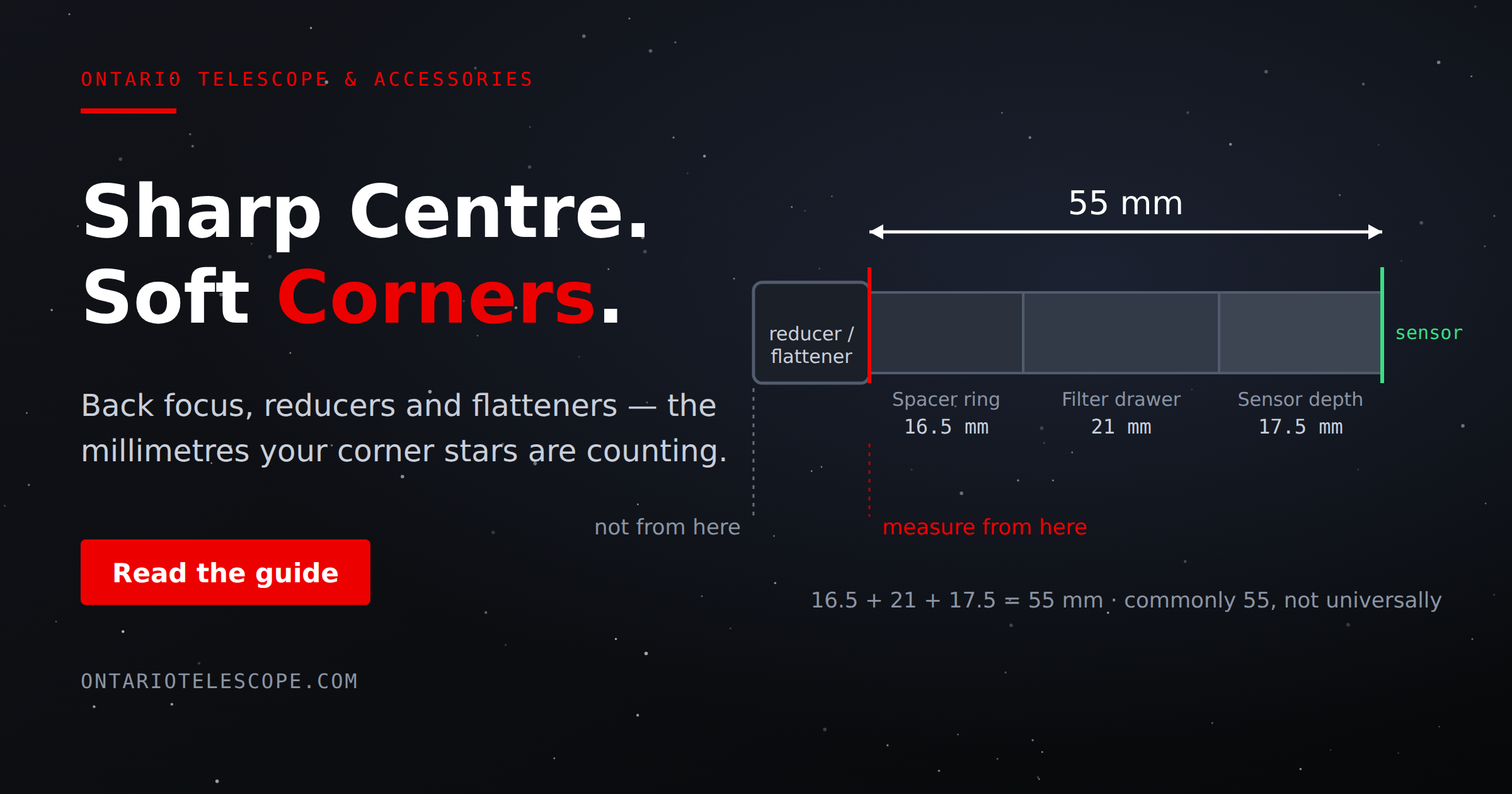
What Is Back Focus in Astrophotography? Telescope Reducers, Flatteners, and Spacing Explained
Read More