
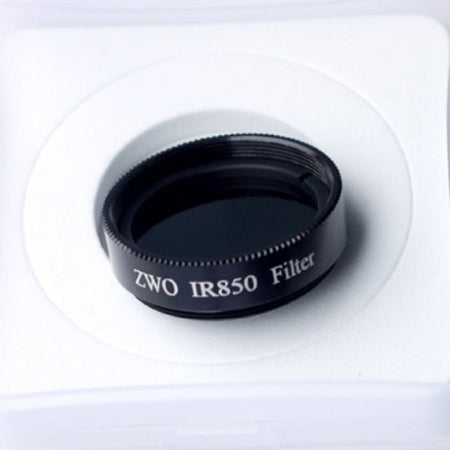

- Description
- Specifications
Product Overview
The ZWO 1.25" IR 850nm Pass Filter is an infrared-pass astronomy filter for lunar and planetary imaging. It allows infrared light above approximately 850nm to pass while reducing the visible-light portion of the spectrum that is most affected by atmospheric seeing.
When used with a monochrome camera or a colour camera that is sensitive to infrared, an 850nm IR-pass filter can help improve image steadiness and contrast during less-than-ideal seeing conditions. It can also be useful when imaging the Moon or planets at lower altitude, where atmospheric turbulence is more noticeable.
Who Is This Product Best For?
This filter is best for planetary and lunar imagers using IR-sensitive astronomy cameras. It is useful for imagers who want to capture steadier detail when visible-light seeing conditions are poor.
Why Choose This Product?
- 850nm IR-pass performance: Passes infrared light above approximately 850nm for specialized lunar and planetary imaging.
- Helps with poor seeing: Longer infrared wavelengths are less affected by atmospheric turbulence than shorter visible wavelengths.
- Useful near the horizon: Can help when imaging planets or the Moon at lower elevations.
- 1.25" format: Fits common 1.25" filter holders, filter wheels, and planetary-camera accessories.
Recommended Uses
- Planetary imaging
- Lunar imaging
- Infrared imaging with IR-sensitive cameras
- High-resolution imaging during poor seeing
- Imaging targets at lower altitude
Compatibility and Accessory Notes
This listing is for the 1.25" ZWO IR 850nm Pass Filter. It should be used with a camera that has useful sensitivity at 850nm. Some colour cameras and many monochrome planetary cameras can record infrared wavelengths, but performance depends on the camera sensor and optical setup.
Important Limitations
- Not a UV/IR cut filter: This filter passes infrared light; it does not block IR for visible-light colour imaging.
- Camera sensitivity matters: The camera must be sensitive at approximately 850nm for this filter to be effective.
- Specialized use: This is mainly for lunar, planetary, and infrared imaging, not general deep-sky colour imaging.
Frequently Asked Questions
What does an IR 850nm pass filter do?
It allows infrared wavelengths above approximately 850nm to pass while reducing shorter visible wavelengths.
Why use this filter for planets?
Infrared wavelengths are less disturbed by atmospheric seeing, so an IR-pass filter can help produce steadier planetary detail when conditions are not ideal.
Can I use this with a colour camera?
Yes, if the colour camera is sensitive to infrared. The result will not be standard full-colour imaging; this is a specialized infrared imaging filter.
Is this the same as a UV/IR cut filter?
No. A UV/IR cut filter blocks infrared for visible-light imaging. This IR 850nm filter passes infrared for specialized imaging.
Our Recommendation
Ontario Telescope recommends the ZWO 1.25" IR 850nm Pass Filter for lunar and planetary imagers who want a specialized tool for improving detail in challenging seeing conditions with IR-sensitive cameras.
| Product Type | IR-pass astronomy filter |
|---|---|
| Shopify SKU | IR-850 |
| Filter Size | 1.25 in mounted filter |
| Passband Function | Passes infrared light above approximately 850 nm |
| Recommended Camera Type | IR-sensitive monochrome or colour astronomy cameras |
| Primary Uses | Lunar imaging, planetary imaging, infrared imaging, and poor-seeing planetary capture |
| Included Accessory | Protective plastic case |
| Important Note | This is an IR-pass filter, not a UV/IR cut filter for normal visible-light colour imaging. |
You may also like
Recently viewed
Recent Blog Posts
View all
Your Guide Graph Is Lying to You
Read More

D-Size vs V-Size: A Complete Guide to Telescope Dovetail Systems
Read More

What Is Back Focus in Astrophotography? Telescope Reducers, Flatteners, and Spacing Explained
Read More